The best crypto wallet API depends on the authority your application needs: choose BuildAWallet for paid Base and Solana balance-read workflows after checking deployment requirements, direct blockchain RPC for network queries, or a locally signed transaction workflow when your application must submit transactions without transferring signing authority to the data provider. This 2026 guide compares API architectures for developers, not wallet-design tools or interchangeable ready-to-use services.
- BuildAWallet fits paid Base and Solana balance reads; confirm deployment, RPC configuration, and current feature availability.
- Choose a crypto wallet API by separating wallet data, transaction preparation, and signing authority.
- Direct RPC fits network queries; indexed data fits application queries that need additional processing.
- Local signing keeps transaction authorization separate from data access; provider-held signing requires a different trust model.
Why API boundaries matter
A wallet address identifies an account or destination; it does not grant permission to move assets. A balance API answers a data question. A signing service authorizes a transaction using cryptographic keys, while broadcasting sends an already signed transaction to a network.
Those differences determine your security boundary. If your agent only needs to report balances, adding signing authority introduces capabilities the task does not require. If your application needs to submit transactions, a balance endpoint alone cannot complete the workflow.
Start with the smallest permission set that completes your task. Compare broader capabilities only after you can explain who holds the keys, who approves actions, and what the deployed service actually supports.
What makes the best crypto wallet API
Use these criteria before comparing providers or building your own integration:
- Task fit: Distinguish balance reads, indexed queries, transaction preparation, broadcasting, and signing. Do not score unrelated capabilities as equivalent features.
- Signing boundary: Identify whether signatures come from a user-controlled signer, an application-controlled signer, or a provider-held key.
- Network coverage: Verify the exact networks and asset types required by your application. A network name alone does not establish every endpoint's coverage.
- Deployment requirements: Check whether you receive a hosted service or must deploy software and configure an RPC connection. RPC means remote procedure call: a way to request operations from another system.
- Failure handling: Require an application design that distinguishes an empty balance from an unavailable response, and a submitted transaction from a confirmed transaction.
- Enforceable controls: Separate checks enforced in code or signing infrastructure from instructions written in an agent's prompt. Natural-language instructions do not replace access controls.
Crypto wallet API options at a glance
The ranking below is a decision tree by task. It does not claim that a data reader, an indexer, and a signer are substitutes.
| Option | Best for | Standout capability | Key limitation |
|---|---|---|---|
| BuildAWallet NON-HUMAN | Paid Base and Solana balance-read workflows | Machine-facing wallet data access | Deployment and RPC configuration are required; policy-controlled agent signing is unavailable or in development |
| Direct blockchain RPC | Applications needing network-native queries | Requests sent to a blockchain node interface | Your application must interpret responses and handle network-specific behavior |
| Indexed wallet-data API | Application queries needing organized account data | Data processing between blockchain records and application queries | Coverage, freshness, and indexing behavior require provider-specific verification |
| Locally signed transaction workflow | Transaction submission with a separate signer | Preparation and broadcast without granting the data provider signing authority | Your application still needs secure signing, approvals, and transaction validation |
| Provider-held signing API | Applications intentionally delegating signing | Signing authority sits inside the provider's service boundary | Key custody and enforced authorization controls become central dependencies |
1. BuildAWallet NON-HUMAN: best for paid balance-read workflows
BuildAWallet NON-HUMAN provides paid machine-facing wallet data access, including Base and Solana balance reads. BuildAWallet is best for developers evaluating paid wallet-data access, not developers seeking an available autonomous signing service.
Keep the product's two modes separate. HUMAN guides individuals through a custom wallet blueprint; choosing networks, custody, or recovery preferences does not deploy a working wallet. NON-HUMAN addresses machine data access and belongs in this API comparison.
The homepage states that deployment and RPC configuration are required. Documentation describes a broader endpoint catalog and locally signed transaction preparation and broadcast, but a documented endpoint is not proof that a deployed service currently supports your intended workflow.
BuildAWallet NON-HUMAN pros
- It identifies Base and Solana balance reads as part of its machine-facing offering.
- It separates the HUMAN design experience from NON-HUMAN data access.
- Its documented local-signing workflow can be evaluated separately from provider-held signing.
BuildAWallet NON-HUMAN limitations
- Deployment and RPC configuration are prerequisites, not incidental setup details.
- Policy-controlled agent signing is unavailable or in development; do not design around it as an available feature.
- Broader documented endpoints require current availability checks before implementation.
Best for: Developers whose immediate task is a paid Base or Solana balance read.
Verdict: Hold deployment approval until you verify the required read operation, configuration, and failure behavior.
2. Direct blockchain RPC: best for network-native queries
A direct blockchain RPC integration sends requests to a node interface rather than a wallet-specific application layer. This architecture suits developers who need network queries and want their application to control response interpretation.
An RPC connection does not inherently grant signing authority. Treat reading network state and authorizing transactions as separate capabilities, even when a node interface exposes operations relevant to both.
You also inherit integration work. Check the network's official documentation for address handling, balance representation, supported methods, and the state against which a request executes. Do not assume that an Ethereum-compatible request translates directly into a Solana request.
Direct blockchain RPC pros
- It gives your application direct access to the selected network interface.
- It supports a clear separation between read requests and your signing component.
- It lets you define application-specific normalization and validation rules.
Direct blockchain RPC limitations
- Your application must manage network-specific request and response handling.
- Account-level queries do not automatically provide a complete asset inventory.
- Node access does not remove the need to verify response freshness and request failures.
Best for: Developers comfortable owning the network integration layer.
Verdict: Buy into this architecture when network-native reads are sufficient; skip it as a shortcut to a complete wallet backend.
3. Indexed wallet-data API: best for organized account queries
An indexed wallet-data API processes blockchain records into structures that an application can query. An indexer is a system that reads and organizes records; it is not inherently a wallet or transaction signer.
This architecture fits requirements that extend beyond a narrow balance call, such as organizing supported asset records or retrieving supported activity data. Those are selection criteria, not promises about any unnamed provider.
Evaluate the actual query you need. An endpoint described as wallet history needs a documented scope: which networks, which activity types, and which indexing rules it covers. A polished response does not establish completeness.
Indexed wallet-data API pros
- It can move data organization out of your application when the required query is supported.
- It provides a separate data layer without requiring signing authority.
- It lets you compare providers against concrete query requirements.
Indexed wallet-data API limitations
- Each provider defines its own coverage and response semantics.
- You must account for indexing delays and missing records in your application design.
- Aggregated values need clear definitions before you use them in decisions.
Best for: Applications needing organized account data rather than a single network-native response.
Verdict: Buy only after the documented query scope matches your application's requirements.
4. Locally signed transaction workflow: best for separate authorization
A locally signed transaction workflow separates transaction preparation, signing, and broadcast. Local signing means that your user or application signs through its own signing component rather than granting the data provider authority to sign.
Transaction preparation is not approval. Before a signature is produced, the application must validate the intended network, destination, asset, amount, and any contract interaction. A prepared payload remains untrusted input until those checks pass.
Broadcasting is also distinct from completion. Your application needs a confirmation check appropriate to the network and must represent uncertain outcomes without silently submitting the action again.
Locally signed transaction workflow pros
- It separates data access from transaction authorization.
- It gives your application a defined checkpoint before signing.
- It supports workflows where a user-controlled signer remains the approval boundary.
Locally signed transaction workflow limitations
- Your team still owns signer configuration and secret handling.
- Prepared transactions require independent validation before approval.
- Submission failures and uncertain confirmation states need explicit handling.
Best for: Applications that need transaction submission while retaining a separate signing boundary.
Verdict: Buy into this architecture when you can implement and review the signing boundary; otherwise, wait.
5. Provider-held signing API: best for deliberate signing delegation
A provider-held signing API places signing authority inside a provider's service boundary. That changes the question from which system returns data to which system can authorize actions.
Choose this category only when delegated signing is an explicit requirement. Evaluate key custody, authorization enforcement, recovery procedures, access revocation, and operational responsibilities against current official documentation.
Do not treat an agent instruction such as asking permission before sending as an enforced policy. The relevant restriction must exist at a boundary the agent cannot bypass through an alternative request or credential.
Provider-held signing API pros
- It provides a distinct architecture for applications that intentionally delegate signing.
- It creates a provider-side location where documented authorization controls can be evaluated.
- It separates the delegation decision from ordinary wallet-data selection.
Provider-held signing API limitations
- Your application depends on the provider's custody and authorization model.
- Policy claims need verification at the enforcement boundary.
- Data-access credentials and signing credentials require different risk treatment.
Best for: Teams that have explicitly approved provider-held signing as part of their application design.
Verdict: Skip this category for read-only agents; evaluate it separately when delegated authority is necessary.
Validate a balance workflow before adding authority
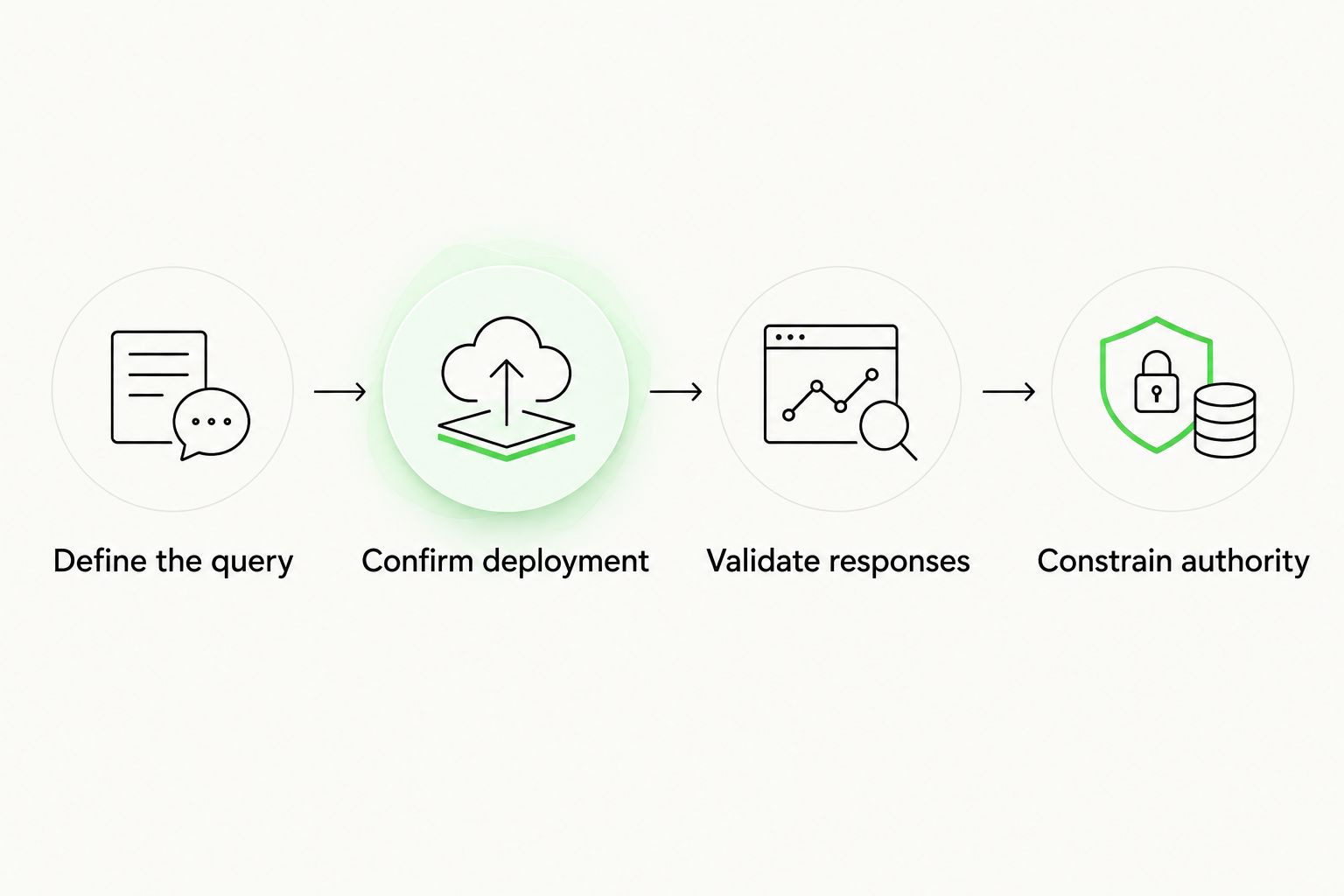
For a balance-reporting agent, the useful setup sequence is narrow: define the query, confirm deployment, validate the response, and constrain the agent's access. The crypto wallets for AI agents guide provides related context for separating data access from spending authority.
Define the query
Write down the network, address, and asset scope your application needs. Specify whether the question concerns a native asset balance, a particular token, or a broader asset list. These are different requirements; do not infer one from another.
Confirm deployment
Check the current service documentation and the deployed configuration. Confirm the requested operation, authentication requirements, RPC configuration, and response contract before connecting an agent. A catalog entry alone is insufficient.
Validate responses
Use an address you can independently inspect through an appropriate network source. Compare like-for-like assets and units. Your application must distinguish a valid zero balance from an error, a missing value, or an unsupported query.
Constrain authority
Expose only the operation the agent needs. Keep private keys and recovery secrets out of prompts and logs, and avoid giving a balance-reporting component access to a signer.
For an application-side example, let an agent request a balance summary from a restricted backend operation. The backend validates the network and address, obtains the data, and returns a normalized result. This is an integration design, not a claim of an officially supported framework integration.
How the options were ranked
This comparison ranks architectures by task fit, signing boundary, deployment requirements, and failure handling. It does not rank providers by latency, security scores, or first-hand test results.
The first option addresses the supplied paid balance-read use case. The remaining options define separate architectural choices, not verified competing products. Before selecting a named alternative, check its current official documentation against the same criteria.
Which crypto wallet API should you choose?
For an undecided developer, start with a read-only workflow. Select the data source that answers your exact query, then validate its deployed behavior before adding transaction capabilities.
BuildAWallet belongs on your shortlist for paid Base and Solana balance access, with deployment and current availability checks attached. Choose direct RPC when you want to own network integration, or an indexed API when you need documented data organization beyond the native query.
Treat local signing and provider-held signing as separate architecture decisions. Neither becomes necessary merely because an agent consumes wallet data.
FAQ
What's the best crypto wallet API for a read-only agent?
The best choice is an API that answers the required wallet-data query without granting signing authority. BuildAWallet is an option for paid Base and Solana balance reads, subject to deployment, RPC configuration, and current availability checks.
Does a wallet balance API let an agent send crypto?
No, balance access alone does not authorize transactions. Sending requires a separate transaction and signing workflow, with explicit control over who can approve actions.
Is direct RPC better than an indexed wallet API?
Direct RPC fits network-native queries; an indexed API fits supported queries that need organized blockchain data. Choose by the exact query and documented coverage rather than treating either architecture as universally better.
Does a wallet blueprint deploy a working wallet?
No, a wallet blueprint is a design rather than a deployed wallet. Selecting custody, recovery, or network preferences does not itself implement those choices or secure assets.
Is local signing the same as provider-held signing?
No, local signing uses your user or application's signing component, while provider-held signing places signing authority inside the provider's service boundary. Transaction preparation and broadcast do not erase that distinction.
Can I assume every documented endpoint is available?
No, documentation alone does not establish that an endpoint works in your deployed configuration. Verify current availability, deployment requirements, authentication, and the response contract before depending on it.
How should an agent handle an unavailable balance response?
The agent should report that the balance could not be verified, not substitute zero. Your backend should distinguish request failures, missing values, unsupported queries, and valid balances.
Related guides
- Best self-custody wallets for Base
- Best self-custody wallets for Solana
- Best non-custodial crypto wallets
Your next step
Write a read-only acceptance test before choosing a signer: define the network, address, asset scope, expected response meaning, and failure behavior. Approve the integration only when the deployed service passes that test without access to keys or recovery secrets.