Best for Base native balances: Ethereum JSON-RPC. Best for SOL balances: Solana JSON-RPC. Best for token inventories: an application-side token adapter. BuildAWallet's NON-HUMAN mode belongs in the paid Base/Solana data-access category, subject to deployment and feature checks. This guide helps developers choose a wallet balance API for AI agents without confusing data access with transaction authority.
- Choose a wallet balance API for AI agents by network, asset scope and deployment requirements.
- BuildAWallet NON-HUMAN fits paid Base/Solana data evaluation; confirm deployment and current feature availability before integration.
- Ethereum eth_getBalance returns native balances, not an ERC-20 token inventory.
- Solana getBalance returns lamports; token holdings require separate account queries.
- Balance reads do not grant signing authority. Keep keys and recovery secrets outside prompts and logs.
Why the balance boundary matters
An agent that answers whether a wallet holds enough native currency needs a balance read. An agent that transfers assets needs a separate transaction workflow, including signing authorization. Connecting the first does not establish the second.
A useful comparison therefore separates three questions: what data the interface returns, what you must deploy or configure, and who controls transaction signatures. The crypto wallets for AI agents guide covers that broader access boundary; this article focuses on choosing and validating balance reads.
What makes the best wallet balance API for AI agents?
Use these criteria before choosing an interface:
- Asset scope: Distinguish native currency from tokens and a complete wallet inventory.
- Network identity: Bind each request to its intended chain and environment. An address alone is insufficient.
- Freshness: Identify the block or commitment context where supported. Record when your application received the response.
- Deployment: Separate a documented endpoint from a configured, reachable service.
- Failure semantics: Keep zero balance, invalid address, timeout and unsupported asset as distinct outcomes.
- Authority boundary: Keep read credentials separate from signing keys and transaction approvals.
BuildAWallet NON-HUMAN is the relevant option for developers evaluating paid Base and Solana balance reads, not agent signing. Its HUMAN mode designs wallet blueprints for individuals and is not a deployed balance API.
Wallet balance options at a glance
These are different interface categories, not interchangeable commercial products. Choose the category that matches your task before evaluating a provider.
| Option | Best for | Standout capability | Key limitation |
|---|---|---|---|
| BuildAWallet NON-HUMAN | Evaluating paid Base/Solana data access | Machine-facing balance-read scope | Deployment, RPC configuration and current availability need verification |
| Ethereum JSON-RPC | Base native-currency checks | Explicit address and block-context queries | Native balance only; access requires an RPC endpoint |
| Solana JSON-RPC | SOL balance checks | Native balance with response context | Does not return an SPL token inventory |
| Application-side token adapter | Normalized token holdings | Combines network-specific token reads | You own discovery, normalization and failure handling |
1. BuildAWallet NON-HUMAN: best for paid balance-data evaluation
NON-HUMAN provides machine-facing data access, including Base and Solana balance reads, with paid access per data request. That makes it a candidate when your application needs a data-access service rather than a wallet-design experience.
Treat deployment as a prerequisite, not an assumed feature. The homepage states that deployment and RPC configuration are required; documentation describes a broader endpoint catalog and locally signed transaction preparation and broadcast. A documented operation is not proof that a configured deployment exposes it.
NON-HUMAN pros:
- Explicitly addresses machine-facing wallet data.
- Includes Base and Solana balance-read scope.
- Separates the developer data mode from HUMAN blueprint design.
NON-HUMAN cons:
- Deployment and upstream RPC configuration require checking.
- Broader documented endpoints need individual availability verification.
- Policy-controlled agent signing is described as unavailable or in development, not a usable signing capability.
Best for: Developers evaluating paid balance reads across the stated networks.
Before integrating, confirm the live read endpoint, authentication requirements, response schema and billing behavior in current documentation. Then validate the deployed service against an independent read using the same network and compatible chain context.
Keep locally signed transaction workflows separate. A transaction signed by your application and broadcast through a service does not establish autonomous provider-held signing authority.
Verdict: Hold production adoption until deployment and the required read operation are verified.
2. Ethereum JSON-RPC: best for Base native-balance checks
JSON-RPC is a structured request-and-response protocol. Ethereum's eth_getBalance method accepts an account address and block identifier, then returns the native-currency balance as a hexadecimal quantity denominated in wei.
On Base, this is the relevant read for an address's native ETH balance. It does not return ERC-20 holdings, token valuations or a complete asset inventory.
Ethereum JSON-RPC pros:
- Uses a standardized native-balance method.
- Makes the requested block context explicit.
- Keeps a balance query separate from transaction signing.
Ethereum JSON-RPC cons:
- Requires an accessible endpoint for the intended network.
- Leaves retries, credential handling and response validation to your application.
- Needs separate contract calls for token balances.
Best for: Agents checking native ETH on Base without needing token discovery.
Ethereum uses 10¹⁸ wei per ETH. Preserve the returned amount as an integer or integer string; convert it only for display. Floating-point arithmetic can lose precision on large integers.
For a read-only workflow, send the address and explicit block context to the configured endpoint. Validate the response before formatting it, and never treat a failed request as a zero balance. Endpoint support for historical state and block tags requires separate confirmation.
Verdict: Use for a narrow Base native-balance task; skip it as a complete token-inventory solution.
3. Solana JSON-RPC: best for SOL balance checks
Solana's getBalance method returns an account's lamport balance, with context identifying the response slot. A slot is a position in Solana's chain progression; it helps describe the state behind a response.
Use this method when the question is about native SOL. Use separate token-account queries when the question concerns SPL tokens, the token standard used by Solana's Token Program.
Solana JSON-RPC pros:
- Provides a dedicated native-balance method.
- Includes response context.
- Supports an explicit commitment choice for the read.
Solana JSON-RPC cons:
- Does not enumerate token holdings.
- Requires deliberate commitment selection and endpoint configuration.
- Leaves application error handling and numeric representation to you.
Best for: Agents checking native SOL before reporting an account's balance.
Solana uses 10⁹ lamports per SOL. Keep lamports as the authoritative amount and derive the display value separately. Check that your client library preserves integer precision throughout parsing and storage.
Commitment describes the confirmation level requested from the node. Choose it according to the task and record it with the result; do not present every response as finalized state.
Verdict: Use for native SOL reads; skip it as a substitute for token-account discovery.
4. Application-side token adapter: best for normalized token inventories
A token adapter is code in your application that translates network-specific reads into a consistent response. It is an architecture choice, not a claim of an officially supported framework integration.
For Ethereum-compatible tokens, ERC-20 defines balanceOf(address) for a specified contract. For Solana tokens, owner-based token-account queries can identify accounts whose balances your application then interprets. Neither task is equivalent to a native-currency balance call.
Token adapter pros:
- Gives your agent a consistent application-level schema.
- Separates asset discovery from balance retrieval.
- Lets you attach network, asset and provenance to each amount.
- Makes partial results explicit instead of hiding them.
Token adapter cons:
- Requires maintained network-specific parsing and validation.
- Needs a defined asset-discovery strategy.
- Must account for token-program differences and unsupported formats.
Best for: Agents answering which supported tokens a wallet holds, rather than checking only native currency.
For an Ethereum-compatible address, knowing the address does not identify every token contract to query. Define whether your adapter uses a curated contract list or a separately verified discovery source. For Solana, do not assume one token-program query covers every token format your application accepts.
Normalize raw amounts before exposing display values. Keep the contract or mint address as the asset identity; a symbol is a label, not a unique identifier.
Verdict: Build when token inventory is the requirement; skip the added layer for a native-only check.
Validate the read before connecting the agent
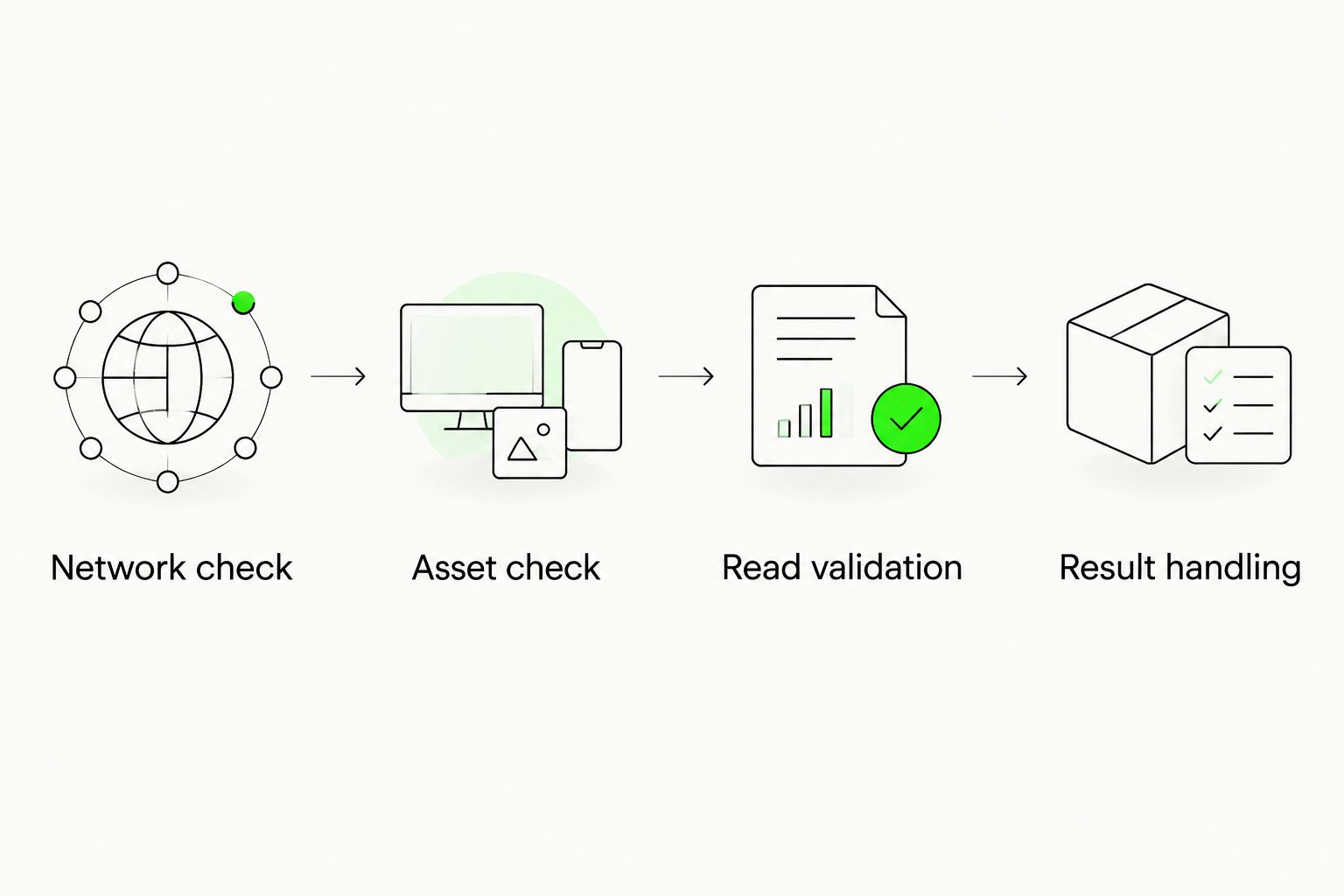
Use this application-side sequence regardless of provider. It describes a validation design, not a vendor endpoint or promised response format.
Network check
Confirm the chain, environment and endpoint configuration. Reject requests that omit network identity instead of inferring it from the address.
Asset check
Specify native currency or a token contract or mint. For inventory requests, state the discovery scope so the agent does not describe a partial list as complete.
Read validation
Validate the address, inspect the transport result and parse the amount using integer-safe handling. Where available, retain block, slot or commitment context.
Result handling
Return a successful amount, a clearly marked stale result, a partial inventory or an explicit error. Those outcomes must remain distinguishable in the agent-facing tool response.
For example, a successful native-currency read can report the network, address, raw amount, unit and observation context. A timeout should report failure rather than an amount. Do not invent a balance to keep the conversation moving.
Keep private keys, seed phrases and recovery secrets outside prompts and logs. Balance reads require an address, not the secret that controls it; protect API credentials through your application's secret-handling mechanism.
How the options are ranked
The ranking uses task fit, asset scope, deployment burden, failure handling and authority boundaries. It is not a latency benchmark, security audit or claim of first-hand testing.
The protocol-level distinctions follow the Ethereum JSON-RPC specification for eth_getBalance, the ERC-20 standard for balanceOf, and Solana's RPC reference for getBalance and owner token-account queries. Provider deployment and endpoint availability are separate checks.
Which balance interface should you choose?
Choose direct native-balance RPC for a narrow, single-network task. Choose an application-side adapter when token discovery and normalized holdings are actual requirements.
Evaluate NON-HUMAN when paid Base/Solana machine data access matches your architecture. Confirm the deployed read path first; do not make planned agent signing part of the acceptance criteria for a balance-only integration.
FAQ
What's the best wallet balance API for AI agents?
The best fit depends on the task: Ethereum JSON-RPC for Base native balances, Solana JSON-RPC for SOL, and an application-side adapter for token inventories. Evaluate paid data services separately for deployment, asset scope and failure handling.
Can BuildAWallet give an agent wallet balances?
BuildAWallet NON-HUMAN includes Base and Solana balance-read scope. Confirm deployment, RPC configuration and current endpoint availability before treating the service as usable in your application.
Does a wallet balance API let an agent send transactions?
No. A balance read does not grant signing authority or permission to transfer assets. Transaction preparation, signing and broadcast are separate operations.
Does eth_getBalance return every token in a wallet?
No. Ethereum's eth_getBalance returns native currency, not ERC-20 holdings. Token balances require contract-specific reads and a separate discovery strategy.
Does Solana getBalance include SPL tokens?
No. Solana getBalance returns the account's native lamport balance. SPL token holdings require separate token-account queries and interpretation.
What should an agent do when a balance request fails?
Report the failed read explicitly rather than returning zero. Distinguish transport errors, invalid input, unsupported assets and partial results in the application response.
Is a wallet blueprint the same as a working wallet API?
No. A wallet blueprint describes design choices; it does not deploy a wallet or establish a live data endpoint. Validate deployment and data access independently.
One last thing: test the failure path first
A zero balance is valid data. A failed balance read is not. Before connecting the agent, test an invalid address and an unreachable endpoint, then confirm that neither becomes a confident claim that the wallet is empty.
Your next step is a read-only acceptance test: choose one network and one asset, validate the successful response against a comparable independent read, and verify that failure remains visible to the agent.