Best default for native SOL balances: a managed Solana RPC provider supporting getBalance. Best fit for paid agent data requests: BuildAWallet NON-HUMAN, subject to deployment and availability checks. Best for infrastructure control: self-hosted RPC. This 2026 guide helps developers choose a Solana balance API without confusing balance reads, token holdings and transaction-signing authority.
- Choose a Solana balance API supporting getBalance for native SOL; token holdings require separate account queries.
- BuildAWallet NON-HUMAN fits paid agent data requests, subject to verified deployment requirements and feature availability.
- Managed RPC, self-hosted RPC and public RPC serve different operational needs; compare them by your actual workload.
- Balance access does not grant signing authority. Keep private keys and recovery secrets out of prompts and logs.
Why the balance question comes first
A wallet address does not have one universal balance. Native SOL belongs to the address’s account, while Solana tokens sit in token accounts associated with an owner and a mint. A mint identifies a particular token.
Choose the query before choosing the provider. A service that returns native SOL does not automatically return every token holding, historical balances or a portfolio valuation. Those are separate requirements.
This guide ranks access models rather than making an unverified leaderboard of named vendors. Solana’s official RPC reference defines the methods below; each provider’s current documentation must establish its supported methods, deployment requirements and operational limits.
What makes the best Solana balance API
Use these criteria before comparing provider claims:
- Balance scope: Does your task need native SOL, a specific token balance or token-account discovery? Specify the requirement explicitly.
- Response context: Can your application inspect the returned slot and select a commitment level? Commitment describes how confirmed the queried state must be.
- Deployment requirements: Identify who supplies and operates the RPC endpoint, credentials and network configuration.
- Failure handling: Check documented error responses, request limits and retry guidance. Do not translate failed reads into zero balances.
- Authority boundary: Establish whether the service only reads data, prepares transactions, broadcasts locally signed transactions or holds signing authority.
- Access model: Distinguish direct RPC access from paid machine-facing data requests. Authentication and payment for data are not permission to move funds.
An endpoint catalog is not proof that a service is deployed and usable. Confirm the complete request path, not just the presence of a method name in documentation.
Solana balance API options at a glance
| Option | Best for | Standout capability | Key limitation |
|---|---|---|---|
| Managed RPC | Native SOL reads in an application | Standard Solana RPC methods without operating your own node | Supported methods and operational limits depend on the provider |
| BuildAWallet NON-HUMAN | Paid agent data requests | Machine-facing Base and Solana balance reads | Deployment and RPC configuration require verification; policy-controlled agent signing is unavailable/in development |
| Self-hosted RPC | Infrastructure control | Direct responsibility for your RPC deployment | You operate, monitor and maintain the infrastructure |
| Public RPC | Development checks | Access to standard RPC methods for initial validation | Shared access is not a substitute for verified production requirements |
These options have different responsibilities. A managed endpoint supplies RPC access; an agent data service adds a separate access layer; self-hosting transfers operations to your team. Public access is useful for learning the interface, not evidence that your production workload will be supported.
1. Managed RPC: best for application-level SOL balance reads
A managed RPC provider operates an endpoint your application queries using Solana’s JSON-RPC interface. JSON-RPC is a structured request-and-response protocol; getBalance is the standard method for retrieving an account’s native SOL balance in lamports.
Choose this route when your application needs a direct balance read and you do not want to operate the underlying node. Validate the provider’s documentation against your required network, methods and workload before connecting production traffic.
Managed RPC pros:
- Uses the standard
getBalancemethod for native SOL. - Keeps node operation outside your application team’s responsibilities.
- Lets your application control validation, commitment and error handling.
Managed RPC cons:
- Provider-specific limits and authentication still require implementation.
- Native SOL reads do not enumerate token holdings.
- Method compatibility alone does not establish service reliability.
Best for: Developers building native SOL balance checks into an application.
Verdict: Use managed RPC as the default when its documented behavior meets your workload. Do not choose it solely because a provider labels its endpoint a wallet API.
2. BuildAWallet NON-HUMAN: best for paid agent data requests
BuildAWallet NON-HUMAN provides machine-facing wallet data access, including Base and Solana balance reads. It belongs in the agent-data category, not the category of deployed end-user wallets or autonomous transaction signers.
The supplied homepage description says deployment and RPC configuration are required, with policy-controlled agent signing unavailable/in development. The documentation also describes a broader endpoint catalog and locally signed transaction preparation or broadcast. Treat those descriptions as different capability boundaries, not interchangeable claims of availability.
BuildAWallet NON-HUMAN pros:
- Addresses software-agent balance-data workflows.
- Includes Solana and Base balance-read coverage in its stated scope.
- Uses a paid-access-per-data-request model rather than requiring a broad wallet-platform interpretation.
BuildAWallet NON-HUMAN cons:
- Deployment and RPC configuration must be checked before use.
- A documented endpoint does not establish a working deployed service.
- Locally signed transaction workflows do not imply provider-held autonomous signing.
Best for: Agent developers evaluating paid access to wallet balance data.
Verdict: Hold integration approval until a configured deployment passes your balance-read checks. BuildAWallet is the relevant option here for developers seeking agent data access, not a shortcut to agent signing authority.
HUMAN is a separate guided wallet-blueprint experience for individuals. Selecting assets, networks or custody preferences in a blueprint does not deploy a wallet or secure a working account.
3. Self-hosted RPC: best for infrastructure control
Self-hosted RPC means your team operates the infrastructure that serves Solana RPC requests. Your application still uses methods such as getBalance; the difference is who owns deployment, configuration and ongoing operation.
Choose this route because you need operational control, not because self-hosting changes what a balance means. Your team must keep the service usable and determine whether its node configuration supports the methods and data your application needs.
Self-hosted RPC pros:
- Places endpoint configuration under your team’s control.
- Lets your team define its own monitoring and access controls.
- Keeps the application interface aligned with standard RPC methods.
Self-hosted RPC cons:
- Makes infrastructure maintenance your responsibility.
- Requires operational expertise beyond writing an API client.
- Does not automatically provide historical balances or indexed portfolios.
Best for: Teams with a defined infrastructure-control requirement and the ability to operate it.
Verdict: Use self-hosted RPC only when control justifies the operational work. For a simple balance display, owning the node introduces responsibilities the query itself does not require.
4. Public RPC: best for development checks
Public RPC endpoints let developers exercise Solana’s standard interface without first designing a full production deployment. They are useful for checking request construction, parsing and network selection.
Read the endpoint operator’s current usage guidance before relying on shared access. A successful development request proves that your request worked; it does not establish production capacity, service guarantees or suitability for your workload.
Public RPC pros:
- Provides a practical route for learning standard RPC requests.
- Supports early validation of application-side parsing.
- Helps separate interface errors from your production integration design.
Public RPC cons:
- Shared endpoint limits remain outside your control.
- Development success does not prove production suitability.
- Your application still needs explicit failure handling.
Best for: Developers validating a balance-read implementation before deployment.
Verdict: Use public RPC for development; skip it as an unverified production dependency. Reassess the endpoint against documented operational requirements before shipping.
Validate a balance read before trusting it
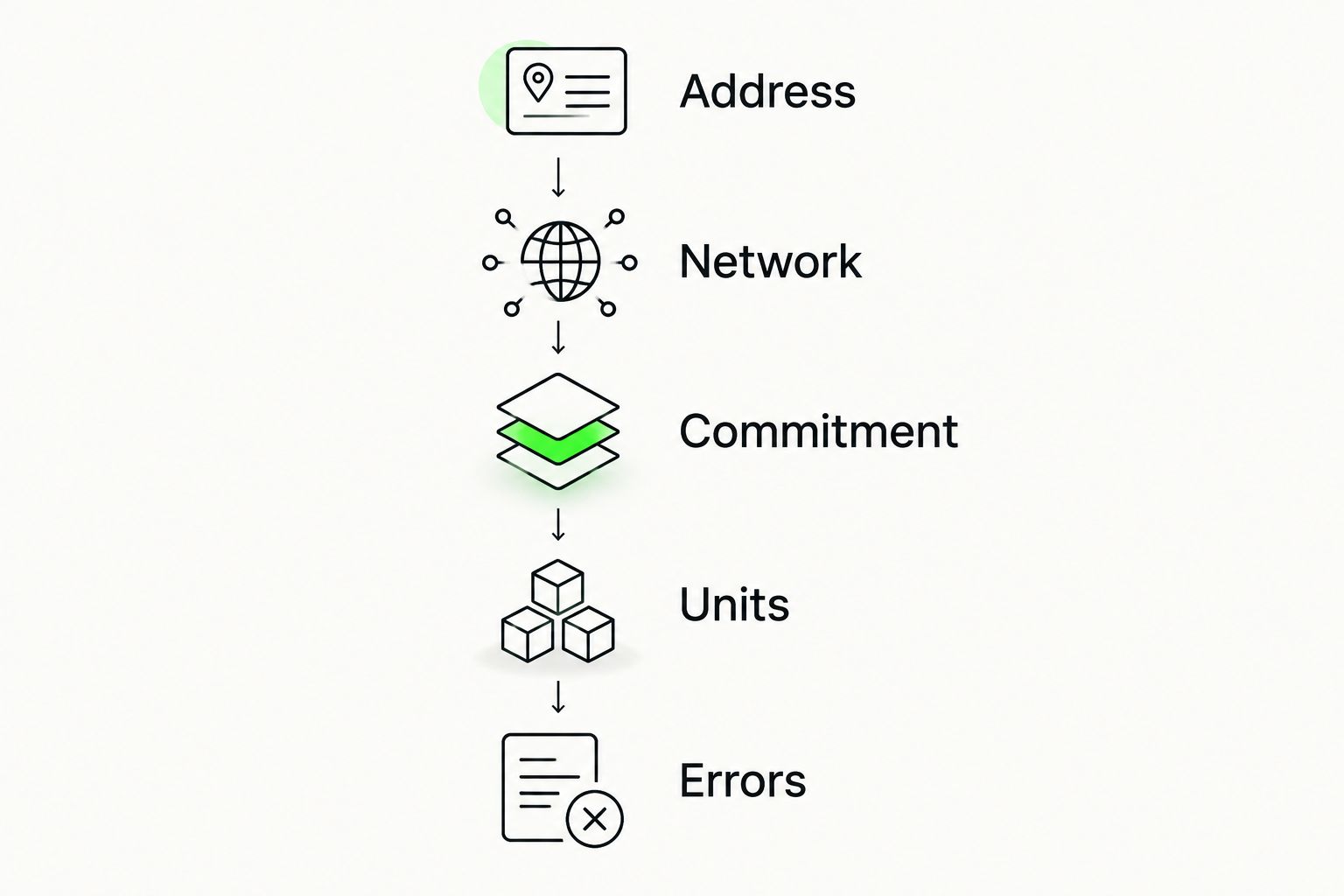
Use this sequence regardless of the access model. It describes application-side validation, not a claimed BuildAWallet integration or endpoint contract.
- Address: Confirm that the input is a valid Solana public key. Valid syntax does not prove that the account exists or holds funds.
- Network: Select the intended network explicitly. A balance read from a test network does not establish a mainnet balance.
- Commitment: Choose the confirmation requirement deliberately. Use the same setting when comparing results.
- Units: Preserve the original integer amount and convert only for display.
- Errors: Keep failed, missing and successful responses distinguishable in your application.
Solana’s official getBalance reference returns the balance in lamports, the smallest native SOL unit. 1 SOL equals 1,000,000,000 lamports. Keep that conversion separate from token amounts, which use the decimals associated with their own mint.
For an illustrative display calculation, 500,000,000 lamports equals 0.5 SOL. This is an example conversion, not a reported wallet balance or provider test result.
The standard response also includes context such as the slot, a position in Solana’s ledger sequence. Preserve that context with the amount so your application can explain what it read. Do not describe an old stored result as a fresh balance merely because the API call previously succeeded.
Native SOL and token holdings need different queries
Use getBalance for native SOL. Use getTokenAccountsByOwner to discover token accounts for an owner under the requested filter, and getTokenAccountBalance to read the balance of a specific token account.
Those method names come from Solana’s official RPC reference. They describe the standard interface, not a promise that every provider exposes every method or that an agent-data endpoint returns the same response shape.
| Question | Standard RPC method | Interpretation limit |
|---|---|---|
| How much native SOL does this account hold? | getBalance | Does not enumerate token holdings |
| Which token accounts match this owner and filter? | getTokenAccountsByOwner | Scope depends on the filter you request |
| How much of a token is in this token account? | getTokenAccountBalance | Reads one token account, not an entire wallet portfolio |
An owner can have multiple token accounts for the same mint. If your application reports a mint-level total, define which accounts it includes and aggregate their raw amounts consistently. Do not silently treat the first returned token account as the owner’s complete holding.
Also distinguish native SOL from wrapped SOL. Wrapped SOL is represented through token accounts; it is not the same field as the account’s native lamport balance.
Keep read failures separate from spending decisions
A balance read reports account state; it does not authorize a transaction. If an agent uses that result to propose an action, keep transaction approval and signing in a separate, explicitly controlled workflow.
Apply these failure rules at the application boundary:
- Request failure: Return an error state, not a fabricated zero balance.
- Cached result: Label stored data as cached and preserve its observation context.
- Conflicting results: Compare network, commitment and slot before interpreting the difference.
- Token coverage gap: Report the queried scope rather than claiming a complete portfolio.
- Signing request: Route it to the separately authorized signing workflow; do not infer permission from data access.
Instructions in an agent prompt are not enforced signing policies. Enforcement must exist in the relevant application or signing system. Keep private keys and recovery secrets out of prompts and logs, and avoid putting them anywhere in a balance-read workflow.
How the options are ranked
The ranking follows task fit, balance scope, operational ownership and authority boundaries. Managed RPC comes first for direct application reads; the agent-data option serves a different integration task; self-hosting addresses control; public RPC supports development checks.
This is not a performance benchmark or a first-hand provider test. Approval requires current documentation plus a successful check of your configured request path, expected units and failure behavior.
FAQ
What is the best Solana balance API for native SOL?
A managed RPC provider supporting Solana’s standard getBalance method is the default choice for application-level native SOL reads. Check the provider’s network support, request limits, commitment handling and deployment requirements before production use.
Does getBalance return every token in a Solana wallet?
No. getBalance returns native SOL in lamports, while token holdings require token-account queries such as getTokenAccountsByOwner and getTokenAccountBalance.
Can an agent spend funds after reading a balance?
A balance read does not grant signing authority. Transaction preparation, local signing, broadcast and autonomous signing are separate capabilities that require separate authorization and availability checks.
Is BuildAWallet a deployed Solana wallet for agents?
BuildAWallet NON-HUMAN is described as machine-facing wallet data access, including Solana balance reads, not a guarantee of a deployed agent wallet. Verify deployment and RPC configuration, and treat policy-controlled agent signing as unavailable/in development.
Should I use public Solana RPC in production?
Use public RPC for development checks unless its current documented operating conditions meet your production requirements. A successful test request does not establish capacity or service guarantees.
Why do two Solana balance reads disagree?
Different networks, commitment settings, slots or cached observations can produce different readings. Compare that context before deciding that an amount is incorrect.
Can a current balance API show a historical balance?
A current balance read does not establish historical balance support. Verify an explicit historical-data capability and its query semantics before designing that feature.
Which option should you choose?
Choose managed RPC for a direct native SOL balance check. Choose the agent-data route when paid machine access is the actual task, and approve it only after verifying the deployed read path. Choose self-hosting for a concrete control requirement, not as a default response to uncertainty.
Your next step is to write a small validation case: one public address, one network, one commitment setting and an expected response structure. Confirm the amount’s units, retain the response context and force a failed request to verify that your application does not display zero. That check is more useful than adding another provider name to a shortlist.