Before adding Coinbase AgentKit external wallet balance data, check the exact network, address, asset, balance units, response freshness, failure behavior and separation from signing authority. BuildAWallet NON-HUMAN is the machine-facing side for AI agents and the developers building them; HUMAN is a separate wallet-blueprint design experience. Treat an external balance source as an application-side integration until its current operation and your AgentKit configuration have been verified together.
- Coinbase AgentKit external wallet balance data needs explicit network, asset, unit, freshness and failure checks.
- BuildAWallet NON-HUMAN serves developers seeking machine-facing wallet data; validate the intended read before integration.
- A balance read establishes neither wallet ownership nor permission to sign transactions.
- Keep missing, stale and failed responses separate from confirmed zero balances.
Why this matters
An agent can produce a confident answer from the wrong balance. A valid-looking response still fails your task when it describes another network, another asset or an observation too old for the decision.
BuildAWallet's crypto wallets for AI agents guide provides related context for separating wallet access from authority. For this integration, start with the narrower question: can your application obtain and interpret the intended external balance without exposing a signing capability?
BuildAWallet NON-HUMAN fits developers evaluating external wallet-data access, not developers seeking proof of autonomous signing. Its stated Base and Solana balance-read scope does not establish that a particular deployment is configured or that an operation succeeds.
What should you check before adding balance data to AgentKit?
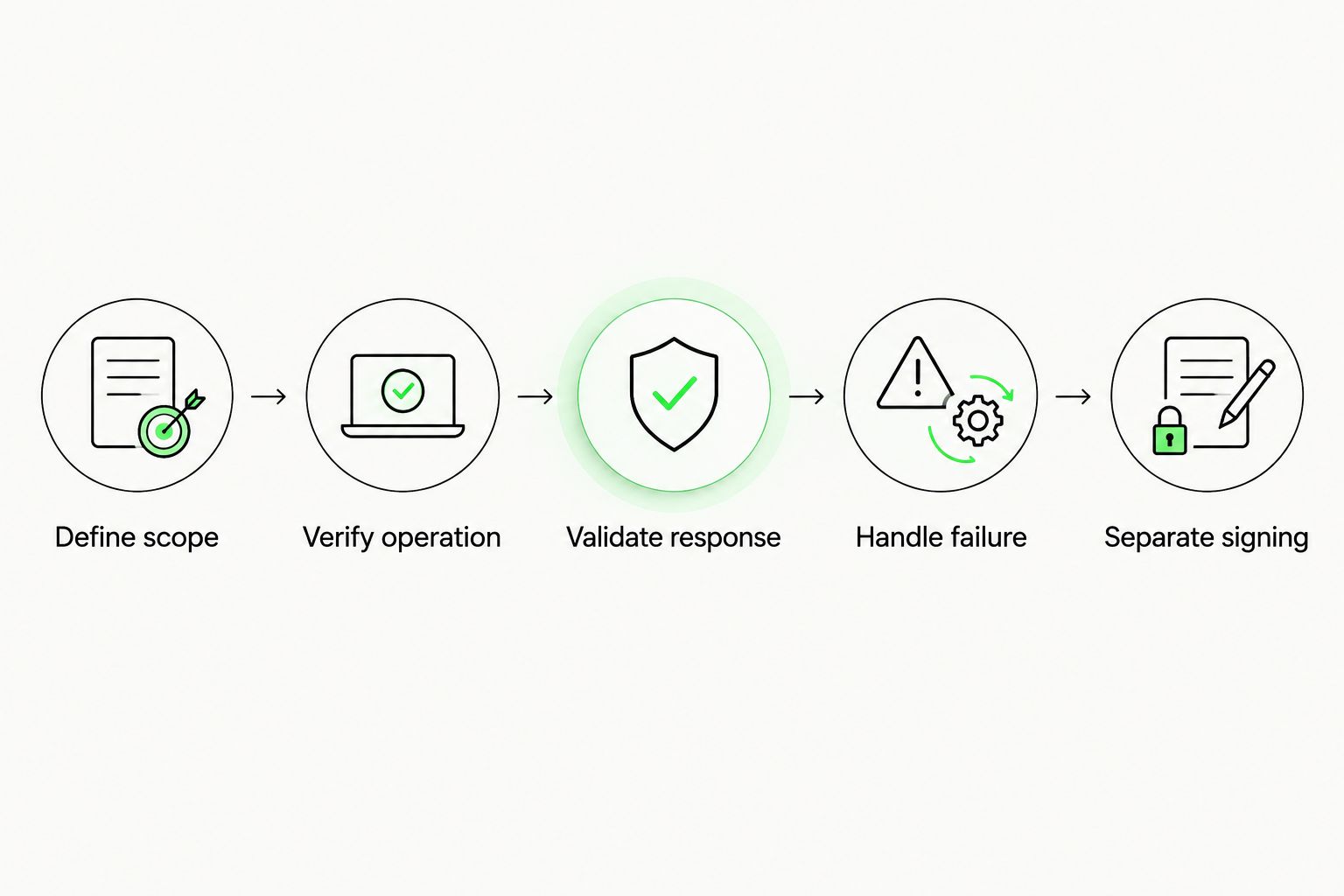
Use the following acceptance sequence before connecting an external balance response to an agent decision. These are application-side validation steps, not claims about a built-in AgentKit integration or a provider's exact API behavior.
- Define scope. Record the network, wallet address, asset and decision that needs the balance.
- Verify operation. Check current documentation, deployment requirements and the intended read-only operation.
- Validate response. Confirm identity, units and observation context before accepting the amount.
- Handle failure. Reject ambiguous, incomplete or unsuccessful responses instead of converting them to zero.
- Separate signing. Ensure the read path cannot independently authorize a transfer.
A useful acceptance record includes the requested identity, returned identity, interpreted amount, observation context and outcome. Keep provider credentials out of that record. The goal is to explain why the application accepted a balance, not to collect every detail of the request.
Define the wallet question before choosing the connection
Write the request as a task: report the native-asset balance for a specified address on a specified network. If the task concerns a token instead, include the network-specific token identifier rather than relying on its displayed symbol.
An address alone is not a complete balance request. Likewise, an asset symbol alone does not establish which asset your application means. Preserve the full identity through request construction, response validation and the final agent-facing result.
Decide whether you need an observation for display, monitoring or a transaction prerequisite. Those tasks have different acceptance conditions. A display can explain that a reading is old; a transaction workflow should stop when the required balance evidence no longer meets its policy.
Which access path fits your task?
Compare access paths by what they establish, what authority they require and what remains unproven. Do not compare a wallet blueprint with a deployed balance service as though they solve the same problem.
| Access path | Best for | What it establishes | Limitation |
|---|---|---|---|
| External balance read | Reporting or monitoring a specified address | An observed balance for the requested scope | Does not establish ownership or signing permission |
| Locally signed workflow | Applications with separately controlled signing keys | A workflow in which signing happens under local key control | Requires separate key protection and transaction review |
| Provider-held agent signing | Tasks explicitly requiring delegated transaction authority | Only the authority actually configured and enforced | Must not be inferred from balance access or endpoint documentation |
| Wallet blueprint | Individuals defining wallet requirements | A design describing intended wallet choices | Is not a deployed wallet or a balance service |
Use a read-only path when the task only needs a balance. Adding signing authority does not improve the correctness of a balance response; it adds a separate permission boundary to manage.
For AgentKit, document the wallet and tool configuration you actually use. Do not assume that a wallet action already present in the application queries an unrelated external address or network. Verify its scope before substituting it for an external read.
What must the balance response prove?
Network and address identity
Check that the response belongs to the network and address you requested. If the provider omits identifying information, document how your application binds the response to the request rather than silently assuming the association.
Keep network selection explicit throughout the workflow. A successful request against the wrong network is still a failed answer to your question. Do not let an agent choose a default network when the user's task leaves that choice unresolved.
Asset identity and units
Establish whether the amount represents a native asset or a token. For tokens, preserve the identifier used by the requested network. Display names and symbols help people read results, but they should not replace identity checks.
Confirm whether the returned value uses base units or a display amount. Avoid arithmetic that loses precision, and retain the original representation alongside any normalized value. Do not add balances across different assets simply because their symbols look alike.
Observation context
Distinguish when your application received the response from when the underlying balance was observed. A recent HTTP response does not, by itself, prove that the balance observation is recent.
Check which observation details the operation actually returns. If a required timestamp or chain reference is absent, mark freshness as unknown rather than inventing it. Your application should decide whether that uncertainty permits display, requires another read or blocks the dependent action.
How should you validate the read before AgentKit uses it?
Create an application-owned adapter: a small boundary that converts provider-specific responses into your application's internal result. This is an integration design, not a claim that an official framework adapter exists.
Keep the adapter's responsibilities narrow. It should validate the requested identity, interpret the amount, classify the outcome and return only the information needed by the agent. It should not gain transaction permissions merely because another part of the application has them.
Use an illustrative internal result
The following field names describe an example application contract, not a documented provider response:
- Request identity: the network, address and asset the application asked about.
- Observed amount: the original amount representation and its interpreted unit.
- Observation context: available evidence about when or where the balance was observed.
- Result state: accepted, failed, incomplete or stale under your application's rules.
- Authority scope: a declaration that this result supplies data, not permission to sign.
Validate that contract before making the result available as an agent tool response. Where identity cannot be checked or units remain ambiguous, return a bounded failure rather than an amount with a warning the agent can overlook.
Compare a controlled request independently
Use an address and network whose expected state you can inspect independently. Compare the same asset and observation context; readings from different moments need not match after account activity.
Record discrepancies without treating either source as automatically correct. Investigate network selection, asset identity, unit conversion and observation timing first. A matching balance supports that specific read test, not a guarantee about every future response.
Why balance-data reliability varies
The reliability of a balance result depends on more than whether a request returns successfully. These factors determine whether the result answers your application's actual question:
- Deployment configuration: required services and remote procedure call connections must be configured for the intended operation.
- Request scope: network, address and asset must remain consistent across the workflow.
- Amount interpretation: units and precision must survive normalization and display.
- Observation freshness: the available evidence must meet the decision's timing requirements.
- Failure classification: denied access, unavailable services and invalid responses must remain distinguishable from a confirmed zero.
- Authority boundaries: data access and transaction permissions must stay separate in application configuration.
A remote procedure call, or RPC, is a way for software to request information or operations from another system. Requiring RPC configuration means that a documented endpoint alone is not enough evidence that your deployed workflow works.
How should failures reach the agent?
An unsuccessful balance lookup is not a zero balance. Report that distinction in the structured result and in any user-facing explanation.
Handle failures according to their cause. An invalid address needs correction; missing access credentials need an authorized configuration change; an unavailable service needs a bounded recovery path. Do not let the agent repeatedly retry an unchanged invalid request.
Set retry and timeout policies in application code. Treat them as your policies unless current provider documentation establishes specific behavior. Avoid describing an invented retry interval or service guarantee as a platform feature.
When a previous observation exists, label it as previous data and preserve its original context. Never overwrite its observation time with the retry time. If a dependent action requires a current reading, stop that action rather than silently using the cached result.
What needs checking specifically for BuildAWallet?
BuildAWallet NON-HUMAN includes paid machine-facing data access and Base and Solana balance reads. Its homepage describes deployment and RPC configuration requirements, while documentation describes a broader endpoint catalog and locally signed transaction preparation or broadcast.
The October 8, 2026 documentation snapshot also identifies differences between the homepage and machine-facing documentation. Verify operation-specific availability; neither a listed endpoint nor a live website proves that a paid read succeeds. Policy-controlled agent signing is described as unavailable or in development, not an established consequence of data access.
For discovery, inspect the current NON-HUMAN overview, machine-readable discovery files, agent manifest and OpenAPI specification before relying on their contents. An OpenAPI specification describes an API contract; discovery files help software find service information. Neither proves successful execution or an official AgentKit integration.
Check the intended read's deployment prerequisites and access requirements, then validate that read without granting signing authority. Locally signed transaction preparation remains distinct from autonomous signing with provider-held keys. Do not treat documentation of the former as evidence of the latter.
Can an external balance read authorize a transaction?
An external balance read cannot establish transaction authorization. It supplies information about an address, not evidence that the requester controls its signing keys.
If a later workflow signs a transaction, evaluate that workflow separately. Check who controls the key, what transaction is authorized and where restrictions are enforced. Instructions in an agent prompt are not equivalent to application-enforced permissions.
Should you give the agent a private key for balance checks?
A balance-checking task should not receive a private key or recovery secret. Keep those secrets outside prompts, tool responses and logs.
Use only the access credentials required by the verified data operation, and protect them separately from wallet keys. Authentication to a data service and authority to spend from a wallet are different capabilities.
FAQ
What should I check before using Coinbase AgentKit external wallet balance data?
Check network, address, asset identity, units, freshness, failure handling and separation from signing authority. Validate the external read in your application before exposing its result to the agent.
Does a successful balance response prove I control the wallet?
A successful balance response does not prove wallet control. Treat ownership verification and signing permission as separate requirements.
Can I treat a failed balance request as zero?
A failed balance request must not become a zero balance. Preserve a distinct failure state so the agent does not make decisions from a fabricated amount.
Is BuildAWallet an officially verified AgentKit integration?
An official AgentKit integration is not established by the information provided here. Treat the connection as an application-side design and verify current documentation before describing it as supported.
Does a documented transaction endpoint mean autonomous signing works?
A documented transaction endpoint does not prove autonomous signing works. Verify deployment, operation availability and signing-key control separately; local signing is not provider-held agent signing.
What should I do when a balance has no observation timestamp?
Treat freshness as unknown when the response lacks the evidence your application requires. Display that limitation or block the dependent action rather than inventing an observation time.
Related guides
Next step: test the negative path
Before connecting the balance tool to an agent decision, deliberately test an invalid request and an unavailable response. Confirm that neither becomes an accepted amount and that neither triggers a signing action.
Then validate the intended read-only operation with explicit network and asset identity. Keep it isolated until the application can explain both a successful result and a failed one without exposing credentials or expanding wallet authority.