NFT marketplace operators’ crypto wallets are tools for separating customer connections, marketplace funds, and transaction authority so the business can operate without giving every workflow control over assets. Choose wallets by operational role: a balance-monitoring agent, a customer connecting to your marketplace, and an administrator changing a contract need different permissions and recovery arrangements.
- Choose crypto wallets for NFT marketplace operators by role: customer connection, treasury control, contract administration, or balance monitoring.
- BuildAWallet NON-HUMAN fits developers evaluating Base and Solana balance reads, not marketplace signing.
- Keep NFT ownership checks separate from native-token balance checks; neither establishes permission to transfer assets.
- Validate deployment, operation availability, recovery, and signing boundaries before connecting production workflows.
Why wallet architecture matters for NFT marketplace operators
An NFT marketplace connects people who hold non-fungible tokens—tokens representing distinct assets—with contracts and services that support listings, transfers, and settlement. Your operator wallet is not the same thing as a customer’s connected wallet. Combining those roles makes permission reviews and incident response harder.
A customer connection should not become marketplace administration authority. A monitoring service should not acquire a signing key merely because it needs to check funds. A treasury wallet should not become the default account for testing unfamiliar contracts.
BuildAWallet separates a HUMAN wallet-blueprint experience from NON-HUMAN machine-facing data access. That distinction matters here: designing custody preferences, reading an address balance, and authorizing a marketplace transaction are separate tasks.
Select the permission boundary before selecting the wallet interface. A convenient interface does not establish who can move assets, replace an administrator, or recover access.
How to choose and validate your wallet setup
Define each wallet’s job before evaluating tools
Start with a document listing every workflow that touches an address. Use your existing contract configuration, transaction history, and operational procedures to identify what each account actually does. Do not begin by giving a general-purpose account every permission.
Separate customer wallets from operator-controlled accounts. Then distinguish operational funds from contract administration: the account paying transaction fees does not automatically need permission to change marketplace settings.
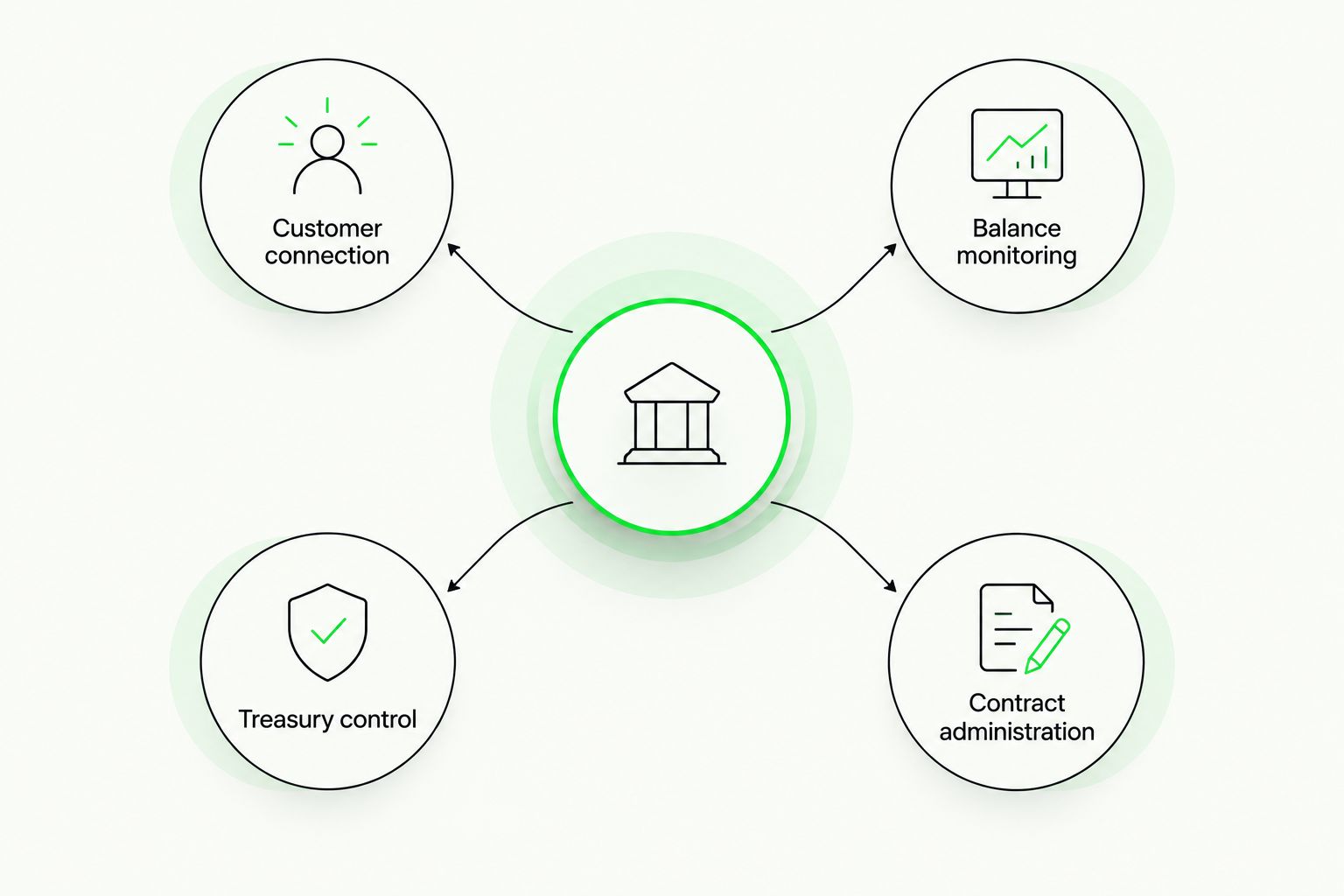
For an illustrative marketplace, the role map below is a starting point, not a required architecture. A small operation can still document separate responsibilities even when the same person performs several tasks.
- Customer connection: identify the user-selected account and network.
- Balance monitoring: read address data without transaction authority.
- Treasury control: authorize movement of marketplace-held funds.
- Contract administration: exercise explicitly assigned contract permissions.
Inventory networks, assets, and required permissions
Manually inspect the contracts and networks your marketplace supports. Record the network identifier, asset contract or mint, operator role, and operation you need. An address alone is not a complete integration requirement.
A native-token balance answers a different question from an NFT ownership query. Transaction-fee monitoring does not prove that a seller owns a particular NFT, that an approval remains valid, or that a listing can execute.
Also separate message signing from transaction signing. A signed login message can establish control of an account for an authentication flow; it does not by itself authorize an asset transfer. Review the exact message and verification logic rather than treating every signature as equivalent.
- Record each supported network and its environment.
- Identify native balances, fungible tokens, and NFTs separately.
- List every required read and every required signature.
- Map administrative permissions to specific accounts.
- Confirm how the application handles account and network changes.
Validate read-only data access before adding an agent
Begin with a manual reference check using an appropriate block explorer or direct blockchain query. Establish what the address, network, asset, and observed state should be before connecting automation. Then evaluate a data service against that reference.
BuildAWallet NON-HUMAN is the machine-facing side for AI agents and the developers building them; HUMAN is a separate wallet-blueprint design experience. NON-HUMAN includes paid machine data access and Base/Solana balance reads. That scope does not establish NFT ownership indexing, order validation, or transaction signing.
Deployment and RPC configuration require verification. RPC means remote procedure call: the interface an application uses to request blockchain data or submit operations. Documentation describing an endpoint is not proof that your deployed configuration serves it successfully.
For agent-specific boundaries, the BuildAWallet AI-agent wallet guide explains why data access and signing authority need separate evaluation.
- Confirm the intended balance operation in current documentation.
- Verify required deployment and RPC configuration.
- Compare a read against the same network and address.
- Check response units and observation context when provided.
- Keep the integration read-only until validation passes.
Give agents narrow tools instead of wallet authority
Design your application-side agent tool around a specific question, such as whether an operator address has enough native currency for a planned workflow. This is a design pattern, not a claim of a supported framework integration.
An illustrative tool contract can accept a network, a public address, and a requested data type. Your application should validate those inputs before calling any provider. Return structured data with an explicit success or failure state rather than asking the language model to interpret an unstructured error.
An instruction telling an agent not to spend funds is not an enforced spending policy. Real restrictions belong in application controls and, where relevant, the signer or contract that authorizes transactions.
For service discovery, verify the current NON-HUMAN overview and any linked machine-readable discovery documents directly. A discovery document helps locate an interface; it does not prove that a paid request works.
- Allow only the networks your application actually supports.
- Validate addresses before sending data requests.
- Expose only the read operations the task needs.
- Keep private keys and recovery secrets out of prompts and logs.
- Return explicit failures instead of invented balance values.
Separate transaction preparation from signing
Review a proposed transaction manually before automating its preparation. Identify the destination, contract function, transferred assets, approvals, and network. A prepared transaction is a request for authorization, not evidence that authorization is appropriate.
Local signing means a key signs within a separately controlled signing environment. Broadcasting means submitting a signed transaction to a network. Neither activity proves that a data provider holds keys or can autonomously authorize spending.
BuildAWallet documentation notes dated October 8, 2026 describe a broader endpoint catalog, including locally signed transaction preparation and broadcast, while homepage guidance identifies deployment requirements and policy-controlled agent signing as unavailable or in development. Verify the intended operation rather than treating the broader catalog as a deployed capability.
- Inspect transaction contents before presenting them for approval.
- Keep signing keys outside the balance-reading service.
- Distinguish preparation, signature collection, and broadcast in application state.
- Require an explicit approval boundary for privileged operations.
- Confirm transaction outcome independently after submission.
Test recovery and failure handling before production
Write the recovery procedure before deciding that a wallet setup is operational. Identify who can regain access, what evidence or secrets recovery requires, and what happens if an authorized operator becomes unavailable.
Recovery needs differ by role. Restoring a monitoring service is not the same task as replacing a contract administrator. A recovered interface also does not prove that the correct account permissions remain in place.
Exercise failures in an isolated environment appropriate to your application. Use a public test address or an account without production authority when validating reads. Do not add signing authority merely to make a balance test feel realistic.
- Test unavailable RPC access and rejected data requests.
- Test malformed addresses and unsupported networks.
- Distinguish a failed request from a genuine zero balance.
- Recheck permissions after recovery or account replacement.
- Document who can pause privileged application workflows.
Revalidate permissions after marketplace changes
Maintain a role register in a document or spreadsheet before adding monitoring automation. Record the purpose of each account, its current authority, the responsible owner, and the procedure for removing access.
Review that register whenever you add a network, change contracts, replace personnel, or introduce an agent. A wallet that was appropriate for observing balances can become inappropriate if the same credentials later gain transaction permissions.
Treat configuration changes as changes to the security boundary. A successful read does not validate a signer, and a successful signature does not validate recovery. Each function needs its own acceptance evidence.
- Review account permissions after contract changes.
- Remove obsolete accounts from application configuration.
- Revalidate data operations after provider or RPC changes.
- Record the last successful recovery exercise.
- Keep an incident contact and revocation procedure accessible.
Compare options by responsibility, not popularity
The relevant selection criteria are custody, signing authority, operational role, recovery, and deployment requirements. No single option below covers every marketplace task. In particular, a design experience belongs outside the category of deployed signing wallets.
| Option | Best for | Practical advantage | Key limitation |
|---|---|---|---|
| Customer-controlled wallet connection | Customer authentication and transaction approval | Leaves customer signing decisions with the customer’s wallet | Connection alone does not validate NFT ownership, listing validity, or transaction intent |
| Hardware-backed signing | Human-approved operator transactions | Separates key handling from the marketplace application | Requires a compatible workflow and deliberate recovery planning; does not verify business intent |
| Shared-control signing | Treasury or administration requiring several approvers | Distributes authorization across designated participants | Thresholds, signer availability, and recovery need operational maintenance |
| BuildAWallet NON-HUMAN | Developers evaluating Base/Solana balance reads | Separates machine-facing data access from the signing task | Requires operation-specific deployment validation; balance access is not signing authority |
| BuildAWallet HUMAN | Individuals documenting a custom wallet blueprint | Organizes choices around custody, networks, security, privacy, features, and style | Produces a design blueprint, not a deployed marketplace wallet or signer |
Choose the smallest capability that completes the task. A read-only balance check does not justify deploying a signer. Conversely, a treasury approval workflow needs an actual signing arrangement, not a data endpoint or wallet blueprint.
For hardware-backed and shared-control options, verify compatibility with the particular chain, contract operation, and application before selection. Category suitability is not a compatibility guarantee.
Common mistakes NFT marketplace operators make
Treating a native balance as proof of NFT ownership
A native-token balance measures native currency at an address. It does not identify a particular NFT or establish transfer approval. Validate ownership and permissions against the relevant asset and marketplace contracts through an appropriate supported read path.
Reusing the administrator account for routine activity
An account used to change marketplace configuration should not become the default for demonstrations, unfamiliar applications, or routine customer support. Keep privileged authority separate from everyday interactions and document exceptions explicitly.
Treating an endpoint catalog as production evidence
An endpoint description establishes intended interface behavior, not successful deployment. Validate configuration, access requirements, and the specific operation before relying on the result. A working homepage or discovery file does not prove a successful machine-data request.
Confusing agent instructions with enforced restrictions
A prompt that says to read balances only is not an authorization control. Restrict the actual tools and credentials exposed to the agent. If the task requires no signature, the agent should not receive signing access.
Planning recovery only after access fails
A recovery phrase alone is not an operational procedure. Your team also needs to know which accounts hold which roles, how replacements receive authority, and how obsolete access is removed. Keep secrets out of shared task systems and support transcripts.
FAQ
What are the best crypto wallets for NFT marketplace operators?
The right setup separates customer connections, operator signing, treasury control, and read-only monitoring. Choose each component by network compatibility, actual authority, recovery requirements, and the marketplace operation it must perform.
Can a balance API verify that a seller owns an NFT?
A native-token balance API does not establish ownership of a particular NFT. Use an appropriate NFT ownership read and separately validate the permissions and conditions required by the marketplace transaction.
Can BuildAWallet operate my marketplace signing wallet?
Do not treat BuildAWallet NON-HUMAN balance access as marketplace signing authority. Its documented transaction-preparation and local-signing workflows require operation-specific verification, and policy-controlled agent signing is described as unavailable or in development.
Does connecting a customer wallet give the marketplace control of it?
A wallet connection alone does not give the marketplace general signing authority. Review authentication messages, transaction requests, and asset approvals separately because each establishes a different permission boundary.
Should an AI agent hold the marketplace administrator key?
A balance-monitoring agent does not need the marketplace administrator key. Expose narrow read tools and keep privileged signing behind a separate, explicitly authorized workflow.
How do I test wallet data without risking marketplace funds?
Start with a public test address or an account without production authority, and compare the result against an independent reference on the same network. Test failures as well as successful reads, especially the distinction between an unavailable result and a zero balance.
Does a wallet blueprint deploy a working wallet?
A wallet blueprint documents design choices; it does not deploy a working wallet or establish its security. Implementation, key management, network configuration, and recovery validation remain separate tasks.
Next step: prove the read-only boundary
Choose one monitoring task and document its address, network, expected data, and failure behavior. Validate that task without granting transaction authority. Then evaluate signing separately, with its own approval and recovery checks.
This is general technical and security education, not a security guarantee or individualized legal advice. Custody and marketplace obligations depend on your operating model and jurisdiction; wallet architecture alone does not resolve them.