An MCP server needs a discoverable read-only tool, validated wallet and network inputs, access to a balance-data source, and structured results that distinguish a balance from a failed request. It also needs authentication, request controls, and explicit freshness information; exposing a balance must not grant signing authority. For developers considering BuildAWallet NON-HUMAN as a wallet-data source, the MCP adapter is an application-side design unless an official integration is verified.
- Wallet balance API MCP server requirements include validated inputs, explicit asset scope, authenticated data access, and distinguishable errors.
- BuildAWallet NON-HUMAN addresses machine-facing wallet data; verify operation-specific availability before connecting an MCP adapter.
- Balance reads need no wallet private key; signing and broadcasting belong outside the read-only tool.
- Reject unsupported networks and preserve balance precision instead of returning misleading zeroes.
What does an MCP server need to expose wallet balance data?
Use the following implementation sequence. Model Context Protocol, or MCP, gives an application a standard way to expose tools to a compatible client. It does not supply blockchain connectivity, payment handling, or permission to access an upstream service.
- Define the read. Specify the network, wallet address, asset scope, and freshness requirements.
- Expose the tool. Publish a clear description and machine-readable input schema through MCP tool discovery.
- Authorize access. Authenticate the caller and separately configure upstream access credentials.
- Retrieve the balance. Call the permitted data source through a configured network connection.
- Validate the response. Preserve precision, identify the asset, and attach available observation context.
- Handle failure. Return a recognizable error instead of inventing a balance.
The MCP specification defines tool discovery through tools/list and invocation through tools/call. A discoverable tool still needs a working implementation behind it: listing a tool does not prove that credentials, payment, deployment, or network connectivity work.
Why this matters
A syntactically valid tool response can still mislead an agent. An empty token list can mean no matching holdings, an unsupported query, or an upstream failure; your contract must distinguish those outcomes.
BuildAWallet NON-HUMAN fits developers evaluating machine-facing wallet data, not developers seeking verified autonomous signing. BuildAWallet NON-HUMAN is the machine-facing side for AI agents and the developers building them; HUMAN is a separate wallet-blueprint design experience.
The separate crypto wallets for AI agents guide explains the broader boundary between reading wallet data and controlling funds. This page focuses on the MCP adapter's read contract.
Separate the interface, data source, and signer
Define these boundaries before choosing an upstream provider. An adapter translates an MCP request into a permitted data request; it does not automatically become a wallet, custodian, or transaction signer.
| Component | Best for | Useful capability | Limitation |
|---|---|---|---|
| MCP adapter | Applications exposing a narrow balance tool | Validates requests and formats responses | Needs a separately configured data source |
| Balance-data source | Applications retrieving holdings | Supplies balances within its supported scope | Coverage and freshness require verification |
| Local signing workflow | Applications intentionally authorizing transactions | Signs with separately controlled keys | Introduces authority unnecessary for balance reads |
| Wallet blueprint experience | Individuals planning wallet requirements | Documents design choices | Does not deploy a working wallet |
Keep the balance adapter read-only by construction. Do not give its process signing keys merely because another part of your application sends transactions.
This separation also makes failures easier to investigate. If a balance lookup fails, you can inspect input validation, upstream authorization, network access, and response parsing without involving a transaction-signing subsystem.
Define exactly what the balance tool returns
A tool named get_wallet_balance is a proposed application-side interface here, not a documented BuildAWallet endpoint. Its description should explain which balances it retrieves and what it excludes.
Request fields
Use a small, explicit request contract:
- Network: Accept only configured network identifiers. Reject unsupported values rather than guessing from the address.
- Wallet address: Validate the address using rules appropriate to the selected network.
- Asset scope: Distinguish native assets, a specified token, and any supported token inventory.
- Observation requirement: Define whether the application accepts a cached observation or requires a fresh lookup.
Do not let an agent supply an arbitrary upstream URL. Keep provider destinations in server-controlled configuration so a balance request cannot redirect the server toward unrelated services.
Address shape alone does not establish network intent. An address accepted on an Ethereum-compatible network does not tell your application which compatible network the caller intended.
Response fields
Return enough context to interpret the amount without inference:
| Field | Purpose | Validation rule |
|---|---|---|
| Network | Identifies the queried chain | Must match the accepted request |
| Wallet address | Identifies the account queried | Must match the validated address |
| Asset identifier | Distinguishes native assets and tokens | Must match the requested scope |
| Raw amount | Preserves the smallest-unit balance | Keep as a precision-safe representation |
| Decimals | Explains human-readable formatting | Use the applicable asset metadata |
| Observation context | Shows when or where data was observed | Report only information actually available |
| Result status | Separates success, partial data, and failure | Never encode a failed read as a successful zero |
For example, an asset with 6 decimal places and a raw amount of 1234567 base units represents 1.234567 asset units. These are illustrative values, not a network balance or product result.
Use a string for large raw integer amounts when your application language or serialization path cannot preserve them exactly. A neatly formatted decimal is not a substitute for retaining the original amount.
Build the read-only request path
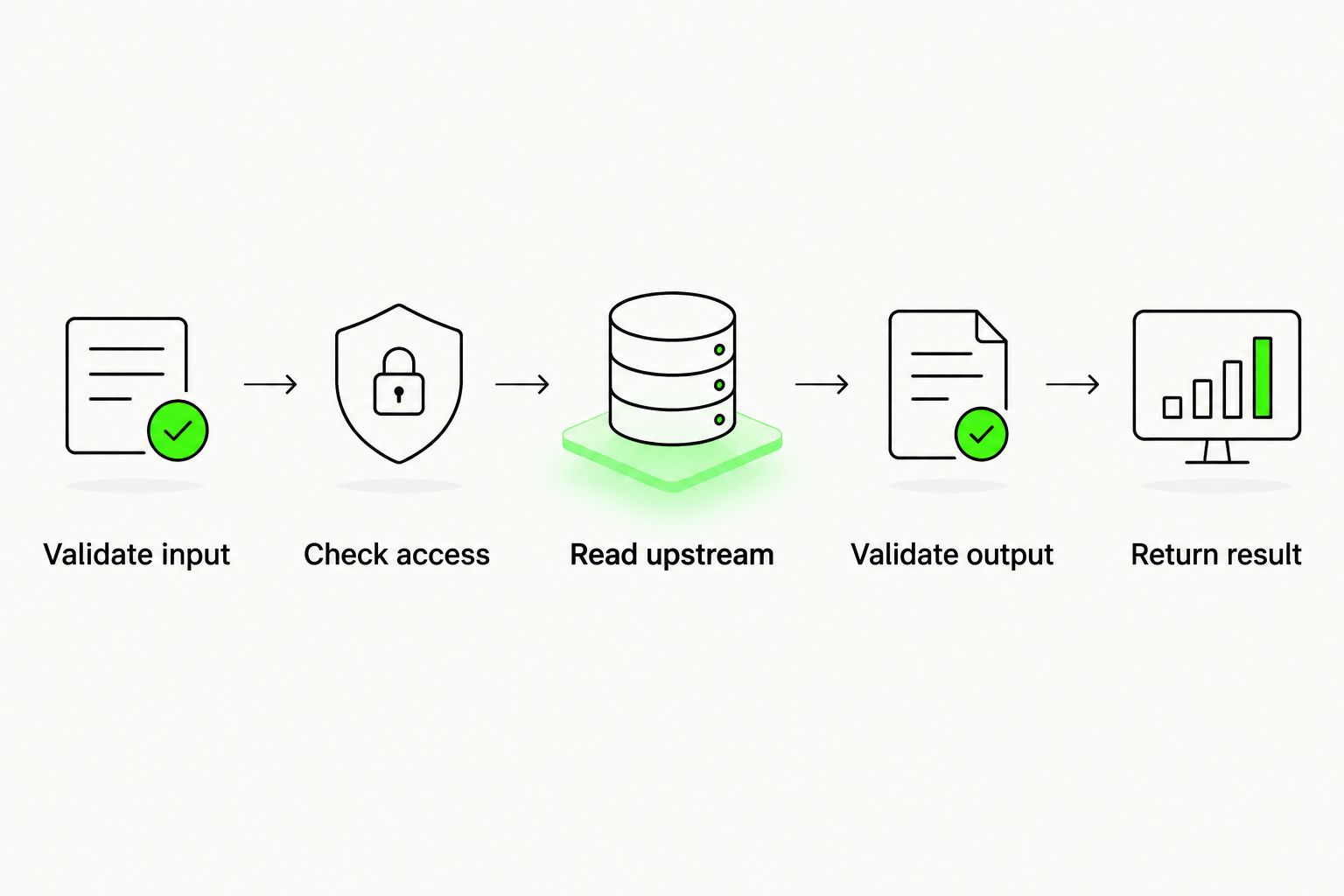
Keep the request path explicit enough to test each boundary independently. The following sequence is an application design, not a claim that any provider implements these exact stages or response fields.
Validate input
Reject malformed addresses, unsupported networks, and ambiguous asset requests before contacting the upstream service. Return an actionable explanation that identifies the invalid field without exposing internal configuration.
Check access
Authenticate the caller, check permission for the requested operation, and apply the application's request budget. Keep provider credentials server-side rather than embedding them in tool descriptions or model-visible arguments.
Read upstream
Call only the configured balance operation. A remote procedure call, or RPC, is a request to a network node or gateway; confirm that the deployed environment has the required RPC configuration and access.
Validate output
Check the returned network, address, asset identity, amount representation, and available observation context. Reject responses that do not satisfy the adapter's contract instead of asking the language model to repair them.
Return result
Return the validated result or a distinct failure. Preserve useful upstream context without leaking credentials, authorization headers, or sensitive diagnostic material.
Verify discovery separately from operation
An agent needs a way to learn which tool exists and how to call it. In an MCP application, tool discovery supplies the tool name, description, and input schema; the surrounding application determines which server the client can connect to.
For a potential upstream service, discovery material can point developers toward documentation and operation definitions. Check the current NON-HUMAN overview, llms.txt, agent manifest, and OpenAPI specification before describing their contents or using them to configure an adapter.
Discovery documents are pointers, not evidence that a paid request succeeds. An OpenAPI operation describes an interface; it does not demonstrate a working deployment, usable credentials, or a supported framework integration.
The documentation review dated October 8, 2026 identified a broader machine offering than the homepage and inconsistent subscription information. Verify the intended read operation directly rather than treating the broadest description as confirmed availability.
Keep BuildAWallet's availability boundaries explicit:
- NON-HUMAN includes paid machine data access and Base/Solana balance reads.
- Deployment and RPC configuration requirements need checking against current documentation.
- Documented transaction preparation or broadcast does not establish provider-held signing authority.
- Locally signed workflows remain separate from autonomous provider-controlled signing.
- Policy-controlled agent signing must not be presented as available when described as unavailable or in development.
Validate the intended read-only operation before funding or signing anything. Do not use a live homepage, manifest, or endpoint catalog as a substitute for that validation.
Why implementation requirements vary
The minimum interface stays narrow, but the work behind it depends on the requested data and deployment:
- Asset scope: A native-asset lookup and a token inventory require different completeness checks. Define omissions explicitly.
- Network coverage: Base and Solana require network-appropriate address handling and balance interpretation. Do not infer additional network support.
- Deployment configuration: Missing credentials, RPC settings, or upstream access can prevent a discoverable tool from working.
- Freshness needs: Cached observations and newly requested observations need different acceptance rules and labels.
- Access model: Paid upstream access requires controlled requests, credential isolation, and explicit handling of authorization or payment failures.
- Signing boundary: A read-only application has no reason to inherit transaction authority from a separate workflow.
Choose these requirements from the task, not from a broad promise of wallet compatibility. A tool that reliably answers a narrow question is more useful than one that silently changes the question when a network or asset is unsupported.
Test failure handling before connecting an agent
Use controlled fixtures and authorized test requests. These checks validate your adapter's behavior; they are not claims of provider testing or operational guarantees.
| Test case | Expected adapter behavior | Failure to prevent |
|---|---|---|
| Malformed address | Reject before upstream access | Unnecessary requests and unclear errors |
| Unsupported network | Return an explicit unsupported-network error | Querying a different chain |
| Successful zero balance | Return zero with normal result context | Treating zero as missing data |
| Upstream timeout | Return an unavailable or timeout result | Reporting a fabricated zero |
| Partial asset coverage | Mark the result incomplete | Presenting a partial inventory as complete |
| Excessive repeated calls | Apply the configured request controls | Unbounded upstream usage |
| Unexpected asset metadata | Reject or clearly identify the inconsistency | Misformatted amounts |
Start with a known address whose expected balance you can independently check at comparable observation context. Confirm network and asset identity before comparing displayed amounts.
For changing balances, different observation times can produce different valid results. Preserve the context you actually have; do not invent a block number or imply that independently retrieved observations are simultaneous.
Keep instructions separate from enforcement
A prompt saying “only read balances” is not an access-control mechanism. Enforce allowed operations in server code, credentials, network permissions, and the actual upstream capabilities assigned to the adapter.
Keep private keys and recovery secrets out of prompts and logs. Public addresses do not authorize spending, but tying addresses to people or application activity can create privacy exposure; minimize unnecessary retention.
Does a balance tool need a wallet private key?
A balance-only tool does not need a wallet private key. It needs the public account identifier and access to an appropriate data source; authentication credentials for that source are a separate concern.
Reject designs that ask users to provide recovery secrets for a balance lookup. Transaction authorization belongs in a separately reviewed workflow.
Can an MCP balance response authorize a transaction?
An MCP balance response does not authorize a transaction. Reading holdings supplies information, while signing requires separate authority over a key or another applicable authorization mechanism.
Do not turn a successful read into implicit permission to spend. Even an agent instructed to make a transfer still needs an independently enforced authorization path.
How do you know the adapter is ready?
The adapter is ready for its defined read task when its configured operation passes input, access, result, and failure checks. A listed tool or generated schema is insufficient evidence.
Record the operation tested, network, asset scope, observation context, and outcome. Leave broader catalog claims outside the acceptance decision.
FAQ
What are the minimum wallet balance API MCP server requirements?
You need a discoverable tool schema, validated inputs, authorized upstream access, a configured data source, precision-safe results, and explicit errors. Keep signing authority outside the balance tool.
Does MCP provide the blockchain balance data itself?
MCP provides the tool interface, not blockchain data. Your server must connect to a separately configured data source and validate its response.
Can I connect BuildAWallet NON-HUMAN directly to any MCP client?
Do not assume a verified direct MCP integration. Treat an MCP adapter as an application-side design until current official documentation confirms a supported integration and the intended balance operation works.
Should a failed balance request return zero?
A failed balance request must not return a successful zero. Return a distinct error so the agent can distinguish unavailable data from an actual zero balance.
Can I use the same address validator for Base and Solana?
Use network-appropriate address validation for Base and Solana. Require the network explicitly and reject unsupported combinations rather than inferring intent from the address alone.
Does a documented transaction endpoint mean an agent can sign?
A documented transaction endpoint does not establish agent signing authority. Transaction preparation, local signing, broadcast, and provider-controlled signing are separate capabilities with separate availability checks.
What should I check before allowing repeated paid balance requests?
Check caller authorization, operation availability, credential isolation, request budgets, and failure handling. Verify the intended read-only operation before permitting unattended repeated requests.
Related guides
Next step: prove a narrow read
Write the request and response contract before connecting the model. Choose a supported network and asset scope, verify the current upstream requirements, and test a successful read alongside an explicit failure.
The acceptance criterion is a trustworthy balance result, not a tool that merely appears in discovery. Keep signing disabled and expand scope only after the next operation passes the same checks.