
Instead of manually checking funds before every agent trade, verify the Base balance in an application-enforced gate that blocks signing when funds, gas or read validity fail validation. BuildAWallet NON-HUMAN is the machine-facing side for AI agents and the developers building them; HUMAN is a separate wallet-blueprint design experience.
- To verify Base balance before agent trade execution, check network, spendable assets and gas before requesting a signature.
- BuildAWallet NON-HUMAN belongs in the wallet-data layer; balance access does not grant signing authority.
- Reject failed, stale or ambiguous balance reads rather than treating them as approval.
- Validate deployment, RPC configuration and operation-specific availability before connecting a data service to your execution path.
Why this matters
A balance check answers whether an address holds an asset at an observed chain state. It does not prove that a proposed transaction will succeed, that another process will leave those funds untouched, or that the agent has permission to spend them.
For developers, BuildAWallet NON-HUMAN belongs in the read-only data layer, not the signing layer. Keep those responsibilities separate in your application, including when the same agent requests both operations.
The guide to crypto wallets for AI agents explains the broader distinction between wallet access and spending authority. This workflow focuses on one narrower task: preventing an execution request from reaching a signer without a valid Base balance decision.
Before you start
- Prepare the transaction context. Identify the spending address, Base network, input asset, proposed amount, intended contract and separate signing component. Keep private keys and recovery secrets out of prompts, requests to the data service and logs.
- Validate the data path. Confirm the intended balance operation, authentication requirements, deployment requirements and remote procedure call configuration. RPC is the connection your application or service uses to communicate with the blockchain.
- Account for gas separately. Holding the trade's input token does not prove the address can pay transaction fees. For an account paying its own Base gas, check native ETH as well as the input asset; validate any alternative fee arrangement independently.
Availability boundary
BuildAWallet describes Base and Solana balance reads, while its homepage requires deployment and RPC configuration. Documentation also describes a broader endpoint catalog and locally signed transaction preparation or broadcast; a documented operation is not evidence of a working deployed service.
The supplied documentation review dated October 8, 2026 identifies differences between the homepage and machine-facing descriptions. Validate the exact read-only operation before relying on it; do not infer autonomous signing from transaction-related documentation. Policy-controlled agent signing is described as unavailable or in development.
Discover the service through its current NON-HUMAN overview and inspect its current machine-discovery documents, including llms.txt, the agent manifest and OpenAPI specification. Treat these as pointers to inspect, not proof that authentication, a paid read or your deployment works. The workflow below defines application behavior, not a verified provider integration.
Transaction context
Use the trade proposal as your trigger. These steps belong in your application's execution path, not only in the agent's instructions.
- Capture the spending address, network, input asset and amount before making a balance request.
- Identify native ETH explicitly. For a token, identify the asset by its contract address rather than its display symbol alone.
- Confirm that both the proposed transaction and the balance reader target the same network. Base mainnet's chain ID is 8453; test networks are separate environments.
- Normalize the amount into the asset's smallest units using verified token metadata. Use integer arithmetic rather than floating-point comparisons.
- Attach an internal proposal identifier so the balance decision, signing request and eventual transaction remain associated.
Expected result: you have an unambiguous proposal tied to one address, network, asset and amount. A missing contract address, unresolved network or invalid amount stops the workflow before the read.
Do not let the model silently substitute a similarly named token or another network when a lookup fails. A corrected proposal requires a new validation decision.
Balance decision
Build the balance gate around a narrow adapter: an application component that translates your internal read request into the provider's verified request format. Do not copy assumed endpoint names or response fields into production.
- Validate the intended operation against the currently deployed service. Check required credentials, RPC configuration and request requirements before enabling automated execution.
- Request the input-asset balance for the proposal's address and network. If the account pays gas in native ETH, obtain that balance too.
- Validate the response before extracting an amount. Reject missing data, malformed values, request failures and an unresolved network context.
- Record the observation time and any chain-state reference the operation actually provides. Do not manufacture a block reference when none is returned.
- Compare the observed amount against the proposed spend, your application's pending reservations and an explicit reserve policy.
Expected result: the gate returns either a validated balance decision or a blocking reason. A timeout, authentication failure or incomplete response never becomes permission to trade.
Spendable balance is an application calculation
An on-chain balance does not account for every transaction your application intends to submit. If two agent jobs read the same funds before either executes, both can appear affordable.
Maintain an application-side reservation ledger for in-flight proposals. Calculate spendable funds as the observed balance minus applicable reservations and any configured reserve. Serialize or atomically coordinate reservation changes so competing jobs cannot independently allocate the same funds.
Reservations constrain your application, not the blockchain. Another wallet interface or external signer can still move funds, so refresh the observation near signing and reconcile reservations after transaction outcomes.
Application-side pseudocode
The names below describe local application functions. They are not BuildAWallet endpoint names, SDK methods or response fields.
proposal = validate_trade_proposal(incoming_proposal)

observation = read_balances_through_verified_adapter(proposal)
require_valid_observation(observation, proposal)
require_acceptable_freshness(observation, application_policy)

with_reservation_lock(proposal.account, proposal.network):
    spendable = calculate_spendable(observation, active_reservations)
    require_input_funds(spendable, proposal)
    require_fee_capacity(spendable, proposal, fee_policy)
    reservation = reserve_for_proposal(proposal)

return balance_gate_pass(proposal, observation, reservation)
The read adapter must fail explicitly. Do not return a cached success object when the current request fails, and do not convert an unknown balance into a valid numeric value.
Signing handoff
A successful balance decision should unlock the next validation stage, not unrestricted signing. Bind the decision to the specific transaction proposal and reject changes after approval.
- Evaluate transaction policy outside the language model. Check the permitted network, contract, asset, amount and any approval scope your application enforces.
- Estimate fee requirements using the intended transaction. If the account pays gas, preserve enough native ETH for that requirement under your application's fee policy.
- Run transaction simulation where your execution infrastructure supports it. Simulation evaluates a proposed transaction against a chain state; it is not a guarantee of later execution.
- Refresh the balance decision when its freshness policy expires or the transaction changes. Recalculate reservations when the amount or fee requirement changes.
- Send only the approved transaction context to the separately authorized signer. Release or reconcile its reservation after rejection, cancellation or a confirmed outcome.
Expected result: the signer receives a bounded, validated proposal rather than a general instruction to spend. A balance approval for one asset or amount cannot authorize a different transaction.
Keep the control path explicit:
- Trade proposal: defines the requested action.
- Balance gate: checks funds and observation validity.
- Policy check: enforces transaction restrictions.
- Separate signer: holds or accesses signing authority.
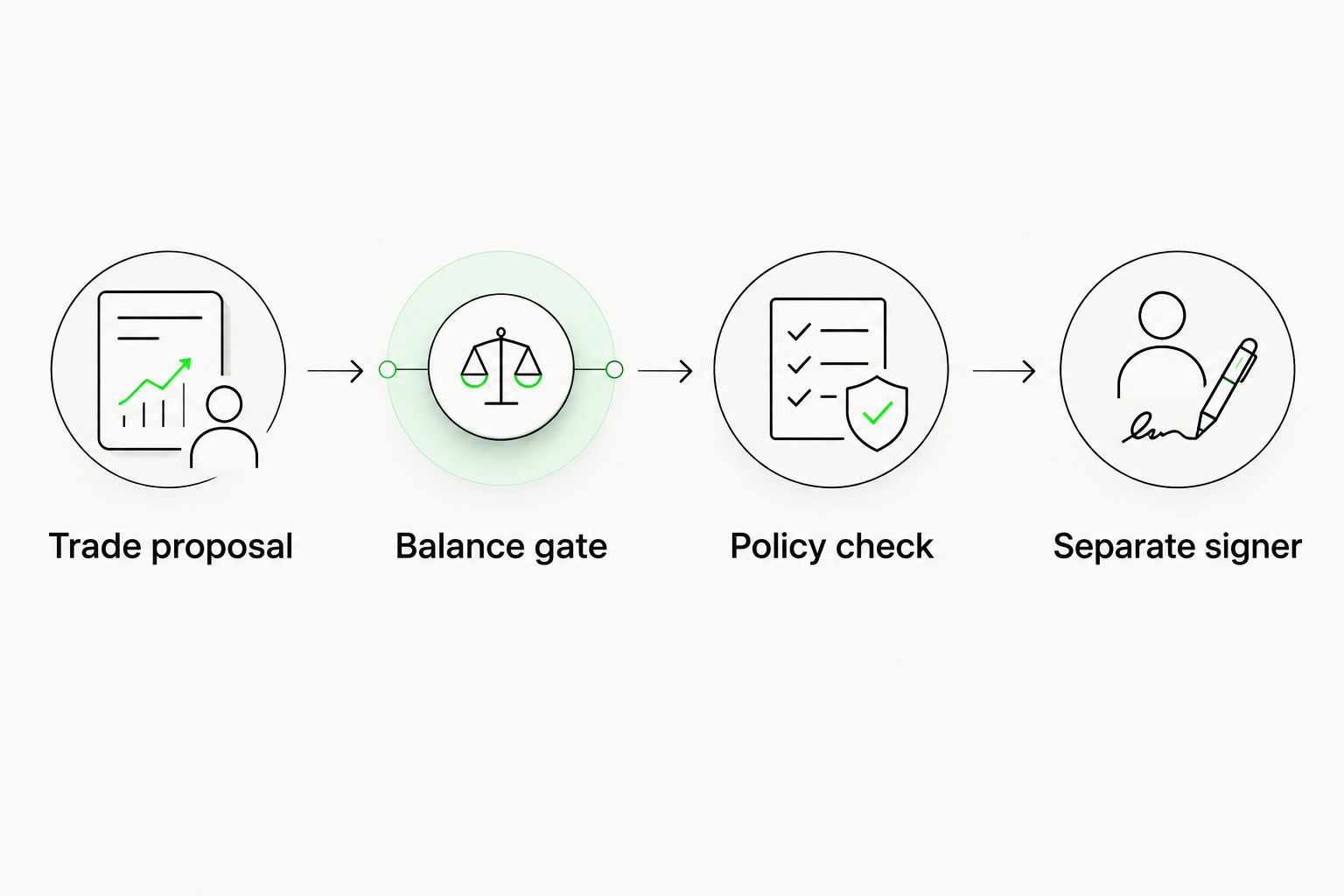
A prompt saying never exceed a spending limit is not an enforced spending limit. Put the restriction in code, signer policy or another control that rejects a noncompliant transaction independently of the model's response.
Choose the correct control boundary
BuildAWallet separates HUMAN blueprint design from NON-HUMAN machine data access. Neither category should be treated as evidence that an autonomous signer is deployed.
| Component | Best for | What it contributes | Limitation |
|---|---|---|---|
| NON-HUMAN data access | Developers validating wallet-data reads | A machine-facing balance-data path, subject to deployment and operation checks | A successful read does not authorize spending |
| HUMAN blueprint design | Individuals defining wallet requirements | A design around custody, security, networks and other preferences | A blueprint is not a deployed wallet or execution component |
| Separate signing component | Applications with explicitly authorized execution | Transaction signatures under its actual access controls | A valid signature does not prove that funds, fees or transaction policy were checked |
Keep balance reads and signing authority separate even when one application coordinates both. This gives you a clear place to reject incomplete data without involving a secret-bearing component.
Recheck balances when a proposal changes
A second useful workflow invalidates an earlier approval whenever the execution context changes. Use it for agent replanning, quote changes or a user editing an intended amount.
- Mark the prior balance decision invalid when the account, network, asset, amount or transaction payload changes.
- Cancel or update the corresponding reservation under the same coordination controls used to create it.
- Repeat the input-asset and fee-capacity checks against the revised proposal.
- Bind the replacement decision to the revised transaction before requesting a signature.
Expected result: the application never reuses an affordable small-trade decision to approve a larger or different trade.
Do not poll continuously merely because an agent remains active. Trigger reads from a defined execution event or an explicit freshness rule, and account for the service's actual request terms when designing retries.
Troubleshooting
The token balance passes, but execution lacks gas
Check the fee-paying account and asset separately. An input-token balance is not a native ETH balance; an alternative fee arrangement also needs its own validation.
Parallel jobs each approve the same funds
Coordinate reservations before releasing approvals. A second balance read alone does not prevent two workers from allocating the same observed amount.
The request succeeds, but the amount cannot be trusted
Reject the response if required values are missing or the asset identity, units or network context remain unresolved. A successful transport response is not enough to establish a valid balance decision.
An approved trade later fails
Inspect the transaction failure rather than assuming the balance service was wrong. Contract conditions, token allowances, fees and chain-state changes are separate from whether the earlier observation showed sufficient funds.
Authentication or the data service fails
Block execution and expose a distinct data-unavailable state. Retry according to a bounded application policy; do not fall back silently to another network, cached approval or a less restrictive signer.
Customize your workflow
Record enough evidence to explain each decision: proposal identifier, network, asset identity, amount, observation time, validation outcome and reservation state. Exclude credentials, private keys and recovery material, and limit address-level logging to what your operations actually need.
Test rejection paths before connecting a signer. Include insufficient input funds, insufficient gas, an expired observation, an unavailable reader, an invalid asset and competing proposals. These tests validate your application's behavior; they do not establish that a provider guarantees execution or transaction safety.
FAQ
How do I verify Base balance before agent trade execution?
Place an application-enforced balance gate before the signing request. Validate the account, network, input asset, spendable funds and fee capacity, then bind the result to the exact transaction proposal.
Does BuildAWallet balance access let an AI agent sign transactions?
No. BuildAWallet NON-HUMAN balance access is distinct from signing authority, and policy-controlled agent signing is described as unavailable or in development. Validate operation-specific availability rather than inferring it from documentation.
Why does my agent need ETH when it already holds the input token?
An account paying its own Base transaction fees needs native ETH for gas. Check that fee capacity separately from the input-token balance, unless a separately validated fee arrangement applies.
Can I reuse a balance check after the agent changes the trade?
Do not reuse a balance approval when the transaction context changes. Invalidate the earlier decision, update its reservation and validate the revised proposal before requesting a signature.
What should happen when a balance API times out?
Block the signing path and return a data-unavailable result. A timeout is not a zero balance or permission to reuse an earlier approval.
Does a successful balance check guarantee the trade will execute?
No. Funds can move after the observation, and execution also depends on transaction conditions, allowances and fees. Keep balance validation, transaction policy, simulation where supported and signing as separate controls.
Is this a supported framework integration?
This is an application-side workflow design, not a verified framework integration. Confirm the current deployed operation and implement its adapter from the applicable official specification before using it in an execution path.
Related guides
One last thing
Test that the signer remains unreachable when the balance reader fails. Start with a read-only deployment, deliberately return an invalid observation, and verify that no signing request is emitted. That rejection test is your next step before enabling the execution path.