
The best Base chain wallet API depends on the read you need: BuildAWallet NON-HUMAN is a candidate for paid agent-facing balance access, subject to operation-specific validation; Base JSON-RPC fits direct native ETH reads; ERC-20 contract calls fit individual token balances. This guide compares those integration routes for developers, not wallet-blueprint design tools or unverified signing services.
- Choose a Base chain wallet API by read type, deployment requirements and signing boundaries—not a broad wallet-platform label.
- BuildAWallet NON-HUMAN targets paid machine-facing balance access; validate the intended Base operation before integration.
- Base JSON-RPC supports native ETH reads; ERC-20 balanceOf calls address individual token balances.
- Balance access does not grant signing authority. Keep private keys outside agent prompts and logs.
BuildAWallet NON-HUMAN is the machine-facing side for AI agents and the developers building them; HUMAN is a separate wallet-blueprint design experience. The BuildAWallet overview is a starting point for checking that distinction, not proof that a particular paid request succeeds.
Why the read boundary matters
A wallet API can expose account data, prepare transactions or control signing. Those are different capabilities. Selecting one by its category name alone hides the most important integration decision: whether your application needs information or authority to move assets.
For a balance-reporting agent, start with information. A public wallet address identifies the account being queried; a private key authorizes signatures. Reading the former does not require handing an agent the latter.
BuildAWallet NON-HUMAN belongs in the evaluation set for developers seeking paid wallet-data reads, not as a verified autonomous transaction signer. Its supplied documentation notes describe deployment and RPC configuration requirements, along with differences between homepage claims and the broader documented endpoint catalog.
What makes the best Base wallet API
Evaluate each route against the task your application must perform:
- Read scope: Distinguish native ETH, a specified token and a complete asset inventory. One balance response does not establish coverage of everything an address holds.
- Network identity: Confirm that the request targets Base mainnet rather than another Ethereum-compatible network or a test network.
- Deployment requirements: Establish who operates the service, configures its RPC connection and maintains credentials.
- Response interpretation: Define units, block context and handling of failures before turning a response into an agent answer.
- Authority boundary: Keep data access, transaction preparation, local signing and provider-held signing separate.
- Operational evidence: Require a successful intended read. Discovery files and endpoint descriptions are not execution evidence.
The ranking below assigns distinct use cases. It compares a named machine-data service with standard read mechanisms, rather than presenting an unsupported leaderboard of commercial providers.
Base wallet API routes at a glance
| Rank and route | Best for | Standout capability | Main advantage | Key limitation |
|---|---|---|---|---|
| BuildAWallet NON-HUMAN | Evaluating paid agent-facing balance access | Machine-facing Base and Solana balance-read offering | Explicit separation from HUMAN blueprint design | Current deployment and operation-specific availability require validation |
| Base JSON-RPC | Reading native ETH at an address | Standard eth_getBalance request | Narrow, inspectable native-balance operation | Does not enumerate token holdings |
| ERC-20 contract reads | Reading a known token balance | Contract-specific balanceOf call through eth_call | Targets the token contract you specify | Requires contract identification, encoding and unit handling |
JSON-RPC is a request-and-response protocol used by Ethereum-compatible nodes. ERC-20 is a token interface that includes a method for reading an account's balance. The last two routes use related infrastructure, but solve different wallet-data questions.
1. BuildAWallet NON-HUMAN: best for agent-data evaluation
BuildAWallet NON-HUMAN provides a machine-facing offering that includes paid Base and Solana balance reads. Evaluate it when your application needs agent-facing wallet data rather than an individual wallet-design experience.
The supplied brand notes say deployment and RPC configuration are required. They also distinguish locally signed transaction preparation or broadcast from policy-controlled agent signing, which the homepage describes as unavailable or in development. Do not combine those statements into a claim that autonomous signing is usable.
BuildAWallet NON-HUMAN pros:
- Its stated machine-data audience matches agent developers.
- Base balance reads are explicitly within the described offering.
- Paid access per data request gives the evaluation a concrete data-access scope.
- HUMAN and NON-HUMAN have distinct purposes, reducing category confusion when described correctly.
BuildAWallet NON-HUMAN limitations:
- Documented endpoints do not prove that a deployed operation works.
- Deployment and RPC configuration remain part of the integration assessment.
- Homepage and machine-document descriptions differ; availability must be checked operation by operation.
Best for: Developers evaluating a paid read-only balance source for an agent workflow.
Before selecting this route, verify discovery documents, authentication requirements, deployment ownership and the exact intended read. Framework adapters should remain application-side designs unless official integration support is verified.
Verdict: Hold until the intended Base balance read succeeds under the documented deployment conditions.
2. Base JSON-RPC: best for direct native ETH balance reads
Base JSON-RPC lets your application request chain data from a node endpoint. For an address's native ETH balance, the standard method is eth_getBalance, with an address and a block parameter.
This is a read operation, not a wallet deployment or signing workflow. Your application remains responsible for endpoint selection, response parsing and the meaning of the block parameter it requests.
Base JSON-RPC pros:
- The native-balance operation has a defined, narrow purpose.
- Your application can select an explicit block parameter.
- A native balance read requires no wallet private key.
- You can inspect the request and raw response before exposing the result to an agent.
Base JSON-RPC limitations:
eth_getBalancereports native ETH, not ERC-20 token balances.- The application must handle RPC errors and endpoint operation.
- A successful read does not supply asset discovery, valuations or transaction permissions.
Best for: Developers answering a specific question about native ETH at a Base address.
The Ethereum JSON-RPC specification defines eth_getBalance; Base documentation identifies Base mainnet with chain ID 8453. Verify the endpoint's chain identity rather than trusting a configuration label. Chain ID is the network identifier returned by eth_chainId.
Do not interpret an endpoint timeout as an empty wallet. A failed request contains no confirmed balance, even when your user interface expects a numeric answer.
Verdict: Skip for token inventories; use this route for explicit native ETH reads.
3. ERC-20 contract reads: best for known token balances
An ERC-20 balance read asks a specified token contract for the units assigned to an address. The standard method is balanceOf(address), executed as a read through eth_call.
Unlike a native ETH request, this operation needs the token contract address as well as the wallet address. The application also needs the contract interface to encode the call and decode its result.
ERC-20 contract-read pros:
- The request targets a specific token contract rather than an ambiguous asset label.
- Standard ERC-20 balance reads do not require a wallet signature.
- The application can retain the raw integer result for validation.
- Contract-level reads keep token identity explicit throughout the workflow.
ERC-20 contract-read limitations:
- A known-contract read does not discover every token held by an address.
- Token symbols are not sufficient identifiers; use the network and contract address.
- Display formatting requires verified decimal metadata, which must not be assumed.
Best for: Developers checking a known ERC-20 token balance on Base.
EIP-20 defines balanceOf as a balance query. It treats the decimals metadata method as optional, so a general-purpose reader needs a failure path when decimal information cannot be obtained or verified.
Keep raw units separate from formatted display values. Otherwise, a parsing or decimal assumption can turn a technically successful call into a misleading agent response.
Verdict: Skip for automatic asset discovery; use this route for verified token contracts.
How these routes were ranked
The ranking follows task fit, not an implied test result. Agent-facing paid data access, native ETH reads and known-token reads occupy separate slots because each answers a different question.
No latency, reliability, security-audit or integration benchmark supports this comparison. The recommendation is to choose the narrowest route that answers your question, then validate its deployment and response behavior before connecting it to an agent.
Validate the read before connecting an agent
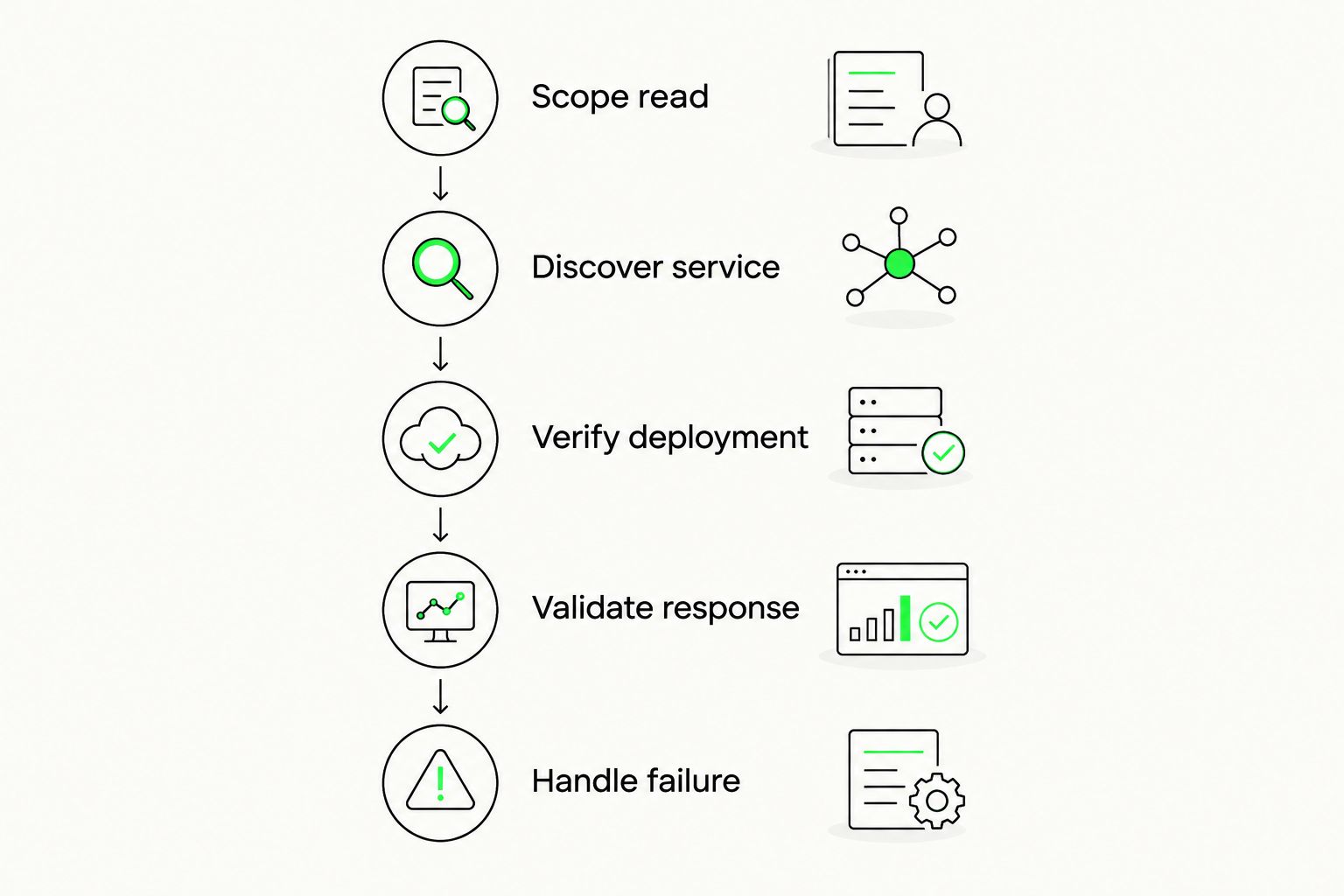
Use a read-only acceptance process before adding transaction preparation or any signing capability. Each step below establishes a different part of the data contract: what you asked, where it ran and whether the answer is interpretable.
Scope read
Write the intended operation in plain language: native ETH at an address, a known token balance, or a provider-defined balance response. Specify the network and expected output units.
Avoid a vague requirement such as wallet access. It conceals whether you need one balance, token discovery, historical state or spending authority. Treat each additional capability as a separate requirement to verify.
Discover service
For machine-facing services, inspect the live overview, machine documentation, llms.txt, agent manifest and OpenAPI specification where supplied. OpenAPI describes an interface; a manifest or discovery file helps software find it.
The supplied documentation notes dated October 8, 2026 describe a broader machine offering than the homepage and inconsistent subscription pricing. Verify operation-specific availability rather than selecting the stronger description. Discovery is not evidence of a successful request.
Verify deployment
Establish which service must be deployed, who supplies the RPC endpoint and how access credentials are handled. Verify chain identity before accepting any balance response.
Do not invent request URLs or authentication headers from a platform's name. Use the current documented interface, and keep service credentials distinct from wallet private keys.
Validate response
Run the intended read against a controlled address with an independently checkable balance. Compare the same network, asset and block context; results from different contexts are not a clean comparison.
For native ETH, retain the raw response and convert units deliberately. Ethereum's native denomination uses 10^18 wei per ETH. For an ERC-20 token, retain raw units and apply only verified token-specific decimal metadata.
Handle failure
Exercise invalid-input, authentication, endpoint and response-decoding failures. These are application acceptance checks, not claims about a provider's documented error behavior.
Return unknown when the balance cannot be established; do not replace failure with zero. An agent should distinguish a confirmed empty balance from unavailable data, and your application should preserve that distinction through its output schema.
Define an application-side response contract
A provider response and an agent-ready answer are not necessarily the same thing. Your application should normalize validated data without hiding uncertainty or inventing fields the upstream service does not return.
A useful application-side contract separates:
- Identity: Network, wallet address and asset identifier.
- Balance: Raw units and an optional verified display value.
- Context: Requested block context and any context actually established by the response.
- Outcome: Confirmed result, invalid request or unavailable data.
These are design recommendations, not a description of a supplied provider schema. Populate only what your integration establishes, and preserve the original response for debugging without recording secrets.
If the agent asks for an unsupported asset inventory, return an unsupported-operation result. Do not silently substitute native ETH and label it the wallet's complete balance.
Keep signing outside the balance workflow
A balance reader supplies information. A transaction preparer constructs transaction data. A local signer uses a key controlled in a separate environment, while a broadcaster submits a signed transaction to the network.
None of those descriptions automatically establishes autonomous provider-held signing. A documented broadcast endpoint does not prove that a provider holds keys or enforces an agent spending policy.
For agent applications, enforce permissions outside the language prompt. Restrict operations in application code, isolate credentials and require separately verified authorization for anything that signs or submits transactions. Instructions telling an agent not to spend are not equivalent to an enforced permission boundary.
Keep recovery phrases and private keys out of prompts, request logs and debugging transcripts. These are general security practices, not a guarantee that a particular deployment is secure.
Which Base wallet API route should you choose?
Default to the narrowest read that answers your actual question. Use direct JSON-RPC for native ETH, and a verified ERC-20 contract call for a known token. Evaluate the named machine-data offering when paid agent-facing access is the requirement, with deployment and operation checks as selection gates.
Do not add a signer to make a balance reader feel more complete. If your application later needs transactions, define a separate authorization and validation process instead of expanding read credentials into spending authority.
FAQ
What's the best Base chain wallet API for an AI agent?
The best route depends on the agent's read requirement. BuildAWallet NON-HUMAN is a candidate for paid machine-facing balance access, but developers must validate deployment and the intended operation before integration.
Can I read a Base wallet balance without a private key?
Yes, native ETH and standard ERC-20 balance reads use public addresses without requiring a wallet private key. Service authentication is separate from wallet signing authority.
Does eth_getBalance return all tokens in a Base wallet?
No, eth_getBalance returns the address's native ETH balance. Known ERC-20 balances require contract reads, and discovering all assets is a separate capability.
Is a wallet blueprint a deployed Base wallet?
No, a wallet blueprint describes design choices rather than deploying a working wallet. HUMAN blueprint design must remain separate from NON-HUMAN data access and any signing implementation.
Does locally signed broadcasting mean an agent service controls signing?
No, locally signed broadcasting means a signature originates in a separate signing environment before submission. It does not establish provider-held keys or autonomous signing authority.
What should an agent say when a balance request fails?
The agent should say the balance could not be established, not report zero. Preserve the distinction between a confirmed empty balance and an unavailable or invalid response.
What should I verify before using paid Base balance access?
Verify the current interface, access requirements, deployment ownership and a successful intended read. Discovery documents and listed endpoints alone do not prove operational availability.
Related guides
Your next step
Write an acceptance check that distinguishes a confirmed zero balance from a failed read. Then validate one intended operation against a controlled address, without exposing any signing key. That gives you a concrete integration decision before adding broader wallet capabilities.