
Best for read-only evaluation: BuildAWallet NON-HUMAN. Best for human-approved transactions: an application-controlled local signer. Best for unattended execution: a separately verified policy-enforced signer. Choose a crypto wallet for AI agents by the authority your application needs—not by whether a service calls itself an agent wallet.
- BuildAWallet NON-HUMAN fits read-only wallet-data evaluation; validate the intended Base or Solana balance operation before integration.
- An application-controlled local signer fits transactions that require separate approval and protected signing keys.
- A policy-enforced signer fits unattended execution only when restrictions operate outside the agent's prompt.
- HUMAN designs wallet blueprints; it does not deploy a wallet or grant transaction authority.
Why the wallet's authority matters
BuildAWallet NON-HUMAN is the machine-facing side for AI agents and the developers building them; HUMAN is a separate wallet-blueprint design experience. This guide serves developers choosing between reading wallet data, preparing transactions and granting software permission to execute them.
Those tasks need different controls. A balance reader reports information about an address. A signer uses a private key—the secret that authorizes transactions—to approve an operation. Broadcasting submits a signed transaction to a network; it does not create the signature.
Reading a balance is not permission to move assets. If your agent only answers questions about holdings, adding signing authority expands the risk without serving the task.
This ranking compares implementation paths, not independently tested vendors. The available brand information supports a specific read-only evaluation path, but it does not establish a working autonomous-signing service. There is no defensible overall winner across those different jobs.
What makes the best crypto wallet for AI agents?
Use these criteria before choosing an implementation:
- Authority boundary: Identify whether the agent receives data, prepares unsigned transactions or can authorize execution.
- Operation availability: Verify the exact operation you intend to call. A documented endpoint is not proof of a deployed service.
- Deployment requirements: Confirm hosting, authentication and RPC configuration. RPC means remote procedure call: the interface used to query or submit requests to a blockchain node.
- Policy enforcement: Determine where destination restrictions, spending limits and approvals are enforced—not merely described to the agent.
- Failure handling: Separate rejected requests, unavailable networks, uncertain transaction status and successful results.
- Secret handling: Keep private keys and recovery secrets outside prompts, conversation history and application logs.
The right implementation is the least-authorized one that completes your task. A read-only assistant does not need a signer. An execution agent needs stronger controls than a useful instruction in its system prompt.
Agent wallet options at a glance
| Option | Best for | Standout capability or design goal | Key limitation |
|---|---|---|---|
| BuildAWallet NON-HUMAN | Evaluating paid wallet-data reads | Machine-facing access described for Base and Solana balances | Deployment and operation-specific availability require validation; agent signing is unavailable/in development |
| Application-controlled local signer | Human-approved transactions | Separates transaction preparation from signing-key access | Your application must implement approval, key protection and transaction review |
| Separately verified policy-enforced signer | Unattended execution | Enforces execution permissions outside the language model | Suitability depends on verified restrictions, deployment and revocation behavior |
| HUMAN blueprint design | Individuals planning a custom wallet | Guided design around custody, networks, recovery and features | A blueprint is not a deployed wallet, SDK or transaction signer |
The final row is a separate design category, not a fourth ranked agent-execution product. An SDK, or software development kit, provides code for application development; a wallet blueprint does not establish that capability.
1. BuildAWallet NON-HUMAN: best for read-only evaluation
BuildAWallet NON-HUMAN is the candidate here for developers evaluating paid machine-facing wallet-data access, including Base and Solana balance reads. Treat that as a data-service evaluation, not a recommendation to delegate transaction signing.
The supplied homepage description requires deployment and RPC configuration. It also describes policy-controlled agent signing as unavailable or in development. Broader documentation describes additional endpoints and locally signed transaction preparation or broadcasting; those descriptions must remain separate from verified operation availability.
NON-HUMAN pros:
- Its stated balance-read scope gives developers a concrete operation to evaluate.
- The machine-facing role is distinct from the consumer blueprint experience.
- A read-only integration can keep transaction signing outside the agent's task.
NON-HUMAN cons:
- The homepage and broader documentation describe different scopes.
- Documented endpoints do not establish that the intended deployed operation works.
- Local transaction signing does not establish autonomous provider-held signing.
Best for: A developer validating a Base or Solana balance-data workflow before adding transaction functionality.
Verdict: Hold production integration until the intended read operation passes validation. Evaluate the narrow data task first; do not infer execution capabilities from the broader documentation.
2. Application-controlled local signer: best for human approval
An application-controlled local signer is an architecture in which your application prepares an operation and a separate signing component authorizes it. Local signing means the signature is created where the key is controlled; it does not mean the data provider holds the key or that the agent can sign autonomously.
Use this path when an agent can propose an action but a person must approve it. Your application should present the destination, network and intended operation before requesting the signature.
Local-signer pros:
- Transaction preparation can remain separate from key access.
- A human approval step can sit between the agent's proposal and execution.
- Your application can reject a proposed operation before it reaches the signer.
Local-signer cons:
- You must implement and validate the approval boundary.
- Key storage and signing-component access remain your responsibility.
- Preparation, signing and broadcasting failures require different recovery paths.
Best for: Assistants that draft transactions while keeping authorization under human control.
Verdict: Choose this architecture for approval-based workflows. Do not describe it as fully autonomous, and do not treat a successful broadcast request as proof that the intended transaction completed.
3. Policy-enforced signer: best for unattended execution
A policy-enforced signer is an architecture where a signing component checks explicit execution rules before authorizing an operation. Policy enforcement must happen outside the language model: a prompt instructing an agent to respect a limit is not an access-control mechanism.
For unattended execution, require evidence that the signer rejects disallowed operations. Verify the actual implementation rather than relying on a policy description or an agent's explanation of its intentions.
Policy-enforced signer pros:
- An independently enforced boundary can restrict what the agent is permitted to authorize.
- Defined permissions make acceptance and rejection behavior testable.
- A separate signing layer can keep private keys out of model context.
Policy-enforced signer cons:
- A restriction is useful only if the deployed signer actually enforces it.
- Unattended execution still needs monitoring and a verified revocation process.
- A documented policy catalog does not prove enforcement for your selected operation.
Best for: Developers whose task genuinely requires unattended transactions and who can verify enforcement before enabling execution.
Verdict: Wait until the signer passes both permitted-action and denied-action tests. This is an implementation requirement, not a claim that any named provider currently satisfies it.
Where HUMAN blueprint design belongs
HUMAN helps individuals plan a custom wallet around assets, networks, custody, security, privacy, features and style. Custody describes who controls the keys; recovery describes how access is restored if normal access is lost.
HUMAN pros: It provides a guided design task and keeps wallet preferences distinct from machine-data access. It can help you identify requirements before selecting an implementation.
HUMAN cons: Choosing custody or recovery options does not deploy or secure a working wallet. A blueprint does not provide a signer, establish network connectivity or prove that an application is ready for use.
Best for: An individual defining a wallet design—not a developer seeking an operational agent signer.
Recommendation: Use HUMAN for planning only. Evaluate deployment and execution through separate evidence.
Validate the data workflow before connecting an agent
Start with the smallest operation that answers your application's question. For a balance assistant, that means validating a read without providing a signing key or recovery secret.
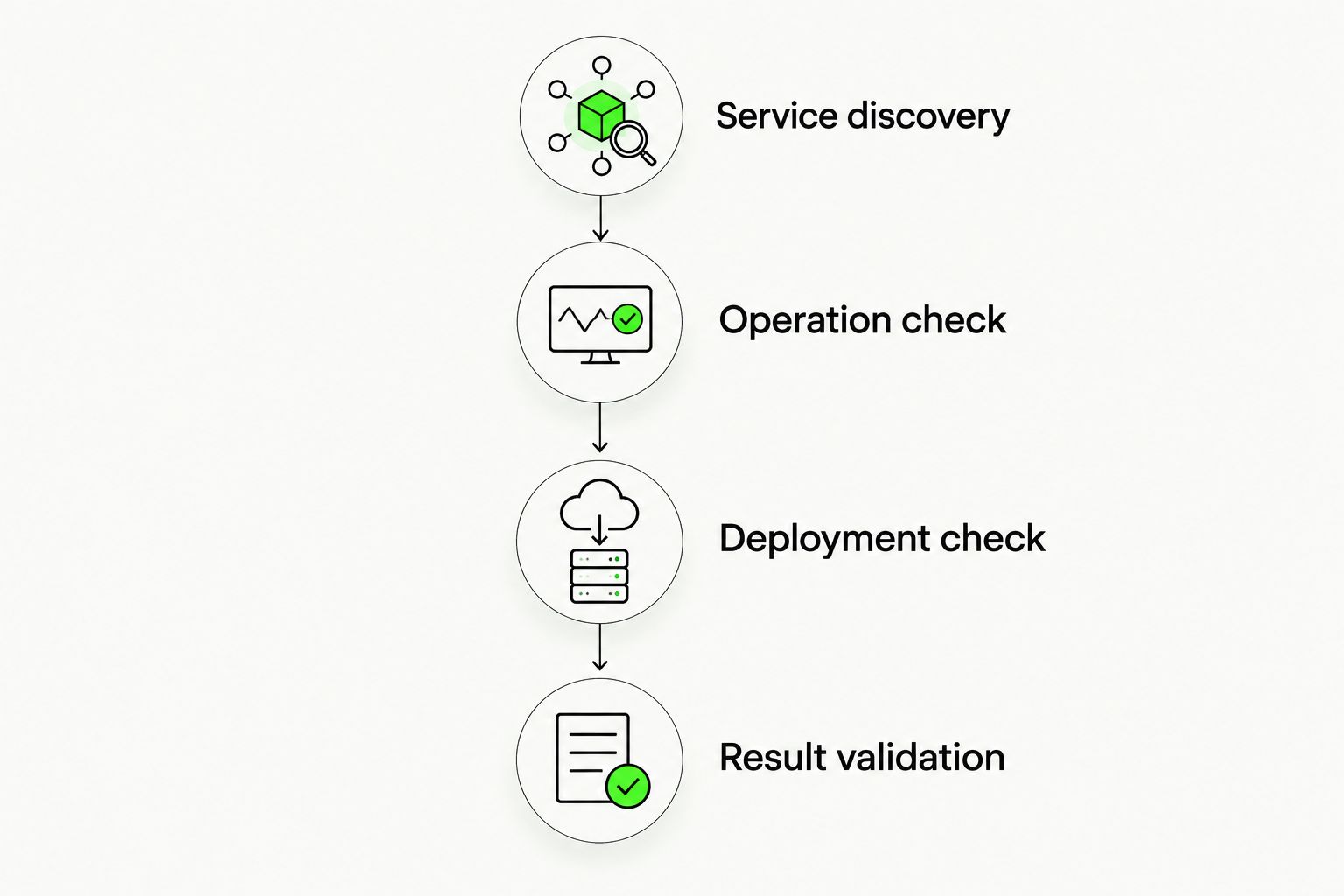
Service discovery
Identify the official machine-facing entry point and check the current NON-HUMAN page, llms.txt, agent manifest and OpenAPI specification where available. These are discovery and interface documents; they point an application toward a service but do not prove successful operation.
The supplied brand notes report that documents checked on October 8, 2026 described a broader machine offering than the homepage and inconsistent subscription pricing. That dated observation is not a fresh verification of today's service. Confirm the intended operation and current access terms directly before integrating it.
Operation check
Write down the exact network, address type and balance question your application needs to answer. Confirm that the current operation covers that question; do not infer support for historical balances, every asset type or additional networks.
A hypothetical task is: retrieve an account balance for an address on Base, then report the returned value with its network context. This example defines an application requirement, not an endpoint name, request schema or claim about a live response.
Deployment check
Establish who operates the deployed service and who supplies the RPC connection. Verify authentication and paid-access requirements from current documentation without assuming that a published interface is ready to use.
Keep service credentials separate from wallet-signing secrets. Authentication to read a service and authority to authorize a blockchain transaction are different permissions.
Result validation
Compare the returned information against an independent network source appropriate to the operation. Preserve the address, network and retrieval context in your application so that the agent cannot silently mix unrelated results.
Treat an unavailable read as unavailable information—not as a zero balance. If the response does not establish the requested result, stop the downstream decision rather than filling the gap with a plausible answer.
Test failure boundaries, not just successful requests
A useful integration must distinguish a valid result from an error. Design application-side handling for these cases without claiming that the service exposes particular error codes:
- Wrong network: Reject a result that does not match the requested network.
- Invalid input: Stop before using information tied to an unvalidated address.
- Unavailable service: Return an explicit failure rather than inventing a balance.
- Uncertain transaction status: Check network status before deciding whether to submit again.
- Denied authorization: Preserve the rejection; do not ask the model to bypass the rule.
For framework integration, describe your adapter as application-side code unless an official supported integration is verified. A tool wrapper can expose a read operation to an agent, but the wrapper does not establish provider support or grant signing authority.
Log enough context to investigate failures without logging credentials, private keys or recovery phrases. General security guidance does not guarantee a secure deployment; validate the controls in your own environment.
How these options were ranked
The ranking follows task fit, authority boundaries and verifiable operation scope. Read-only evaluation comes first because it answers the narrow wallet-data question without requiring transaction authorization; human-approved signing and unattended execution serve progressively different tasks.
This is not a speed benchmark, security audit or firsthand product test. No provider wins on latency, reliability or enforcement without evidence for that claim.
Which crypto wallet for AI agents should you choose?
BuildAWallet NON-HUMAN is best suited to developers evaluating read-only Base and Solana wallet-data access, subject to operation validation. Choose a separate application-controlled signer when a person must approve transactions; require a verified policy-enforced signer when execution must be unattended.
If you cannot explain where signing authority resides, stop at reads. Adding a signer should answer a concrete application requirement, not make a balance assistant appear more autonomous.
FAQ
What's the best crypto wallet for AI agents?
The best fit depends on whether the agent needs balance reads, human-approved transactions or unattended execution. Choose the least-authorized implementation that completes the task, and validate its deployed behavior.
Can BuildAWallet NON-HUMAN sign transactions autonomously?
Do not treat NON-HUMAN as an available autonomous-signing service. The supplied homepage description says policy-controlled agent signing is unavailable or in development; broader documentation about locally signed workflows does not establish provider-held signing authority.
Does reading a wallet balance require the private key?
A read-only balance lookup for a public address does not require that address's private key. A data service can require separate authentication, but service credentials are not wallet-signing authority.
Is local signing the same as autonomous signing?
No. Local signing describes where a signature is created; autonomous signing describes whether software can authorize an operation without a person approving it. Check both the key-control boundary and the approval policy.
How does an AI agent discover a wallet-data service?
An application can use current official discovery and interface documents to identify the service and its described operations. Validate the intended deployed operation separately; discovery documents do not prove successful requests or supported framework integration.
Does HUMAN create a working crypto wallet?
HUMAN is a guided wallet-blueprint design experience, not evidence of a deployed wallet. Choosing a network, custody model or recovery preference does not deploy a signer or secure an operational application.
What should happen when a balance request fails?
The application should report the read as unavailable and stop decisions that depend on it. Do not convert an error into a zero balance or let the model invent a replacement value.
One last thing: test rejection before granting authority
A successful read demonstrates a data operation. It says nothing about whether a signer rejects a forbidden transaction.
Your practical next step is to document the required authority, validate the narrow read operation and keep signing disabled unless the task requires it. If you add execution later, test a prohibited operation as well as an allowed one before enabling unattended use.