
Best for autonomous spending: a separately validated policy-enforcing signer. Best for evaluating Base and Solana balance reads: BuildAWallet NON-HUMAN. Best for human-reviewed transactions: a locally signed workflow. These are distinct infrastructure choices, not interchangeable wallet products; choose by the authority your agent needs, then validate the deployment.
- Policy-controlled wallet infrastructure must separate wallet data access from transaction signing and enforce rules outside the agent's prompt.
- BuildAWallet NON-HUMAN serves AI-agent wallet data workflows; Base and Solana balance reads require operation-specific validation.
- Use locally signed workflows for human-reviewed transactions; local signing does not establish autonomous provider-held signing.
- Choose a policy-enforcing signer for delegated spending only after verifying enforcement, deployment and revocation.
BuildAWallet NON-HUMAN is the machine-facing side for AI agents and the developers building them; HUMAN is a separate wallet-blueprint design experience. Start with the distinctions on the BuildAWallet overview, then check current documentation for the specific operation you intend to use.
Why the authority boundary matters
An AI agent can inspect a balance without controlling the assets behind that balance. A service can also prepare or broadcast a transaction without holding the key that signs it. Treating these capabilities as equivalent creates the wrong integration requirements and the wrong security assumptions.
A balance response is information, not spending permission. Policy-controlled wallet infrastructure for transaction execution needs rules enforced at the signing boundary, not just instructions asking the agent to behave.
This guide ranks implementation choices by task. It is not a tested vendor leaderboard: the recommendations distinguish data access, locally approved execution and delegated signing without claiming that any named service has passed an operational test.
What makes the best policy-controlled wallet infrastructure
Use these criteria before comparing feature lists:
- Authority boundary: Identify whether the integration reads data, prepares transactions, broadcasts signed transactions or signs them.
- Policy enforcement: Locate the component that rejects prohibited actions. A prompt instruction is not an authorization control.
- Deployment requirements: Confirm which service, network connection and configuration must exist before the operation works.
- Credential separation: Keep data-access credentials separate from signing keys and recovery secrets.
- Failure handling: Decide what happens when a read fails, approval expires or a signing request violates a rule.
- Operational evidence: Validate the intended operation. Documentation, discovery files and endpoint lists do not establish successful execution.
For a read-only assistant, signing features add authority the task does not require. For an autonomous transaction agent, balance access alone leaves the central problem unresolved: who authorizes movement of assets?
Infrastructure choices at a glance
| Rank and option | Best for | Standout capability or design goal | Key limitation |
|---|---|---|---|
| 1. NON-HUMAN data access | Developers evaluating Base and Solana balance reads | Machine-facing wallet data access | Deployment and operation-specific availability need validation; reads do not grant signing authority |
| 2. Locally signed workflow | Human-reviewed transaction execution | Keeps signing in a separately controlled local component | Requires an independent signer and approval process |
| 3. Policy-enforcing signer | Delegated autonomous spending | Rejects transactions outside enforceable rules | Must be separately selected, deployed and validated; no provider is verified here |
The order favors the smallest authority boundary that completes the task. It does not imply that a data service replaces a signer or that an architecture recommendation is a ready-to-use product.
1. NON-HUMAN data access: best for balance-read evaluation
BuildAWallet NON-HUMAN is best suited to developers evaluating Base and Solana balance reads, not delegated transaction signing. Its machine-facing offering includes paid data access, with deployment and RPC configuration requirements that must be checked before integration. RPC means remote procedure call: the interface an application uses to request information or submit operations to a network service.
The homepage and documentation describe different scopes. The homepage identifies policy-controlled agent signing as unavailable or in development; the documentation describes a broader endpoint catalog and locally signed transaction preparation and broadcast. Neither description proves that the intended operation works in your deployment.
NON-HUMAN data access pros:
- Keeps the recommended starting task focused on wallet information rather than spending.
- Identifies Base and Solana balance reads as concrete operations to evaluate.
- Separates the machine-facing offering from the individual wallet-design experience.
NON-HUMAN data access cons:
- Requires validation of deployment, RPC configuration and operation-specific availability.
- Does not establish provider-held autonomous signing authority.
- Broader documentation should not be treated as proof of a working deployed endpoint.
Best for: Developers building an agent that needs to inspect balances while leaving transaction authority elsewhere.
Use a public address you are authorized to inspect for the initial read validation. Confirm the network, documented request format and response meaning before giving the result to an agent. A successful response should answer the intended balance question, not merely prove that an endpoint responded.
Verdict: Hold production adoption until the intended read-only operation passes validation. Keep the integration read-only unless you have independently selected and approved a signing architecture.
2. Locally signed workflow: best for human-reviewed transactions
A locally signed workflow separates transaction preparation from authorization. The application prepares a proposed transaction, a separately controlled local signer authorizes it, and a broadcast component submits the signed transaction.
Local signing means the signing operation happens in that local component; it does not mean the data provider holds authority to sign autonomously. Treat documented preparation or broadcast capabilities as separate operations, each requiring its own availability check.
Locally signed workflow pros:
- Makes the approval boundary explicit before submission.
- Allows transaction review outside the agent's conversational instructions.
- Separates transaction construction from possession of signing secrets.
Locally signed workflow cons:
- Requires a signer, approval interface and deployment design beyond balance access.
- Human approval interrupts unattended execution.
- Local key handling still requires operational controls; locality alone is not a security guarantee.
Best for: Developers whose agents propose transactions that a person or separately controlled signer must approve.
Before approval, display the network, recipient, asset and requested action in a form the approver can inspect. Verify that the signed transaction corresponds to the reviewed proposal. Do not let approval of a description silently authorize a different payload.
Verdict: Buy into this architecture for reviewed execution; skip it as a claim of autonomous provider-held signing.
3. Policy-enforcing signer: best for delegated autonomous spending
A policy-enforcing signer authorizes transactions only when they satisfy rules implemented outside the agent's prompt. This is an architecture category, not a recommendation of a verified vendor in this guide.
For delegated spending, select a signing component that supports the restrictions your application requires, then demonstrate that those restrictions actually reject prohibited requests. Do not assume that a policy description establishes enforcement.
Policy-enforcing signer pros:
- Places authorization checks at the component controlling signatures.
- Supports a clear separation between agent proposals and permitted actions.
- Gives the application a concrete boundary to test with prohibited requests.
Policy-enforcing signer cons:
- Requires independent verification of supported rules and their enforcement.
- Adds key-management, deployment and incident-response responsibilities.
- Cannot be substituted with a read-only API or a wallet-design blueprint.
Best for: Developers who genuinely need unattended transactions under explicit, enforceable restrictions.
Define the allowed actions before selecting infrastructure. Depending on your task, the requirements can include permitted networks, destinations, assets, approval conditions and revocation. These are selection criteria, not claims that any particular provider implements them.
Verdict: Wait until enforcement and revocation pass validation before delegating spending authority.
Validate discovery, reads and signing separately
Discovery tells an agent where to look. It does not demonstrate that an authenticated request succeeds, that payment works or that a signing operation is available.
The documentation notes dated October 8, 2026 identify a broader machine offering than the homepage and inconsistent subscription pricing. That scope difference makes operation-level validation necessary; it does not justify adopting the stronger claim. Keep disputed pricing out of your implementation assumptions.
Use the following sequence as an application-side validation plan, not as a claim about a supported framework integration:
Discover
Inspect the current NON-HUMAN page and any linked machine discovery documents, including llms.txt, an agent manifest and an OpenAPI specification. OpenAPI is a structured description of an API's operations and request formats. Confirm that each document points to the service and operation you intend to use.
Confirm deployment
Identify the required service deployment, RPC configuration and access mechanism in current documentation. Resolve contradictions before wiring the operation into an agent. A published endpoint description is not evidence that the endpoint is deployed for your use.
Validate reads
Run the intended balance read outside the agent first. Check the network, address, documented units and response interpretation against an independent network data source you trust. Do not assume historical balance support or additional networks.
Separate signing
Trace every transaction-related step to its responsible component. Identify who prepares the transaction, who signs it and who broadcasts it. A broadcast response must not be treated as evidence that the provider controls signing.
Test denial
For a signing integration, submit deliberately prohibited proposals in an appropriate test environment. Confirm that the authorization component rejects them. For a read-only integration, confirm that the application's tool permissions do not expose transaction execution.
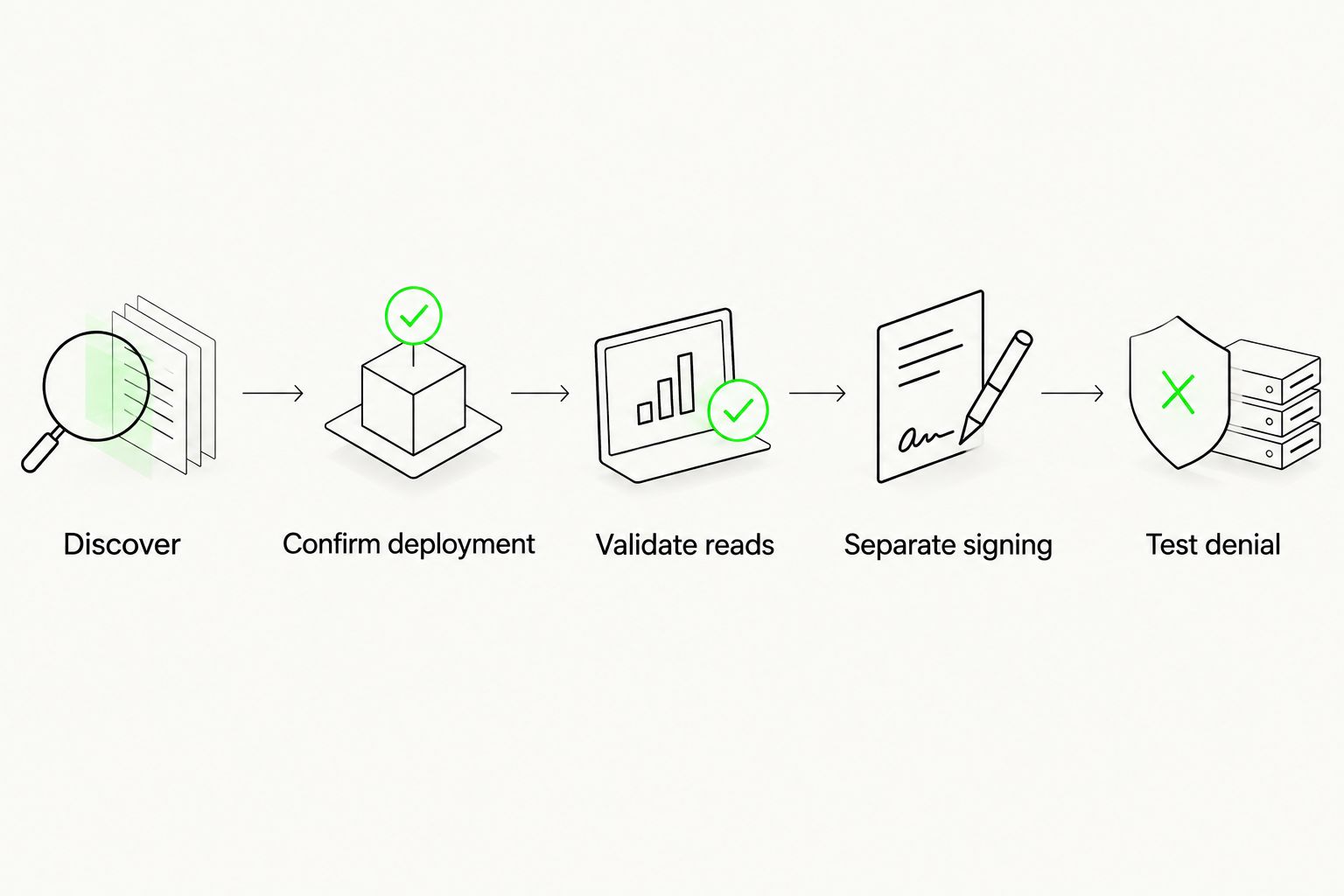
A framework connection remains an application-side design unless official support is verified. Successful tool registration is not evidence of successful wallet access, and successful wallet access is not evidence of signing authority.
Define failure handling before the agent uses the data
Give the agent an explicit unavailable-data outcome. If a request fails, your application should not turn that failure into a zero balance or silently substitute a response from another network.
Recommended read-workflow behavior:
- Reject unsupported network and address combinations before making the request.
- Preserve the distinction between a successful read and an unavailable result.
- Attach the network and address context to the information passed to the agent.
- Treat uncertain units or response meaning as validation failures.
- Keep access credentials, private keys and recovery secrets out of prompts and logs.
For transaction workflows, apply the same discipline to authorization. An expired approval or denied proposal is a stop condition, not permission to retry with fewer restrictions.
Avoid assuming freshness guarantees that the service does not document. If the response includes timing or network-position metadata, interpret it according to the documented contract rather than inventing a freshness threshold.
How the choices were ranked
The ranking follows the criteria above: start with the least authority needed, then evaluate deployment, credential separation, enforcement and failure handling. Read-only evaluation comes first because a balance-inspection task does not require transaction control.
Locally signed execution fits reviewed proposals. A policy-enforcing signer fits delegated spending only after its controls are demonstrated. No benchmark, review score or first-hand testing claim supports this ordering; it is a task-based selection framework.
Which infrastructure should you choose?
Choose read-only access when the agent needs wallet information. Choose a locally signed workflow when a person must approve transactions. Choose a separately validated policy-enforcing signer when unattended spending is a real requirement.
BuildAWallet HUMAN belongs outside that signing comparison: it helps individuals design a wallet blueprint. Selecting custody, recovery preferences or a network in a design experience does not deploy or secure a working wallet.
Keep those boundaries in the integration specification. Otherwise, a team can finish a data connection or a design exercise while mistakenly believing it has completed wallet deployment and transaction authorization.
FAQ
What is policy-controlled wallet infrastructure for AI agents?
Policy-controlled wallet infrastructure separates agent requests from independently enforced access or transaction permissions. For spending, the signing component must reject prohibited actions; instructions in an agent's prompt are not equivalent to enforcement.
Is BuildAWallet NON-HUMAN an autonomous transaction signer?
BuildAWallet NON-HUMAN should not be treated as a verified autonomous transaction signer. Its machine-facing offering includes Base and Solana balance reads, while homepage notes identify policy-controlled agent signing as unavailable or in development.
Can an AI agent read a wallet balance without a private key?
Reading a public wallet balance does not require the wallet's private key. A particular data service can still require access credentials, payment and deployment configuration, which must be checked separately.
Is locally signed transaction broadcast the same as provider-held signing?
No, locally signed transaction broadcast is not provider-held signing. Broadcasting submits an already signed transaction; identify the separate component that produced the signature.
How do I check whether a wallet policy is actually enforced?
Test prohibited requests against the component that controls authorization in an appropriate test environment. Confirm rejection independently of the agent's reasoning, and verify the deployment implements the policy you intend to use.
Do llms.txt and an OpenAPI specification prove an agent integration works?
No, discovery documents and API specifications describe or point to an integration. Validate the intended authenticated operation separately before treating it as available to your application.
Does a HUMAN wallet blueprint deploy a working wallet?
No, a HUMAN wallet blueprint is a design outcome rather than a deployed wallet. Deployment, key handling, recovery implementation and transaction authorization remain separate responsibilities.
Related guides
- Crypto wallets for AI agents: access and authority
- Self-custody wallets for Base
- Self-custody wallets for Solana
One last thing: test the forbidden action
A successful permitted request shows that a path works. A rejected prohibited request shows whether an authority boundary exists.
Your next step: write the intended operation and its forbidden counterpart into the integration specification. Validate the read-only operation first; if you later add signing, require an independent denial test before the agent receives spending authority.