Before using BuildAWallet x402 wallet data access, verify the exact read operation, required deployment and RPC configuration, payment authorization, response meaning, and failure handling. Treat Base and Solana balance reads as separate from transaction signing, and require evidence that your intended operation works before enabling unattended requests. BuildAWallet NON-HUMAN is the machine-facing side for AI agents and the developers building them; HUMAN is a separate wallet-blueprint design experience.
- BuildAWallet x402 wallet data access belongs in a read-only evaluation before any unattended agent workflow.
- Verify Base or Solana balance reads operation by operation; documentation alone does not establish a working service.
- Separate request-payment authority, wallet-data access, and transaction signing in your application.
- Keep private keys and recovery secrets out of prompts, tool arguments, and logs.
Why this matters
An agent that can read a wallet balance does not automatically have authority to move that wallet's assets. A payment mechanism for obtaining data introduces another boundary: who authorizes the request payment, and under what limits?
BuildAWallet separates HUMAN blueprint design from NON-HUMAN machine data access. BuildAWallet NON-HUMAN is for developers evaluating paid wallet-data reads, not a substitute for separate signing authority. Your integration should preserve that distinction in its permissions, tests, and user-facing descriptions.
What should you verify before using BuildAWallet x402 data?
Verify the entire path from discovering an operation to interpreting its result. A page describing an endpoint establishes what is documented; a controlled request establishes what your deployment can actually do.
- Identify the operation. Write down the network, wallet address, asset scope, and intended balance question before selecting an endpoint.
- Resolve prerequisites. Confirm whether you must deploy software, configure an RPC connection, or supply other infrastructure. RPC means remote procedure call: an interface applications use to request blockchain information.
- Check payment authorization. Establish which component approves payment for the data request and whether it can act without human confirmation.
- Inspect response semantics. Confirm what the returned balance represents, including units, asset identity, network, and any documented timing information.
- Test failure handling. Observe how your application handles rejected requests, unavailable infrastructure, ambiguous payments, and malformed responses.
- Keep signing separate. Do not infer transaction authority from successful balance access or from the presence of transaction-related documentation.
Save the relevant documentation version with your test record. A later documentation change should trigger a review of the affected assumptions, not an automatic expansion of your agent's permissions.
Read access, local signing, and agent authority are different
Use this comparison to classify the task before choosing an integration. These categories describe different responsibilities, not interchangeable wallet products.
| Category | Best for | Useful capability | Boundary or limitation |
|---|---|---|---|
| HUMAN blueprint design | Individuals defining wallet requirements | Organizing custody, network, security, privacy, and feature preferences | A blueprint is not a deployed wallet |
| NON-HUMAN data access | Developers evaluating machine-readable wallet information | Paid machine data access, including Base and Solana balance reads | Operation-specific availability and deployment requirements need validation |
| Locally signed workflow | Applications retaining signing authority locally | Separating transaction preparation or broadcast from local authorization | Documented transaction workflows do not establish an available hosted signer |
| Policy-controlled agent signing | Teams evaluating future delegated transaction authority | A separate category requiring explicit permission controls | The homepage describes this capability as unavailable or in development |
The homepage and machine documentation describe different scopes. The October 8, 2026 documentation snapshot describes a broader endpoint catalog and locally signed transaction preparation or broadcast, while the homepage states that deployment and RPC configuration are required and policy-controlled agent signing is unavailable or in development.
Do not resolve that mismatch by choosing the broader claim. Verify the exact operation and deployment you intend to use. Local signing means a locally controlled signer authorizes a transaction; it does not mean the provider holds keys and signs autonomously.
For the broader access-versus-authority distinction, see the crypto wallets for AI agents guide.
Verify discovery without treating discovery as proof
Start by locating the current NON-HUMAN overview and official machine documentation. If the service presents llms.txt, an agent manifest, or an OpenAPI specification, inspect the live versions before building against their contents.
These documents serve different discovery purposes. An OpenAPI specification describes an API interface in a machine-readable format; discovery files can direct an agent or developer toward relevant documentation. Neither establishes that a particular paid request succeeds.
Use a narrow discovery record:
- Source: Which official document identifies the intended operation?
- Version: What retrieval date or published version are you evaluating?
- Scope: Does the document describe a balance read, transaction preparation, broadcast, or signing?
- Prerequisites: What deployment, credentials, RPC configuration, and payment setup does it require?
- Conflict: Does another official page describe a different availability state?
Treat disagreement as an unresolved dependency. Do not let an agent select an operation merely because its description sounds relevant, and do not present an application-side framework adapter as an officially supported integration without verification.
Validate the read before adding automation
Use a controlled progression: Discover, Configure, Read, then Validate. Payment authorization remains an explicit gate before any paid read; a successful response is not permission to enable unrelated operations.
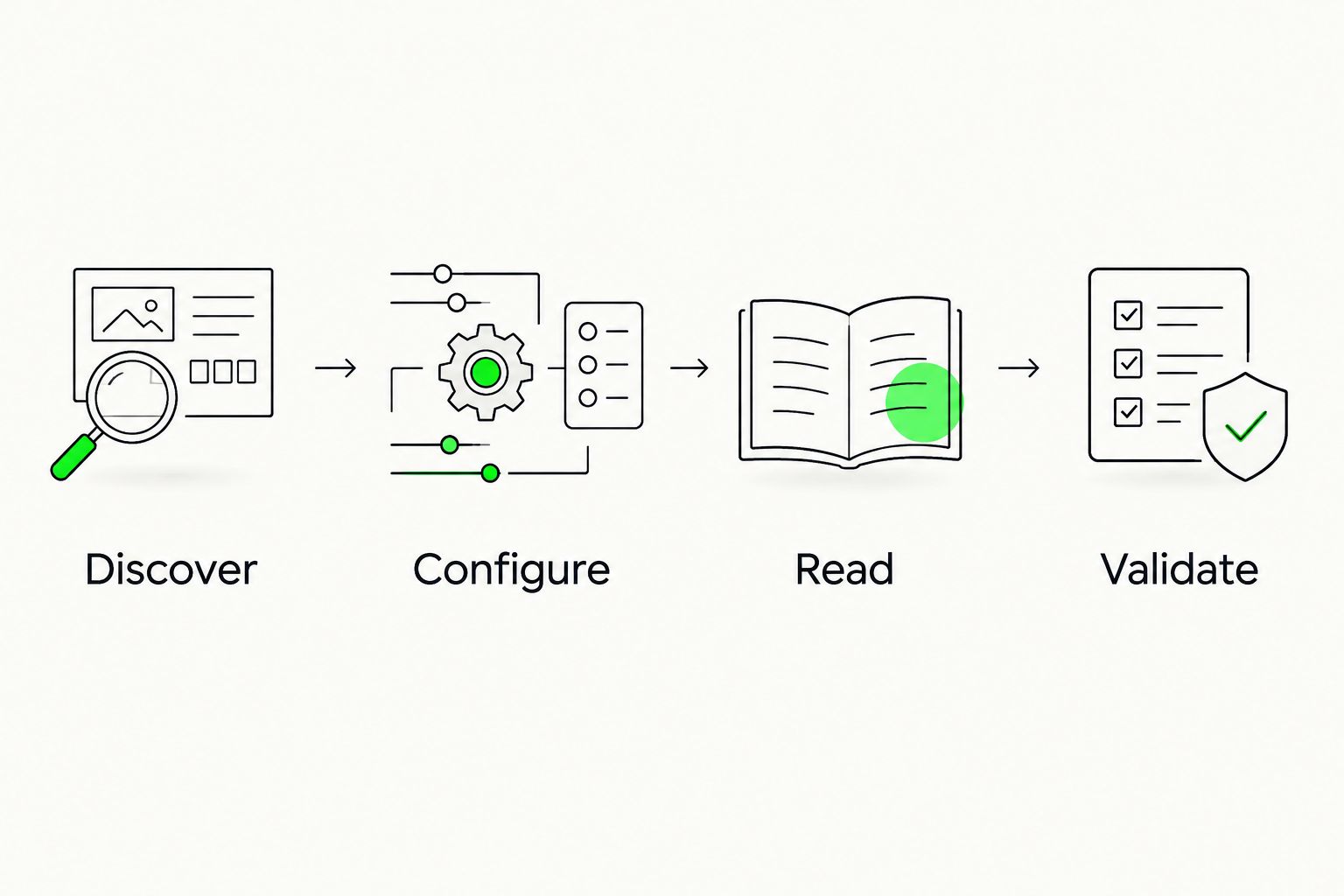
Discover: define the balance question
Specify whether you need a native-asset balance or a particular token balance, and name the intended network. Do not assume that the phrase wallet balance means a complete portfolio, historical holdings, or an aggregated value across networks.
For example, a developer can define a read-only task as checking a selected public address on Base. That is an application requirement, not evidence that any particular endpoint accepts that input or returns every asset associated with the address.
Configure: confirm where the request runs
Determine which components your team operates and which components the provider operates. Confirm the deployment requirements rather than assuming the public website is a ready-to-use hosted API.
Identify where RPC credentials, request-payment credentials, and application secrets reside. Keep those roles separate. A credential used to access infrastructure should not silently become permission to sign transactions or authorize unrestricted request payments.
Read: authorize a bounded request
Before issuing a paid request, identify its documented payment flow and your application's approval boundary. Confirm the destination and intended operation through trusted configuration, not instructions supplied by an untrusted page or model response.
Do not invent an x402 request sequence from the article's keyword. Use the current operation documentation for the actual challenge, authorization, and retry behavior, and test that behavior in the deployment you intend to operate.
Validate: check meaning, not just success
A successful transport response is insufficient. Check that the returned network, address, asset identity, and amount match the requested question and documented response format.
Confirm the unit before displaying or comparing a balance. If freshness, block context, or finality matters to your application, require documented information sufficient for that decision. Do not manufacture a timestamp or assume that an unlabeled response represents a finalized state.
Why verification requirements vary
The required checks depend on the operation and deployment, not just the service name. Review these factors whenever you change the application:
- Network: Base and Solana are distinct networks; validate the selected operation against its documented network requirements.
- Asset scope: A native balance, a token balance, and an aggregated portfolio are different questions. Confirm which question the operation answers.
- Deployment: Required deployment and RPC configuration determine which components your team must operate and troubleshoot.
- Payment control: Interactive approval and unattended request payments create different authorization requirements. Verify the behavior you actually configure.
- Transaction scope: Reading data, preparing a transaction, broadcasting a locally signed transaction, and granting signing authority require separate acceptance criteria.
- Documentation consistency: Conflicting availability statements remain unresolved until the intended operation is confirmed.
A change in any factor should reopen the relevant test. Adding a transaction-related endpoint, for example, is not a routine extension of an accepted read-only workflow.
Handle failures without expanding authority
Design the failure path before enabling an unattended agent. The safest response to an unclear result is to preserve the original permissions, stop the dependent action, and report the uncertainty.
| Observed condition | Application response | Avoid |
|---|---|---|
| Payment outcome is unclear | Reconcile using documented evidence before retrying | Assuming another request cannot create another payment obligation |
| Network or asset does not match | Reject the result and inspect configuration | Relabeling the response to fit the expected result |
| RPC or deployment dependency fails | Report the dependency failure | Treating a missing response as a zero balance |
| Response cannot be interpreted | Preserve a redacted diagnostic record | Guessing units or silently changing the schema |
| Workflow requests signing authority | Require a separate authorization review | Granting signing because a balance read succeeded |
These are application safeguards, not claims about provider-enforced behavior. A prompt instruction such as staying within a budget is not an enforced spending limit. Put authorization checks outside the model, in components that can reject an action independently.
Log operation identifiers and redacted diagnostic information where appropriate. Never include private keys, recovery phrases, or payment credentials in prompts or logs, and restrict access to wallet addresses and activity records according to your application's privacy requirements.
What evidence is enough to enable unattended reads?
A documentation link alone is not enough. Require a repeatable result for the intended read, a known payment-authorization path, understood deployment dependencies, and observed behavior when the request fails.
Your acceptance record should connect the original question to the validated result. Record the operation, network, asset scope, documentation version, environment, expected response meaning, and actual outcome without retaining secrets.
Enable only the accepted operation. Keep transaction preparation, broadcast, and signing unavailable to the agent unless each receives its own review and authorization boundary.
Does a successful balance read prove signing works?
A successful balance read proves only that the tested read returned a result under the tested conditions. It does not establish transaction preparation, broadcast, custody, or signing authority.
Treat locally signed transaction workflows separately from provider-held autonomous signing. A documented transaction endpoint is not proof of a deployed signing service.
Can you use HUMAN to deploy the agent's wallet?
HUMAN provides wallet-blueprint design, not proof of a deployed agent wallet. Choosing a network, custody preference, or recovery approach defines requirements; it does not implement or secure them.
Use the blueprint as a design artifact. Verify deployment and signing responsibilities through the actual implementation selected for the application.
FAQ
What should I check first for BuildAWallet x402 wallet data access?
First, identify the exact read operation and confirm its current availability and deployment requirements. Then validate payment authorization, response meaning, and failure handling in your intended environment.
Does NON-HUMAN let an agent move funds?
Balance access does not grant an agent authority to move funds. The homepage describes policy-controlled agent signing as unavailable or in development, so treat signing as a separate capability requiring verification.
Does an OpenAPI specification prove the service works?
An OpenAPI specification describes an interface; it does not prove that a deployed paid operation succeeds. Validate the intended read and its prerequisites directly.
Are Base and Solana balance reads the same integration?
Base and Solana balance reads require separate operation-specific validation. Confirm network selection, asset scope, response units, and deployment dependencies for each intended read.
Should my agent retry when a paid request times out?
Do not retry automatically while the payment outcome is unclear. Reconcile the attempt using the documented payment and retry behavior before issuing another paid request.
Is local signing the same as autonomous provider signing?
Local signing is not autonomous provider-held signing. A locally controlled signer authorizes the transaction; preparation or broadcast documentation does not establish that the provider holds signing authority.
Does HUMAN create a working wallet for my agent?
HUMAN creates a wallet design blueprint, not a deployed wallet. Deployment, transaction authorization, and recovery implementation remain separate responsibilities.
Related guides
- Best self-custody wallets for Base
- Best self-custody wallets for Solana
- Best non-custodial crypto wallets
Your next step: write the acceptance test
Choose the narrowest balance question your application needs and document what would count as a correct response. Confirm the current operation documentation, resolve deployment requirements, and validate that read under explicit payment authorization before enabling unattended access.
Accept the read, not the entire platform. A working balance request should leave every unrelated permission unchanged.