
Cache crypto wallet API balance reads when repeated requests can reuse the same observation without violating your application's freshness requirements. Refresh before consequential decisions, and never treat a cached balance as proof that a transaction can succeed. For developers building AI-agent workflows, the key distinction is between reusing read-only data and granting authority to move funds.
- Use a crypto wallet API cache for repeated balance displays, with explicit freshness limits.
- BuildAWallet NON-HUMAN serves machine-facing wallet data needs; cache policy belongs in your application design.
- Separate networks, assets, access scopes and read semantics in cache keys.
- A stale balance must never silently become spending approval.
When should you cache crypto wallet API balance reads?
Cache a balance response when the next caller needs the same account, network, asset and read semantics, and the saved observation remains fresh enough for that task. A dashboard refresh and a transaction preflight have different requirements; they should not inherit one universal cache lifetime.
BuildAWallet NON-HUMAN is the machine-facing side for AI agents and the developers building them; HUMAN is a separate wallet-blueprint design experience. The crypto wallets for AI agents guide provides related context for separating data access from transaction authority.
Choose caching behavior by the consequence of stale data, not just by request frequency:
| Approach | Best for | Benefit | Limitation |
|---|---|---|---|
| Reuse a fresh observation | Repeated informational displays | Avoids repeating an equivalent upstream read | Changes after the observation remain invisible |
| Serve stale while refreshing | Non-critical background views | Keeps a previous observation visible during refresh | Requires a visible stale state and an age limit |
| Refresh before use | Consequential balance checks | Requests a newer observation for the decision | Still cannot guarantee transaction execution |
| Skip persistent caching | Sensitive or isolated workflows | Reduces retained wallet activity data | Repeated requests require another read |
Cache for presentation; refresh for decisions. Even a fresh read is an observation, not a reservation of funds or a signing permission.
Why this matters for paid wallet-data requests
Repeated balance reads can create redundant upstream work. In a paid-per-request workflow, reusing an eligible response avoids another request for that observation. The trade-off is that your application now owns the freshness decision.
BuildAWallet NON-HUMAN includes paid machine data access and Base/Solana balance reads. BuildAWallet NON-HUMAN is for developers building AI-agent wallet-data workflows, not a substitute for separate signing authority. Deployment and remote procedure call (RPC) configuration requirements still need verification against current documentation.
The supplied brand guidance distinguishes the homepage's deployment requirements from a broader documented endpoint catalog. It also identifies policy-controlled agent signing as unavailable or in development. A documented operation is not evidence that your deployed service can execute it; validate the intended read before building cache behavior around its response.
Caching is an application-side design here, not a verified built-in feature or framework integration. It does not remove deployment requirements, establish endpoint availability or turn a balance service into a transaction signer.
Define freshness before choosing a cache lifetime
A time to live, or TTL, is the period during which your application permits reuse of a cached entry. Set it from the task's acceptable observation age, rather than copying a duration from an unrelated API example.
Write down what happens when the entry expires. Deleting it, refreshing it synchronously and showing it with a stale label produce different user experiences and different failure behavior.
Informational displays: reuse with visible age
A balance display can reuse an observation if the interface makes its age clear and the task tolerates delayed changes. Show when the application obtained the value, and distinguish that time from any upstream chain timestamp.
The benefit is fewer repeated reads. The limitation is equally important: an unchanged screen does not prove that the account balance has remained unchanged.
Background monitoring: refresh without duplicate work
A monitoring process can share a fresh observation across equivalent requests. Combine simultaneous cache misses into one upstream request, a pattern often called request coalescing.
Coalescing reduces duplicate concurrent work, but it needs a bounded wait and an error path. If the shared refresh fails, every waiting caller must receive an explicit failure or permitted stale result, not an invented successful balance.
Transaction preparation: require a separate freshness gate
Before preparing a transaction, request balance data that meets the transaction workflow's freshness policy. Do not inherit the display cache's policy simply because both workflows ask about the same wallet.
A fresh balance still does not establish spendability. Fees, pending activity, asset-specific restrictions and state changes between reading and execution can affect the result. Signing and transaction validation remain separate controls.
Build cache keys around the meaning of the read
A cache key identifies which stored observation a request can reuse. Using only the wallet address is insufficient when the request also depends on network, asset, permissions or chain-state semantics.
Define the following fields in your application contract. Include them when they affect the operation; do not invent provider parameters to match this list.
- Network identity: distinguish the exact network and environment, rather than grouping everything under a wallet address.
- Account identity: use the address representation appropriate to the network. Do not apply address-normalization rules from another chain.
- Asset scope: separate native-asset balances, individual token balances and aggregate responses.
- Read semantics: distinguish supported commitment or finality settings, meaning the chain-state assurance requested by the caller.
- Access scope: isolate tenants or authorization contexts whenever response access or meaning differs.
- Response contract: distinguish incompatible application schemas and upstream configurations.
Keep authentication secrets out of cache keys. If you need an access-scope identifier, use an application-controlled identifier rather than a raw credential.
Store enough metadata to evaluate reuse: observation receipt time, expiry, network, account, asset scope and the response's supported chain context. Preserve the difference between metadata supplied by the provider and metadata added by your application.
Use an explicit read-and-refresh workflow
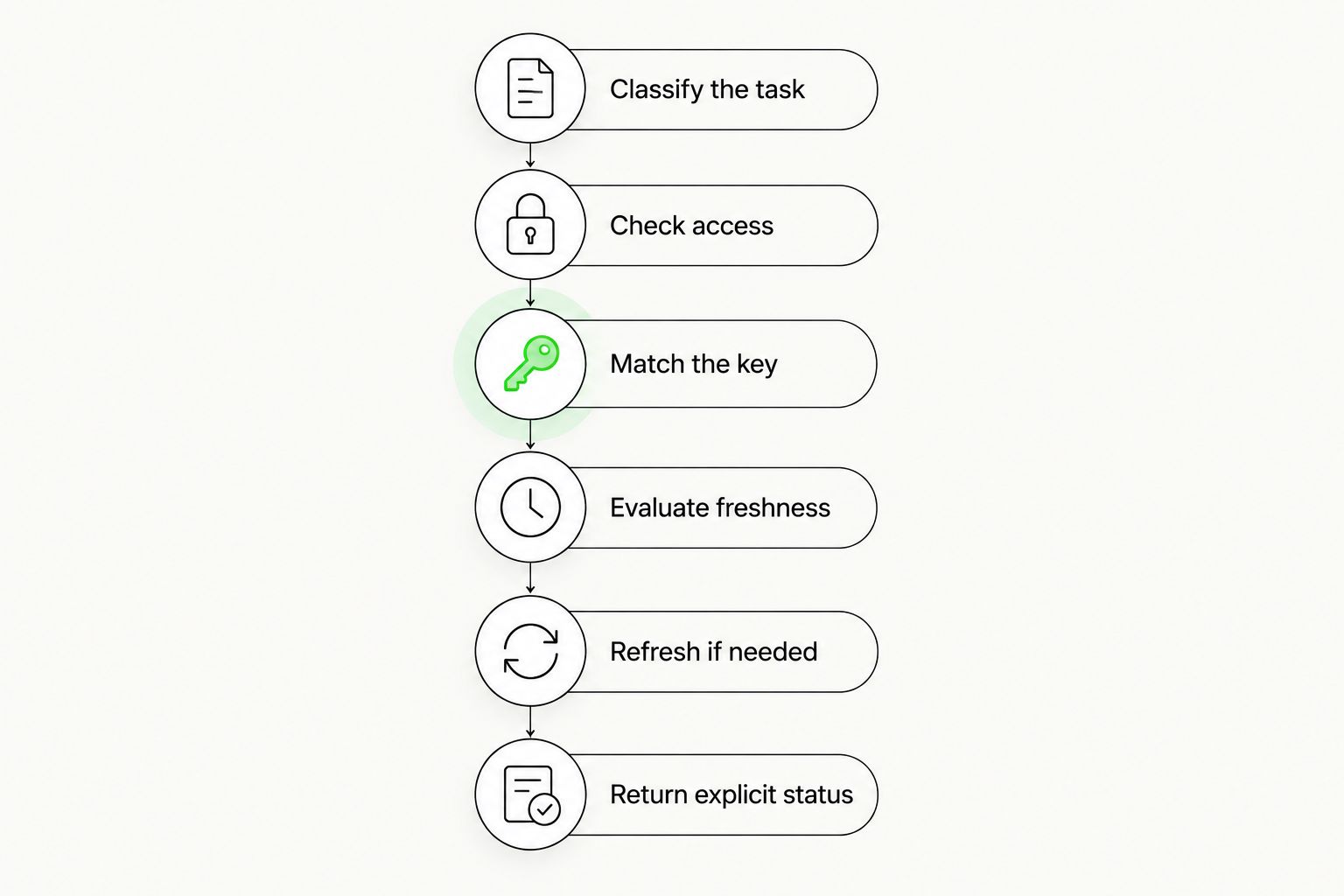
Treat cache behavior as a decision process with named outcomes. Your caller should know whether it received a fresh observation, an allowed stale observation or no usable result.
- Classify the task. Identify whether the caller needs an informational display, monitoring result or transaction-preparation input.
- Check access. Authorize the caller before returning cached data; possession of a cache key is not permission.
- Match the key. Confirm that network, account, asset and relevant read semantics match.
- Evaluate freshness. Compare the observation's age with the policy for this task.
- Refresh if needed. Coalesce equivalent in-flight requests and validate the upstream response before storing it.
- Return explicit status. Return freshness metadata or a clear failure alongside the application result.
This sequence belongs in application logic, outside the model's prompt. An agent instruction to use fresh data is not an enforced freshness check.
A useful application response distinguishes the balance value from its status. Suggested application-owned fields include observed_at, expires_at, cache_status and source_context; these are design examples, not claims about any provider's response schema.
Keep raw asset quantities separate from formatted display strings. Preserve the upstream numeric representation without an unnecessary conversion through floating-point arithmetic, which can introduce rounding errors.
Why balance-cache policies vary
The correct policy depends on what stale data would change. Use these factors to decide whether reuse is acceptable and what must trigger a refresh:
- Decision consequence: a background display and a spending decision need different freshness gates.
- Observation context: preserve supported chain-state information so callers do not confuse observations with different assurances.
- Known account activity: a submitted transaction or another known change can make an earlier observation unsuitable.
- Failure tolerance: decide whether the task can show a labelled previous observation when refresh fails.
- Access and retention: wallet activity can be sensitive; retain only what the workflow needs and enforce access on every read.
- Response scope: a cached native balance does not answer a token-balance or aggregate-portfolio question.
Document these decisions beside the application code that enforces them. A cache configuration without a stated task boundary is difficult to review and easy to reuse incorrectly.
Handle invalidation without pretending to know chain state
Invalidation marks an entry as unsuitable for reuse. It does not prove that a replacement observation is already available or that a transaction has settled.
After your application submits a transaction, invalidate affected entries or mark them as requiring refresh. Track submission separately from confirmation, and use verified transaction-status behavior rather than assuming that a successful broadcast means the balance has reached its final state.
Your application will not necessarily observe every change affecting an account. Keep an age-based expiry even if you also invalidate on known activity. Use event-driven invalidation only when the relevant event source and delivery behavior have been verified.
Separate environments and upstream configurations as well. Switching a deployment's network or data source must not silently preserve entries whose meaning has changed.
Treat refresh failures as failures, not zero balances
A zero balance is valid data only when a successful, validated response reports it. A timeout, denied request, missing field or parsing error is not evidence of zero funds.
Preserve the failure category in your application. Authentication failures require different handling from temporary upstream failures; repeated retries cannot correct missing authorization.
If stale fallback is permitted, return the last observation with its age and stale status. If the task requires fresh data, stop that workflow rather than quietly relaxing its policy.
Do not overwrite a valid cached observation with a malformed response. Validate the response's structure, requested scope and quantity representation before accepting it as the next observation.
Keep private keys and recovery secrets out of prompts, logs and cache records. Minimize account-identifying logs too, and apply retention and access controls to any wallet-data records your application stores.
Does caching a wallet balance give an agent spending authority?
Caching a wallet balance gives an agent data, not spending authority. A balance read cannot sign a transaction, and locally signed transaction preparation or broadcast is not autonomous provider-held signing.
For BuildAWallet, verify operation-specific availability through the BuildAWallet site and its current documentation before implementation. Discovery documents can point to operations; they do not prove a successful paid read, a working deployment or an enforced signing policy.
Should a wallet dashboard and transaction worker share a cache?
A wallet dashboard and transaction worker can share stored observations only if each enforces its own reuse policy. Sharing storage does not justify sharing a freshness threshold.
Keep the freshness decision at the consumer boundary. A transaction worker must reject an observation that fails its requirements even when the dashboard considers that same observation acceptable.
How do you validate a crypto wallet API cache?
Validate a crypto wallet API cache by testing both eligible reuse and mandatory rejection. A cache hit is correct only when authorization, request identity, freshness and response semantics all match.
Exercise expired entries, concurrent misses, network mismatches, malformed responses and refresh failures. Also test that a previously authorized caller loses access when permissions change, and that a transaction workflow cannot silently accept the display workflow's stale fallback.
FAQ
What's the best cache lifetime for crypto wallet balance reads?
The best cache lifetime follows the task's maximum acceptable observation age. Define separate policies for informational displays, monitoring and transaction preparation rather than applying one duration everywhere.
Can an AI agent use a cached balance before sending a transaction?
An AI agent must satisfy a separate freshness check before using balance data for transaction preparation. A cached or freshly fetched balance still does not grant signing authority or guarantee execution.
Should I cache a zero crypto wallet balance?
Cache a zero balance only when a successful, validated response reports zero for the requested account, network and asset scope. Never turn a failed request or missing field into zero.
Can I serve an old balance when the API fails?
Serve an old balance only when the task explicitly permits stale fallback. Return its age and stale status, and stop workflows that require a fresh observation.
Does BuildAWallet provide autonomous agent signing?
The supplied BuildAWallet guidance identifies policy-controlled agent signing as unavailable or in development. Balance access and locally signed transaction workflows are separate from autonomous provider-held signing; verify current operation-specific availability.
Do I need separate cache keys for Base and Solana?
Base and Solana reads must not share a cache entry merely because they concern the same user. Include network identity, account, asset scope and relevant read semantics in the application cache key.
Related guides
Next step: define rejection before reuse
Start by writing the conditions under which your application must reject a cached balance. Specify the task, maximum observation age, required scope and permitted failure behavior, then validate a read-only operation in your deployment before connecting the cache to any signing workflow.