
Yes, DAO contributors can share one multi-sig wallet when each signer controls a separate key and the wallet enforces a defined approval threshold. A multi-sig, or multisignature wallet, requires approvals from multiple keys rather than relying on one shared secret. This reduces dependence on one signer, but it does not prevent collusion, careless approvals, compromised devices, or unsafe permissions.
- DAO contributors can share a multi-sig wallet, but must not share a seed phrase.
- Independent keys and enforced approval thresholds separate shared treasury access from shared credentials.
- BuildAWallet HUMAN supports wallet-blueprint design; it does not deploy a working DAO treasury.
- Check signer recovery, transaction details, and alternative authorization paths before transferring treasury control.
Why shared control needs more than multiple names
A decentralized autonomous organization, or DAO, needs a clear distinction between contributors who propose payments and signers who authorize them. Membership alone should not grant treasury access. Your governance process decides who should approve; the deployed wallet determines whose approvals actually count.
Share the wallet address, not the recovery secret. Giving several contributors copies of one seed phrase creates shared access to one signing identity, not independent approval control. A seed phrase is recovery material that can restore the associated signing keys.
If you are still choosing a custody model, compare non-custodial crypto wallets before deciding how your DAO will distribute authority. Non-custodial means the user controls the signing keys; it does not automatically mean several people must approve a transaction.
Can DAO contributors share one multi-sig wallet safely?
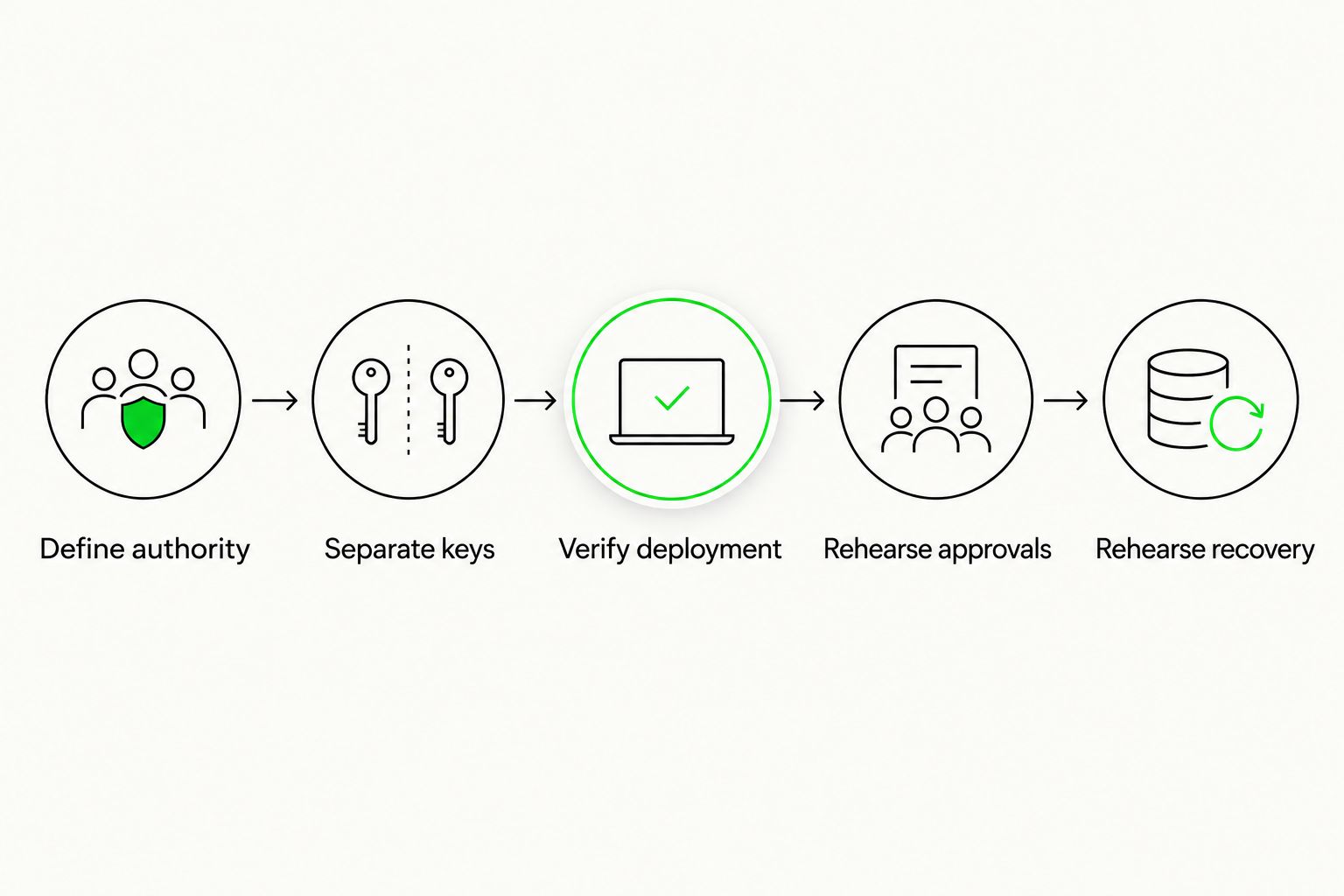
Yes, with independent signing keys, an appropriate threshold, verified transaction review, and a workable recovery process. Use the following sequence before treating the wallet as your shared treasury.
Define authority
Write down who can propose transactions, who can approve them, and who can change the signer list. These roles can differ. A contributor preparing a payment does not need permission to authorize it.
Also decide which decisions require governance approval outside the wallet. A passed proposal is not automatically an executable transaction, and a transaction meeting the wallet threshold is not automatically consistent with the DAO's rules.
Record how the DAO handles disputed proposals, emergency requests, and signer replacement. These are operating rules unless a deployed mechanism actually enforces them.
Separate keys
Each signer should generate and control a distinct signing identity. Keep private keys and recovery secrets out of shared documents, chat messages, prompts, and logs.
Separate addresses do not necessarily mean separate control. If one administrator holds every recovery backup, the treasury still depends on that administrator. Review who can restore each signer, not just who currently uses each device.
For each signer, document the recovery owner and process without collecting the secret itself. Recovery planning should not become a new repository of treasury credentials.
Verify deployment
Confirm the wallet's network, address, signer list, and approval threshold using a reliable view of the deployed configuration. Check the implementation's current documentation for how signature verification, signer replacement, and recovery work.
Do not assume every wallet described as multi-sig uses the same architecture. Some implementations enforce approvals through a smart contract, a program deployed on a blockchain; others use different signing arrangements. The relevant question is what the deployed system actually requires to authorize an action.
Rehearse approvals
Use a clearly labeled test transaction with limited exposure before relying on the wallet for routine treasury work. Have signers independently check the recipient, network, asset, amount, and action.
Where supported, inspect transaction simulation: a preview of expected execution effects. A preview helps review, but it is not a guarantee that execution will be safe or unchanged.
Include a rejected proposal in the rehearsal. Your process should demonstrate how contributors stop an incorrect payment, not only how they approve a correct one.
Rehearse recovery
Work through a signer becoming unavailable, losing access, or leaving the DAO. Determine whether the remaining authorized signers can still meet the threshold and replace the affected key.
Do not deliberately destroy a working key to test this. Rehearse with a separate test setup or a documented scenario, then verify the actual replacement mechanism in the chosen implementation.
Compare approval thresholds before choosing one
The following configurations are illustrative examples, not universal recommendations. The arithmetic assumes that the stated threshold governs the action and that no separate authorization route applies.
| Configuration | Best for | Benefit | Limitation |
|---|---|---|---|
| 2-of-3 approvals | A small signer group needing one unavailable signer | Any 2 authorized signers can approve | Any cooperating pair can meet the threshold |
| 3-of-5 approvals | A broader signer group needing two unavailable signers | Any 3 authorized signers can approve | Review and coordination involve more people |
| Unanimous approvals | Decisions where every signer must consent | No signer can be bypassed through the ordinary threshold | One unavailable or unwilling signer blocks approval |
A larger signer list is not automatically safer. Independence, review quality, recovery arrangements, and additional permissions matter alongside the threshold.
2-of-3 approvals: one unavailable signer
In this example, a 2-of-3 wallet needs 2 approvals from 3 authorized signing identities. One unavailable signer does not prevent approval if the other two retain access.
The trade-off is equally concrete: two cooperating or compromised signing identities can satisfy the threshold. This arrangement does not protect against a malicious pair, and it does not make a transaction safe merely because two people approved it.
3-of-5 approvals: two unavailable signers
In this example, a 3-of-5 wallet needs 3 approvals from 5 authorized signing identities. Two unavailable signers do not prevent approval if the remaining three can sign.
That additional availability margin comes with more coordination. If three signing identities become inaccessible, ordinary threshold approval is blocked unless a separately configured recovery mechanism applies. Confirm such a mechanism exists before relying on it.
Why multi-sig safety varies between DAOs
The threshold is only one part of shared treasury control. Review these factors together:
- Signer independence: Separate people and independently controlled recovery material reduce dependence on one operator. Different addresses under one person's control do not provide the same separation.
- Review quality: Approvals should follow inspection of the actual transaction. A familiar proposal title or message from a colleague is not a substitute.
- Availability: A threshold that your active signers cannot meet interrupts treasury operations. Plan for departures and lost access before they occur.
- Additional permissions: Modules, delegated permissions, or recovery mechanisms can create authorization paths beyond the ordinary signer threshold, where the implementation supports them.
- Ongoing asset permissions: Token allowances can authorize a spender to move tokens under the relevant token contract's rules. Review these separately from the wallet's signer list.
- Change management: Replacing signers or changing thresholds alters who controls the treasury. Apply the same review discipline to configuration changes as to payments.
What should every signer check before approving?
Approve the action encoded in the transaction, not just the explanation attached to it. A payment description can omit a permission change or misidentify the destination.
Check these fields independently wherever the wallet exposes them:
- Network and wallet: Confirm you are reviewing the intended treasury on the intended blockchain.
- Destination: Compare the complete destination address against an independently confirmed record.
- Asset and amount: Check the token contract as well as the displayed symbol. Symbols alone do not establish token identity.
- Operation: Distinguish a transfer from an approval, contract interaction, or wallet configuration change.
- Scope: Determine whether the action is one-time or creates continuing permission.
- Execution effects: Review readable transaction details and simulation results where available. Stop if the requested action cannot be explained.
For recurring contributor payments, maintain a reviewable payment record separate from the signing interface. Reconcile the approved proposal, transaction details, and execution result rather than treating a submitted transaction as completed work.
Can contributors share a seed phrase instead?
No. Sharing a seed phrase gives contributors access to the same signing identity rather than requiring independent approvals. Anyone who can restore that identity can act within its authority.
A shared phrase also complicates departure handling. Removing someone from a chat does not remove a recovery secret they already copied; replacing the affected signing identity requires an actual wallet-control change.
What happens when a contributor leaves the DAO?
Remove the departing contributor's signing authority through the wallet's supported configuration process, then verify the resulting signer list and threshold. Updating a governance document alone does not revoke a deployed key's authority.
Also review permissions outside the signer list, including any operational accounts or delegated access the contributor controlled. Keep an execution record so the DAO can distinguish a proposed replacement from a completed one.
Can a bot monitor the treasury without becoming a signer?
Yes. Reading public on-chain balances does not require the bot to hold a treasury signing key. Keep observation separate from transaction preparation, signing, and broadcasting a signed transaction to the network.
A balance alert is not an enforced spending limit. If a bot reports that funds are low, that report does not prevent an authorized signer or another permissioned route from executing a transaction.
For a monitoring workflow, define what happens when a read fails or returns stale information. Report the uncertainty explicitly; do not turn an unsuccessful balance check into a fabricated zero balance or an approval to proceed.
Where wallet-blueprint design fits
BuildAWallet HUMAN is for individuals designing a wallet blueprint, not DAOs seeking a deployed multi-sig treasury. You can use BuildAWallet to explore requirements around custody, networks, security, privacy, and features, but selecting those requirements does not deploy or secure a working wallet.
Treat any blueprint as input to implementation selection and verification. Your DAO still needs to confirm that its chosen deployed wallet supports the required network, approval rules, signer changes, and recovery process.
BuildAWallet NON-HUMAN is the machine-facing side for AI agents and the developers building them; HUMAN is a separate wallet-blueprint design experience. NON-HUMAN includes paid wallet-data access and Base and Solana balance reads, but deployment and RPC configuration requirements must be checked against current documentation. RPC is the interface used to communicate with a blockchain node.
Do not equate a documented endpoint with a working deployed service. Locally signed transaction workflows are also distinct from provider-held autonomous signing; policy-controlled agent signing must not be treated as available without current verification. None of these data-access capabilities establishes shared treasury authority.
FAQ
Can DAO contributors share one multi-sig wallet safely?
Yes, when contributors use independent signing keys, an enforced approval threshold, and a verified review and recovery process. Multi-sig reduces dependence on one signer but does not eliminate collusion, compromised keys, or unsafe permissions.
Does every DAO contributor need to be a signer?
No. Contributors can propose or review payments without receiving signing authority. Define membership, proposal rights, and treasury authorization as separate roles.
Is a 2-of-3 multi-sig enough for a DAO?
A 2-of-3 multi-sig requires 2 approvals from 3 signing identities under its ordinary threshold. Whether that suits your DAO depends on signer independence, availability, recovery arrangements, and additional authorization paths.
Can one multi-sig signer move funds alone?
One signer cannot satisfy an ordinary threshold that requires multiple independent approvals. Separately configured permissions or authorization paths need their own review, so inspect the deployed configuration rather than relying on the multi-sig label.
What happens if a multi-sig signer loses a key?
A lost key does not necessarily block the wallet if the remaining signers can meet the threshold. Verify the implementation's replacement or recovery process before assuming access can be restored.
Does a multi-sig stop a malicious contract interaction?
No. A multi-sig can authorize a harmful interaction when enough signers approve it. Review the destination, encoded action, permissions, and available simulation before signing.
Can a wallet blueprint serve as the DAO's live treasury?
No. A wallet blueprint records design requirements; it is not a deployed wallet. The DAO must separately select, configure, and verify an implementation before relying on it for shared control.
Before your next treasury transaction
A correctly approved transaction can still be the wrong transaction. Threshold approval proves that the required signing identities authorized an action under the applicable rules; it does not prove the recipient, permission, or governance decision was correct.
Your next step is to document the current signer list, threshold, additional authorization paths, and replacement process, then rehearse an approval and a rejection without exposing treasury secrets. Resolve any unexplained authority before using the wallet for further shared activity.
This is general security education, not a security guarantee or individualized legal advice. A DAO's legal responsibilities depend on its circumstances and jurisdiction; wallet configuration does not settle them.