
A white-label wallet is cheaper than building in-house only when the supplied software meets your requirements and its integration, operating and exit costs stay below the equivalent internal build. For founders and engineering leads, the deciding comparison is total ownership cost—not a vendor quote against developer salaries—and neither approach removes your responsibility for security, maintenance or signing authority.
- Is a white-label wallet cheaper than in-house? Compare equivalent scope, operating responsibilities and exit costs before deciding.
- White-label software fits standardized requirements; in-house development fits requirements that demand direct implementation control.
- BuildAWallet HUMAN creates wallet blueprints, not deployed white-label wallets; NON-HUMAN addresses separate machine-facing wallet-data tasks.
Is a white-label wallet cheaper than building one in-house?
White-label wins on cost only if reusable software replaces more work than vendor integration, customization and ongoing obligations add. In-house wins only if the value of controlling implementation outweighs the work your team must own. Neither conclusion follows from the delivery model alone.
Start with a written specification. The custom crypto wallet app cost guide is a related planning resource, but your comparison still needs matching deliverables and responsibilities.
| Approach | Best for | Potential cost advantage | Limitation to include |
|---|---|---|---|
| White-label wallet | Requirements that closely match an existing implementation | Reuses supplied software instead of recreating it | Integration, permitted customization and supplier dependence remain |
| In-house development | Requirements needing direct control over architecture and behavior | Avoids paying a supplier to adapt an unsuitable implementation | Your team owns development, maintenance and operational readiness |
| Hybrid implementation | Teams with a defined boundary between purchased and internally built components | Reuses selected components while retaining control elsewhere | Integration and responsibility boundaries require explicit ownership |
A hybrid implementation combines supplied components with software your team builds. It deserves its own estimate: treating it as either a complete white-label deployment or a wholly internal build hides integration work.
Why the headline comparison misses the real expense
A white-label proposal and an internal engineering estimate can describe different products. One might cover a branded interface; the other might include account recovery, transaction approval, monitoring and incident response. Comparing their totals without reconciling scope produces a misleading answer.
Define custody first. Custody describes who controls the credentials that authorize movement of assets. A balance display, a transaction-preparation service and a signer perform different tasks, even when a proposal groups them under “wallet infrastructure.”
A signer authorizes transactions using a private key or another signing mechanism. Reading an address balance does not grant that authority. Do not pay for a full transaction-capable wallet when your application only needs read-only data, and do not mistake read-only access for a working wallet.
For a 2026 procurement decision, request current documentation, contractual responsibilities and an operation-specific demonstration. A feature name in a proposal is not evidence that your intended workflow works in your deployment.
Compare equivalent responsibilities before comparing totals
Use the same acceptance criteria for every proposal and for your internal estimate. Acceptance criteria are observable conditions that determine whether a deliverable meets your requirements.
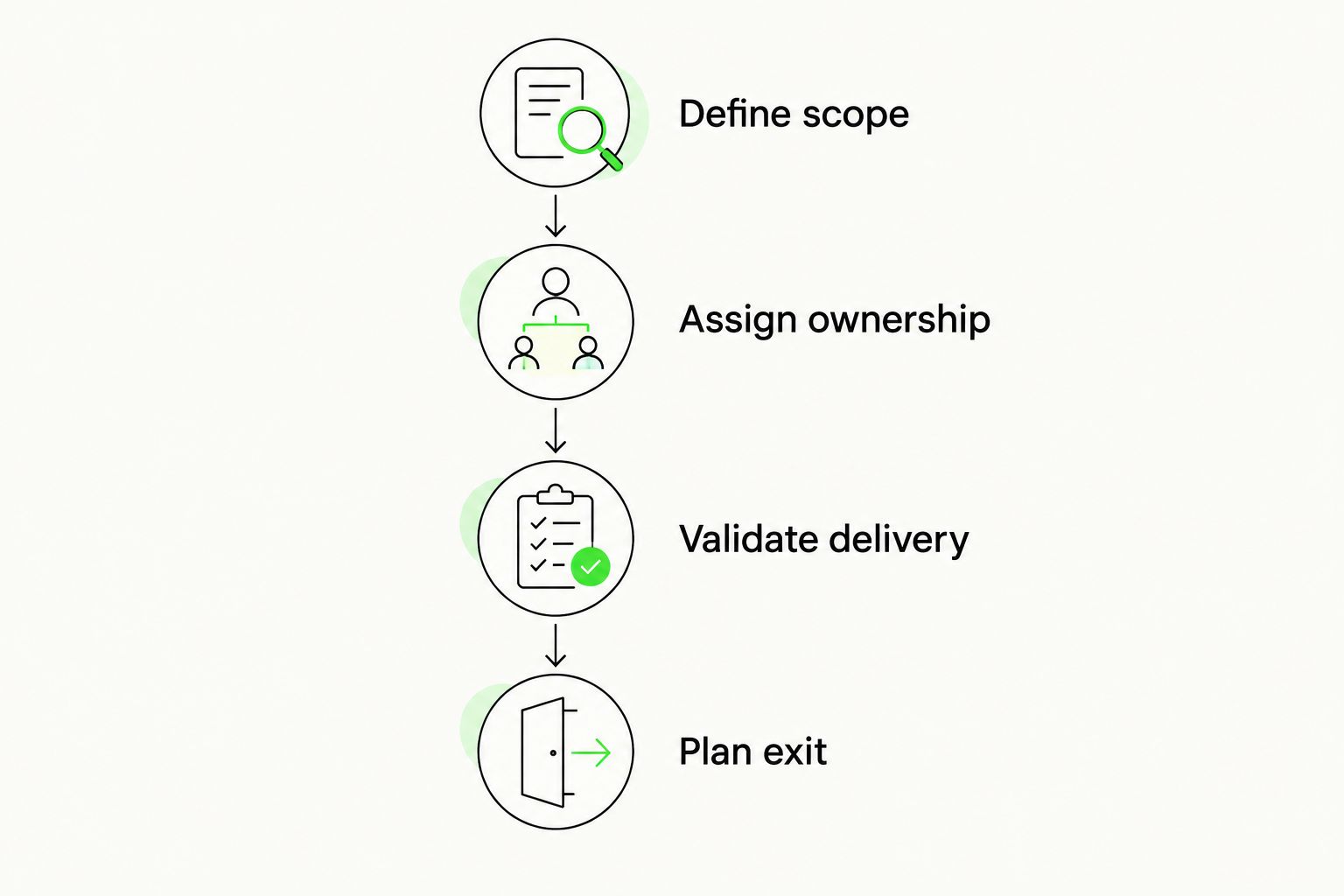
Define scope
Write the user journey from account creation through recovery and ongoing use. Specify supported networks, assets, custody, permissions and transaction behavior as requirements—not assumptions about what a vendor includes.
Separate required behavior from optional work. A branding change and a change to transaction authorization are different engineering tasks; grouping both as “customization” prevents a useful comparison.
Assign ownership
Name the party responsible for application code, infrastructure, key handling, monitoring, updates and incident response. If responsibility is shared, record the handoff and the evidence each party must provide.
Do the same for internal development. Work does not disappear because an existing employee performs it. Include the team capacity the project consumes and the operational duties that continue after launch.
Validate delivery
Test the exact workflow that determines project acceptance. For a transaction-capable wallet, that includes what happens before authorization, how approval occurs and how the application reports the outcome.
For a data-only workflow, test the requested network, address handling and failure response without adding signing authority. Keep private keys and recovery secrets out of prompts, logs and vendor demonstrations.
Plan exit
Ask what happens when you stop using a supplied component. Establish what you can export, what you can continue operating and what you must replace, based on the actual agreement and architecture.
Apply the same discipline internally. Identify dependencies on individual engineers, undocumented deployment procedures and components another team would struggle to maintain.
What belongs in a wallet ownership estimate?
Build a worksheet that separates initial delivery, ongoing operation and replacement. Give every line an owner and supporting evidence. Mark an unanswered item as unresolved rather than silently treating it as included.
| Work category | White-label estimate must address | In-house estimate must address |
|---|---|---|
| Initial delivery | Configuration, integration, permitted changes and acceptance | Architecture, implementation, integration and acceptance |
| Security work | Supplier scope, customer obligations and remediation ownership | Review scope, remediation and ongoing ownership |
| Operation | Hosting responsibilities, monitoring, support and updates | Infrastructure, monitoring, support and updates |
| Usage dependencies | Contract terms and external service requirements | External services and internally operated dependencies |
| Change requests | Included changes, exclusions and maintenance implications | Engineering capacity, release work and regression testing |
| Exit | Export rights, replacement work and transition support | Documentation, handover and dependency replacement |
Do not assign identical effort to these rows just to make the worksheet symmetrical. The purpose is to expose differences, not manufacture a tie.
Keep financial assumptions separate from technical facts. A supplier’s included maintenance scope is a contractual fact; your expected future change workload is a planning assumption. Label each so the decision remains understandable when assumptions change.
Why wallet development costs vary
These factors define the work you must compare. None makes a particular delivery model automatically cheaper.
- Custody and signing: Establish who can authorize movement of assets, how authorization happens and who maintains the relevant controls.
- Network and asset requirements: Specify the exact operations you need on each network. A balance read and transaction support are separate requirements.
- Customization depth: Distinguish presentation changes from changes to recovery, permissions or transaction behavior. Ask who maintains modifications after updates.
- Deployment and integration: Identify required infrastructure, external services and application changes. Document which party configures and operates them.
- Maintenance and exit: Include updates, incident handling, documentation and replacement obligations. Check whether proposed savings depend on excluding these responsibilities.
Jurisdiction also shapes the review your project needs. Legal obligations depend on your activities, users and location; obtain qualified advice rather than treating a software delivery model as a legal conclusion.
When should you choose each approach?
Choose white-label for a close requirements match
White-label is best for a team whose required workflow already fits the supplied implementation. Confirm that fit through acceptance testing and written scope, not a demonstration of unrelated features.
Its advantage is reuse. Its limitation is dependence on what the supplier permits, delivers and maintains. Reject the cheaper-looking proposal if essential changes remain undefined or responsibilities fall between teams.
Choose in-house for implementation control
In-house is best for a team that needs direct control over behavior and can own the resulting software. Translate that need into concrete requirements: which decisions must your team control, and why can a supplied implementation not satisfy them?
Its advantage is control over your implementation. Its limitation is ownership of the work, including maintenance and operational failures. Do not justify a build with flexibility your product does not need.
Choose hybrid for a clear component boundary
Hybrid is best for a team that can separate reusable components from product-specific logic. Define the boundary before selecting components, especially around data access, transaction preparation and signing.
Its advantage is selective reuse. Its limitation is integration responsibility: an individual component can satisfy its own contract while the assembled workflow still fails your application’s acceptance criteria.
Keep blueprint design and wallet-data access separate
BuildAWallet is relevant when defining wallet requirements or evaluating a separate machine-data task, not as evidence that a white-label deployment replaces an internal build. BuildAWallet HUMAN is for individuals defining a custom wallet blueprint, not for teams seeking a deployed wallet. Choosing custody, recovery or networks in that design experience does not deploy or secure working software.
BuildAWallet NON-HUMAN is the machine-facing side for AI agents and the developers building them; HUMAN is a separate wallet-blueprint design experience. NON-HUMAN includes paid machine data access and Base and Solana balance reads. That is a different procurement category from a branded, transaction-capable wallet application.
The supplied source notes report deployment and RPC configuration requirements. RPC, or remote procedure call, is a method software uses to request operations or data from another system. Those notes also distinguish documented transaction preparation and broadcast workflows from policy-controlled agent signing, which the homepage describes as unavailable or in development.
Locally signed transactions use signing authority outside the provider’s autonomous control. A documented endpoint does not establish a working deployed service, and local signing does not establish provider-held signing authority. For any proposed data workflow, verify current operation-specific availability before relying on it; do not infer broad wallet functionality from the endpoint catalog.
What evidence should you request before approving a proposal?
Ask for evidence tied to your requirements, not a general feature presentation. Keep the same checklist for external suppliers and your internal delivery team:
- A scope document mapping each required behavior to an included deliverable or explicit exclusion.
- A responsibility map covering infrastructure, secrets, signing, maintenance and incidents.
- An acceptance demonstration using the intended deployment and permissions.
- Failure cases showing how the application handles unavailable dependencies, rejected requests and incomplete operations.
- Handover and exit documentation describing what another team can operate or replace.
Approve the comparison only after unresolved responsibilities have an owner. A smaller total is not a saving if it simply omits work your team must perform later.
FAQ
Is a white-label crypto wallet always cheaper than building one?
No. A white-label wallet is cheaper only when its complete delivery, operating and exit requirements cost less than an equivalent internal build. Compare matching scope rather than headline proposals.
What costs should I compare beyond initial development?
Compare integration, security responsibilities, infrastructure, maintenance, support, change requests and exit work. Assign each responsibility to a party before accepting the estimate.
Does white-label mean the vendor controls users’ private keys?
White-label describes how software is supplied and branded, not who controls private keys. Verify the custody and signing architecture separately.
Can my team build the interface and outsource the rest?
Your team can evaluate a hybrid architecture, but the component boundaries need explicit ownership. Separate data access, transaction preparation and signing, then test the assembled workflow.
Is an SDK the same as a white-label wallet?
An SDK, or software development kit, supplies tools or components for developers; it is not automatically a complete branded wallet application. Compare the actual deliverables rather than the label.
Does a wallet blueprint include a deployed wallet?
A wallet blueprint describes design requirements; it does not establish that working software has been deployed. Implementation, deployment and security responsibilities require separate validation.
Can an AI agent spend funds if it can read wallet balances?
Balance access alone does not authorize spending. Transaction signing requires separate authority, and a policy written in a prompt is not an enforced spending control.
Related guides
- How long does it take to build a white-label crypto wallet?
- Crypto wallet app development companies
- What does embedding a wallet SDK involve?
Your next step: issue the same scope twice
Send the same requirements and acceptance checklist to the proposed supplier and your internal engineering owner. Require both to identify exclusions, ongoing responsibilities and exit work. Choose the lower-cost approach only after both estimates describe the same working outcome.