
Wallet API integration time for a fintech app depends on the job: reading balances, preparing locally signed transactions, and controlling spending require different implementation and validation work. Estimate the schedule from a verified operation and its release requirements—not from the time needed to make the first successful request. Paid-request handling, deployment configuration, failure recovery and signing boundaries belong in that estimate.
- Estimate wallet API integration time for a fintech app from verified scope, not a successful demo request.
- BuildAWallet NON-HUMAN covers machine-facing wallet data; HUMAN is a separate wallet-blueprint design experience.
- Separate balance reads, local transaction signing and agent spending authority before estimating work.
- Validate deployment, response meaning and paid-request failures before setting a release date.
BuildAWallet NON-HUMAN is the machine-facing side for AI agents and the developers building them; HUMAN is a separate wallet-blueprint design experience. For a fintech developer, the relevant task here is integrating wallet data without silently adding transaction authority.
How long does wallet API integration take for a fintech app?
There is no defensible universal duration for wallet API integration. A read-only balance display and a transaction-capable wallet are different projects, even when both start with an API request.
An API, or application programming interface, lets your application request a defined operation from another system. Your integration is complete only when that operation works within your application's security, accounting and failure-handling requirements.
Use the following boundaries to decide what you are estimating:
| Integration scope | Best for | Useful outcome | Limitation to include in the estimate |
|---|---|---|---|
| Balance reads | Balance displays and agent data checks | Retrieves wallet data without requiring transaction authority | Must validate network, asset units, freshness and failure states |
| Local signing workflow | Applications with a separately controlled signer | Separates transaction preparation from authorization | Requires signer security, transaction review and submission handling |
| Policy-controlled agent signing | Applications requiring delegated spending | Makes spending rules part of the authorization design | Requires verified signing availability and enforceable controls |
| Wallet blueprint design | Individuals defining wallet requirements | Documents custody, recovery and feature preferences | Does not deploy a wallet or implement an API integration |
Do not put these scopes into the same delivery estimate. If the initial task is displaying a balance, exclude signing from the implementation and document that exclusion.
Why the first successful request is not the finish line
A successful request proves that a particular path worked under particular conditions. It does not establish what happens when payment fails, the network is unavailable, a response is incomplete or an address belongs to the wrong network.
For a fintech app, those cases affect what users see and what downstream software decides. A missing balance must not become a displayed zero, and a stale balance must not silently authorize an action that requires current information.
Define completion before implementation starts. Your acceptance criteria should cover the response contract, safe failure behavior, operational visibility and any separately required authorization.
Balance reads: estimate the read-only path first
A balance-read integration requests wallet information without granting permission to move assets. Keep that boundary explicit in application code, credentials and the agent's available tools.
BuildAWallet NON-HUMAN fits developers evaluating paid Base and Solana balance reads, not teams assuming autonomous signing is available. Its stated deployment and RPC configuration requirements must be checked before you treat an operation as ready to use. RPC means remote procedure call: the interface used to communicate with a blockchain node.
Start with a narrowly defined question, such as displaying a specified asset balance for an address on a specified network. Confirm whether the chosen operation returns a native asset balance, token balances or another documented result; do not infer coverage from a general endpoint name.
The useful outcome is a verified read with a known meaning. The limitation is equally important: balance access is not signing authority, and a balance result alone is not a complete spending decision.
Local signing: estimate authorization separately
Local signing means a separately controlled signer authorizes a transaction using a private key. Preparing transaction data, signing that data and broadcasting the signed transaction are distinct stages.
If your application needs this workflow, estimate each stage separately. Identify where the key lives, who approves the transaction, how the application verifies the intended network and recipient, and how it tracks the submitted result.
Do not infer signing support from balance-read support. Likewise, documentation describing transaction preparation or broadcast does not establish that a hosted service holds keys or signs autonomously.
The wallet access guide for AI agents provides related context for separating data access from spending authority. Keep that separation in your implementation plan as well as your architecture diagram.
Agent signing: verify availability before scheduling it
An instruction telling an agent not to overspend is not an enforced spending policy. Enforcement must exist in the component that controls authorization or execution, outside the agent's discretion.
BuildAWallet's supplied product context distinguishes documented locally signed transaction workflows from policy-controlled agent signing, which the homepage describes as unavailable or in development. The supplied documentation review dated October 8, 2026 also identifies differences between the homepage and broader machine documentation.
Treat operation-specific availability as a release dependency. Do not schedule an autonomous signing feature on the assumption that a documented endpoint is a working deployed service.
If your app requires signing and availability remains unresolved, keep the read-only integration independently releasable. That preserves a clear boundary rather than turning a data task into an unverified custody project.
Why wallet API integration time varies
These factors determine the work your estimate must include:
- Operation scope: Reading data, preparing transactions and authorizing spending require different acceptance criteria.
- Deployment requirements: Required service deployment and RPC configuration introduce work before application integration can be validated.
- Network and asset handling: Address validation, network selection and asset-unit conversion need explicit treatment.
- Paid-request behavior: Payment failures, uncertain outcomes and retries need separate handling from successful data responses.
- Application decisions: Displaying a balance and using a balance in an execution decision require different freshness and failure rules.
- Operational ownership: Someone must own credentials, monitoring, incident response and changes to the response contract.
Estimate the dependencies as well as the coding. An unresolved deployment requirement blocks a verified result even when the application-side adapter is finished.
Build an estimate from validation gates
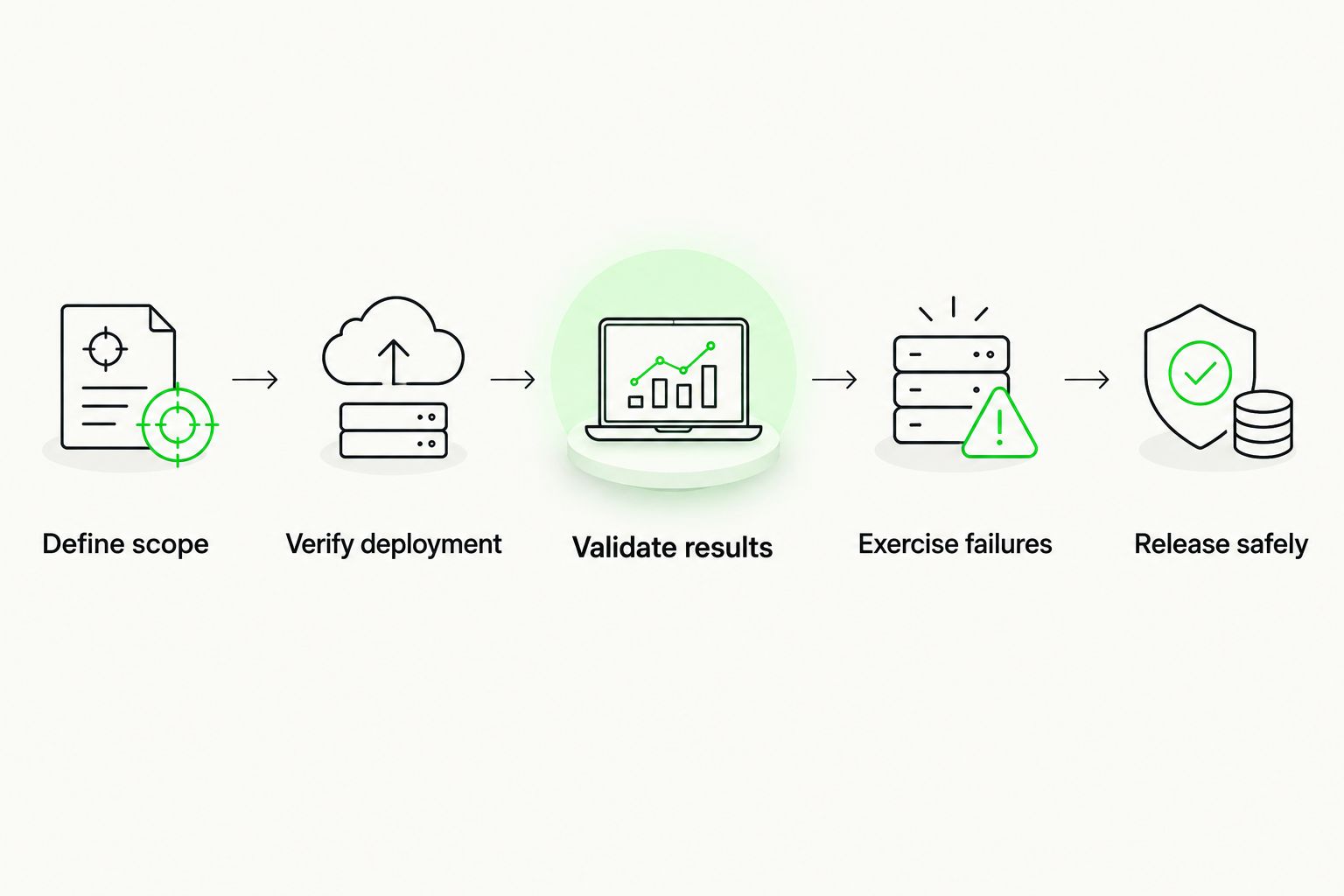
Use these gates as a planning sequence. They are completion criteria, not promised durations, and they do not assume a particular endpoint, authentication scheme or deployment model.
Define scope
Write the intended operation in a sentence: the application reads a specified balance for a specified address and network, then displays or evaluates the result. State whether signing and transaction submission are excluded.
Record the input and output your application actually needs. This prevents a simple balance display from expanding into token discovery, transaction history or portfolio valuation without a deliberate scope change.
Verify deployment
Check current official documentation for the exact operation, required deployment, RPC configuration and access mechanism. Confirm that you can reach the intended service in the intended environment.
Discovery documents, manifests and an OpenAPI specification can describe how to find an operation. They do not prove that a paid request succeeds, that a framework integration works or that the service is ready for your release.
Validate results
Compare a read against an independently checked reference for the same address, network and asset. Account for observation timing rather than treating every difference as a parsing bug.
Inspect units and precision before formatting values. Preserve the raw response separately from the display representation, and avoid arithmetic that silently loses precision.
Exercise failures
Test invalid inputs, unavailable service responses, payment failures and incomplete results. Verify that your application distinguishes an unsuccessful read from a successful zero balance.
For ambiguous paid-request outcomes, establish the documented reconciliation and retry behavior before automating retries. A network timeout does not tell your application whether the upstream operation completed.
Release safely
Assign ownership for configuration, monitoring and incident response. Define what disables the integration and how the app behaves while wallet data is unavailable.
Only then turn the work into a delivery commitment. Record assumptions beside the estimate so a change in signing scope or deployment requirements triggers a visible revision.
Turn the gates into an engineering estimate
Create a work item for each gate and assign an owner. For every item, record the implementation task, the evidence needed for completion and any external dependency.
Keep active engineering effort separate from elapsed delivery time. Waiting for deployment access is not coding effort, but it still affects the date you can release.
Use this worksheet without inserting unsupported benchmark durations:
| Work item | Completion evidence | Dependency to resolve |
|---|---|---|
| Service access | Intended read succeeds in the intended environment | Deployment, RPC and access configuration |
| Data adapter | Validated response becomes a typed application result | Actual response contract |
| Balance formatting | Raw units produce the intended display value | Asset precision and representation |
| Failure handling | Unavailable, invalid and zero states remain distinct | Documented error and payment behavior |
| Operational release | Monitoring, ownership and disable behavior are checked | Application release process |
For parallel tasks, identify which dependency actually blocks release. Do not simply add every task's effort and call the total elapsed time.
Keep the read-only adapter small
Place the wallet-data integration behind an application-side adapter: a component that translates a verified provider response into your application's own result type. This is an architecture recommendation, not a claim about a supported SDK or framework integration.
A balance result should carry enough context for the application to interpret it correctly. Preserve the requested network, address, asset identity, raw amount and the provenance of any timing information.
If your app records when it received a response, label that as receipt time. Do not present it as the blockchain observation time unless the response contract supports that interpretation.
Keep signing functions out of the read-only adapter. Credentials that authorize paid data access also belong outside prompts, client-visible code and logs; private keys and recovery secrets must never enter agent prompts or request logs.
What usually gets left out of the release definition?
A balance display needs an unavailable state as deliberately designed as its successful state. Decide whether the app hides an outdated result, labels it or disables the dependent action.
A transaction decision needs a separate authorization check. A previously observed balance is information, not a reservation of funds or permission to spend them.
Your support process also needs useful diagnostics. Record operation context and sanitized failure information without collecting secrets or unnecessary wallet-associated data.
These requirements belong in the estimate before the team commits to a date. They are not evidence of any provider's specific behavior; they are checks your application must pass.
FAQ
Can I estimate wallet API integration time from a sample request?
A sample request establishes a starting point, not a production integration estimate. Include deployment, response validation, paid-request failures, application behavior and operational ownership before committing to a date.
Is a balance API integration the same as embedding a wallet?
A balance API integration reads data; embedding a wallet can introduce account, key and transaction responsibilities. Define those responsibilities separately rather than assigning both tasks the same schedule.
Does BuildAWallet balance access let an agent sign transactions?
BuildAWallet balance access is not signing authority. Its product context distinguishes Base and Solana data reads, documented locally signed transaction workflows and policy-controlled agent signing described as unavailable or in development.
Should I integrate Base and Solana together?
Integrate Base and Solana together only when both are part of your defined application requirement. Validate each intended operation and its network-specific response meaning rather than assuming identical behavior or a combined request.
How should my app handle a failed paid balance request?
A failed paid balance request must remain distinct from a successful zero balance. Check the documented payment and retry behavior, and reconcile uncertain outcomes before automatically repeating requests.
What proves a wallet API integration is ready for production?
Production readiness requires verified operation behavior, correct data interpretation, tested failures and assigned operational ownership. A live page, discovery document or successful demonstration request does not establish all of those conditions.
Can I keep the first release read-only?
A read-only first release is appropriate when the application needs wallet information rather than transaction authority. Exclude signing tools and credentials, and make unavailable or stale data visible to the application.
Your next step
Write the acceptance test before estimating the integration. Specify the network, asset, intended read, expected interpretation and failure behavior; then verify that exact operation in your intended environment.
Keep signing out of scope unless your app needs it and you can verify the authorization path. The useful planning milestone is a validated operation with known limits—not an endpoint name in a document.