
Yes—NFT marketplaces can offer wallets without browser extensions by embedding wallet creation in the application or using a custodial account; connecting an existing mobile wallet also avoids an extension but does not issue a new wallet. For marketplace developers, the deciding question is who can authorize transactions, not whether an extension appears. Removing the extension does not remove signing, recovery, transaction fees or custody responsibilities.
- NFT marketplace wallets without browser extensions are possible; distinguish wallet creation from connecting an existing mobile wallet.
- Embedded wallets need explicit custody, recovery and signing decisions; an account login does not answer those questions.
- Custodial accounts remove user-side signing but place transaction authority with the operator or its custody provider.
- BuildAWallet HUMAN fits wallet-blueprint planning, not deployed marketplace wallet issuance.
Can NFT marketplaces issue wallets without browser extensions?
Yes. A browser extension is one interface for accessing a wallet, not a requirement for creating a blockchain account or authorizing transactions. Marketplace software can present those functions through an embedded interface, a mobile connection or an operator-controlled account.
Start by separating the approaches below. The Web3 wallet comparison provides additional context for distinguishing wallet interfaces and use cases.
| Approach | Does it issue a wallet? | Best for | Practical advantage | Main limitation |
|---|---|---|---|---|
| Embedded wallet | Can create or provision an account within the application | Marketplaces that need in-app wallet onboarding | Keeps account setup inside the marketplace experience | Custody, recovery and portability depend on the implementation |
| Connected mobile wallet | Usually connects an existing wallet rather than issuing one | Users who already manage assets on mobile | Preserves an existing wallet relationship | Requires a connection and transaction-approval handoff |
| Custodial account | Can assign an address or account under operator-controlled custody | Services intentionally taking responsibility for custody | Users do not manage transaction-signing keys themselves | Users depend on the operator for access and withdrawals |
Choose the custody and authorization model before choosing the onboarding interface. An embedded login and a custodial login can look similar while giving different parties control over assets.
Why the distinction matters for an NFT marketplace
An NFT, or non-fungible token, represents a distinguishable token on a blockchain. A marketplace interface displays and organizes activity, but the blockchain and the transaction-signing system determine what an account can actually do.
Creating a marketplace profile is not necessarily creating a wallet. Likewise, displaying a deposit address does not prove that the user controls its signing key. Explain that boundary before asking users to receive or transfer assets.
For developers, this changes the integration brief. “No extension required” is an interface requirement; custody, account creation, signing, recovery and withdrawal are separate requirements that need separate acceptance tests.
Embedded wallets: best for in-app onboarding
An embedded wallet places wallet-related controls inside the marketplace application. The underlying implementation determines how keys are created or managed, how users authenticate and what must happen before a transaction is signed.
Do not treat “embedded” as a synonym for “self-custodial.” Self-custody means the user controls the authority needed to authorize transactions, rather than depending on a custodian to authorize them. Check the actual control and recovery arrangements instead of relying on the interface label.
An embedded approach is useful when your task is to create a wallet during account onboarding. Its limitation is that a familiar login screen can conceal unfamiliar dependencies: recovery providers, signing services or account-management rules.
Before selecting an implementation, establish:
- Whether the user receives a new account or connects an existing one.
- Which parties can authorize transactions, including through recovery.
- Whether the user can access assets without the marketplace interface.
- What changes when the user loses access to the original login method.
Recommendation: use embedded onboarding only after documenting the complete signing and recovery path. A successful login is not evidence that these paths work.
Mobile wallet connections: best for existing wallet users
A marketplace can connect to a wallet application on a phone without requiring a desktop browser extension. The connection establishes communication with a wallet; it does not, by itself, create a new wallet for the user.
This distinction matters in product requirements. If your promise is “bring your existing wallet,” a mobile connection can fit. If your promise is “receive a wallet when you register,” connection alone does not satisfy it.
The advantage is continuity: users retain their existing wallet and its recovery arrangements. The limitation is the handoff between the marketplace and the wallet, particularly when approval happens in another application or on another device.
Test connection rejection, session expiry and the return to the marketplace after approval. Recommend a mobile connection for existing-wallet access, not as proof of wallet issuance.
Custodial accounts: best for intentionally managed custody
A custodial arrangement places transaction-signing authority with the operator or its custody provider. Users interact with an account interface rather than independently authorizing every blockchain transaction with a key they control.
The interface advantage is clear: users do not need to install an extension or manage a signing key directly. The trade-off is dependence on the custodian for account access, asset movement and recovery procedures.
Document the distinction between internal account records and on-chain ownership. A balance shown inside a marketplace account does not, by itself, establish that the user controls a corresponding blockchain address.
Custody also raises legal and operational questions that vary by jurisdiction and business model. Obtain qualified advice for the intended service rather than treating a technical architecture as a legal conclusion. Choose custody deliberately, not as an accidental consequence of simplifying onboarding.
How do you validate an extension-free wallet flow?
Validate the whole user task, not just account creation. A wallet flow is incomplete if users can sign in and see an address but cannot understand authorization, recover access or leave the marketplace.
Use this sequence as an application-side acceptance plan, not as a claim about any particular provider's supported features.
- Account creation. Record whether onboarding creates a blockchain account, assigns a custodial account or connects an existing wallet. Make the interface describe the actual result.
- Signing authority. Identify every party capable of authorizing a transaction, including administrators and recovery participants. Confirm where approval is enforced.
- Transaction approval. Show the intended network, action, recipient and permissions before authorization. Test rejection as carefully as approval.
- Recovery. Test loss of the normal login method in a controlled environment. Confirm that recovery restores the intended access without silently changing the custody model.
- Exit access. Establish how users transfer assets or continue accessing their account if they stop using the marketplace. State any provider dependencies plainly.
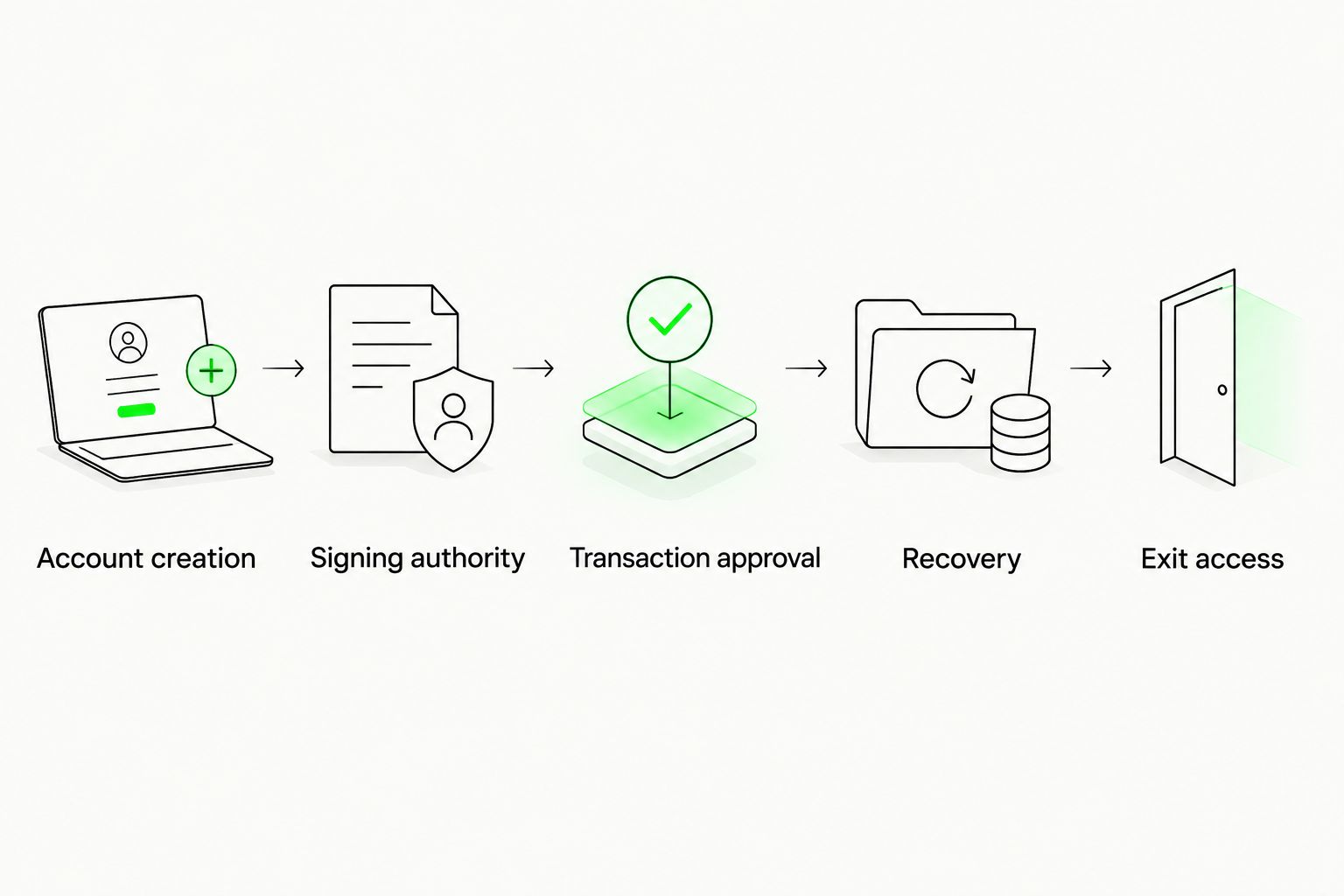
Keep the test evidence tied to the exact environment and account configuration. Documentation that describes an endpoint or signing method is not evidence that your deployment has configured it correctly.
For development, use test environments and non-sensitive fixtures where the implementation supports them. Never place private keys, recovery phrases or recovery secrets in prompts, analytics events or application logs.
Why extension-free wallet implementations vary
The visible onboarding flow reflects several independent technical decisions. Compare these factors directly rather than treating every extension-free wallet as the same product category.
- Custody: User-controlled signing and provider-controlled signing create different dependencies and responsibilities.
- Account model: The selected blockchain and account architecture determine which signing and recovery mechanisms are possible.
- Authentication: A login verifies access to an application account; the implementation must separately establish transaction authority.
- Recovery: Recovery arrangements determine who can restore access and what happens when credentials or devices are lost.
- Transaction permissions: A single transfer, an asset approval and a delegated action require different user explanations and checks.
- Portability: Continued access depends on whether users can operate their account outside the marketplace and its providers.
Ask implementation vendors to explain each factor with current documentation and a reproducible test. Do not accept “extension-free” as an answer to a custody or recovery question.
What should happen when approval fails?
An extension-free marketplace still needs explicit failure states. Closing a signing window, rejecting approval and losing connectivity are not successful transactions, and the interface should not imply otherwise.
Separate authentication, submission and confirmation in your application state. A user can be logged in without authorizing a transaction; a transaction can be submitted without reaching the confirmation state your application requires.
Before retrying a transaction, check whether the earlier attempt was submitted. Blindly asking for another signature can create duplicate intent or confuse the user about which action remains pending.
For asset listings and transfers, distinguish a permission grant from the later action that uses it. Explain each requested authorization in context rather than presenting every signature as a generic confirmation.
Can users keep self-custody without an extension?
Yes—self-custody does not require a browser extension. It requires a control arrangement in which the user holds the necessary transaction authority; the interface alone cannot establish that arrangement.
Check how keys or signing authority are controlled during normal use and recovery. If a provider can independently authorize transactions, describe that dependency rather than calling the experience self-custodial because it uses an embedded interface.
Does a passwordless login replace transaction signing?
No—passwordless login does not, by itself, replace transaction signing. Authentication establishes access to an application; a blockchain transaction still needs authorization under the account's signing rules.
An implementation can connect those steps, but developers must document the connection. Users should understand which actions follow from logging in and which require separate approval.
Where does BuildAWallet fit?
BuildAWallet HUMAN is best for individuals planning a custom wallet blueprint, not marketplace teams seeking a deployed wallet issuer. It guides design choices around assets, networks, custody, security, privacy, features and style; those choices do not deploy or secure a working wallet.
Use BuildAWallet to distinguish the design experience from the machine-facing offering. BuildAWallet NON-HUMAN is the machine-facing side for AI agents and the developers building them; HUMAN is a separate wallet-blueprint design experience.
NON-HUMAN includes paid machine data access and Base and Solana balance reads. That is not evidence of NFT ownership-query support, embedded wallet issuance or transaction-signing authority. Current documentation and deployment requirements must be checked before recommending a particular operation.
The homepage and documentation describe different scopes: deployment and RPC configuration are required, while broader documentation also describes locally signed transaction preparation and broadcast. Policy-controlled agent signing is described as unavailable or in development. Do not turn a documented workflow into a claim that provider-held autonomous signing is operational.
FAQ
Can an NFT marketplace create a wallet when I sign up?
Yes, an NFT marketplace can integrate wallet creation into signup. Confirm whether it creates a user-controlled wallet, assigns a custodial account or merely creates a marketplace profile.
Do I need a browser extension to hold an NFT?
No, holding an NFT does not require a browser extension. Your access depends on the blockchain account and its custody and signing arrangements, not on that particular interface.
Is an embedded wallet always non-custodial?
No, an embedded wallet is not automatically non-custodial. Check who can authorize transactions and who can restore or change access through recovery.
Does connecting a mobile wallet create another wallet?
Connecting a mobile wallet generally connects an existing account rather than creating another wallet. Treat connection and wallet issuance as separate product functions.
Can an extension-free wallet transfer NFTs?
An extension-free wallet can transfer NFTs when its implementation supports the relevant network, token and authorization workflow. Verify the exact transfer operation rather than inferring support from login or balance display.
Does a wallet balance API let a marketplace move assets?
No, read-only balance access does not grant authority to move assets. Transfers require a separate signing and transaction-submission workflow.
What should a marketplace test before launching embedded wallets?
Test account creation, signing authority, transaction approval, recovery and exit access. Include rejected approvals, interrupted sessions and uncertain transaction status, not just the successful onboarding path.
Related guides
- Non-custodial crypto wallets
- Wallets for NFT marketplace operators
- Recovering a non-custodial wallet without a seed phrase
Your next step: write the authority map
Before selecting an extension-free implementation, write down who creates the account, who authorizes transfers, who restores access and how the user exits. Then validate each answer in a controlled deployment. If your team cannot explain those boundaries, the wallet integration is not ready for users.