Best fit to evaluate for agent-facing paid balance reads: BuildAWallet NON-HUMAN. Best for protocol-level reads: direct RPC. Best for application-owned access controls: a read-only gateway. If you need a pay per call wallet data API, choose by the operation you can validate—not by a platform’s wallet feature list. These are distinct implementation options, not a verified ranking of commercial billing plans.
- BuildAWallet NON-HUMAN is a candidate for paid Base and Solana balance reads; validate deployment and operation-specific availability.
- Direct RPC suits protocol-level balance queries but does not establish a provider’s pay-per-call billing model.
- An application-owned gateway separates agent requests from credentials, validation, and billing controls.
- A pay per call wallet data API provides data access, not signing authority.
BuildAWallet NON-HUMAN is the machine-facing side for AI agents and the developers building them; HUMAN is a separate wallet-blueprint design experience. Start with the BuildAWallet overview and check the current machine documentation before treating a described operation as usable.
Why this choice matters
A wallet-data request and a transaction authorization solve different problems. Reading an address’s balance does not require giving an agent the authority to move its assets.
Your selection therefore starts with a narrow task: read a specified balance on a specified network, return a usable result, and account for the request. Transaction preparation, local signing, and broadcasting belong to separate decisions.
Choose the smallest interface that answers your data question without introducing unnecessary signing authority. A broader endpoint catalog is not proof that your intended read works in your deployment.
What makes the best pay-per-call wallet data API?
Use these criteria before comparing options:
- Operation fit: Confirm the exact network, asset type, and balance operation. Native-asset reads and token holdings are different requirements.
- Billing clarity: Establish what constitutes a chargeable request, including failed calls, retries, and repeated reads. Do not infer this from the phrase “usage-based.”
- Deployment requirements: Identify which service you must deploy, which remote procedure call connection you must configure, and which credentials your application needs.
- Authority separation: Distinguish read credentials, transaction preparation, local signing, and provider-held signing. None proves the availability of another.
- Result validation: Require enough context to interpret the result, including network, address, asset, units, and the observation’s freshness.
- Failure handling: Decide how your application handles unavailable services, invalid inputs, incomplete responses, and uncertain request accounting.
A remote procedure call, or RPC, lets your application ask a blockchain node for information. An application-owned gateway is your service between the agent and an upstream data source; it is an architecture, not a provider recommendation.
Wallet-data options at a glance
The table ranks approaches by their distinct use cases. Only the first entry is the client’s named offering; the other entries describe implementation choices rather than verified commercial alternatives.
| Option | Best for | Standout characteristic | Key limitation |
|---|---|---|---|
| BuildAWallet NON-HUMAN | Evaluating agent-facing paid balance access | Machine-facing offering that includes Base and Solana balance reads | Deployment, RPC configuration, and operation-specific availability require validation |
| Direct RPC | Reading balances through network methods | Application chooses and validates the protocol-level request | Provider billing, normalized results, and operational handling remain separate questions |
| Application-owned read-only gateway | Enforcing application-specific access rules | Your service controls the agent-facing interface and upstream access | You own implementation, accounting, failure handling, and maintenance |
None of these options makes an agent a transaction signer merely by returning a balance. None establishes a best-budget winner without current, comparable billing terms.
1. BuildAWallet NON-HUMAN: best for paid agent-read evaluation
Best for: Developers assessing machine-facing Base and Solana balance access while keeping signing outside the read workflow.
BuildAWallet NON-HUMAN includes paid machine data access and Base/Solana balance reads. HUMAN serves a different task: guiding an individual through a custom wallet blueprint, not deploying a working wallet.
The availability boundary matters. The homepage states that deployment and RPC configuration are required and that policy-controlled agent signing is unavailable or in development. Documentation also describes a broader endpoint catalog and locally signed transaction preparation and broadcasting; those descriptions do not establish that every operation is deployed and usable.
BuildAWallet NON-HUMAN pros:
- The stated machine-facing use case directly addresses agent developers.
- Base and Solana balance reads are explicitly included in the offering.
- HUMAN blueprint design and NON-HUMAN data access have distinct purposes.
BuildAWallet NON-HUMAN limitations:
- Current operation-specific availability requires confirmation, not inference from endpoint documentation.
- Deployment and RPC configuration remain prerequisites to investigate.
- Local signing workflows do not establish autonomous provider-held signing.
The documentation check dated October 8, 2026 recorded differences between the homepage and machine documents, including inconsistent subscription descriptions. Treat that as a reason to verify the intended operation and its accounting terms—not as evidence of a successful paid request.
Verdict: Hold production adoption until the intended read-only operation, deployment requirements, and request accounting pass validation. This is a focused evaluation candidate, not a claim that a live paid service or autonomous signer has been demonstrated.
2. Direct RPC: best for protocol-level balance reads
Best for: Developers who want explicit control over network requests and can own response interpretation.
Direct RPC means your application calls a blockchain node interface rather than relying on a wallet-specific abstraction. Ethereum-compatible networks expose methods such as eth_getBalance; Solana exposes getBalance for an account’s lamport balance. These native-balance methods do not, by themselves, return a complete token portfolio.
One lamport is the smallest denomination of SOL. Keep raw units and display units distinct so your application does not present an integer response as a human-readable asset amount.
Direct RPC pros:
- You choose the specific method and network connection.
- Protocol-level responses give you a clear starting point for validation.
- A read-only request does not require a transaction-signing key.
Direct RPC limitations:
- A provider’s commercial model is separate from the protocol method; direct RPC does not mean pay-per-call billing.
- Token discovery and normalized portfolio views require additional work beyond a native-balance request.
- Your application must handle connection failures, response errors, and unit conversion.
Avoid treating an Ethereum-compatible address as sufficient network identification. The application must select the intended chain and confirm that the configured connection matches it.
Verdict: Hold selection of a commercial RPC service until its supported methods, billing unit, and error behavior match your workload. Choose this architecture when protocol transparency matters more than a pre-normalized wallet-data interface.
3. Read-only gateway: best for application-owned controls
Best for: Teams that need an agent-facing interface with enforced network restrictions, request validation, and explicit upstream accounting.
A read-only gateway receives the agent’s request, validates it, calls an approved data source, and returns a constrained result. It can sit in front of an eligible machine-data service or a direct RPC connection; it does not replace the upstream service’s deployment or commercial requirements.
Treat framework connections as application-side designs unless official support is verified. An agent tool definition alone is not evidence of a supported integration.
Read-only gateway pros:
- Your application defines which networks and operations the agent can request.
- Credentials can remain outside model prompts and conversation logs.
- A stable internal result format can isolate the agent from upstream response differences.
Read-only gateway limitations:
- You must implement and maintain the gateway.
- Caching and retries complicate the relationship between agent requests and upstream charges.
- A gateway cannot make an unavailable upstream operation work or guarantee result freshness.
Enforce restrictions in code and infrastructure. A prompt telling an agent to use only approved networks is an instruction, not an access-control boundary.
Verdict: Skip this architecture if you cannot own its operational controls. Use it when application-enforced restrictions justify the additional service you must maintain.
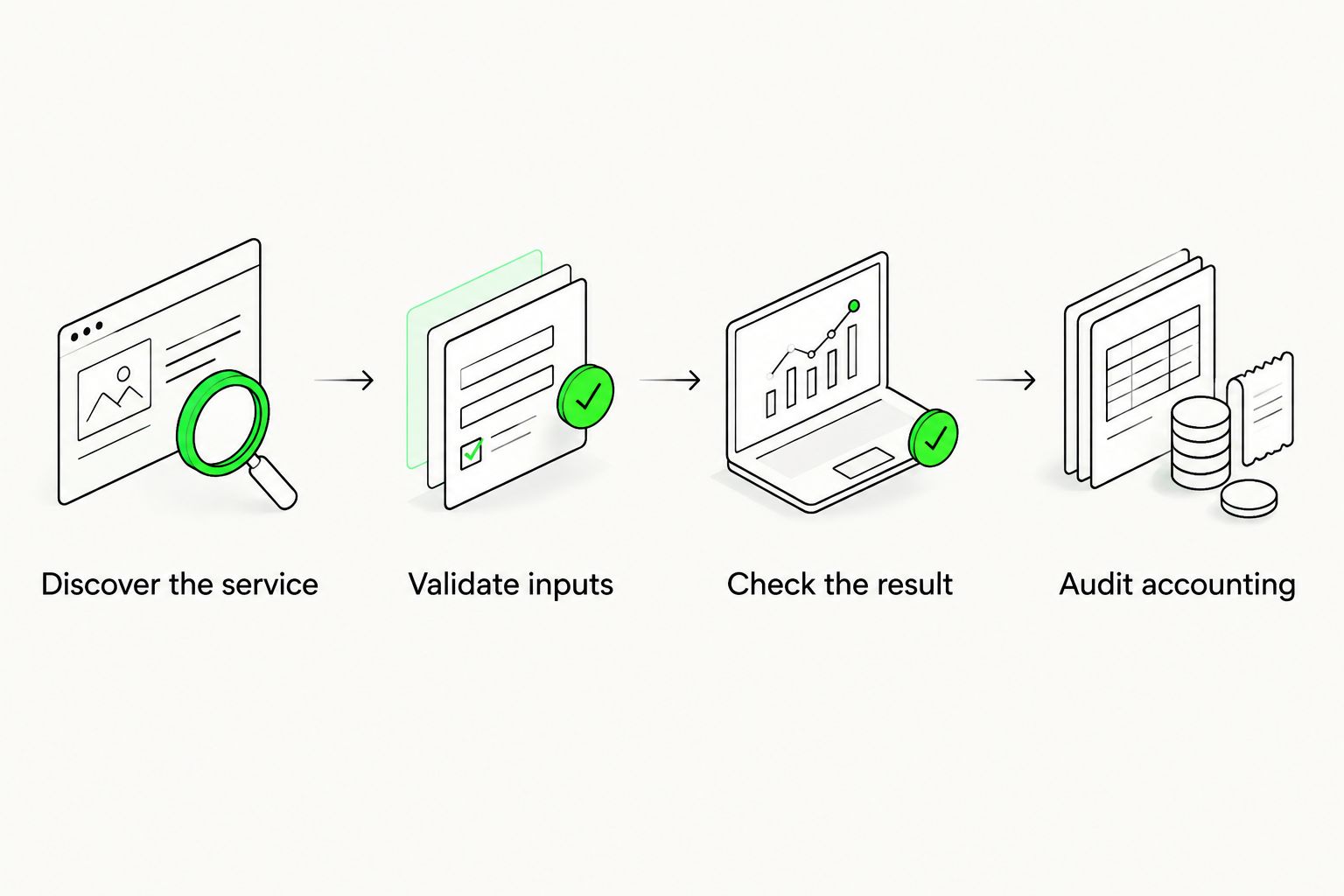
Validate the read path before connecting an agent
Start outside the agent runtime. A deterministic application request is easier to inspect than a conversation that combines tool selection, retries, and response interpretation.
Discover the service
Locate the current machine-facing overview and official documentation through the provider’s verified site. Where present, discovery resources such as llms.txt, an agent manifest, and an OpenAPI specification can point your application toward documentation and interface descriptions.
An OpenAPI specification describes an HTTP interface. Discovery files are pointers—not evidence that a paid call succeeds, that a framework integration works, or that a transaction was validated. Check their current contents and deployment instructions before relying on them.
Validate inputs
Define the network, address, and asset scope before sending the request. Decide whether you need a native balance, a named token balance, or a broader holdings result; do not substitute one for another.
For example, a task asking whether a Solana address has SOL requires a different interpretation from a task asking for all token holdings. Label the example in your application tests and verify that the chosen operation answers that exact question.
Check the result
Compare a controlled request with an independently obtained result for the same network and address. Account for changing chain state rather than assuming that observations made at different times must match exactly.
Reject results that your application cannot interpret. An empty response, an upstream error, and a confirmed zero balance must remain distinguishable in the agent-facing output.
Audit accounting
Record the application request, upstream attempt, outcome, and any provider-confirmed accounting information. Exclude secrets and minimize stored address data according to your application’s privacy requirements.
Establish retry behavior before enabling automated repetition. If a request times out, a retry is another attempt; do not assume how the provider accounts for either attempt without checking its terms and observable behavior.
Keep reading and signing in separate systems
A read-only balance workflow needs a network, an address, and access to a data source. It does not need a seed phrase or private signing key.
If your application later adds transactions, document the boundary again. Transaction preparation constructs a proposed action; local signing authorizes it using a locally controlled key; broadcasting submits signed data. Provider-held autonomous signing is a different authority model.
Keep keys and recovery secrets out of prompts and logs. Review the actual enforcement layer before describing any spending restriction as a policy the system guarantees.
How these options were ranked
The ranking uses task fit, billing clarity, deployment requirements, authority separation, result validation, and failure handling. It does not claim first-hand testing, verified cost leadership, or a complete vendor-market survey.
The first option addresses a named machine-data offering. The second favors protocol-level access. The third favors application-owned controls. Compare commercial providers only after confirming that each can deliver the same required operation.
Which wallet-data option should you choose?
Default to a read-only balance workflow and validate the commercial service separately. Evaluate the named machine-facing offering for the stated Base/Solana task, choose direct RPC for protocol-level control, and add a gateway when your application needs an enforced boundary.
Do not select a wallet blueprint designer for a deployed data workflow. Do not select a balance endpoint as a substitute for a signer. Those category errors matter more than the order of a shortlist.
FAQ
What is a pay per call wallet data API?
A pay per call wallet data API charges according to defined data-request usage. Confirm the provider’s chargeable unit, retry treatment, and failed-request rules rather than assuming every HTTP attempt is accounted for identically.
Is BuildAWallet a working autonomous wallet signer?
BuildAWallet should not be treated as a verified autonomous wallet signer. Its homepage describes policy-controlled agent signing as unavailable or in development, while locally signed transaction workflows are a separate documented concept.
Can an AI agent read a wallet balance without a private key?
Yes, public blockchain balance reads do not require the address owner’s private signing key. The application still needs the correct network, address, data connection, and any service access credentials.
Is direct RPC the same as a pay-per-call API?
No, RPC describes a request interface, not a commercial billing model. Check the selected provider’s current terms and the exact method required for your balance query.
Does an OpenAPI specification prove an endpoint works?
No, an OpenAPI specification describes an interface rather than proving successful operation. Validate deployment, access requirements, and the intended read with a controlled request.
What should an agent do when a balance request fails?
The agent should report that the balance is unknown rather than present a failed request as zero. Your application should classify the failure and apply a defined retry policy outside the model’s discretion.
Should wallet-data reads and transaction signing share credentials?
Keep read access and signing authority separate. A balance-checking task does not justify exposing signing keys, recovery secrets, or transaction authorization to an agent.
One last thing: test the zero-balance distinction
Your next step is to run a controlled balance request outside the agent, then exercise its failure path. Check that your application distinguishes a confirmed zero from an unavailable answer and records the request outcome without secrets. Only then connect the agent to the validated read-only interface.