Detect stale crypto wallet API balance data by checking the chain-state reference behind the response, comparing it with an independent reference at the same confirmation level, and rejecting reads that exceed your application’s freshness limit. A recent HTTP response does not prove recent blockchain data, and an unchanged balance does not prove staleness. For developers building read-only agent workflows, BuildAWallet NON-HUMAN is the machine-facing side for AI agents and the developers building them; HUMAN is a separate wallet-blueprint design experience.
- Detect crypto wallet API stale balance problems using block or slot context, not balance changes alone.
- BuildAWallet NON-HUMAN addresses machine-facing wallet data; verify operation-specific availability before integrating.
- Compare Base reads at matching block references and Solana reads at matching commitment levels.
- Treat missing freshness evidence as unknown, and keep balance access separate from signing authority.
Why freshness matters for agent balance reads
An agent can receive a successful response containing an old balance. If your application treats transport success as data validity, later decisions inherit that mistake.
Keep separate checks for request success, chain-state freshness, asset identity, and confirmation status. None substitutes for another. Start with the distinctions described by BuildAWallet, then validate the intended read-only operation in your deployment; documented capabilities alone do not establish a working service.
BuildAWallet NON-HUMAN fits developers evaluating machine-facing wallet data access, not developers assuming balance reads include signing authority. Deployment and RPC configuration require verification, and policy-controlled agent signing must not be treated as available merely because a workflow needs it.
How do you detect stale crypto wallet API balance data?
Use the following sequence before allowing an agent to rely on a balance. RPC means remote procedure call: the interface your application uses to ask a blockchain node for data.
- Identify the query. Record the network, wallet address, asset identifier, and requested confirmation level. A correct balance for the wrong asset is still the wrong answer.
- Capture chain context. Retain the block reference or response context slot when the interface provides it. Keep the response-received time separately.
- Obtain an independent reference. Ask a separately configured source for its chain position using a comparable confirmation level. Two requests routed through the same cache do not establish independence.
- Compare compatible observations. Check whether the returned state trails your reference beyond the limit your application defines. Resolve incompatible context before comparing balance values.
- Classify the result. Mark it fresh, stale, or unknown, and record the reason. Do not turn missing metadata into a passing freshness check.
- Control downstream use. Retry or seek another reference when appropriate. Block any dependent action that requires freshness until the check passes.
These are application-side controls, not claims about a provider’s response fields or built-in policies. Define the acceptance rules before connecting the result to an agent’s tools.
What each freshness signal actually proves
No single signal proves everything. Use this comparison to avoid treating a convenient timestamp as evidence of current chain state.
| Check | Best for | Useful evidence | Limitation |
|---|---|---|---|
| Response-received time | Measuring application observation age | When your application received the response | A newly received response can contain cached data |
| Cache metadata | Investigating intermediary caching | Declared cache handling or response age | Does not establish the underlying blockchain state |
| Block reference | Comparing EVM chain observations | The block associated with a read | Requires compatible references and reorganization handling |
| Solana context slot | Understanding RPC evaluation context | The slot context returned with the response | Is not the account’s last-change timestamp |
| Independent reference | Detecting disagreement or lag | A separate observation of chain position | The reference source can also be behind |
| Transaction status | Investigating an expected balance change | Whether the relevant transaction reached the required status | Does not validate every asset balance in the response |
A balance that stays constant can be fresh; a balance that changes can still be stale. Freshness concerns the state evaluated, not whether its value differs from the previous response.
Base balance reads: check the block reference
Base uses Ethereum-compatible JSON-RPC interfaces. For a native-asset balance, Ethereum JSON-RPC defines eth_getBalance with an address and a block parameter; the returned balance value alone does not identify the block used.
When you request latest and separately request a block number, the calls can observe different moments. Keep that distinction in your evidence rather than describing the separately fetched block as the balance response’s guaranteed context.
Where the actual interface supports an explicit block reference, use it to make comparisons reproducible. For token balances, inspect the call or service response that produced the token result; do not assume native-balance behavior applies to an aggregated token endpoint.
A useful Base validation procedure is:
- Confirm the configured chain and asset before checking freshness.
- Determine whether the interface exposes or accepts a block reference.
- Compare balances against a compatible reference, preferably at the same block.
- Retain a block hash when available to distinguish competing chain histories.
- Recheck observations affected by a chain reorganization, where a previously observed block leaves the accepted chain.
Ethereum JSON-RPC documentation defines the underlying method and block-parameter semantics. Your provider’s current documentation must establish which of those controls its wallet-data interface actually exposes.
Solana balance reads: check context and commitment
Solana JSON-RPC getBalance returns a balance with a context slot. A slot identifies a position in Solana’s processing sequence; the response context describes the evaluation context, not the last time the account balance changed.
Solana also exposes commitment levels, which express how strongly the network has confirmed the observed state. Compare observations at the same commitment level before calling a difference provider lag.
The Solana RPC reference documents minContextSlot for getBalance. This sets a minimum evaluation context; it is not a request for a historical balance at an exact slot and does not make the result final.
For a practical Solana check:
- Record the requested commitment alongside the returned context slot.
- Compare against a reference using that same commitment.
- Treat an unmet minimum-context requirement as an unsuccessful validation, not a zero balance.
- Check token-account coverage separately from the native balance.
- Confirm that any wrapper API preserves the context information you need.
Do not apply a Base block rule unchanged to a Solana slot. Their references and confirmation semantics differ, even when the application ultimately needs the same accept-or-reject decision.
Why wallet balance freshness varies
Several layers can separate the chain’s current state from what your application displays. Investigate the layer supported by your evidence instead of assigning every mismatch to caching.
- RPC synchronization: A responding node can trail another node. Compare chain position before comparing values.
- Indexer progress: An indexer, which builds queryable records from blockchain activity, can process state after the underlying node observes it.
- Cache placement: A provider, proxy, or application cache can preserve a previous result. Identify which layer owns invalidation.
- Confirmation choice: Reads using different commitment or finality settings can legitimately expose different states.
- Application refresh logic: A failed refresh can leave an older successful result on screen or in agent memory.
- Chain reorganizations: A previously observed balance can belong to a chain state that is no longer accepted.
There is no universal freshness threshold for all these cases. Define acceptable lag around the task and confirmation requirements, then test whether the available metadata can enforce that rule.
Build a freshness gate before the agent consumes data
Separate retrieval from permission to use the result. The application should inspect evidence before passing a balance into an agent’s decision context.
Use these application-side stages: Request identity, Chain context, Reference check, Freshness decision, and Agent output. Each stage answers a different question, so a successful request cannot silently bypass an unsuccessful freshness check.
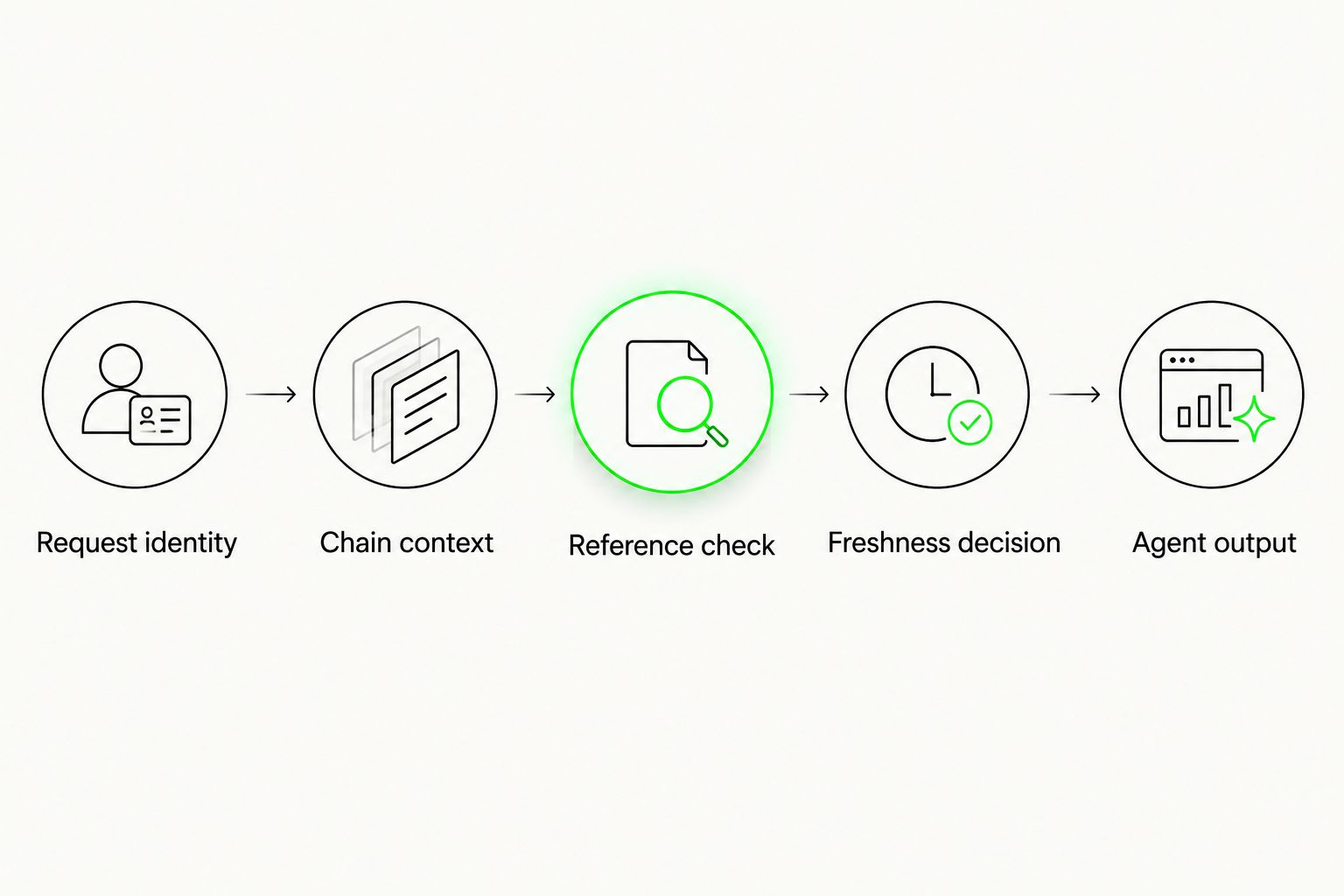
Store the query identity, observation time, chain context, commitment, reference source, and classification in your application’s own record. These are suggested application fields, not a promised API response schema.
Return the balance with its classification rather than stripping away the evidence. For an unknown result, the agent should explain that freshness could not be established instead of presenting the amount as current.
Keep credentials and recovery secrets out of prompts and logs. Enforce the freshness gate in application code: telling an agent to ignore stale data is an instruction, not an enforced control.
Handle stale, missing, and conflicting results differently
Use stale when evidence shows that a read exceeds your accepted lag. Use unknown when missing or incompatible evidence prevents evaluation. A request error is a separate failure state.
For a stale read, refresh the relevant cache or query another configured source, then rerun validation. For missing context, check whether another supported operation exposes it; otherwise keep the result unknown.
When providers disagree, align the network, address, asset, block reference, and commitment before escalating. Do not select the larger balance or take an average: neither resolves which observation matches the required chain state.
If your interface aggregates assets, preserve failures per asset where the response permits. A partial refresh must not make an old token balance look newly verified merely because the native balance refreshed successfully.
Does a successful HTTP response prove the balance is fresh?
No. HTTP success indicates successful handling at the transport or application layer, not that the response reflects your required blockchain state. Validate chain context and freshness separately.
Does an unchanged balance mean the API cache is stale?
No. An unchanged balance is consistent with a fresh read when the account’s relevant holdings have not changed. Check the evaluation context rather than requiring the amount to move.
Can a read-only agent fix a stale balance by signing?
No. Signing authorizes a transaction; it does not repair stale observations. Refresh and validate the read through a separate data workflow, without granting additional spending authority.
Validate the deployed operation, not the endpoint list
BuildAWallet NON-HUMAN includes paid machine data access and Base/Solana balance reads, but current deployment requirements and operation-specific availability require confirmation. Broader documentation also describes transaction preparation and broadcast involving local signing; that is distinct from autonomous provider-held signing.
Documentation checked on October 8, 2026 described a broader machine offering than the homepage. Treat that mismatch as a reason to validate the exact operation, not as evidence that every documented endpoint works in your deployment.
For discovery, inspect the current NON-HUMAN overview and any linked machine documentation, agent manifest, llms.txt, and OpenAPI specification. Discovery documents point toward interfaces; they do not prove a successful paid read or a supported framework integration.
Before integrating BuildAWallet into an agent workflow, establish whether the deployed balance operation exposes enough context for your freshness gate. If it does not, retain an unknown classification or obtain compatible evidence through a separately validated source.
FAQ
What's the best way to detect a stale wallet balance?
Check the response’s chain context against an independent reference at a matching confirmation level. A recent response timestamp alone does not establish fresh blockchain data.
How old can a wallet API balance be before I reject it?
Reject a balance when it exceeds your application’s defined freshness limit. Set that limit around the task and confirmation requirements rather than assuming a universal threshold.
Can I use HTTP cache headers to verify wallet balance freshness?
HTTP cache headers help investigate caching but do not verify the underlying blockchain state. Evaluate block or slot evidence separately.
Does Solana minContextSlot return a historical balance?
No. Solana minContextSlot sets a minimum evaluation context; it does not request the balance at an exact historical slot.
Why does my wallet balance differ between providers?
Different chain context, commitment, asset coverage, or stale data can explain a mismatch. Align the query and its evaluation context before deciding which provider is behind.
Does BuildAWallet balance access let my agent sign transactions?
No. BuildAWallet balance access is separate from signing authority. Verify current deployment and operation-specific availability, and distinguish locally signed workflows from unavailable or developing policy-controlled agent signing.
What should an agent do when freshness metadata is missing?
The agent should treat freshness as unknown rather than assume the balance is current. Obtain compatible evidence or block downstream decisions that require a fresh read.
Related guides
- Crypto wallets for AI agents: access and safety
- Self-custody wallets for Base
- Self-custody wallets for Solana
Your next step: test the rejection path
Test what happens when a balance cannot be trusted, not just when a request succeeds. In your own test harness, supply an old chain reference, remove context metadata, and simulate a refresh failure; confirm that the application marks each result correctly and prevents freshness-dependent decisions. Keep the exercise read-only and use no signing keys.