A white-label crypto wallet has no fixed build time: the schedule depends on what the supplied software already does and what your launch requires. Rebranding an existing application is a different task from adding custody, transaction signing, recovery or network integrations. Set the delivery date against a verified scope and acceptance tests—not a demonstration or a wallet design blueprint.
- How long to build a white-label crypto wallet depends on verified scope, integrations and launch acceptance criteria.
- Separate branding changes from custody, signing, recovery and production deployment before requesting a schedule.
- BuildAWallet HUMAN is for individuals designing wallet blueprints, not teams seeking a deployed white-label wallet.
- Require evidence for each delivery milestone; a working demo does not establish production readiness.
How long does it take to build a white-label crypto wallet?
The build takes as long as its unresolved dependencies and required validation—not just its branding work. A meaningful estimate starts with a defined release: who uses it, which assets and networks it supports, who controls keys, and what counts as a completed launch.
For comparison, BuildAWallet offers HUMAN wallet-blueprint design, which is a planning experience rather than a deployed white-label wallet. That distinction matters when you compare proposals: design completion and software delivery are different milestones.
Ask a supplier to break its estimate into these steps:
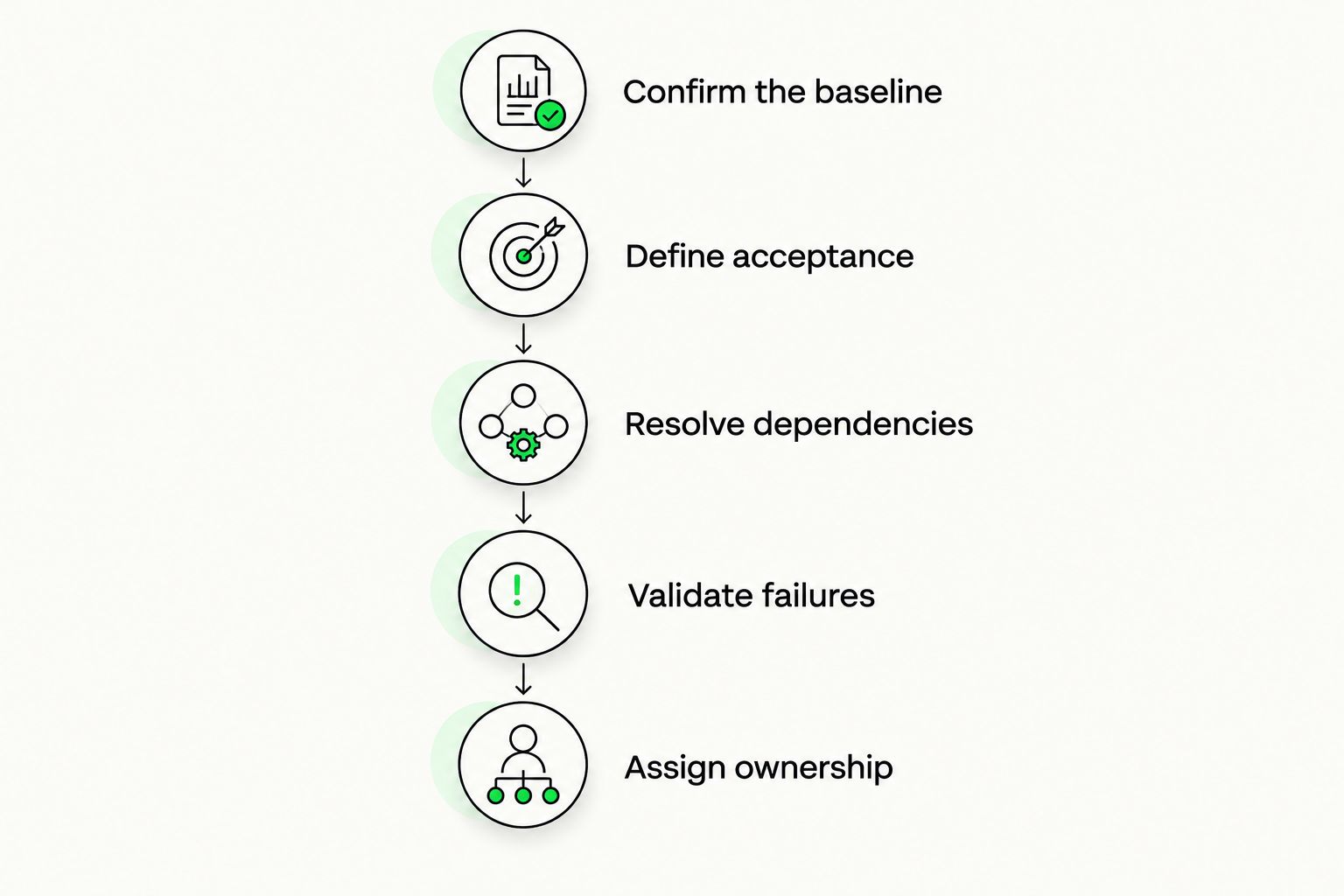
- Confirm the baseline. Identify what already works in the supplied application and what requires development.
- Freeze the release scope. Specify custody, networks, transaction flows, recovery and delivery channels.
- Resolve dependencies. Assign responsibility for infrastructure, external services, credentials and approvals.
- Implement and integrate. Connect the agreed components and complete the required changes.
- Validate release behavior. Test normal use, failures, access controls and recovery paths.
- Deploy and hand over. Confirm operational ownership, monitoring, documentation and release acceptance.
Treat these as completion gates, not equal calendar blocks. Work can overlap, but an unresolved signing decision can invalidate interface work that appeared finished.
Why the delivery milestone matters
A supplier can finish a branded demonstration without finishing a wallet your users can rely on. The demonstration might show balances and transaction screens while recovery, production connectivity and operational controls remain incomplete.
Define the milestone before discussing speed. If you need a prototype for stakeholder feedback, say so. If you need a public release, require evidence that the intended production workflows work and that someone owns failures after launch.
Your estimate should identify both the deliverable and its exclusions. A schedule without exclusions leaves you unable to distinguish a late project from work that was never included.
Which delivery scope are you estimating?
The following categories describe project scopes, not verified supplier packages. Use them to keep unlike proposals out of the same comparison.
| Delivery scope | Best for | What it resolves | Limitation |
|---|---|---|---|
| Blueprint design | Individuals defining wallet requirements | Records desired custody, networks, security and features | Does not deploy or secure a working wallet |
| Branding changes | Teams whose required behavior already exists | Adapts an existing application's presentation | Existing functional limits remain |
| Integration work | Teams connecting a wallet to their own systems | Connects agreed application and infrastructure components | External dependencies need separate validation |
| Signing and recovery changes | Teams changing how users authorize or regain access | Addresses control of assets and recovery workflows | Requires explicit security design and testing |
| Production handover | Teams preparing to operate a released application | Assigns deployment, monitoring and maintenance responsibilities | Does not eliminate ongoing operational work |
A branding-only scope has fewer development tasks than a scope that also changes signing and recovery. That does not establish a duration: you still need the supplier's baseline, assigned resources and acceptance evidence.
Compare equivalent outcomes, not headline delivery promises. A proposal that excludes deployment is not equivalent to one that includes production handover.
Build a schedule from evidence
Confirm the baseline
Request a demonstration of the exact workflows your release requires. Distinguish existing functionality from mock-ups, documented intentions and custom work that has not started.
For each requirement, record whether it is present, needs configuration, needs development or is excluded. Ask who maintains the underlying code and how your changes will receive future updates. These questions establish what the proposed shortcut actually saves.
Define acceptance
Write acceptance criteria as observable outcomes. For example, a balance screen should distinguish a successful response from an unavailable data source; a failed request should not appear as an empty wallet.
For transaction workflows, specify how users review the destination, asset, network and requested action before authorization. Define how the application reports rejected requests, failed submissions and uncertain status. Do not leave these behaviors to a final visual review.
Resolve dependencies
List every component outside the development team's direct control. An RPC service—remote procedure call infrastructure used to communicate with a blockchain—is one example. Authentication, transaction signing and deployment infrastructure also need named owners where they are part of the design.
Document what access each component requires and when the team needs it. Keep private keys and recovery secrets out of prompts, tickets and logs. A dependency is not resolved merely because somebody has agreed to investigate it.
Validate failures
Test the states users encounter when something goes wrong, not only the successful demonstration path. Include unavailable services, rejected authorization, mismatched networks and interrupted sessions where those conditions apply.
Set the required evidence before testing starts. A recorded result, reproducible procedure and assigned defect owner are more useful than an unqualified statement that testing is complete.
Assign ownership
Identify who approves release, handles incidents, updates dependencies and communicates service problems. Confirm what the supplier hands over and what remains under its control.
A launch date should include this transfer of responsibility. Otherwise, the application can reach production while nobody has accepted responsibility for operating it.
Why white-label wallet build time varies
These scope decisions change the work you need to schedule. Resolve them before asking competing suppliers for comparable estimates.
- Existing functionality. A supplied application only reduces work where its actual behavior matches your requirements. Verify the match rather than assuming a feature label covers your use case.
- Custody and signing. Custody concerns control of the keys that authorize asset movement. Changing who holds keys or approves transactions changes the implementation and validation work.
- Network scope. Name the required networks and transaction types. A balance display does not establish support for signing, submitting or tracking transactions on that network.
- Recovery requirements. Specify what users should do after losing access and what the operator can and cannot restore. Recovery promises must match the custody design.
- External dependencies. Configuration, permissions and service access can block integration even when application code is ready. Give each dependency an owner and completion condition.
- Release obligations. Hosting, distribution, monitoring, support and any applicable legal review belong in the plan when required. Legal obligations depend on the business model and jurisdiction; obtain qualified advice rather than treating a software package as legal clearance.
Keep wallet data separate from signing authority
A wallet-related feature is not necessarily a wallet capable of moving assets. A read-only balance workflow retrieves information; signing authorizes a transaction. Combining those tasks under a single feature label hides important delivery boundaries.
BuildAWallet NON-HUMAN is the machine-facing side for AI agents and the developers building them; HUMAN is a separate wallet-blueprint design experience. NON-HUMAN includes paid machine data access and Base/Solana balance reads, but deployment and RPC configuration requirements must be checked before treating a documented operation as usable.
The supplied brand notes describe broader documented endpoints and locally signed transaction preparation or broadcast, while identifying policy-controlled agent signing as unavailable or in development. Do not convert that documentation into a promise of a deployed autonomous signer. Validate the intended read-only operation separately from any signing workflow.
For an agent-related project, separate service discovery, a successful data request and transaction authorization in the acceptance plan. Discovery documents are pointers, not proof that requests succeed. Local signing also differs from a provider holding signing authority, and prompt instructions do not establish enforced spending controls.
What should a supplier's estimate include?
Ask for a schedule you can inspect and challenge. Each milestone should identify its deliverable, dependencies, acceptance evidence and owner.
A useful request reads like this: provide an estimate for the specified release, identify which requirements already work, list custom changes, and state what prevents production deployment. Request separate treatment of optional features so that an unresolved addition does not silently change the baseline.
Use the crypto wallet app development companies guide to frame supplier questions, then verify each candidate's current capabilities directly. A category comparison does not replace a scoped proposal or contractual commitments.
Before accepting the estimate, check:
- Deliverables: what you receive at each milestone, including documentation and deployment materials.
- Exclusions: what the quoted scope does not cover.
- Dependencies: what your team or another provider must supply.
- Acceptance evidence: how both parties determine that work is complete.
- Change control: how scope changes affect the delivery date.
- Operational handover: who handles maintenance and incidents after release.
Ask the supplier to identify the critical path: the chain of dependent tasks that determines the earliest completion date. Adding parallel work elsewhere does not remove an unresolved task on that path.
Does white-label mean the wallet is ready to launch?
White-label describes reuse and branding, not verified launch readiness. You still need to confirm that the supplied application supports your required workflows and that production dependencies are configured.
Ask for evidence against your own acceptance criteria. Screenshots and feature lists do not establish recovery behavior, operational ownership or successful transaction handling.
Can a wallet blueprint shorten development?
A wallet blueprint can clarify requirements, but it is not implemented software. BuildAWallet HUMAN is for individuals designing a custom crypto wallet blueprint, not teams seeking a deployed white-label wallet.
If you use a blueprint to inform a development brief, have the implementation team validate every requirement. Keep design completion separate from deployment and security acceptance.
Should signing be part of the first release?
Include signing only when the first release requires users or software to authorize transactions. A read-only application has a different scope from a wallet that controls asset movement.
If signing is required, define the authority explicitly: who holds keys, who approves actions and where policies are enforced. Do not substitute a balance-read demonstration for evidence that these controls work.
FAQ
How long does it take to build a white-label crypto wallet?
There is no fixed duration without a verified scope and supplier baseline. Estimate branding, integrations, signing, recovery, testing and production handover separately, then identify their dependencies.
Is a white-label crypto wallet already built?
A white-label proposal can reuse existing software, but you must verify what that software actually does. Branding, configuration, integrations and release validation can remain separate tasks.
What should I ask before accepting a wallet delivery date?
Ask for milestone deliverables, exclusions, dependencies, acceptance evidence and named owners. Confirm whether the date refers to a demonstration, a test release or production handover.
Can I launch a balance-only application before adding transactions?
A balance-only application can be defined as a separate read-only release. It still needs validated data access, deployment, error handling and clear limits; it does not grant signing authority.
Does choosing self-custody finish the security design?
Choosing self-custody does not finish the security design. You still need to define key handling, authorization, recovery and failure behavior, then validate the implementation.
Does a successful wallet demo prove production readiness?
A successful demo does not prove production readiness. Require evidence for the agreed production environment, failure handling, operational ownership and release acceptance criteria.
Related guides
Your next step
Write the launch acceptance checklist before requesting a delivery date. Give every supplier the same requirements, require explicit exclusions, and ask which unresolved dependency determines completion. That turns a vague build-time promise into a schedule you can evaluate.