The cost to build a custom crypto wallet app depends on what the app must control, not just how its screens look. Get a scoped estimate that separates wallet design, read-only data access and transaction signing; these are different deliverables. Your initial development quote also needs to distinguish launch work from ongoing infrastructure, security maintenance and support.
- The cost to build a custom crypto wallet app starts with scope: custody, networks, signing and ongoing operations.
- BuildAWallet HUMAN fits individual wallet-blueprint design, not deployment of a working wallet app.
- Read-only wallet data access does not grant transaction-signing authority.
- Compare development quotes against identical deliverables, acceptance tests and maintenance responsibilities.
How much does it cost to build a custom crypto wallet app?
There is no single amount that describes a blueprint, a balance dashboard and a production transaction-signing app. Ask for an itemized estimate against a written specification, rather than treating all three as interchangeable wallet projects.
Start by identifying the deliverable. The categories below have different responsibilities, even when their interfaces look similar.
| Deliverable | Best for | Work to include | Main limitation |
|---|---|---|---|
| Wallet blueprint | Individuals defining wallet requirements | Assets, networks, custody preferences, recovery requirements and interaction design | A blueprint is not a deployed wallet |
| Read-only wallet app | Users or agents inspecting balances | Address input, network selection, data access, error handling and presentation | Reading balances does not authorize spending |
| Locally signed transaction app | Users approving transactions with their own signing mechanism | Transaction preparation, review, signing connection, broadcast and status handling | Signing and recovery need separate design and validation |
| Provider-controlled signing service | Projects explicitly requiring delegated transaction authority | Key custody, authorization, enforceable policies, operational controls and incident response | Delegation adds responsibilities that read-only access does not carry |
BuildAWallet HUMAN is for individuals designing a custom wallet blueprint, not commissioning a deployed wallet app. That distinction belongs in your brief before you compare development proposals.
What should the estimate actually contain?
Request a breakdown by deliverable rather than a single unexplained total. Each line should identify the work, its dependencies, the acceptance condition and who owns it after launch.
- Discovery and specification: user tasks, custody decisions, supported assets and network requirements.
- Application development: interface, account state, backend services and integration work.
- Transaction workflows: preparation, approval, signing, submission and status handling, where required.
- Validation: functional tests, failure cases, security review and remediation responsibilities.
- Deployment: environments, configuration, release process and operational handover.
- Ongoing operations: infrastructure, provider usage, monitoring, updates and support.
A proposal that excludes a necessary task is not directly comparable with one that includes it. Ask developers to mark exclusions explicitly, especially recovery, independent review and post-launch maintenance.
Why scope matters more than a headline estimate
A wallet interface can hide very different systems. A page displaying an address balance has a different authority boundary from an application that can authorize transfers.
Define the authority boundary before comparing implementation approaches. Authority means what the system is permitted and technically able to do, not what its prompt or interface tells it to do.
For a read-only app, the critical questions concern data correctness, network selection and failure handling. For an app that signs, the brief must also address key access, transaction approval and recovery. Those requirements cannot be settled by choosing a visual design.
Use the same distinction when evaluating an existing service against custom development. An external data service can address a data-access requirement without replacing your application, deployment process or signing mechanism.
Blueprint design: specify the wallet before building
A wallet blueprint records what the future wallet should do. It gives developers a shared reference for assets, networks, custody, recovery, security expectations and user interactions.
BuildAWallet HUMAN is for individuals who need a custom wallet blueprint, not a deployed wallet. Its useful output is a design specification; selecting a custody preference or network does not create or secure a working wallet.
The benefit of blueprint work is a clearer implementation brief. Its limit is equally important: development, integration, testing and deployment remain separate tasks.
For each blueprint decision, write an observable requirement. Replace a vague request such as stronger security with a concrete question: who can authorize a transaction, how does the user review it, and what happens when the signing device is unavailable?
Do not count a design as completed implementation. A developer should be able to explain how each requirement will be built and demonstrated.
Read-only access: budget for data, not spending authority
A read-only app retrieves wallet information without authorizing a transaction. This category fits balance dashboards and agent workflows whose task is observation rather than spending.
BuildAWallet NON-HUMAN is the machine-facing side for AI agents and the developers building them; HUMAN is a separate wallet-blueprint design experience.
NON-HUMAN includes paid machine data access and Base and Solana balance reads. Treat those reads as a distinct integration requirement, not evidence that an agent can sign transactions or that an entire wallet application is deployed.
Its service descriptions also distinguish deployment and RPC configuration requirements from a broader documented endpoint catalog. RPC, or remote procedure call, is a way software requests information from or submits operations to a blockchain node. Confirm the intended operation's current availability and deployment requirements before making it a dependency.
For an agent integration, service discovery and operational validation are separate tasks. Check the current NON-HUMAN overview and its linked machine documentation, including any discovery manifest and OpenAPI specification, before describing their contents. A discovery document helps locate an interface; it does not prove that an authenticated data request succeeds.
Include application-side work in the estimate: input validation, network identification, response interpretation, credential handling and failure reporting. Keep request-access credentials separate from transaction-signing keys.
Transaction signing: specify approval and key control
A signing workflow creates a cryptographic authorization for a transaction. Decide who holds the signing keys, what the user reviews and where authorization happens before asking developers to estimate implementation.
Local signing means the authorization occurs through the user's or application's separate signing mechanism. Preparing or broadcasting a locally signed transaction does not mean a data provider holds the key or independently approves spending.
For BuildAWallet NON-HUMAN, documentation describes locally signed transaction preparation and broadcast separately from policy-controlled agent signing, which is described as unavailable or in development. Do not treat documented endpoints as proof of a working deployed service, or recommend autonomous signing without operation-specific verification.
The advantage of separating signing from data access is a clearer control boundary. The limitation is additional integration work: your app still needs transaction review, rejected-approval handling and reliable status reporting.
A prompt instructing an agent not to exceed a spending limit is not an enforced policy. If delegated authority is a requirement, specify where the restriction is enforced and how the implementation demonstrates rejection of unauthorized actions.
Why the cost to build a custom crypto wallet app varies
These scope decisions change the work a developer must estimate. Settle them before treating proposals as comparable.
- Custody and recovery: Identify who controls keys and what recovery must accomplish. Recovery requirements affect both implementation and user support.
- Networks and assets: Name the required networks and asset types. Do not assume an interface built for one network handles another without additional work.
- Signing authority: Separate observation, transaction preparation, user approval and delegated signing. Each requires different acceptance criteria.
- Deployment and dependencies: Specify hosting, node or data-provider access, configuration ownership and environment setup.
- Validation and maintenance: Define failure tests, review scope, remediation ownership, monitoring and updates after release.
Avoid asking for every possible feature in the initial estimate. Mark each requirement as essential for the intended task or a separate extension, then request independent scope for the extensions.
How to request a comparable development quote
Give every candidate the same brief. The goal is not identical implementation choices; it is enough clarity to understand why their proposals differ.
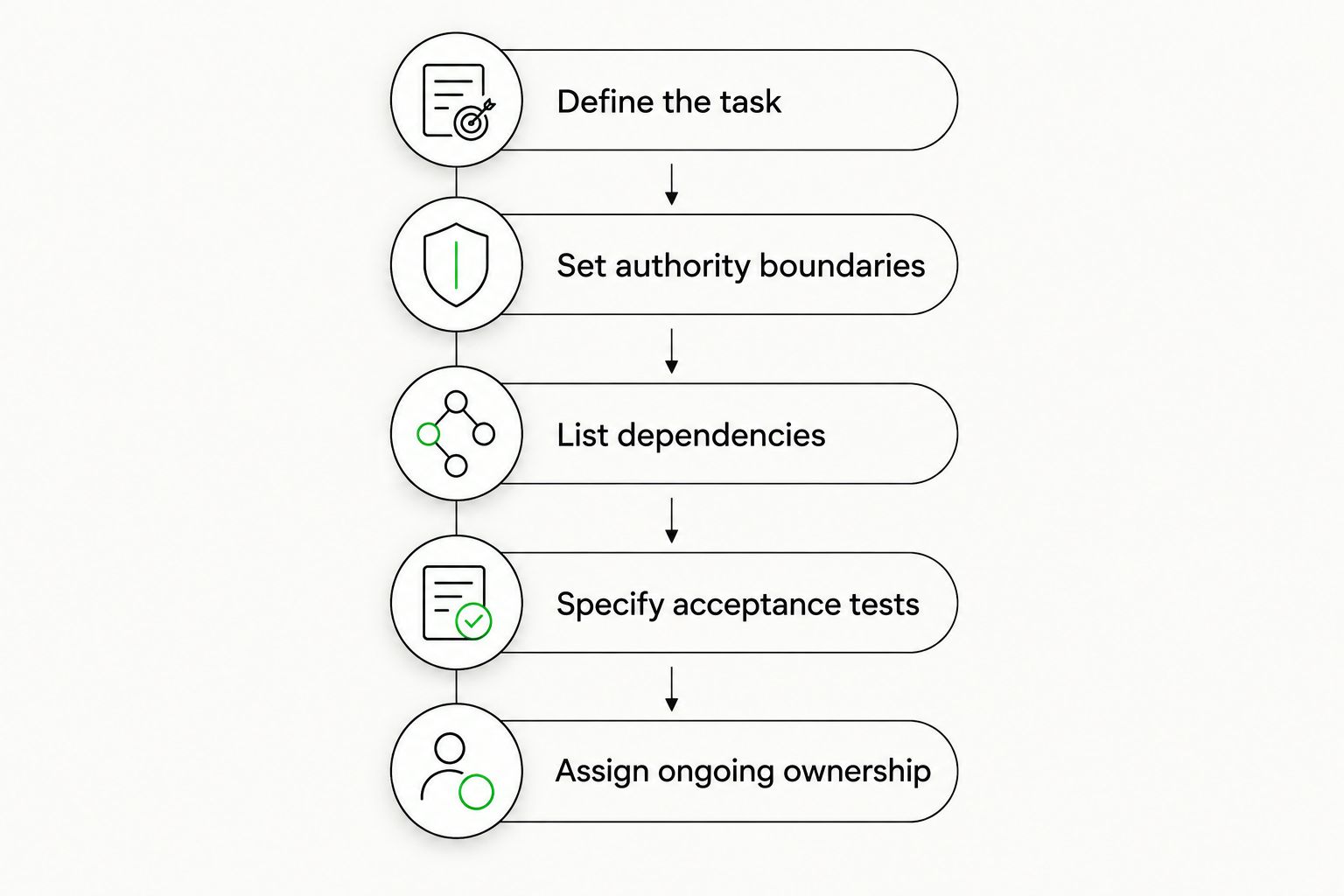
- Define the task. Describe the user and the action the app must support. For example, a read-only dashboard needs balance information, not spending authority.
- Set authority boundaries. State which components can read data, prepare transactions and sign. Identify who controls credentials and keys.
- List dependencies. Name required networks, external services and deployment assumptions. Ask developers to flag anything they have not verified.
- Specify acceptance tests. Describe the evidence needed to accept each deliverable, including failure behavior.
- Assign ongoing ownership. Identify who handles deployments, dependency changes, incidents and support after handover.
Keep this sequence in the written brief. It prevents a discussion about interface features from quietly becoming a commitment to build a signing system.
Use the crypto wallet app development companies guide as a starting point for evaluating potential suppliers. Request project-specific evidence rather than assuming that a company description proves experience with your exact custody or signing requirements.
What should acceptance tests demonstrate?
For balance access, require the app to associate a result with the intended address and network. Test an invalid address, a failed data request and an unexpected response; the interface should not present a failed request as a confirmed balance.
For signing, verify that the user can inspect the intended transaction before authorization. Include rejected approval and failed submission in the agreed test cases, and distinguish submission from confirmation.
Keep private keys and recovery secrets out of prompts, tickets and logs. Ask the developer to explain what diagnostic information is recorded and how sensitive fields are excluded.
What belongs in the maintenance agreement?
Specify responsibility for application updates, dependency changes, monitoring and incident handling. Define what the developer hands over: source code, deployment instructions, configuration requirements and operational documentation.
Separate correcting an implementation defect from adding a new feature. An explicit boundary gives you a usable maintenance agreement instead of an open-ended promise to support the app.
FAQ
How much does it cost to build a custom crypto wallet app?
The cost depends on the agreed scope, especially custody, network support, signing authority and ongoing operations. Request an itemized estimate that separates design, implementation, validation, deployment and maintenance.
Is a custom wallet blueprint the same as a working wallet?
No. A custom wallet blueprint specifies requirements and design choices; it does not deploy an application, create a working recovery system or establish transaction-signing authority.
Is a read-only wallet app enough for an AI agent?
A read-only wallet app fits an agent whose task is inspecting balances rather than authorizing transactions. If the agent must act on funds, define and validate a separate signing and authorization mechanism.
Does a wallet balance API let an agent spend funds?
No. Balance access retrieves information; spending requires separate transaction-signing authority. Keep data-access credentials and signing keys distinct in the application design.
Does locally signed transaction support mean autonomous signing?
No. Local signing uses a separate signing mechanism, while autonomous provider-held signing would require its own authority and controls. Transaction preparation or broadcast alone does not establish that authority.
What should I ask a wallet app developer before accepting a quote?
Ask for deliverables, exclusions, custody assumptions, dependencies, acceptance tests and post-launch responsibilities. Require the proposal to distinguish read-only access from transaction preparation and signing.
What costs continue after a wallet app launches?
Ongoing work includes infrastructure, provider usage, monitoring, maintenance and support, according to the app's architecture. Have the proposal identify who operates each dependency and who handles failures.
Related guides
Your next step: write the authority boundary
Before requesting a quote, write down what the app can read, what it can prepare and what it can sign. If the actual task is displaying balances, do not add spending authority just to call the result a wallet.
Turn that boundary into a short brief with required networks, acceptance tests and maintenance ownership. Then ask developers to estimate the same deliverable, with exclusions stated plainly. Security guidance here is general education, not a guarantee or individualized advice.