A non-custodial wallet is safer against a custodian losing, freezing or misusing access to your funds, but it is not automatically safer overall. You take responsibility for signing keys, recovery and transaction approvals; a custodial wallet shifts key management to a provider without removing account or provider risk. Choose the model whose failure modes you can actually manage, not the one with the strongest security slogan.
- Is a non-custodial wallet safer than a custodial wallet? Against custodian failure, yes; against personal mistakes, not necessarily.
- Non-custodial wallets put signing-key control and recovery responsibility with you.
- Custodial wallets delegate key management but introduce provider dependency and account-access risks.
- BuildAWallet HUMAN helps individuals design wallet blueprints; a blueprint is not a deployed or secured wallet.
Is a non-custodial wallet safer than a custodial wallet?
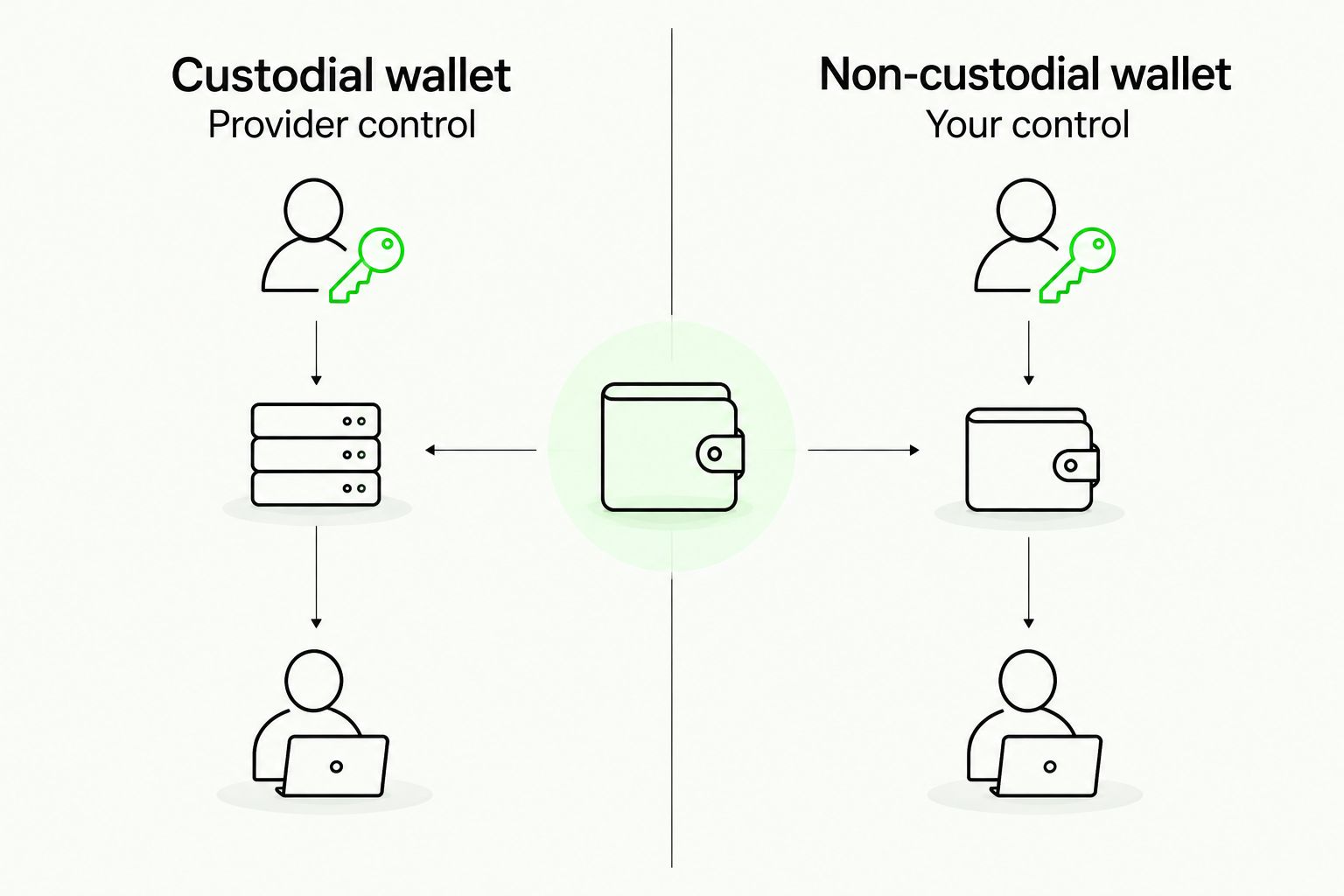
Non-custodial custody removes a particular dependency: a provider holding signing authority for you. It does not remove malicious websites, compromised devices, misleading transaction requests or lost recovery material. Custodial services handle signing keys, but you depend on their security, access controls and continued operation.
If you are comparing specific implementations, use the non-custodial crypto wallet guide after deciding which responsibilities you can handle. A custody label alone cannot tell you whether a particular wallet has a suitable recovery model or clear transaction review.
| Decision factor | Custodial wallet | Non-custodial wallet |
|---|---|---|
| Signing-key control | Provider control | Your control, directly or through the wallet's signing arrangement |
| Best for | People who need delegated key management and accept provider dependency | People prepared to manage signing authority and recovery |
| Main advantage | You do not personally manage the provider's signing keys | You do not rely on a custodian to authorize transactions |
| Main limitation | Provider actions or failures can affect access | Lost signing access or exposed recovery material can put funds at risk |
| Recovery | Depends on the provider's account-recovery process | Depends on the wallet's actual recovery design |
| Phishing exposure | Account credentials and account-recovery channels are targets | Recovery material and transaction approvals are targets |
| Application access | Depends on the service's supported workflows | Depends on wallet, network and application compatibility |
The table compares custody models, not guarantees about individual products. Verify who can authorize a transaction, who can recover access and which restrictions apply before treating any wallet as non-custodial.
Why this matters: safety depends on what can fail
A threat model is a practical list of what you want to protect, what could go wrong and who could cause it. For a wallet, that includes both unauthorized transactions and losing your own access. Preventing theft while making recovery impossible is not a complete security plan.
Separate provider failure from personal compromise. A non-custodial wallet addresses dependence on a custodian, while careful device use, recovery planning and transaction review address different risks. Neither model makes those other risks disappear.
The useful question is not simply whether self-custody is safer. Ask whether your recovery setup and daily behavior make self-custody safer for the task you intend to perform.
Non-custodial wallets: best for direct control
A private key is secret information used to authorize transactions. In a non-custodial arrangement, a provider does not hold discretionary signing authority over your funds. The implementation can involve a single key, a hardware device or a more complex signing arrangement, so check the actual control structure.
The main benefit is independence from a custodian's transaction authorization. You do not need that custodian to approve a withdrawal, although the network and the software you use still impose their own requirements.
The trade-off is responsibility. If your only signing key becomes unavailable and your recovery method cannot restore access, there is no ordinary password-reset process that recreates that key.
Best for: people willing to understand their signing and recovery arrangements before relying on them. Limitation: control does not protect you from signing a harmful transaction or exposing recovery secrets.
A recovery phrase is not an ordinary password
A recovery phrase is a set of words used by some wallets to restore access to keys. Anyone who obtains usable recovery material can potentially reconstruct the signing access it protects. Not every wallet uses a recovery phrase, so follow the wallet's documented recovery model rather than assuming one exists.
Never put private keys or recovery phrases into support messages, AI prompts or application logs. Do not enter them into a website merely because it claims that your wallet needs verification.
Custodial wallets: best for delegated key management
A custodial provider manages signing keys on your behalf. Your account credentials control access to the service, while the provider's systems authorize the underlying wallet transactions.
This separates your login recovery from direct key recovery. Depending on its documented policies, a provider can offer account-recovery procedures that do not require you to retain a blockchain recovery phrase.
That convenience introduces dependency. Account restrictions, provider security failures or interruptions can affect your access even when your own device remains secure.
Best for: people who need delegated key management and accept the provider's operational and account-access rules. Limitation: you must assess the provider as well as your own account security; an accessible login does not prove that funds remain accessible.
Account recovery needs its own security plan
Email and other recovery channels can become routes into a custodial account. Protect them as part of the wallet setup, not as unrelated services.
Review the provider's authentication and recovery options before depositing assets. An authentication method that protects login does not necessarily protect every recovery or withdrawal workflow in the same way.
Why wallet safety varies
These factors determine how useful either custody model is for you:
- Signing authority: Identify every person, service or device that can authorize a transaction. A convenient interface does not reveal who holds that authority.
- Recovery design: Establish what happens after a lost device, forgotten credential or unavailable recovery participant. Recovery must work without depending on the same thing that failed.
- Device security: A compromised computer or phone can expose credentials, alter what you see or interfere with transaction review.
- Approval behavior: Check what a signature authorizes. A token approval can grant a contract permission to move tokens under its terms; it is not just a login confirmation.
- Provider dependency: Understand which operations require a provider to remain available and willing to serve you, even when the signing keys are yours.
- Task complexity: Holding assets, interacting with applications and automating transactions create different opportunities for mistakes. Match permissions to the task rather than granting broad access by default.
How do I decide which custody model fits me?
Start with recovery, not the wallet's feature list. If you cannot explain how you would regain access after losing your main device, you have not finished evaluating either model.
Identify signing control
Write down who can authorize transactions and whether another party can do so without you. Distinguish an account password from a signing key: resetting the former does not necessarily restore the latter.
For shared-control arrangements, document the required participants and what happens if one becomes unavailable. Do not assume shared control automatically includes a workable recovery path.
Map recovery dependencies
List the devices, credentials, physical backups and people needed to restore access. Look for common failures: a backup stored only on the device it is meant to replace does not solve device loss.
For custodial accounts, read the recovery requirements. For non-custodial wallets, use the wallet's documented recovery procedure without sharing secrets with an unverified helper.
Review transaction permissions
Before approving a transaction, check the intended network, destination, asset and authorization. If the wallet cannot present enough information for you to understand the request, stop rather than treating a familiar website as proof of safety.
Distinguish a transfer from an approval. Sending an asset and granting a contract permission to use an asset are different actions with different consequences.
Plan for failure
Decide what you will do if your device disappears, your account is restricted or an application asks for unexpected access. Keep instructions understandable without including secrets in ordinary notes or logs.
If a step depends on customer support, confirm what support actually promises in the current documentation. Do not assume assistance includes reversing a completed blockchain transaction.
Does a hardware wallet make non-custodial custody safer?
A hardware wallet can keep signing keys isolated from a general-purpose computer, depending on its design and correct use. That addresses key exposure, not every reason funds can be lost.
You still need to verify what you authorize and protect the recovery method. A malicious approval remains dangerous even when a dedicated device signs it.
Treat the device and its recovery arrangement as separate parts of the security plan. Protecting one while exposing the other leaves a route to the same signing authority.
Can a non-custodial wallet be hacked?
A non-custodial wallet can be compromised through exposed keys, malicious software or weaknesses in its implementation. An attacker can also deceive you into authorizing a harmful action without extracting the key.
Those are different failure modes. Replacing a device does not cancel an existing token approval, and changing an application password does not secure an already exposed blockchain key.
Your response must match the suspected compromise. Use official incident guidance for the affected wallet or service, and never disclose recovery secrets to someone offering to investigate.
Where wallet blueprint design fits
BuildAWallet HUMAN is for individuals designing a custom wallet blueprint, not for obtaining a ready-to-use wallet. The BuildAWallet design experience covers choices such as assets, networks, custody, security, privacy and features.
Use a BuildAWallet blueprint to make those requirements explicit. For example, record whether you need direct signing control, how recovery should work and which dependencies you are prepared to accept.
BuildAWallet does not turn those design choices into a deployed or secured wallet simply because you selected them. The benefit is a clearer specification; the limitation is that implementation, deployment and validation remain separate tasks.
FAQ
Is a non-custodial wallet safer than a custodial wallet for beginners?
A non-custodial wallet is not automatically safer for beginners. It removes custodial key control but requires a workable recovery plan and careful transaction approvals; a custodial wallet delegates keys while adding provider dependency.
Can I recover a non-custodial wallet if I lose my phone?
You can recover access only if the wallet's recovery arrangement remains available and works as documented. Losing a phone and losing all signing and recovery access are different situations.
Can a custodial wallet provider restrict access to my funds?
A custodial wallet provider can restrict account access under its operational rules and applicable requirements. Check the service's current terms and the rules relevant to your jurisdiction rather than assuming unrestricted access.
Does a hardware wallet stop phishing?
A hardware wallet does not stop every phishing attack. It can isolate signing keys, but you can still expose recovery material or authorize a harmful transaction.
Is my wallet password the same as my private key?
A wallet password is not the same as a private key. A password can protect an app or account, while a private key authorizes blockchain transactions; the relationship depends on the wallet's design.
Does choosing self-custody in a wallet blueprint secure my assets?
Choosing self-custody in a wallet blueprint does not deploy or secure a working wallet. You still need to implement and validate signing, recovery and the intended transaction workflows.
Related guides
Your next step: explain recovery before choosing custody
Write a plain-language answer to this question: If my main device disappears, exactly what restores access, and who else can use that route? If the answer is unclear, resolve it before relying on the wallet.
That exercise tests both sides of wallet safety: keeping unauthorized people out and keeping your own access recoverable. This is general security education, not a guarantee or individualized advice; provider terms and legal requirements depend on the service and jurisdiction.