Self-custody is worth it for everyday crypto payments when you need direct control over your funds and can manage recovery, verify recipients, and handle network-specific payment steps. It is a poor fit when you need a provider to restore access or resolve payment mistakes for you. Choose self-custody for control, not because it removes payment risk.
- Is self-custody worth it for everyday payments? Yes, when direct control justifies recovery responsibility and transaction checks.
- BuildAWallet HUMAN fits individuals planning a wallet blueprint, not people expecting a deployed payment wallet.
- Self-custody does not guarantee merchant acceptance, payment privacy, refunds, or protection from signing mistakes.
- Keep everyday spending separate from reserves, and verify the recipient, asset, and network before signing.
Is self-custody worth it for everyday crypto payments?
Self-custody is worthwhile when you can operate the wallet safely without relying on someone else to recover access. A private key is the secret that authorizes transactions. In a self-custody arrangement, you control that authority rather than handing it to a custodial provider.
That distinction matters more than the app's appearance. BuildAWallet HUMAN helps you design a wallet blueprint, but choosing custody and recovery preferences does not deploy or secure a working wallet.
Compare the operating responsibilities before choosing a payment setup:
| Arrangement | Best for | Main advantage | Main limitation |
|---|---|---|---|
| Self-custody | People prepared to manage signing and recovery | Direct control over transaction authorization | You must protect recovery access and check what you authorize |
| Custodial account | People who want provider-managed account access | The provider manages signing infrastructure | Access and transfers depend on the provider's rules and systems |
A custodial account does not guarantee reimbursement, and self-custody does not guarantee uninterrupted access. Device failure, network conditions, application problems, and payment acceptance still matter. Choose according to the responsibilities you can actually carry.
Why the control question matters at checkout
A payment wallet has to work when you need it, not just hold assets. You need to identify the requested asset, select the correct network, understand the authorization, and confirm that the recipient recognizes the payment.
Self-custody puts those checks closer to you. That is useful when you want direct authority, but it also makes a rushed checkout a poor place to learn recovery or transaction approval.
Evaluate non-custodial crypto wallets against your actual payment task: sending to a merchant, paying another person, or interacting with a payment application. Features that help with decentralized applications are not automatically useful for routine transfers.
Why self-custody's usefulness varies
Your decision depends on the payment workflow, not a universal claim that one custody model is safer.
- Recovery readiness: Can you restore access using the wallet's documented recovery method without exposing secrets?
- Recipient compatibility: Does the recipient accept the exact asset on the network you intend to use?
- Authorization complexity: Are you approving a direct transfer, granting spending permission, or signing another kind of message?
- Device protection: Can you keep signing access separate from untrusted applications and protect a lost device?
- Payment support: Who handles an incorrect amount, an expired payment request, or a refund dispute?
- Privacy expectations: Are you comfortable with the transaction history associated with the address you use?
A wallet can fit your recovery needs and still be awkward at checkout. Assess the whole sequence rather than selecting it on custody alone.
Build a payment routine before relying on the wallet
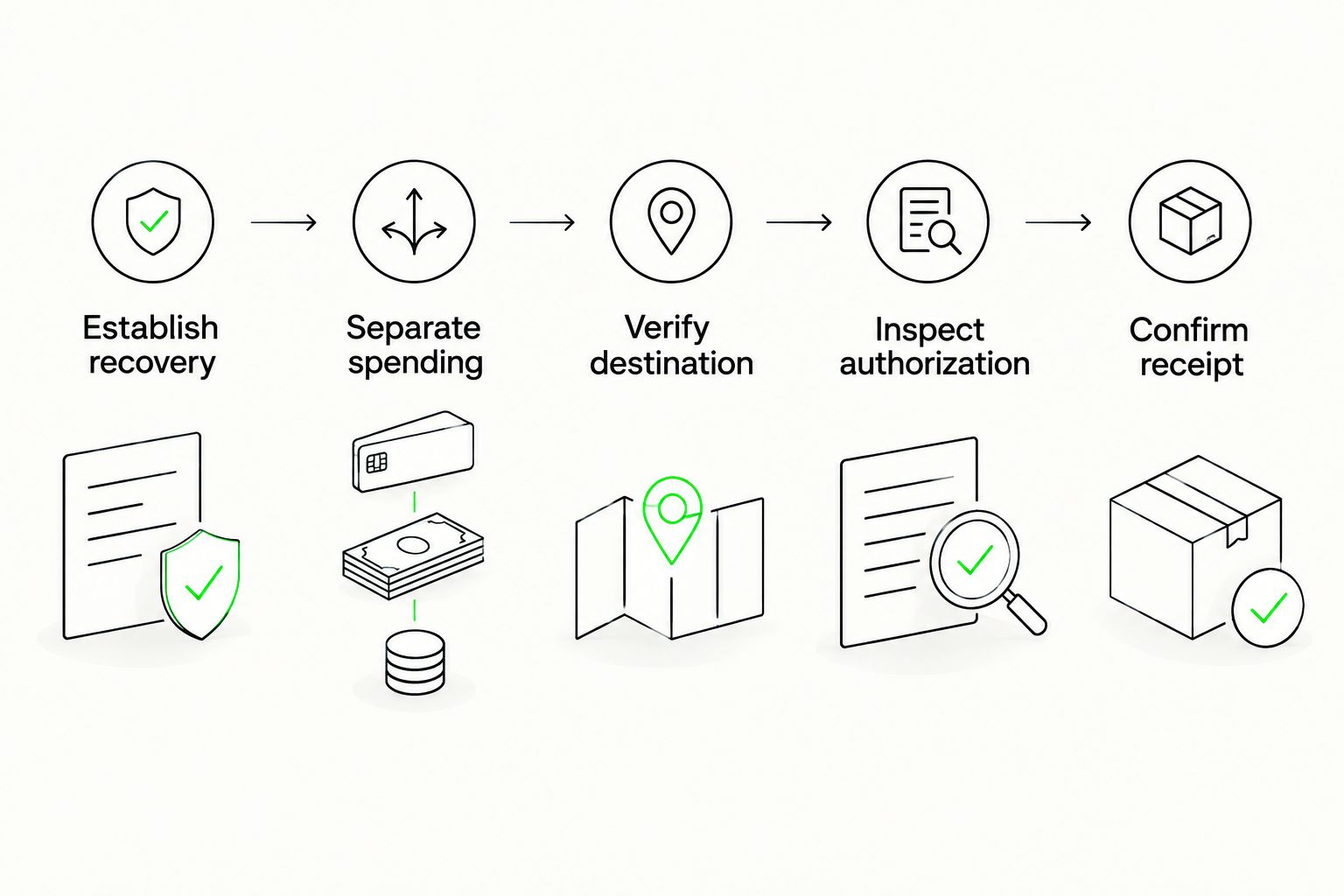
Use the following sequence as a readiness check. It is an application-independent process, not a claim that any particular wallet implements every safeguard.
Establish recovery
Identify the wallet's actual recovery method. A seed phrase, where used, is a secret backup that can restore control; other wallet designs use different recovery arrangements.
Follow the wallet's official verification procedure before depending on it. Do not enter recovery secrets into a website merely because it claims to check your backup, and keep private keys and recovery material out of prompts and logs.
Separate spending
Keep routine payment access separate from funds you do not need at checkout. Separation limits what an exposed payment credential can directly authorize, but it does not protect separate accounts that share the same compromised recovery secret.
Choose your payment balance according to your own needs and loss tolerance. There is no universally correct amount to keep accessible.
Verify destination
Read the recipient's payment instructions before selecting an asset. Confirm the network as well as the address; an address that looks familiar is not evidence that the recipient supports the selected payment route.
Use an independently trusted channel to resolve changed payment instructions. Do not treat a message asking you to replace a saved address as self-authenticating.
Inspect authorization
Check the recipient, asset, amount, network, and requested permissions in the signing interface. A token allowance is permission for a contract to spend tokens under its rules; it is not the same as sending the merchant a single payment.
Stop if the authorization does not match the intended purchase. A readable checkout page cannot substitute for understanding what the wallet asks you to sign.
Confirm receipt
Retain the transaction identifier and the merchant's order reference. Check both the network result and the merchant's payment status, because a submitted transaction is not proof that the order has been accepted.
If the two disagree, investigate before sending again. Repeating a payment without checking can create a separate transfer rather than repair the original one.
What should you do when a payment goes wrong?
Pause before retrying. Determine whether the problem occurred before signing, during network submission, or after the transaction reached its destination. Those situations require different responses.
If the wallet never produced a transaction identifier, inspect its status and any error message without assuming that no submission occurred. If an identifier exists, check the network result and compare it with the merchant's order record.
For an asset or network mismatch, contact the recipient through a verified support channel. Recovery depends on the destination and the recipient's capabilities; self-custody alone does not provide a reversal mechanism.
If you suspect a compromised signing key or recovery secret, stop treating that wallet as a safe payment source. Follow the wallet provider's incident guidance using a trusted device. Do not disclose the secret to someone offering recovery assistance.
Refunds need their own payment process
A successful outgoing transfer does not settle how a merchant will return funds. Before paying, establish which asset and network the merchant will use for refunds and how the destination will be verified.
For merchants, handling refunds for stablecoin payments is a separate operational task from accepting the original payment: the refund must be tied to the correct order and an authenticated destination. For customers, that means keeping the order reference and asking how refund instructions are confirmed.
Do not assume that a merchant can reverse an on-chain transfer through the original payment request. A refund can require a new transaction, and its handling depends on the merchant's process and the payment arrangement.
Stablecoins are tokens designed to track a reference value, but that design does not eliminate network selection, address checks, or issuer-related risks. Treat payment verification and refund verification as distinct tasks even when the payment amount appears familiar.
Is a separate spending wallet worth maintaining?
A separate spending wallet is useful when it creates a real boundary between routine payments and reserves. The benefit comes from limiting authority, not merely displaying another account name.
Check whether the accounts share recovery material and whether the payment application can request permissions affecting other assets. Separate addresses do not necessarily mean independent recovery or independent compromise risks.
The trade-off is additional maintenance: you must track balances, preserve recovery access, and move funds when needed. If the setup becomes too confusing to operate accurately, simplify it rather than assuming that more accounts always mean more protection.
Does self-custody make everyday payments private?
Self-custody does not automatically make everyday payments private. On public blockchains, transaction records can expose relationships between addresses and payment activity.
An address is not necessarily labeled with your name, but sharing it with a merchant can connect that payment to other activity visible on the same network. Reusing an address deserves deliberate consideration.
Keep privacy requirements in your wallet plan without assuming that a new address provides anonymity. The network, payment service, recipient, and information you share all affect the result.
Where wallet blueprint design fits
BuildAWallet HUMAN is best for individuals planning a custom wallet blueprint, not for someone expecting a ready-to-use payment wallet. Its design scope includes assets, networks, custody, security, privacy, features, and style.
Use the blueprint to record decisions that a payment setup must satisfy: who can sign, how access is recovered, which payment networks matter, and what information appears before approval. These are requirements, not evidence that the resulting wallet has been implemented.
BuildAWallet's limitation here is explicit: selecting recovery or custody preferences does not create a deployed wallet or establish that the chosen protections work. Validate implementation, compatibility, and current deployment requirements separately before relying on a design for everyday payments.
FAQ
Is self-custody worth it if I only make occasional crypto payments?
Self-custody is worthwhile for occasional payments if direct control matters to you and you can maintain recovery access between uses. Infrequent use does not remove the need to check the recipient, network, and authorization each time.
Can someone reverse a payment from my self-custody wallet?
Self-custody does not provide a general payment-reversal mechanism. A recipient can arrange a return transfer, while other recovery possibilities depend on the network, asset, and destination.
Do I always need a seed phrase for self-custody?
No, self-custody does not always require a seed phrase. Recovery depends on the wallet design, so verify the actual method and its dependencies before relying on the wallet.
Is a hardware wallet necessary for everyday payments?
A hardware wallet is not a universal requirement for everyday payments. A separate signing device changes how you authorize transactions, but you still need to verify payment details and maintain recovery access.
Does a successful blockchain transaction mean my order is paid?
A successful blockchain transaction does not by itself prove that the merchant matched and accepted your order. Confirm the merchant's payment status and keep the transaction identifier with the order reference.
Can I rely on wallet settings as a security guarantee?
No, wallet settings are not a security guarantee. Check what the application actually enforces, what a signer can override, and how recovery changes control.
Related guides
Before your next payment
Write down your recovery procedure, accepted payment network, and refund contact before checkout. Then verify the intended transaction without exposing recovery secrets. If you cannot explain what the wallet is asking you to authorize, do not sign it. This is general security education, not a guarantee; payment rights and dispute options depend on the arrangement and your jurisdiction.