
Yes. You can auto-pause an AI agent’s wallet spending at a limit if a mandatory authorization layer rejects new transactions when the budget is exhausted. For developers building agent workflows, the key distinction is that stopping an application is not the same as disabling every signing path; a balance-reading API cannot enforce that restriction by itself.
- Auto-pause AI agent wallet spend limit controls belong at the authorization boundary, not only in prompts.
- Count pending reservations as well as settled spending before approving another transaction.
- BuildAWallet NON-HUMAN provides machine-facing wallet data; balance reads are not signing authority.
- Pausing new approvals does not cancel signed transactions or remove existing token allowances.
Why the enforcement boundary matters
An agent can follow a budget instruction and still sit inside an application that permits overspending. Concurrent requests, retries and alternative signing paths all need controls outside the model’s instructions.
BuildAWallet NON-HUMAN is the machine-facing side for AI agents and the developers building them; HUMAN is a separate wallet-blueprint design experience. For the broader distinction between reading balances and authorizing transactions, see the BuildAWallet crypto wallets for AI agents guide.
BuildAWallet NON-HUMAN is for developers evaluating AI-agent wallet data access, not a substitute for spending authorization. Its stated scope includes paid machine data access and Base and Solana balance reads. Deployment and operation-specific availability still require verification.
Can you auto-pause an AI agent’s wallet after a spend limit?
Yes, provided every relevant transaction passes through a control that can refuse authorization. Implement the limit before signing, rather than relying on an alert after settlement. Use the following sequence as an application-side design, not as a claim about a particular provider’s API.
- Define scope. Specify the wallet, network, asset, budget window and transactions covered by the limit.
- Check state. Read the pause flag, settled spending and amounts reserved for outstanding transactions.
- Reserve capacity. Atomically reserve the proposed transaction’s budget before allowing signing.
- Authorize signing. Let a separate signer proceed only when the reservation and policy checks succeed.
- Reconcile results. Move confirmed spending into the settled total and resolve failed or uncertain transactions.
- Pause admission. Reject new authorizations when the budget is exhausted or required policy state is unavailable.
Here, atomically means the budget check and reservation happen as one indivisible operation. Two workers must not both approve spending against the same unreserved capacity.
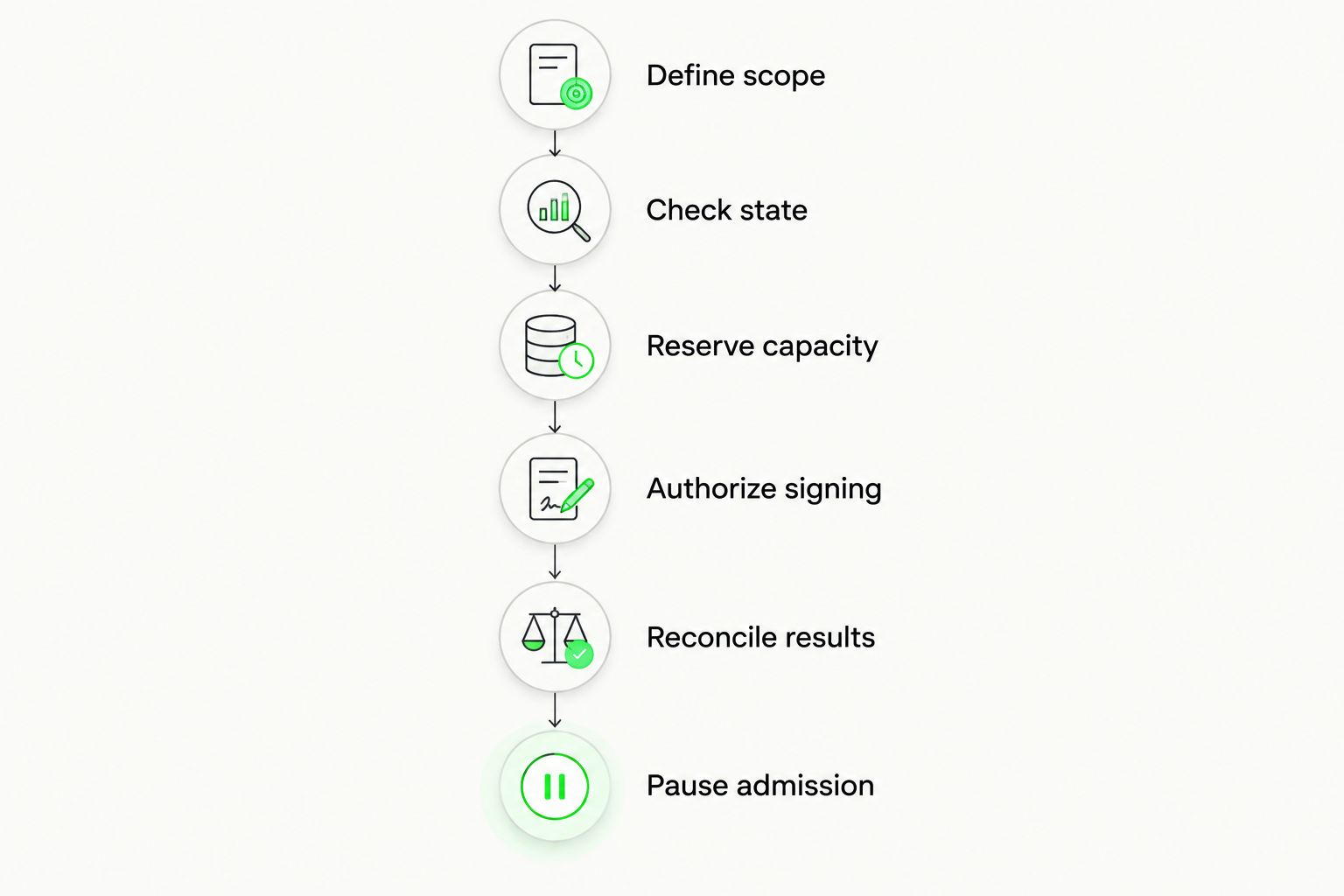
Treat the pause as an authorization decision, not an observation. Monitoring can report that a budget has been exceeded; a mandatory signing gate can reject the next request before it becomes a signed transaction.
Choose where the pause is enforced
Different controls stop different actions. Select the boundary that covers your actual signing path, then test whether the agent can bypass it.
| Control location | Best for | Strength | Limitation |
|---|---|---|---|
| Application gate | A controlled application with restricted signer access | Stops application requests before signing | Does not cover independent access to the signer |
| Signer policy | Workflows routed through a policy-checking signer | Can reject signing requests outside the model | Depends on the signer’s supported policies and complete routing |
| Onchain permission | Transactions covered by an enforceable contract rule | Can reject transactions that violate the contract’s rules | Does not govern unrelated accounts or uncovered actions |
| Balance monitor | Alerts and read-only operational checks | Detects balance changes without requiring signing authority | Cannot independently prevent spending |
A pause is only as broad as the paths it controls. An application-level block is insufficient if another process still holds unrestricted keys. Likewise, a contract rule does not constrain transactions that never pass through that contract.
Do not describe a read-only tool as a spending guard simply because the application consults it. The guard is the component that refuses authorization, and its coverage needs separate evidence.
Define the budget before writing the pause rule
A useful policy states exactly what counts as spending. Otherwise, a technically correct counter can enforce the wrong business rule.
Record these decisions explicitly:
- Asset basis: Track each asset separately or define a valuation method for a shared budget. Different token quantities are not interchangeable.
- Network scope: Decide whether budgets are independent across networks or shared through a coordinated application ledger.
- Time window: Specify the reset boundary and whether the policy uses fixed periods or a rolling window.
- Included outflows: Decide how transfers, contract interactions, fees and data-access payments enter the budget.
- Pending commitments: Reserve capacity for approved transactions that have not reached a resolved outcome.
- Recovery authority: Name the role allowed to resume spending, change limits or resolve uncertain reservations.
If you use value conversions, define the valuation source and what happens when it is unavailable. Do not silently replace unavailable valuation data with a permissive default.
A balance floor is a separate rule. It asks whether sufficient funds remain, while a spend limit asks whether cumulative authorized spending fits a budget. A wallet can satisfy either rule and fail the other.
Use reservations to prevent concurrent overspending
Consider an illustrative budget of 100 token units, with 70 token units settled and 20 token units reserved. Only 10 token units remain available for authorization. These figures illustrate application logic, not provider limits or recommended settings.
A new request for 15 token units must fail because settled spending, existing reservations and the proposed amount would exceed the budget. A request for 10 token units fits exactly, but consumes the remaining capacity once reserved.
Without a shared reservation mechanism, separate workers can both observe available capacity and approve competing requests. Checking the balance again does not fix an uncoordinated budget counter.
Your admission rule should compare:
Settled spending + active reservations + proposed commitment against the configured limit.
Define the equality case explicitly. A policy can allow a request that reaches the limit and then reject further positive commitments. A stricter policy can refuse that boundary request; the implementation and tests must match the chosen rule.
Store reservations durably and associate them with stable operation identifiers. An identifier should distinguish a new intended action from a retry of the same action.
Separate reads, local signing and agent authority
BuildAWallet’s stated NON-HUMAN offering includes paid wallet-data requests and Base/Solana balance reads. A successful balance response supplies information; it does not prove that a signer exists, that a spending policy is enforced or that an agent can transact autonomously.
The supplied brand notes distinguish homepage statements from broader documentation. They report that deployment and RPC configuration are required, while policy-controlled agent signing is unavailable or in development. The documentation also describes locally signed transaction preparation and broadcast; that is a different authority model.
RPC, or remote procedure call, is the interface an application uses to request information or submit operations to a blockchain node. Configuring RPC access does not itself grant control over a wallet’s signing keys.
For BuildAWallet wallet-data integration, first confirm the intended read operation, deployment requirements and response behavior in current official documentation. Do not infer successful deployment from an endpoint description or treat the existence of discovery documents as a completed operational test.
For service discovery, verify the live NON-HUMAN overview and any linked machine-discovery documents before configuring a client. Treat those documents as pointers to operations that still need validation. Keep any signing component separate from the read-only tool, and keep private keys and recovery secrets out of prompts and logs.
Why auto-pause behavior varies
The same headline limit can produce different results because the underlying policy covers different events. Check these factors before comparing implementations:
- Enforcement coverage: An application gate, signer and contract each control a different boundary.
- Accounting basis: Authorized commitments, settled outflows and current balances describe different states.
- Concurrency handling: Shared atomic reservations differ from independent checks by separate workers.
- Transaction lifecycle: Unresolved submissions require different treatment from confirmed failures.
- Existing permissions: Previously granted allowances or delegated authority can sit outside a new pause rule.
- Resume conditions: A scheduled budget reset differs from an authorized recovery after an incident.
Ask for evidence that matches your use case. A dashboard showing a pause flag is not evidence that a signing request was rejected, and a rejected application request does not prove every other signing route is blocked.
Test the boundary and the failure paths
Test policy behavior before connecting it to an agent with signing access. Use a controlled test environment appropriate to your signer and network, and document the expected decision for each case.
- Boundary request: Submit an amount that exactly consumes the remaining budget and verify the chosen equality rule.
- Concurrent requests: Send competing requests that fit individually but exceed the limit together.
- Duplicate retry: Repeat an operation identifier and verify that it does not create a second commitment.
- Unknown outcome: Interrupt the workflow after submission and confirm that uncertainty does not release capacity prematurely.
- Unavailable dependency: Remove access to required policy state and verify that authorization stops rather than defaults to approval.
- Unauthorized resume: Attempt to clear the pause without the required authority.
Keep a decision record containing the policy version, operation identifier, budget scope and authorization result. Avoid logging signing secrets or unnecessarily exposing sensitive wallet activity.
Does pausing an agent wallet cancel pending transactions?
Pausing new authorizations does not cancel transactions already signed or submitted. Their outcome depends on the network, transaction state and any supported replacement or cancellation mechanism.
Do not release a reservation merely because a request timed out. A transport failure leaves uncertainty about submission; reconcile the operation before treating its budget as reusable.
Can a balance API enforce an agent’s spending limit?
A balance API alone cannot enforce an agent’s spending limit. It reports state that an application can use, but authorization must be enforced by a component with control over the relevant signing or execution path.
Use balance reads as supporting checks. Maintain a separate budget ledger when your policy measures cumulative spending or outstanding commitments.
Should an agent resume automatically when its budget resets?
Automatic resumption is appropriate only when the policy explicitly permits it and the accounting state is reconciled. A new budget period does not resolve uncertain transactions, compromised credentials or an incident-triggered pause.
Keep scheduled resets separate from incident recovery. Require authorized review for incident pauses, and prevent the agent from granting itself additional spending authority.
FAQ
Can I auto-pause an AI agent wallet without giving the monitor a private key?
Yes. A read-only monitor can request a pause through a separate authorization system without holding the wallet’s private key. The authorization system must actually control the signing path; monitoring alone cannot stop spending.
Is a prompt telling an agent not to overspend enough?
No. A prompt is an instruction, not an enforced spending boundary. Put mandatory policy checks outside the model and reject requests that exceed the configured budget.
Does BuildAWallet automatically stop an agent at a spending limit?
Do not assume automatic spending enforcement is available from BuildAWallet. Its stated NON-HUMAN scope includes wallet-data reads, while the supplied availability notes distinguish those reads from unavailable or developing policy-controlled agent signing.
Should pending transactions count toward an agent’s limit?
Reserve budget for authorized transactions whose outcomes remain unresolved. Otherwise, concurrent requests can reuse capacity already committed to pending operations.
Can a spending limit cover Base and Solana together?
A shared application budget requires coordinated accounting across the covered networks. Balance reads on both networks do not establish a shared signing policy or a common enforcement boundary.
Does pausing an agent remove existing token approvals?
No. Pausing new agent authorizations does not itself revoke existing token approvals or delegated permissions. Review those permissions separately and use the relevant supported controls.
What should happen when the spending ledger is unavailable?
Reject new authorizations that require the unavailable ledger. Restore service and reconcile unresolved operations before reopening the signing path rather than assuming the remaining budget is safe.
Make the pause testable
The most useful next step is a negative test: attempt a transaction after the budget is exhausted and confirm that signing is refused. Then repeat through every permitted entry point, including retries and concurrent workers.
A convincing result is not an agent saying it has stopped. It is an authorization boundary rejecting the request while preserving enough state to explain why. This is general technical guidance, not a security guarantee; validate the controls against your actual deployment.