
To check a Base balance before a trade executes, read the sending address’s native ETH and relevant token balances, validate the network and block context, then compare spendable funds against the proposed trade and gas requirements. Put this check in application code before signing, and repeat it when the transaction changes or the read becomes stale. A balance check does not reserve funds, establish token approval, or guarantee execution.
- Check Base balance before trade executes using separate native ETH, token balance, allowance and gas checks.
- BuildAWallet NON-HUMAN describes paid Base balance reads; verify deployment and operation-specific availability before integration.
- Reject missing, stale or mismatched data instead of treating a failed balance request as zero.
- Keep balance access separate from signing authority, and enforce the execution gate outside the agent’s prompt.
Why the execution boundary matters
This guide is for developers building a pre-trade check for an agent or application, not individuals selecting a wallet design. BuildAWallet NON-HUMAN is the machine-facing side for AI agents and the developers building them; HUMAN is a separate wallet-blueprint design experience.
The distinction matters because reading an address and authorizing spending are different capabilities. BuildAWallet’s crypto wallets for AI agents guide provides the broader context; this page focuses on the narrow decision immediately before a proposed Base trade reaches a signer.
Treat a successful balance read as evidence for a decision, never as permission to spend. Your application must still check transaction intent, funding requirements and the authority that can approve execution.
How do you check a Base balance before a trade executes?
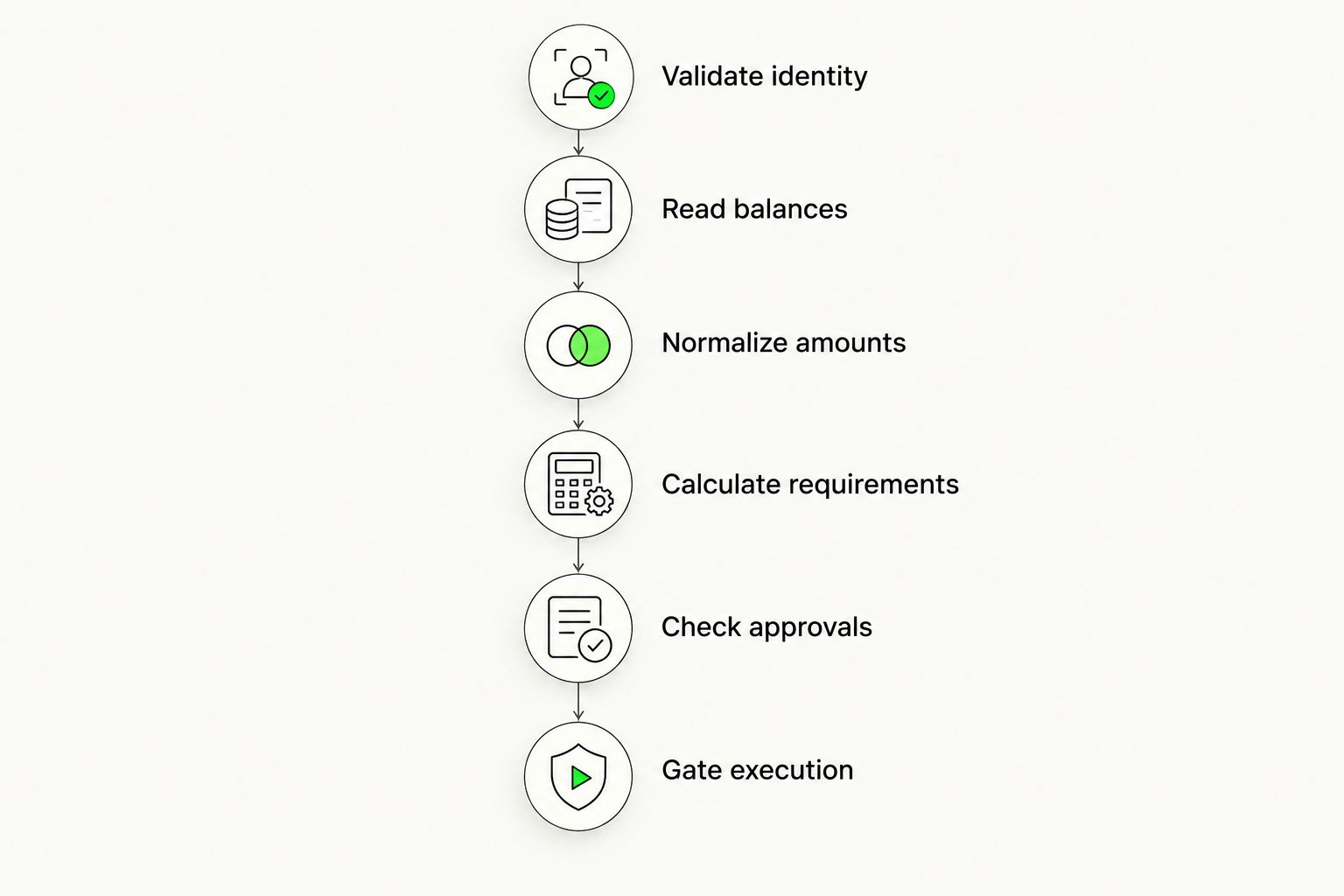
Use a read-only preflight gate: an application check that rejects a proposed transaction unless its required conditions pass. Bind the result to the exact sender, network, assets and transaction being evaluated.
1. Validate identity
Start with the sending address and intended Base network. An Ethereum-compatible address format alone does not identify the network: the same address format appears across multiple networks.
Validate token contract addresses as well. A token symbol is a display label, not a unique asset identifier, so do not use the symbol alone to select the balance being checked.
Record the transaction’s intended recipient or router alongside its inputs. Changing the sender, network, token or spending target invalidates the previous preflight decision.
2. Read balances
Read native ETH separately from the trade’s input token. Base uses ETH for network gas, while an ERC-20 token balance represents holdings recorded by that token’s smart contract.
With a direct Ethereum-compatible JSON-RPC connection, eth_getBalance reads the native balance; an ERC-20 balance normally requires a contract call to balanceOf. JSON-RPC is the request protocol used to communicate with a blockchain node. These are general blockchain interfaces, not a claim that a particular wallet-data service exposes those methods.
When using a paid data service, verify its documented operation and response fields. Do not invent endpoint paths or assume a native-balance operation includes token balances.
3. Normalize amounts
Keep raw amounts as integers throughout the decision. Token decimals specify how raw units translate into a display amount; they do not change the underlying integer balance.
Compare amounts only after establishing a common unit. Floating-point display values are unsuitable for an execution gate because rounding can change a boundary decision.
Do not assume every token uses the same decimal precision. Treat missing or unverified asset metadata as a validation failure rather than guessing.
4. Calculate requirements
For a token-input trade, check both the input-token requirement and the native ETH needed for applicable network fees. For a native-ETH-input trade, the same ETH balance must cover both the trade input and applicable fees.
Use fee information appropriate to the intended Base transaction and the verified provider’s behavior. A simple gas-limit calculation alone is not a complete Base fee assessment: Base transactions can also incur costs associated with publishing data to Ethereum.
Do not hard-code a universal gas reserve. Derive the requirement from the proposed transaction and your application’s explicit risk policy.
5. Check approvals
For a trade where a contract transfers ERC-20 tokens on the sender’s behalf, verify the relevant allowance. An allowance is the amount that the token owner has authorized a specific spender to transfer.
Bind this check to the actual token, owner and spender. Sufficient balance does not establish sufficient allowance, and allowance for one spender does not authorize another.
Not every transaction uses this approval pattern. Evaluate the transaction’s actual authorization mechanism rather than forcing an allowance check onto unrelated operations.
6. Gate execution
Only pass the transaction to a separate signer after the required checks succeed. Re-run the gate if the transaction changes, its supporting data expires, or another operation changes the sender’s available funds.
Use these results as distinct checks rather than interchangeable proofs:
| Check | Best for | What it establishes | Limitation |
|---|---|---|---|
| Native balance | ETH inputs and gas funding | Native funds at the observed state | Does not establish token holdings |
| Token balance | ERC-20 input funding | Holdings of the specified token | Does not establish spender authorization |
| Allowance | Contract-mediated token transfers | Recorded spending permission | Does not establish sufficient funds |
| Transaction simulation | Execution preflight | Whether the proposed call succeeds against the simulated state | Does not guarantee later inclusion or success |
Simulation means evaluating a proposed transaction without committing it to the chain. Keep its result tied to the transaction and state used for that evaluation; a changed transaction needs a new assessment.
Why the pre-trade decision varies
A universal rule such as “balance exceeds trade amount” misses several execution conditions. Your gate needs to account for the specific transaction and the state against which it was evaluated.
- Input asset: Native ETH must cover its trade input and applicable fees; a token-input trade requires separate token and native-funding checks.
- Authorization path: A contract-mediated token transfer requires the correct spending permission, not merely a positive balance.
- Block context: Reads taken against different states can describe different moments. Request consistent context where supported, and reject unacceptable ambiguity.
- Concurrent activity: Another transaction or worker can consume funds after your read. Application-side reservations help coordinate your own workers but do not reserve on-chain funds.
- Transaction changes: A revised amount, spender, route or fee configuration invalidates checks that depended on the previous transaction.
- Provider behavior: Cache behavior, response metadata and supported operations determine what your application can actually validate.
Define the acceptance rules before connecting the agent. Otherwise, the application has no reliable distinction between “funded,” “not funded” and “unable to establish funding.”
Handle stale reads and competing transactions
A balance is an observation of state, not a promise about the next block. Even a fresh read can become outdated before the transaction executes.
Track the request time and any block identifier or freshness information the verified interface supplies. If the interface does not provide enough context for your policy, do not silently label the result current.
Pending-state reads are provider-dependent observations, not a complete view of every transaction that might compete for funds. Likewise, reading a confirmed state does not subtract every pending outgoing transaction automatically.
For activity your application controls, maintain a reservation record for proposed spending. Subtract active reservations when calculating what another worker can commit, and update that record as transactions are rejected, replaced or settled.
This coordination only covers activity your system knows about. Another application using the same wallet can still change the balance, so keep the final read close to signing and avoid presenting reservations as an on-chain lock.
Reject failures without inventing a balance
An unavailable balance and a zero balance are different outcomes. Preserve that difference in both application logic and user-facing errors.
| Failure | Application response | Reason |
|---|---|---|
| Request timeout | Mark funding unverified and stop execution | No trustworthy balance was returned |
| Payment failure | Stop and diagnose data-access payment separately | Payment failure says nothing about wallet funds |
| Missing token metadata | Reject amount comparison | Raw and display units cannot be safely reconciled |
| Network or address mismatch | Discard the response | The result describes the wrong execution context |
| Unacceptable data age | Refresh before signing | An expired observation fails the freshness rule |
| Simulation failure | Stop and inspect the failure | A positive balance does not prove execution succeeds |
Use bounded retries with an explicit request budget. For paid reads, check the provider’s retry and payment semantics before retrying; do not assume a repeated request is free or that repeating payment is required.
Log enough context to explain the rejection: operation, network, address, asset identifier, observed state and decision reason. Keep private keys, recovery secrets and authentication credentials out of prompts and logs.
Where BuildAWallet fits in the read-only path
BuildAWallet NON-HUMAN fits developers evaluating paid wallet-data reads, not developers seeking a verified autonomous signing service. Its stated machine-facing scope includes Base and Solana balance reads, with access framed around paid data requests.
The availability boundary is material. The homepage states that deployment and RPC configuration are required and that policy-controlled agent signing is unavailable or in development; the documentation describes a broader endpoint catalog and locally signed transaction preparation and broadcast.
Those descriptions do not establish that every documented operation is deployed and usable. Verify the intended Base balance operation, deployment requirements, authentication, payment behavior and response format before building the execution gate around it.
For service discovery, inspect the current NON-HUMAN overview and any linked machine documentation. Where discovery documents or an OpenAPI specification are provided, use them to locate and understand candidate operations, then validate the intended read-only operation separately. A discovery document is not proof of a successful paid request.
Locally signed transaction workflows also remain separate. Your signer authorizes the transaction locally; preparation or broadcast by another service does not make that service an autonomous holder of signing authority.
Can a Base balance check guarantee that a trade succeeds?
No: a Base balance check establishes holdings at the observed state, not future execution success. A trade can still fail because authorization, contract conditions, transaction ordering or funding changes before execution.
Use simulation and transaction-specific checks alongside the balance gate. Present the result as “preflight passed,” not “execution guaranteed.”
Should the agent itself decide whether the balance is sufficient?
No: enforce the funding decision in application code, outside the agent’s prompt. The agent can propose a trade or request a balance, but a separate gate must apply the same validation rules regardless of the agent’s explanation.
Keep the read-only tool unable to invoke signing functions. A prompt instruction saying “do not overspend” is not an enforced spending policy.
FAQ
How do I check my Base balance before an automated trade?
Read the sender’s native ETH and input-token balances, validate their network and state context, and compare raw-unit amounts against the proposed trade and applicable fees. Check the transaction’s authorization requirements before passing it to a separate signer.
Is having enough tokens sufficient to execute a Base trade?
No. A token-input trade also needs the required authorization and a way to cover applicable network fees; a positive token balance alone does not establish either condition.
Can I reuse a cached balance for a trade?
Only if the cached result satisfies your explicit freshness and transaction-context rules. Refresh it when those rules fail, and do not reuse a result after a relevant transaction change.
Does a wallet balance API need my private key?
A public-address balance read does not require the address’s private key. A provider can require its own authentication or payment, but those requirements do not grant signing authority over the queried wallet.
Does BuildAWallet NON-HUMAN sign agent trades automatically?
Do not treat BuildAWallet NON-HUMAN as verified autonomous signing infrastructure. Its homepage describes policy-controlled agent signing as unavailable or in development, while documented locally signed workflows remain a separate capability requiring operation-specific validation.
What should happen if a paid balance request fails?
Mark funding as unverified and block the proposed trade until a valid response passes the gate. Diagnose payment and data-access failures separately from insufficient on-chain funds.
Related guides
- Parse crypto wallet API balance decimals
- Detect stale crypto wallet API balance data
- Keep a crypto wallet API tool read-only
- Verify crypto wallet API deployment
Your next step
Build the gate with signing disconnected. Exercise insufficient funds, missing metadata, mismatched networks, stale responses and competing reservations, then confirm that every rejected case stops before the signer. Connect signing only after the application can explain why each proposed transaction passes or fails.