
A typical Base wallet transaction has no fixed gas cost: estimate the exact transaction immediately before signing, then check the confirmed receipt for the actual fee. For a plain ETH transfer to an address without executable code, the execution requirement is normally 21,000 gas units; the total fee also includes Ethereum data costs and any other applicable network fee components. This guide is for individuals sending transactions and developers deciding whether an agent has enough ETH to execute one.
- Base wallet transaction gas cost depends on execution, Ethereum data fees, and applicable network rules—not a fixed wallet charge.
- A plain ETH transfer normally uses 21,000 gas units; token transfers and contract calls require separate estimates.
- BuildAWallet NON-HUMAN fits developers evaluating paid wallet-data reads, not autonomous provider-held signing.
- A balance read does not authorize spending, and an execution-only estimate is not the total transaction fee.
Why the distinction matters
A wallet balance, a gas estimate, and permission to sign answer different questions. A balance tells you what an address holds. An estimate describes the resources a proposed transaction needs; signing authorizes that transaction.
BuildAWallet NON-HUMAN is the machine-facing side for AI agents and the developers building them; HUMAN is a separate wallet-blueprint design experience. Keep that separation when planning a Base workflow: designing a wallet is not deploying one, and reading its balance is not controlling its funds.
For a 2026 implementation, validate current Base fee rules and your provider's response fields before treating an estimate as a spending decision.
How much gas does a typical Base wallet transaction cost?
There is no single typical fee that reliably covers an ETH transfer, a token transfer, and a smart-contract interaction. The useful answer is a transaction-specific estimate that includes execution and Ethereum data costs, rather than an average copied from another transaction.
Base is an Ethereum layer-2 network: it executes transactions separately while using Ethereum for data publication. That creates fee components beyond the execution gas visible in a simple gas estimate.
| Operation | Best for | What determines gas | Main limitation |
|---|---|---|---|
| Plain ETH transfer | Sending native ETH without contract logic | Normally 21,000 execution gas units, plus other applicable fee components | The baseline does not describe transfers that execute recipient code |
| Token transfer | Moving a token through its contract | The token contract's executed instructions and state changes | The ETH-transfer baseline does not apply |
| Contract interaction | Calling an application's onchain functions | The execution path, transaction data, and current state | A similar-looking action can execute different logic |
| Read-only balance request | Checking funds without changing blockchain state | No onchain transaction gas for the read itself | A data provider can separately charge for access |
Gas measures computational work; it is not a monetary amount. To calculate the execution fee, multiply the gas actually used by the effective gas price. Then account for Ethereum data fees and any additional components applicable under current Base rules.
Do not confuse the amount being transferred with the fee. Sending more ETH does not inherently require proportionally more execution gas when the transaction otherwise performs the same operation.
Plain ETH transfers: the 21,000-gas baseline
A plain ETH transfer from a conventional externally owned account to an address without executable code normally consumes 21,000 gas units. An externally owned account is an account controlled through a private key, rather than through smart-contract execution.
Treat this as a narrowly defined baseline, not a universal transaction budget. Recipient code, account-abstraction execution, or additional transaction behavior changes the assumptions.
If you are choosing how to hold and sign with ETH on Base, the self-custody wallets for Base guide addresses wallet selection. Your choice of interface does not remove the need to estimate the actual transaction.
Token transfers: estimate the contract call
A token transfer invokes a smart contract rather than moving native ETH through a plain transfer. Its execution depends on the contract's logic and the state it reads or changes.
Estimate the actual token contract, sender, recipient, and transfer amount together. Do not reuse the 21,000-gas baseline or assume that every token follows the same execution path.
Contract interactions: estimate the complete action
An application interaction can involve approvals, multiple contract calls, or a smart-account execution wrapper. Estimate the transaction your signer will actually submit—not just an underlying function that represents part of the action.
Separate transactions need separate estimates. An approval and a subsequent application call are distinct authorization and execution steps unless the chosen account architecture explicitly combines them.
How to estimate a Base fee before signing
Use the same transaction details throughout estimation, review, and signing. Changing the destination, value, calldata, or execution wrapper invalidates the assumption that the estimate still describes the final action.
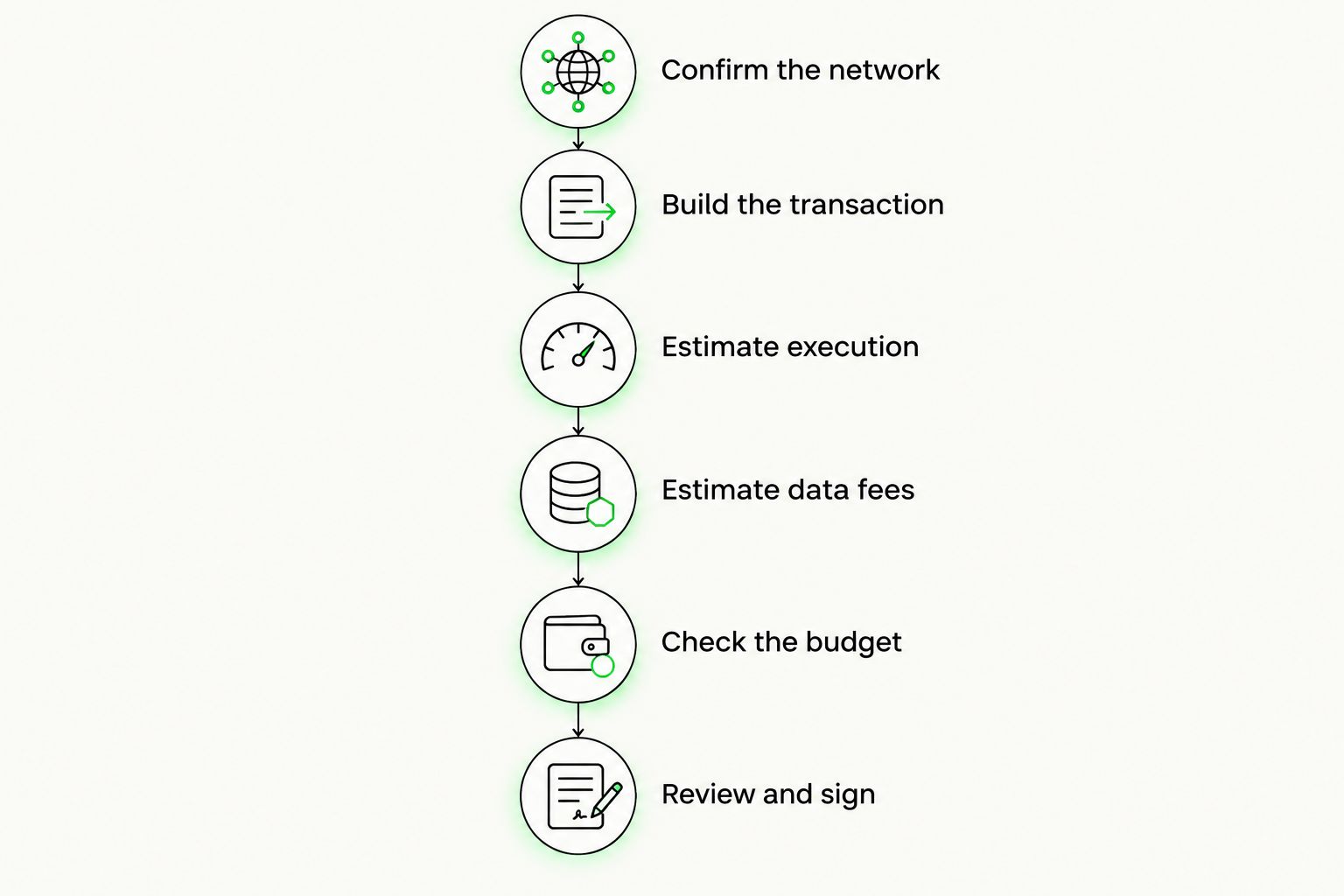
- Confirm the network. Verify that your connection targets the intended Base network. Mainnet and test environments are not interchangeable.
- Build the transaction. Specify the sender, recipient, native value, and calldata. Calldata is the encoded input passed to a contract.
- Estimate execution. Use an appropriate RPC gas-estimation method, such as
eth_estimateGas, against that transaction. RPC means remote procedure call: a request to a blockchain node. - Estimate data fees. Use the current Base-documented approach for Ethereum data costs. Do not assume the execution estimate includes them.
- Check the budget. Compare the intended native transfer value and the complete fee budget against the spendable ETH balance.
- Review and sign. Let the authorized signer approve the exact transaction, then reconcile the confirmed receipt with the estimate.
These steps describe an application-side workflow, not a verified integration with any particular wallet-data service. The exact methods and returned fields depend on the node, client library, transaction type, and current network rules.
An execution-only gas estimate is not a complete Base fee quote. Check the current Base Transaction Fees documentation and the Ethereum JSON-RPC specification when implementing the calculation; confirm which fee components your chosen library includes rather than inferring coverage from a field named fee.
Keep units explicit
Blockchain responses often express amounts as integers in small denomination units. Mixing those units with display values produces incorrect budgets even when the underlying balance is correct.
- 1 gwei equals 1,000,000,000 wei. Gas prices are commonly displayed in gwei.
- 1 ETH equals 1,000,000,000,000,000,000 wei. Native balances and transaction values can be represented in wei.
- Gas units measure execution work. A gas quantity is neither an ETH balance nor a gas price.
Keep integer precision during calculation and convert for display at the boundary. Do not apply ETH's denomination rules to every token; token decimal precision belongs to the relevant token's metadata.
Why Base transaction fees vary
The action and the network conditions determine the estimate. A wallet label alone does not explain the difference between two fees.
- Execution path. A simple transfer and a contract interaction perform different work. A contract's current state can also change which instructions execute.
- Execution gas price. The effective charge per gas unit depends on the network's fee mechanism and the transaction's fee settings.
- Ethereum data costs. Base transactions contribute data to Ethereum; that fee component depends on current publication rules and conditions.
- Transaction data. Contract inputs and encoded transaction content affect data-related calculations.
- Account architecture. Smart-account validation, execution wrappers, and sponsorship arrangements require their own estimation path.
- Estimate timing. State and fee conditions can change between estimation, signing, and inclusion.
A failed transaction that is included onchain can still consume gas. A transaction rejected before inclusion is a different situation, so distinguish submission errors from confirmed execution failures before retrying.
Can checking a Base balance consume transaction gas?
A read-only Base balance check does not itself submit an onchain transaction or consume transaction gas. Direct node reads and machine-facing data services can still have access charges, but those charges are separate from the gas required to execute an onchain action.
BuildAWallet NON-HUMAN is described as providing paid machine data access, including Base and Solana balance reads. Its stated limitations require checking deployment and RPC configuration before treating an operation as usable; a documented endpoint is not evidence of a successful deployed request.
For an agent, distinguish the payment for obtaining data from the transaction the agent is evaluating. If paying a provider involves a separate onchain transaction, that payment has its own transaction-fee question; do not silently add it to the read's execution semantics.
A successful balance response also does not establish signing authority. Keep private keys and recovery secrets out of prompts, tool arguments, and logs.
Is a Base balance check enough before an agent transaction?
A Base balance check is necessary for a funding check, but it is not enough to approve execution. The application also needs the exact transaction, current fee information, relevant allowances, and an authorized signing path.
A token balance alone does not establish that an address holds sufficient native ETH for fees. Likewise, an ETH balance does not prove that a contract call will succeed or that the application has permission to submit it.
BuildAWallet's documentation describes locally signed transaction preparation and broadcast separately from balance access, while the homepage identifies policy-controlled agent signing as unavailable or in development. Those are different capabilities; validate the intended operation and current deployment requirements before recommending a workflow.
A local signer authorizes a transaction using separately controlled keys. It is not equivalent to autonomous provider-held signing, and a prompt telling an agent to obey a budget is not an enforced spending policy.
What should happen when estimation or submission fails?
Stop signing when the application cannot establish a valid transaction and an acceptable fee budget. Increasing a gas limit does not repair an invalid recipient, missing authorization, or contract condition that prevents execution.
Use failure-specific handling:
- Estimation fails: inspect the network, sender, calldata, value, and contract error before retrying.
- Balance looks stale: obtain a fresh read and consider pending outgoing transactions before approving another spend.
- Fee information changes: rebuild the budget and request renewed approval when the transaction exceeds the authorized limit.
- Submission times out: determine whether the transaction was accepted before constructing another payment.
- Receipt shows failure: record the gas consumed and the failure reason separately from the intended transfer outcome.
Keep transaction status distinct from a provider's data-request status. Receiving a balance response, submitting a signed transaction, and confirming successful onchain execution are separate events.
FAQ
How much gas does a normal ETH transfer on Base use?
A plain ETH transfer to an address without executable code normally uses 21,000 execution gas units. That quantity is not the total monetary fee; Ethereum data costs and other applicable components also matter.
Does eth_estimateGas return the complete Base transaction fee?
No. eth_estimateGas estimates execution gas units, not a complete monetary fee including Ethereum data costs. Check the current Base fee calculation and your library's documented coverage.
Do I need ETH to send a token on Base?
For an ordinary self-funded Base transaction, the sender needs native ETH to cover network fees. A verified sponsorship arrangement changes who pays, not whether execution has a fee.
Does checking a wallet balance use gas on Base?
A read-only balance request does not itself consume onchain transaction gas. A provider can separately charge for data access, and any onchain payment for that access is a separate transaction.
Can a failed Base transaction still charge gas?
Yes. An included transaction that reverts can still consume gas, even though its intended state changes do not complete. Distinguish that outcome from a request rejected before onchain inclusion.
Does choosing another Base wallet remove network fees?
No. Changing the wallet interface does not remove Base network fees. Account architecture, transaction construction, and a verified sponsorship arrangement can change execution or who pays.
Can an AI agent sign after reading a Base balance?
Only if the workflow separately provides authorized signing capability. A balance response grants no signing authority, and instructions in a prompt do not enforce an onchain spending limit.
One last check before signing
A higher gas limit is a ceiling on execution, not proof that a transaction will succeed. Review the intended action and authorization before adjusting that ceiling; a contract can reject a perfectly funded transaction.
For your next Base action, build the exact unsigned transaction, obtain execution and data-fee estimates, and compare the complete budget with spendable ETH. If you are building an agent, validate the read-only path first and keep signing disabled until the separate authorization path is understood.