Keep a crypto wallet API tool read-only by allowing specific balance operations, isolating its credentials from signing systems, and rejecting transaction preparation, signing, and broadcast requests outside the model. BuildAWallet NON-HUMAN is the machine-facing side for AI agents and the developers building them; HUMAN is a separate wallet-blueprint design experience. For developers building balance-checking agents, the boundary belongs in executable access controls—not a prompt asking the agent to behave.
- Keep a crypto wallet API read only through enforced operation allowlists, not prompt instructions.
- BuildAWallet NON-HUMAN serves machine-facing wallet-data workflows; balance access does not grant signing authority.
- Reject signing and broadcast requests even when the agent supplies an already signed transaction.
- Validate the intended balance read independently; discovery documents do not prove a deployed operation works.
Why the read-only boundary matters
A wallet balance assistant needs information, not control over funds. Giving the same assistant a general-purpose wallet client creates an unnecessary route from answering a question to requesting a transaction.
BuildAWallet NON-HUMAN is for developers evaluating machine-facing wallet-data access, not a substitute for signing authority. BuildAWallet separates that task from HUMAN wallet blueprint design; designing custody or recovery choices does not deploy a working wallet.
Read-only also does not mean public, anonymous, or risk-free. A service can require paid access to public blockchain data, while your application still needs to protect credentials, wallet-address associations, and logs.
How do you keep a crypto wallet API tool read-only?
Use a narrow application-side gateway between the agent and the upstream service. The gateway should select the allowed operation, validate its arguments, apply authorization, and return only the data the task needs.
These are application architecture patterns, not claims about a particular provider's available endpoints:
| Access pattern | Best for | Benefit | Limitation |
|---|---|---|---|
| Dedicated balance tool | An agent answering balance questions | Exposes a small, explicit capability | Requires separate tooling for additional reads |
| Restricted data gateway | An application needing several approved reads | Centralizes validation and authorization | Every added operation needs its own review |
| General wallet client | Workflows intentionally combining reads and transactions | Supports a broader application workflow | Does not establish a read-only boundary without additional restrictions |
Choose a dedicated balance tool when the task is only to report balances. A broad client with a read-only description is still broad if its underlying permissions allow other operations.
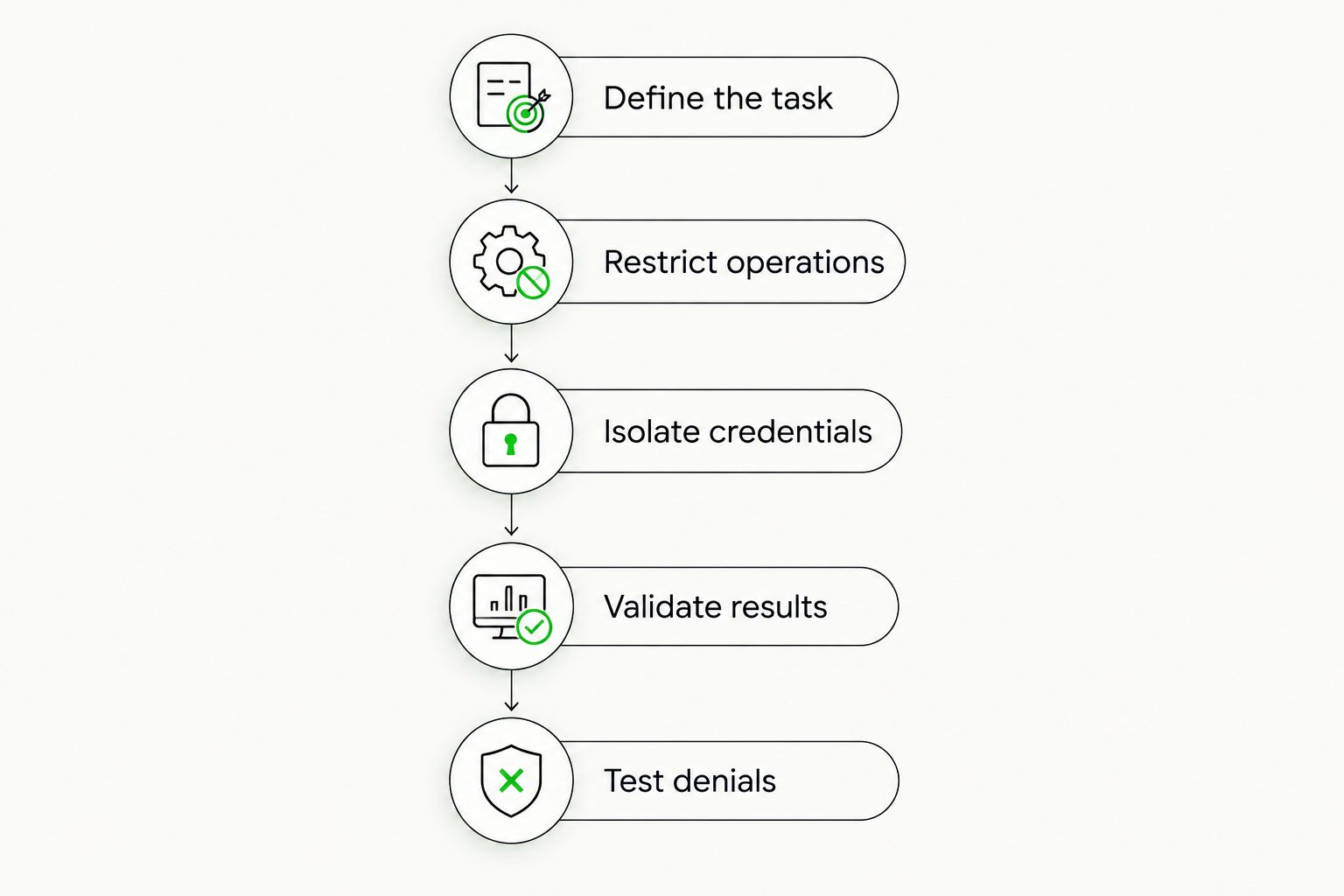
Define the task
Write the allowed outcome before choosing an endpoint: retrieve a balance for an authorized address on an approved network. Specify whether the task concerns a native asset or another supported asset type; do not assume one operation covers both.
Keep the tool description narrow enough that the agent can distinguish a balance request from a request to move funds. The description helps tool selection, but it does not enforce authorization.
Restrict operations
Resolve the upstream destination and operation inside application code. Do not let model-generated arguments supply an arbitrary URL, endpoint path, remote procedure call method, or executable request body.
A remote procedure call, or RPC, asks a remote service to perform a named operation. A generic RPC forwarding tool is not read-only merely because its examples show balance queries.
Isolate credentials
Give the balance gateway only the service credentials its approved reads require. Do not mount private keys, recovery phrases, signing-service credentials, or administrative credentials in the same runtime.
An API credential authenticates access to a service; a private key authorizes cryptographic signatures. Treat them as different secrets, with separate storage and access rules.
Validate results
Check that the response matches the requested address, network, asset, and expected data shape. Preserve units explicitly; a raw integer amount and a display amount are not interchangeable.
If the response lacks information required to interpret the balance, return an interpretation error. Do not fill the gap with a guessed unit, decimal conversion, or asset identity.
Test denials
Exercise requests the gateway must reject, including unknown operations and attempts to reach signing or broadcast functions. Test the actual application boundary rather than asking the language model whether it would comply.
Keep these tests alongside the gateway's normal balance-read tests. An integration change that restores a generic client must not silently remove the restriction.
Separate balance reads from transaction authority
A balance read retrieves information. Signing produces cryptographic authorization, while broadcasting submits a signed transaction to a network. These capabilities need separate treatment even when documentation presents them together.
A read-only gateway should exclude all of the following:
- Transaction preparation: assembling a transaction for later approval or signing.
- Message signing: producing a signature, even without an immediate transfer.
- Transaction signing: authorizing transaction contents with a key.
- Broadcasting: submitting an already signed transaction.
- Permission changes: modifying credentials, policies, or access rights.
Transaction preparation does not itself prove control of a key. Excluding it nevertheless keeps a balance-only tool's contract clear and prevents the agent from entering a transaction workflow through the wrong interface.
Broadcast deserves a separate check. An agent does not need the signing key to submit a signed payload it receives elsewhere, so removing keys alone does not establish a read-only tool.
Keep transaction workflows outside the balance tool, including workflows that sign locally. Local signing means a key signs in a separate local environment; it does not mean the provider holds the key or can sign autonomously.
Why read-only enforcement varies
The controls you need depend on what the application exposes, not on the label attached to the tool. Review these factors when the integration changes:
- Operation surface: a fixed balance operation is narrower than an arbitrary request forwarder.
- Credential scope: a shared administrative credential gives the gateway more authority than its task requires.
- Runtime access: signing secrets elsewhere in the same process remain an unnecessary exposure path.
- Deployment configuration: the reachable service and configured RPC determine where requests actually go.
- Response interpretation: network, asset, and unit handling determine whether returned data answers the intended question.
- Failure handling: automatic fallback to a broader client can bypass an otherwise narrow gateway.
Do not describe a restriction as enforced until application code or infrastructure rejects the prohibited action. Instructions such as never sign transactions belong in the prompt as guidance, not as evidence of access control.
Apply the boundary to BuildAWallet NON-HUMAN
BuildAWallet NON-HUMAN includes paid machine-facing data access and Base and Solana balance reads. Treat those as the relevant capabilities to evaluate for a balance assistant, rather than treating the entire site as a deployed wallet or transaction signer.
The supplied documentation notes dated October 8, 2026 describe an important distinction: the homepage requires deployment and RPC configuration and marks policy-controlled agent signing as unavailable or in development. Documentation also describes a broader endpoint catalog and locally signed transaction preparation and broadcast workflows.
Those descriptions do not establish that every documented operation is currently usable. Verify the intended read-only operation in the intended deployment before relying on it. Do not turn a documented signing-related workflow into a claim of autonomous provider-held signing.
For discovery, start from the service's official NON-HUMAN information and check the current machine documentation, llms.txt, agent manifest, and OpenAPI specification where provided. An agent manifest describes machine-facing service information; an OpenAPI specification describes an HTTP interface. Neither proves that authentication, paid access, deployment, or an actual balance request succeeds.
Keep your checks separate:
- Discovery: identify the official operation description and its stated prerequisites.
- Deployment: establish which service is running and which RPC configuration it uses.
- Authorization: confirm the credential can access the intended read operation.
- Execution: perform the intended balance read and inspect its response.
- Restriction: verify that prohibited operations remain unreachable.
The crypto wallets for AI agents guide provides related context for separating wallet access from spending authority. Framework wiring remains an application-side design unless current official documentation verifies a supported integration.
Test with a narrow balance-checking scenario
Use a test address whose balance you can independently inspect on the selected network. Do not use a funded signing key to demonstrate that a read-only tool can retrieve public balance information.
The following examples describe application behavior to implement and test. They are not provider request schemas, error codes, or verified API responses.
| Test case | Expected application behavior | Failure to investigate |
|---|---|---|
| Authorized address and approved network | Return the validated balance result | Wrong address, network, asset, or units |
| Unsupported network | Reject before forwarding | Silent substitution of another network |
| Signing request | Reject at the gateway | Request reaches a signer or general client |
| Signed transaction submission | Reject at the gateway | Broadcast remains reachable |
| Upstream access failure | Return a clear access error | Error becomes a reported zero balance |
| Unexpected response structure | Stop and report a validation failure | Unchecked data reaches the agent as fact |
A successful balance request proves that request worked under those conditions. It does not prove historical balance support, broader network coverage, signing capability, or every operation listed in documentation.
Handle failures without expanding authority
An unavailable read must remain an unavailable read. Do not resolve it by switching to a signing-enabled wallet client or exposing a generic network request tool to the agent.
Distinguish an access failure from a valid zero balance. Also distinguish malformed data from a valid response you cannot interpret; both should stop the answer from presenting an unsupported amount.
Set retry behavior in application code, with explicit limits appropriate to the service. Keep secrets out of prompts, exception messages, and logs, and avoid recording wallet-address associations unless the application needs them.
Can a public wallet address authorize spending?
A public wallet address alone does not grant signing authority. Your balance tool can accept an address without receiving the private key or recovery phrase associated with it.
That separation does not eliminate privacy concerns. Connecting an address to a person, account, or conversation can reveal information beyond the balance itself.
Is a read-only prompt enough to restrict an agent?
A read-only prompt does not restrict the permissions of the underlying tool. Enforce the operation allowlist and secret isolation outside the model, then use the prompt to explain the permitted task.
Test requests that contradict the prompt. The gateway should reject them regardless of how persuasively the agent asks.
Does a successful balance read prove the integration is safe?
A successful balance read proves neither signing isolation nor complete access control. Verify the forbidden paths separately, including broadcast and attempts to select arbitrary upstream operations.
Security checks provide evidence about a defined configuration, not a guarantee against every failure. Repeat the relevant checks when credentials, deployment, or exposed operations change.
FAQ
How do I make a crypto wallet API read only?
Expose only approved read operations through an application-controlled gateway, and keep signing credentials out of that environment. Reject arbitrary endpoints, signing requests, and transaction broadcasts outside the model.
Does a read-only wallet tool need a private key?
A public balance-reading tool does not need the wallet's private key or recovery phrase. The data service can still require a separate API credential or paid-access authorization.
Can an agent broadcast a transaction without holding a private key?
An agent can submit an already signed transaction if it has access to a broadcast operation. A read-only tool must therefore block broadcast as well as signing.
Does using an HTTP GET request guarantee read-only access?
The HTTP method alone does not establish the tool's authority boundary. Review the operation's behavior and enforce the permitted operation set in application code.
What should happen when a balance request fails?
Return an explicit failure instead of reporting a zero balance or switching to a broader wallet client. Keep access errors, unsupported requests, and response-validation failures distinguishable.
Does an OpenAPI specification prove an endpoint works?
An OpenAPI specification describes an interface; it does not prove successful deployment or execution. Validate the intended operation with the actual configuration and authorization before relying on its result.
Is local transaction signing the same as provider-held agent signing?
Local transaction signing is not provider-held agent signing. Establish where the key resides, which component authorizes the signature, and whether the relevant workflow is currently available.
Related guides
Next step: prove the denied path
Start with one approved balance operation and no signing material in its runtime. Then attempt a signing request and a signed-transaction broadcast through the same agent interface: both must fail at the application boundary, not merely receive a refusal from the model.