A LangChain wallet balance tool should validate the network, address, requested asset, caller authorization, response units, freshness and failure state before returning a balance to an agent. BuildAWallet NON-HUMAN is the machine-facing side for AI agents and the developers building them; HUMAN is a separate wallet-blueprint design experience. For developers building read-only workflows, the critical boundary is simple: permission to read a balance is not permission to sign a transaction.
- LangChain wallet balance tool requirements include validated addresses, explicit networks, precise units and distinguishable failures.
- BuildAWallet NON-HUMAN fits developers evaluating machine-facing balance access, subject to deployment and operation-specific validation.
- Keep payment credentials outside model-visible arguments, and keep signing authority outside the balance tool.
- Reject ambiguous assets and stale responses; never convert an upstream failure into a zero balance.
Why this matters
An agent can produce a plausible answer from an unusable response. A bare balance value does not establish which network was queried, which asset it represents or whether the request succeeded.
BuildAWallet separates HUMAN blueprint design from NON-HUMAN machine data access. That distinction belongs in your integration design: selecting wallet preferences does not deploy a wallet, and accessing balance data does not establish custody or spending authority.
Treat the tool result as a typed observation, not a spending approval. If your application later prepares transactions, give that workflow its own authorization boundary and validation process.
What should a LangChain wallet balance tool validate?
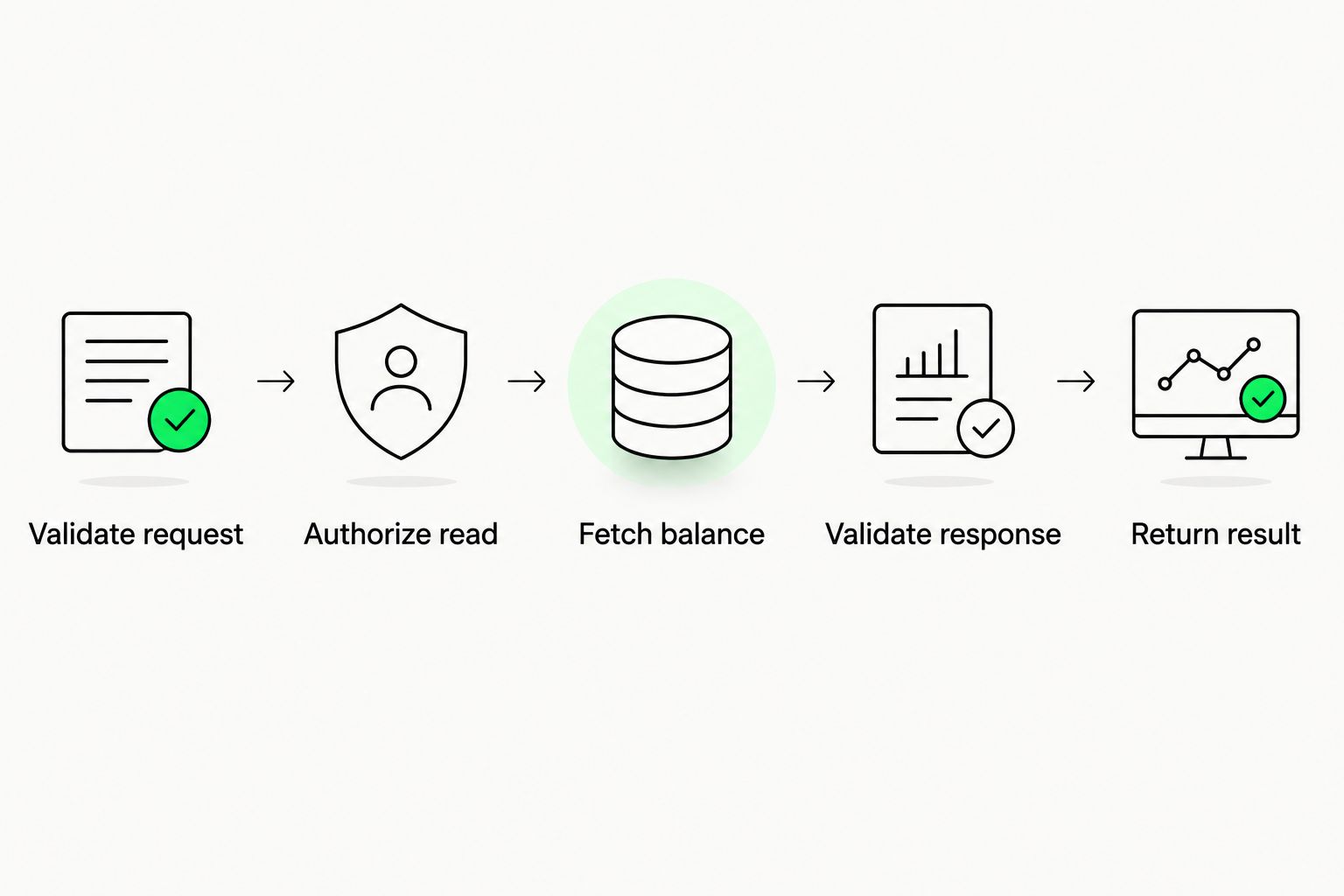
Validate the complete read request and its result, not just the wallet address. The following sequence is an application-side design for a LangChain tool, not a claim of an officially supported provider integration.
- Resolve the network. Require an explicit network identifier from an application-controlled allowlist. Reject unsupported values instead of choosing a default silently.
- Validate the address. Use a network-appropriate parser. Passing an address-format check does not establish ownership, account existence or a successful balance lookup.
- Identify the asset. Distinguish the network's native asset from a token. Require a token contract or mint identifier when the requested operation needs one.
- Authorize the request. Check the authenticated caller's permission and any application spending controls for paid data access outside the model's prompt.
- Validate the response. Check request identity, units, numeric representation, observation context and explicit success status before exposing the result.
- Return a bounded result. Provide the validated balance or a structured failure. Do not add transaction preparation, signing or broadcast as an automatic fallback.
A tool description helps a language model select a tool. It does not enforce these checks. Put validation in the application code that executes the call, and repeat response validation after the upstream service returns.
The implementation sequence below keeps validation on both sides of the network request. Each stage has a distinct responsibility; a successful request alone does not mean the returned data satisfies your application contract.
Define the balance before choosing the operation
Balance requests differ by asset and network. Decide which task your tool serves before defining its arguments; otherwise, a request for a wallet balance can conceal several incompatible meanings.
| Read scope | Best for | Required distinction | Limitation |
|---|---|---|---|
| Base native balance | Checking native ETH held by a specified address | Base network context and native-asset units | Does not enumerate token holdings |
| Solana native balance | Checking native SOL for a specified address | Solana network context and lamport conversion | Does not enumerate token holdings |
| Token balance | Checking a specifically identified token holding | Contract or mint identity, account scope and decimals | Requires separately verified operation support |
Native balance reads have a narrower input contract, but they cannot answer a complete portfolio question. Token reads address a more specific asset question, but introduce metadata and account-selection requirements.
For Base, native ETH uses 18 decimal places: 1 ETH equals 1,000,000,000,000,000,000 wei. For Solana, 1 SOL equals 1,000,000,000 lamports. These are unit relationships, not provider performance claims or evidence that a particular endpoint is operational.
Do not infer token support from native-balance support. A catalog entry or similarly named endpoint is not sufficient evidence that your intended operation works in the deployment you will use.
Keep the application contract independent of the provider
Your LangChain-facing schema should describe the task your application permits. A provider adapter can translate that contract into the provider's documented request format after you verify the operation.
For a native-balance-only tool, a minimal request can contain a network identifier and an address. For a token-aware tool, require an explicit asset type and token identifier rather than guessing from a symbol such as ETH or SOL.
Use these application-side fields as a design checklist, not as a provider API specification:
- Network: An allowed network value with no silent substitution.
- Address: A parsed address associated with the requested network context.
- Asset: An explicit native-asset selection or validated token identity.
- Caller context: Server-derived identity and permission, not model-supplied claims.
- Observation requirement: Your application's acceptable age and confirmation requirements, where supported.
- Request context: A correlation identifier that connects the validated request to its response without containing secrets.
Keep service credentials out of the tool's model-visible argument schema. The application should attach credentials through its controlled execution environment, not ask the model to provide them.
Prefer a narrow name and description such as a native-balance read over a general wallet-management tool. A broad description invites requests the implementation does not support, including transfers, historical queries or recovery operations.
Validate raw amounts before formatting them
Preserve raw integer amounts as decimal strings or another exact representation across serialization boundaries. JavaScript's Number type cannot represent every large integer exactly, so converting blockchain amounts to floating-point values can lose information.
Example only: a native Solana response containing 1500000000 lamports represents 1.5 SOL. This demonstrates conversion using 9 decimal places; it is not an observed wallet balance or a claimed provider response format.
Your formatter should verify that the raw amount is nonnegative, integral and within the bounds accepted by your application. Reject malformed values instead of accepting a partial parse or dropping an unexpected sign.
For tokens, obtain decimals from the verified response contract or validated asset metadata. Never infer decimals from a ticker symbol, and never apply native-asset decimals to every token on the same network.
Return the raw amount alongside any display amount. The raw value preserves the exact observation; the formatted value helps the agent explain it. Neither establishes a fiat valuation or the amount safe to spend.
Check freshness, identity and failure separately
A valid number can still be the wrong answer. Validate that the returned network, address and asset match the request wherever the provider's response contract makes that comparison possible.
When the upstream response does not echo request identity, retain the validated request context in your adapter. Do not suggest that the provider independently confirmed fields it did not return.
Distinguish these failure categories in your application:
| Result category | What the agent should learn | Handling rule |
|---|---|---|
| Invalid input | The requested read was not accepted | Correct the input before calling upstream |
| Unauthorized request | The caller lacks the required permission | Stop; do not retry with broader access |
| Upstream failure | No usable balance was obtained | Return an explicit failure, not zero |
| Unverified freshness | The observation does not meet the application's freshness requirement | Label or reject it according to policy |
| Valid zero | A successful, validated read returned zero | Preserve the successful status and asset context |
Record a local retrieval timestamp, but do not label it as the chain's observation time. If block, slot or confirmation information is available, preserve its documented meaning rather than treating those fields as interchangeable.
A timeout is not evidence of an empty wallet. A cached response is not automatically a current balance. Make those distinctions visible in the result the agent receives.
Why validation requirements vary
The same validation checklist applies broadly, but the accepted inputs and evidence depend on the operation. Set requirements from your application's task rather than from a generic wallet feature list.
- Network: Base and Solana use different address formats and native balance units.
- Asset scope: Native balances and token holdings need different identifiers and metadata.
- Freshness: A descriptive balance answer and a transaction-preparation workflow have different observation needs.
- Deployment: Remote procedure call configuration, abbreviated RPC, and service setup affect which operations you can actually execute.
- Access controls: Paid data reads require credential handling and application-controlled limits separate from wallet signing.
- Response contract: The fields an operation returns determine which checks your adapter can perform directly.
Avoid a universal freshness threshold invented for convenience. Document an application-specific acceptance rule, then reject or label observations that do not satisfy it.
Does balance access authorize an agent to sign?
Balance access does not grant signing authority. A read tool observes data; a signer authorizes transactions using keys or another signing mechanism.
BuildAWallet NON-HUMAN is suited to developers evaluating machine-facing balance access, not to treating read access as autonomous signing authority. Its supplied materials distinguish Base and Solana reads, locally signed transaction workflows and policy-controlled agent signing.
The documentation snapshot dated October 8, 2026 describes a broader machine offering than the homepage. The homepage requires deployment and RPC configuration and describes policy-controlled agent signing as unavailable or in development; validate operation-specific availability rather than treating the broader catalog as proof of a working service.
Locally signing a transaction means signing occurs under separately controlled authority. It does not establish provider-held autonomous signing. Keep private keys and recovery secrets out of prompts, tool arguments and logs.
How should an agent discover and verify the service?
Treat discovery as locating documentation, not proving execution. Before implementing against a service, inspect the current NON-HUMAN overview, llms.txt, agent manifest and OpenAPI specification, then reconcile them with deployment instructions.
For BuildAWallet, those discovery documents are pointers to inspect, not evidence of a successful paid read, a working LangChain integration or a validated transaction. Do not assume a discovery document's contents remain unchanged from a supplied snapshot.
After checking the current documentation, exercise only the intended read-only operation with a public address you are authorized to use. Verify request authentication, network selection, units, response identity and failure handling in the actual deployment.
Keep payment authorization for data requests separate from access to the observed wallet. A wallet address used as a query subject is not authorization to debit that wallet or request its signing secrets.
FAQ
What are the main LangChain wallet balance tool requirements?
A LangChain wallet balance tool needs validated network, address and asset inputs, application-enforced authorization, exact amount handling and explicit failure states. Validate the returned observation before presenting it to the agent.
Does LangChain validate wallet addresses automatically?
Do not assume a LangChain tool schema establishes blockchain address validity. Your application must apply network-appropriate parsing and enforce its own supported-network rules.
Can an AI agent read a balance without a private key?
A public-address balance read does not require the observed wallet's private key. A data service can separately require authentication or paid access, which does not grant wallet signing authority.
Should a failed balance request return zero?
A failed balance request must not return zero as if the read succeeded. Return a distinguishable failure so the agent cannot confuse unavailable data with a valid zero balance.
Can I use the same decimal conversion for Base and Solana?
No: native Base ETH uses 18 decimal places, while native Solana SOL uses 9. Token decimals require separate validation and must not be inferred from the network alone.
Does BuildAWallet have a verified LangChain integration?
An officially supported LangChain integration is not established by the supplied information. Treat the wrapper described here as an application-side design and verify current documentation and operation-specific availability before implementation.
Does a recent balance prove a transaction will succeed?
A recent balance does not prove a transaction will succeed. Transaction validity, fees, account state and signing authorization require separate checks outside the balance tool.
Related guides
- Crypto wallets for AI agents: access and safety
- Self-custody wallets for Base
- Self-custody wallets for Solana
Your next validation step
Start with a native-balance-only contract and test a valid read, malformed address, unsupported network, upstream failure and valid zero result. Use controlled fixtures to exercise failure paths that are difficult to reproduce safely against a live service; fixtures do not prove live availability.
Do not connect the result to a signing workflow until failures remain distinguishable from successful reads throughout your application. First establish that the agent can say it does not have a valid balance, rather than inventing certainty from an error.