OpenAI wallet balance function calls should validate the requested operation, arguments, wallet address, network, asset, application permissions and returned balance before an agent uses the result. For developers connecting wallet data to agents, the boundary is read-only access: a balance request must not inherit signing authority or permission to make unbounded paid requests. BuildAWallet NON-HUMAN is the machine-facing side for AI agents and the developers building them; HUMAN is a separate wallet-blueprint design experience.
- OpenAI function calling wallet balance validation belongs in application code, not only in model instructions.
- Validate network, address, asset, permissions and response units before presenting a balance.
- BuildAWallet NON-HUMAN describes Base and Solana balance reads; verify operation-specific availability and deployment requirements.
- A failed or unverified read is unknown, not a zero balance.
What should OpenAI wallet balance function calls validate?
Validate the whole path from the model's proposed arguments to the balance your application presents. A well-formed function call is a request for execution, not proof that execution is authorized or that its result is correct.
For developers evaluating BuildAWallet, keep these checks in your own application boundary. They are integration requirements, not claims about checks the service already performs.
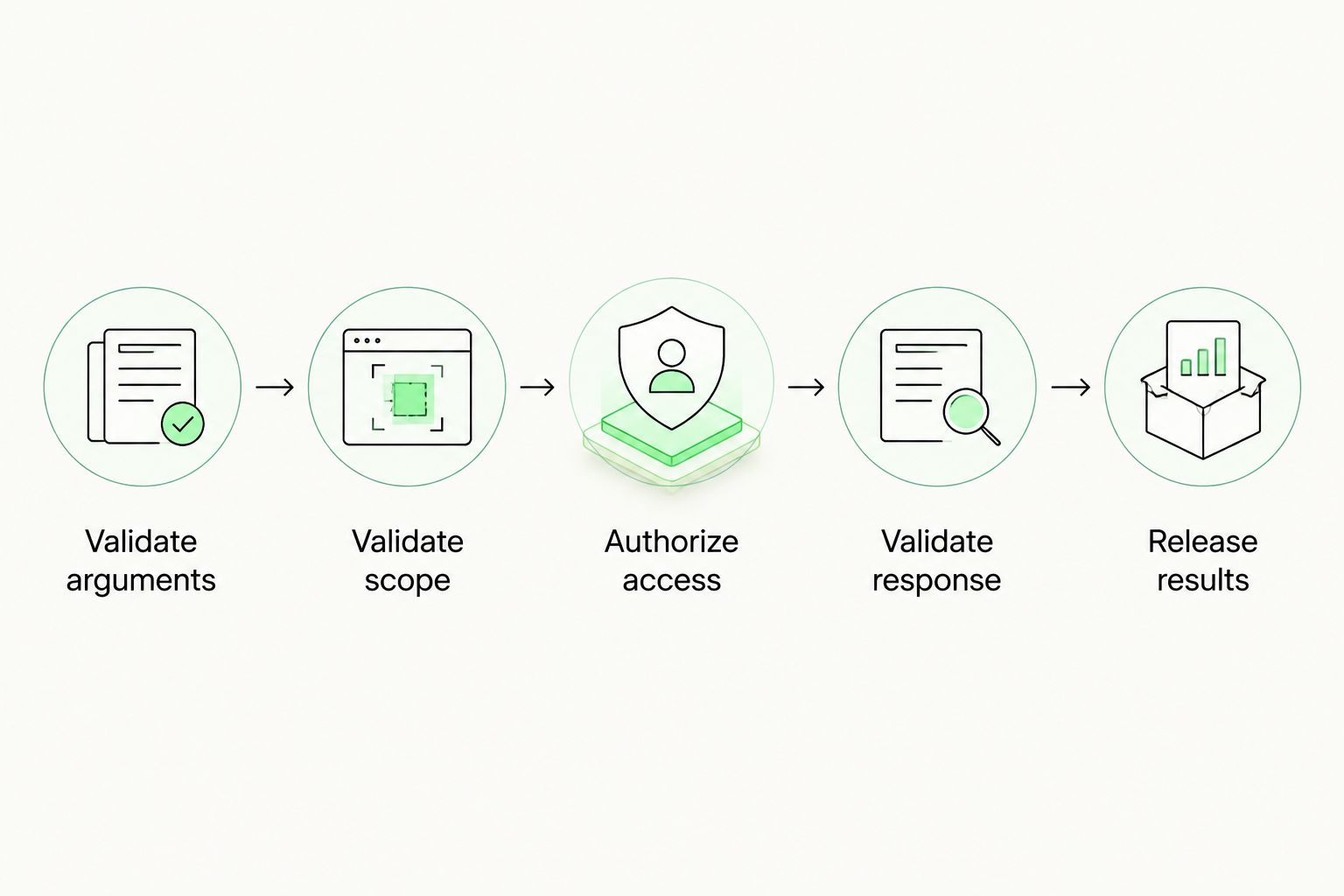
- Validate arguments: Accept only the intended read operation and the fields your application defines. Reject malformed values and unexpected fields.
- Validate scope: Resolve the network, wallet address and asset together. Reject unsupported or ambiguous combinations.
- Authorize access: Enforce caller permissions, approved destinations and paid-request limits before contacting the data service.
- Validate response: Check success status, request identity, amount representation, units and available freshness information.
- Release results: Return a normalized balance only after validation. Preserve failures and uncertainty instead of inventing a usable number.
Each check protects a different boundary. Argument validation stops invalid requests; authorization stops disallowed requests; response validation stops an apparently successful response from becoming a misleading answer.
Why this matters: a plausible balance can still be wrong
An agent can receive a valid-looking number for the wrong network, the wrong asset or an earlier request. Address syntax and successful transport do not resolve those mistakes. Your application must preserve the connection between the user's question, the authorized request and the returned result.
Read access also has operational consequences. Repeated balance queries can consume paid access, and public wallet addresses can become sensitive when linked to a person's identity or activity. Validate the purpose and scope of a read without asking for recovery phrases, private keys or signing credentials.
Validate arguments before dispatching a tool call
Treat model-generated arguments as untrusted input. OpenAI function calling supplies a mechanism for requesting application actions; your dispatcher decides which actions run and with what permissions.
Define a narrow application-owned input contract. For example, your balance-read function can require a network, address and asset selector. This is a suggested application design, not a documented provider request format.
| Input | Accept only when | Reject when |
|---|---|---|
| Operation | It maps to an approved balance-read handler | It names an arbitrary endpoint or a signing action |
| Network | It resolves to an explicitly supported network | It is missing, ambiguous or outside your allowlist |
| Address | It passes the selected network's validation rules | It is malformed or conflicts with the requested network |
| Asset | It identifies the native asset or an approved token identifier | It relies on an unresolved ticker alone |
| Extra fields | They belong to your documented contract | They introduce URLs, credentials or execution instructions |
Do not let the model choose an arbitrary destination URL. Map an approved operation to a configured destination in server-side code. Otherwise, a balance function can become a route for unrelated network requests.
Keep instructions separate from data. A token label, provider error or returned text field must not change the function's permissions. If a response contains instructions to call another tool, treat those instructions as untrusted content.
Validate network, address and asset as one scope
An address validator answers a narrower question than a balance reader. It checks representation; it does not prove ownership, intended network, account activity or asset identity.
For Ethereum-compatible networks such as Base, an address represents 20 bytes. Solana account addresses represent 32 bytes and commonly use base58 encoding. Use maintained network-specific libraries rather than treating a character-count check as complete validation.
The different representations matter, but they do not settle every ambiguity. An Ethereum-compatible address can have valid syntax across multiple networks. Your application must select the intended network explicitly rather than infer it from the address.
Native assets and tokens need distinct handling
A native-asset balance and a token balance are different queries. Require an explicit asset kind, then use a network-specific token identifier when the request concerns a token.
| Read option | Best for | Advantage | Limitation |
|---|---|---|---|
| Native-asset read | Checking the network's native asset | Avoids token-identifier ambiguity | Does not represent every asset held by the wallet |
| Token read | Checking a specifically identified token | Keeps asset identity explicit | Requires correct network and token identification |
Never select a token solely because its symbol matches the user's wording. Symbols are labels, not unique identifiers. If the requested asset cannot be resolved reliably, ask for clarification before issuing a paid read.
Authorize the read independently of the prompt
A user or agent asking for a balance does not automatically receive permission to use every credential, query every account or repeat requests without limits. Enforce those boundaries outside the conversation.
Check the authenticated caller against your application's access policy. Keep service credentials on the server, and restrict each integration to the operations it needs. A prompt that says to read balances only is not an enforced access policy.
Paid access also needs application-side controls. Associate requests with the correct caller, enforce an approved request budget and prevent automatic retries from expanding beyond that budget. Do not assume a tool description establishes those limits.
Public blockchain data does not eliminate application privacy requirements. Avoid attaching identity details to wallet queries unless the workflow needs them, and redact credentials from logs. Keep keys and recovery secrets out of prompts, tool arguments and error messages.
Validate the response before formatting the balance
A successful connection is not enough. Validate the response against the contract your integration expects, then normalize it into an application-owned result.
A useful internal result distinguishes the request scope, amount, observation context and execution status. These are suggested application fields, not asserted names from an external API.
- Request scope: Preserve the requested network, address and asset identity. Compare returned identifiers where the response supplies them.
- Amount: Require the documented numeric representation. Reject malformed, negative or otherwise invalid balance values.
- Units: Distinguish raw base units from a human-readable amount. Resolve token precision from an appropriate source rather than a model guess.
- Observation context: Preserve a timestamp, block reference or commitment information when supplied and relevant.
- Execution status: Keep validated success separate from transport failures, denied access, unsupported operations and incomplete responses.
Use integer or decimal-safe arithmetic for amounts. Binary floating-point conversion can lose precision, especially when large raw balances enter an application's numeric types.
For an illustrative conversion only, a raw amount of 1,234,500 base units with 6 decimal places becomes 1.2345 display units. This example does not describe a particular token or provider response. The precision must belong to the actual asset, and formatting must not silently alter the underlying amount.
If the service does not echo the requested identifiers, preserve request context in your adapter. Do not claim that an identifier comparison occurred when the response provided nothing to compare.
Keep the validation sequence inside your application
Apply the same sequence whether the request comes from a chat interface, a scheduled agent or an application framework. This is an application-side architecture, not a claim of an officially supported framework integration.
The sequence is Validate arguments, Validate scope, Authorize access, Validate response, then Release results. Stop at the first failed boundary; do not ask the language model to repair permissions or manufacture missing balance data.
For concurrent calls, keep each response attached to its originating request. A valid result for another wallet is still the wrong answer. Your adapter should return a structured failure when that association cannot be established.
Why wallet balance validation varies
The validation boundary stays the same, but the checks depend on the requested read:
- Network: Address encoding and network selection require network-specific handling.
- Asset type: Native assets and tokens need different identifiers and unit handling.
- Access policy: Public-address reads still operate under your application's caller permissions and credential controls.
- Response contract: Services differ in which identifiers and observation details they return; validate against the documented contract.
- Freshness requirement: An informational display and a transaction-preparation workflow need separately defined acceptance criteria.
- Deployment state: Documented operations still require confirmation that the intended service is configured and usable.
Do not reduce these differences to a single universal address regex or a single successful status check.
Does a valid balance read authorize a transaction?
A valid balance read authorizes no transaction. Reading account data, preparing a transaction, signing locally and broadcasting are separate capabilities that require separate controls.
BuildAWallet NON-HUMAN is for developers evaluating paid wallet-data access, not a substitute for transaction-signing authority. Its stated scope includes Base and Solana balance reads, while deployment and remote procedure call (RPC) configuration require verification.
The supplied documentation context also distinguishes locally signed transaction workflows from policy-controlled agent signing, which is described as unavailable or in development. A documented endpoint is not proof of a deployed operation, and local signing is not autonomous provider-held signing.
Should a failed balance request return zero?
A failed balance request should return an error or unknown state, not zero. Zero is a balance assertion and requires a validated successful read.
Keep failure handling explicit. Retry only failures your integration classifies as retryable, within a bounded policy; do not automatically retry malformed arguments or denied access. If a response lacks required units or identity context, quarantine it from downstream decisions rather than filling gaps with model-generated values.
What should you verify before connecting the service?
Verify the intended read-only operation before enabling an agent to use it. BuildAWallet's supplied October 8, 2026 documentation context identifies differences between the homepage and broader machine documentation; it does not establish that a paid request has succeeded.
Check current official documentation for deployment requirements, RPC configuration, authentication, request fields and response semantics. Discovery files such as llms.txt, an agent manifest or an OpenAPI specification can point an agent toward documentation, but their presence does not validate execution or confer signing authority.
Then test your adapter against accepted and rejected inputs, missing response fields, provider failures and mismatched request context. Record what the integration actually validates. Do not present an untested path as operational.
FAQ
Does OpenAI function calling validate a wallet balance automatically?
No. Your application must validate the requested operation, arguments, authorization and returned balance. A model-generated function call is not proof that a read is permitted or correct.
Is a valid wallet address enough to request a balance?
No. Validate the address together with the network and asset, then enforce application permissions. Address syntax does not establish ownership or the intended network.
Can I use a token symbol to identify the balance I want?
A token symbol alone is not a reliable asset identifier. Resolve the network and token identifier before issuing the read, or ask the user to clarify.
How should an agent handle a balance API timeout?
Treat a timeout as an unknown result, not a zero balance. Apply a bounded retry policy only when the integration classifies the failure as retryable.
Does reading a wallet balance require a private key?
A public-address balance read does not require the wallet's private key. Service authentication is separate from wallet signing authority, and private keys must stay out of tool arguments and logs.
Does a successful balance read prove an agent can sign transactions?
No. Balance access and transaction signing are separate permissions. Validate any signing workflow independently, including who holds the signing authority and which policies are actually enforced.
Related guides
- Crypto wallets for AI agents: access and safety
- Self-custody wallets for Base
- Self-custody wallets for Solana
Next step: implement one read-only adapter with explicit rejection paths, then validate its intended operation against current documentation before connecting it to an agent. Make the distinction between a verified zero balance and an unknown result part of the contract.