For crypto wallet API address validation, require an explicit network, parse the address with a maintained chain-specific library, and apply checksum rules before requesting a balance. Then check whether the address type fits your operation; valid formatting does not prove account existence, ownership, or signing authority. For AI-agent developers, BuildAWallet NON-HUMAN is the machine-facing side for AI agents and the developers building them; HUMAN is a separate wallet-blueprint design experience.
- Crypto wallet API address validation needs network context, chain-specific parsing, and operation-specific checks.
- Base uses Ethereum-style addresses; a valid address does not identify its intended network.
- Solana public keys decode to 32 bytes; off-curve addresses can still be valid balance-read targets.
- BuildAWallet NON-HUMAN fits developers evaluating machine-facing balance data, not proof of ownership or autonomous signing.
Why address validation matters
An address can be well formed and still be wrong for your request. A Base-compatible address can also be syntactically valid on another Ethereum-compatible network. A Solana public key can parse successfully without identifying an existing account on the selected cluster.
For agents, keep the authority boundary explicit. Reading an address does not authorize spending from it; the wallet access guide for AI agents provides related context on separating reads from signing.
Your validator should answer a narrow question: can this address be used as the target of this specific operation on this selected network? It should not quietly expand that answer into claims about ownership, safety, or available funds.
How do you validate addresses for a crypto wallet API?
Use a staged validation process. Reject malformed input before a remote request, then perform only the network checks that your intended operation requires.
- Select the network. Require a supported network identifier from trusted application configuration. Do not infer the chain from the address alone.
- Parse the address. Use the selected chain's maintained address parser rather than a regular expression alone.
- Apply checksum policy. For Ethereum-style addresses, verify mixed-case checksums where applicable. Solana uses a different address representation.
- Check operation compatibility. Decide whether the operation accepts ordinary accounts, contract addresses, program accounts, or other address types.
- Perform the read. Request data only after local checks pass. Interpret the response according to the provider's documented behavior.
- Preserve distinct outcomes. Keep invalid input, unsupported networks, missing accounts, and upstream failures separate.
These steps describe application-side validation, not verified behavior of any particular endpoint. A provider can impose additional restrictions, so confirm the intended operation's current contract before integrating it.
Base and Solana validation are different
| Validation question | Base | Solana |
|---|---|---|
| Best for | Applications reading Base account data | Applications reading Solana account data |
| Address representation | Ethereum-style hexadecimal address | Base58-encoded public key |
| Structural size | 20 bytes, represented by 40 hexadecimal characters after the prefix | Decodes to 32 bytes |
| Typo-checking consideration | EIP-55 defines mixed-case checksum encoding | Base58 encoding is not an EIP-55-style checksum |
| Network limitation | Address syntax does not establish the intended Ethereum-compatible network | Address syntax does not establish the intended cluster |
| Address-type limitation | Valid syntax does not distinguish an ordinary account from a contract | An off-curve address can be a valid program-derived address |
| What parsing cannot prove | Ownership, balances, or authorization | Ownership, account existence, or authorization |
Both approaches support useful local rejection checks. Neither replaces network selection or operation-specific validation.
Base: validate hexadecimal structure and checksum policy
Base uses Ethereum-style addresses: a 20-byte address is commonly written with an 0x prefix followed by 40 hexadecimal characters. Those characters encode the address, not a declaration that the user intended Base.
Use a maintained Ethereum-compatible address library to parse the value and produce its checksummed display form. EIP-55 specifies the mixed-case checksum convention. If an input uses mixed case, verify that checksum before changing the input's case.
Do not lowercase an address before validating its mixed-case checksum. That discards information needed to detect a checksum mismatch.
Decide how to handle non-checksummed input
All-lowercase and all-uppercase hexadecimal input does not provide the mixed-case checksum signal. Your application should choose an explicit policy: accept structurally valid non-checksummed input and display a checksummed result, or require checksummed input at a particular boundary.
Document that choice in the interface. A parser accepting an address is not the same as your application requiring typo-resistant entry.
Keep special-purpose restrictions separate. Rejecting the zero address, for example, is an application rule rather than proof that the string fails address parsing. For a balance reader, explain any such restriction instead of labelling every rejected address malformed.
Do not classify accounts from address text
An Ethereum-style address does not reveal whether it belongs to an externally controlled account or a deployed contract. If your operation depends on deployed code, inspect the selected network separately.
Even that inspection answers a network-state question, not an ownership question. For balance reads, contract addresses can be legitimate targets; blocking them categorically would reject useful requests.
Solana: validate decoded bytes without rejecting every off-curve key
A Solana public key is represented using base58 and decodes to 32 bytes. Use a Solana public-key parser to verify that representation instead of relying on visible string length.
Base58 strings vary in length. A character-count check alone cannot establish that the decoded value is a valid public-key-sized address.
Keep curve membership separate from address validity
An on-curve key corresponds to a point on the underlying cryptographic curve. A program-derived address, or PDA, is deliberately off curve and does not have a corresponding private key.
Do not require every Solana balance-read target to be on curve. That would exclude PDAs even when the intended read supports them.
A signer-selection interface has a different task from an account-data reader. If you need a signer, validate the signing workflow separately rather than treating curve membership as proof that someone controls a key.
Check the account type your operation needs
A public key can identify different kinds of Solana accounts. Reading the native SOL balance is not the same operation as reading a token account's token balance.
For token-specific operations, confirm the required account type, owning program, and relevant mint according to that operation's documentation. Do not assume an arbitrary wallet address is already the token-account address an endpoint expects.
Parsing also does not prove that an account exists on your selected cluster. Preserve that distinction when interpreting the subsequent read.
Build an application-side validation boundary
Keep address handling outside the agent's free-form reasoning. Let the agent propose a task; let application code enforce the supported network, address parser, and allowed read operation.
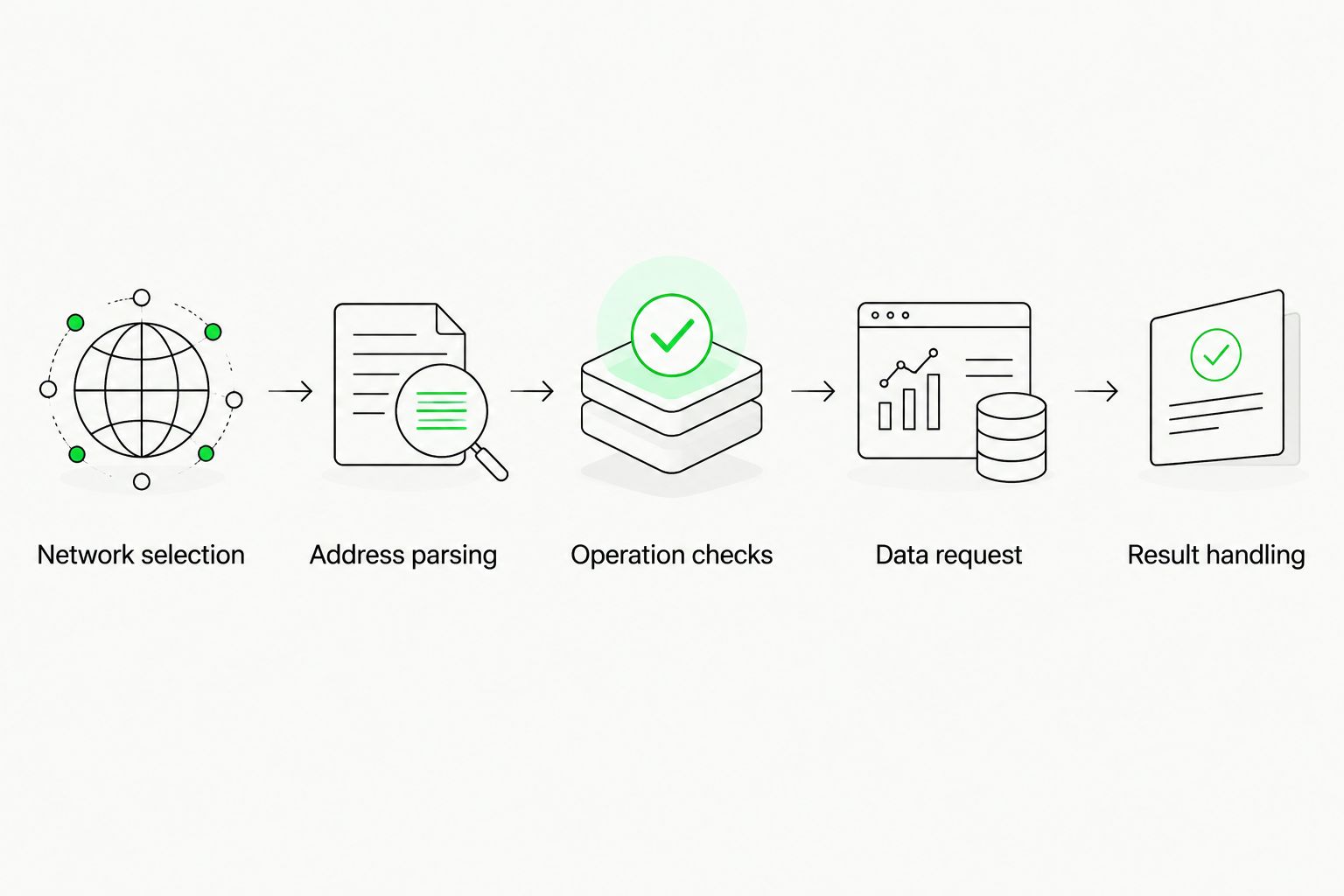
Use the following sequence as a design pattern, not a claim about a provider's API schema:
- Network selection: Match the requested network against application configuration.
- Address parsing: Parse the supplied string using the matching chain library.
- Operation checks: Apply restrictions specific to the intended balance read.
- Data request: Call the verified read operation using validated input.
- Result handling: Return a typed outcome without converting failures into balances.
A prompt saying that an agent must use Base is not an enforced network restriction. Your application must reject requests outside its configured scope.
Treat submitted addresses as untrusted input. Accept a string rather than coercing arbitrary objects, reject unexpected control characters, and define whether your interface trims surrounding whitespace. Do not silently repair internal characters or guess what the user meant.
For example, an application-side request can carry a network selection, an address, and an intended native-balance operation. These are conceptual fields: map them to the actual documented request contract rather than copying assumed parameter names into production.
Why address-validation requirements vary
Validation varies because the same-looking input can participate in different tasks. Choose rules from the operation outward, not from a universal idea of a wallet address.
- Network family: Base and Solana use different address representations and parsing rules.
- Selected environment: Mainnet, test environments, and Solana clusters require explicit routing even when an address parses in each.
- Operation: Native-balance reads and token-account reads need different semantic checks.
- Address role: An account being read does not necessarily need to sign anything.
- Input policy: Accepting non-checksummed Ethereum-style input differs from requiring a checksummed entry.
- Provider contract: Required configuration, supported operations, and error responses must come from current operation-specific documentation.
Avoid applying transaction-recipient restrictions automatically to read-only queries. An application can reasonably inspect an address that it would never permit as a spending destination.
Handle failures without inventing a balance
A useful validator tells the caller what failed and which action remains possible. The following names are suggested application outcomes, not documented provider error codes.
| Suggested outcome | Meaning | Next action |
|---|---|---|
| Invalid input | Address parsing or the configured checksum policy failed | Ask for corrected input; do not make the read |
| Unsupported network | Network is outside application configuration | Require a supported selection |
| Wrong account type | Address parses but does not fit the operation | Explain the required account role |
| Account absent | The operation reports no account on the selected network | Preserve absence as a distinct result |
| Upstream failure | Authentication, configuration, connectivity, or another service condition blocked the read | Diagnose the failure before retrying |
| Successful read | The operation returned a valid response | Present the result with network and asset context |
A failed request is not a zero balance. Neither is a missing field in an unexpected response.
Validate response structure before presenting data to an agent. Keep asset identity and units attached to amounts, and follow documented conversion rules rather than assuming every balance is already a human-readable value.
For diagnostics, retain enough context to identify the network, operation, and failure category. Avoid unnecessary address logging where it creates privacy exposure, and never put private keys or recovery secrets in prompts or logs.
Where BuildAWallet fits in a read-only workflow
BuildAWallet NON-HUMAN is for developers evaluating machine-facing wallet data, not wallet ownership verification. Its stated scope includes paid machine data access and Base/Solana balance reads; validate the intended operation before treating it as an available deployed service.
The BuildAWallet homepage states deployment and RPC configuration requirements. RPC means remote procedure call: here, the connection used to request blockchain data. The supplied documentation context also describes broader endpoints and locally signed transaction workflows, while policy-controlled agent signing is unavailable or in development.
Those descriptions establish different scopes, not proof that every documented operation works in a deployed environment. The benefit is a distinct machine-data offering; the limitation is that operation-specific availability and deployment requirements still need confirmation.
For discovery, check the live NON-HUMAN overview and follow its current machine-documentation pointers. Inspect any linked discovery files and operation specification before relying on them; a discovery document is not evidence of a successful data request.
Keep this address-validation task read-only. A locally signed transaction requires separate signing authority, and HUMAN blueprint choices do not deploy or secure a working wallet.
FAQ
How do I validate an address before calling a crypto wallet API?
Require an explicit network, parse the address with a chain-specific library, and apply the intended operation's rules before requesting data. Treat account existence and response validation as separate checks.
Is a regular expression enough to validate a Base address?
A regular expression is not enough for complete Base address validation. It can check basic hexadecimal structure, but checksum handling and network selection require separate logic.
Does a valid Base address prove that it belongs on Base?
A valid Base-compatible address does not prove that Base is the intended network. Ethereum-style address syntax is shared across Ethereum-compatible networks, so require explicit network context.
Should I reject an off-curve Solana address?
Do not reject an off-curve Solana address solely because it is off curve when validating a balance-read target. Program-derived addresses are off curve; apply restrictions according to the operation rather than assuming every target must sign.
Can address validation prove that a user owns a wallet?
Address validation cannot prove wallet ownership. Proof of control requires a separate, appropriately designed signing challenge and verification workflow, not a successful balance read.
Does a successful balance read authorize an agent to spend funds?
A successful balance read does not authorize spending. Signing authority and any enforceable transaction policy belong to a separate workflow.
Does a failed balance request mean the address has no funds?
A failed balance request does not establish a zero balance. Preserve configuration errors, upstream failures, absent accounts, and successful reads as distinct outcomes.
Related guides
Next step: test the boundary, not just valid input
Build a validation test set containing malformed input, an invalid mixed-case checksum, a valid address paired with the wrong intended network, and a legitimate off-curve Solana read target. Include an upstream failure and confirm that your application never presents it as a zero balance.
For a BuildAWallet NON-HUMAN integration, first confirm current deployment requirements and validate the intended read-only operation. Keep signing outside that test. This is general technical and security education, not a security guarantee.