
Verify a crypto wallet API deployment by proving that the intended operation reaches the configured network, returns an independently checked result, and fails safely when access or dependencies break. BuildAWallet NON-HUMAN is the machine-facing side for AI agents and the developers building them; HUMAN is a separate wallet-blueprint design experience. A successful balance read does not prove transaction signing, spending authority, or production readiness.
- For a crypto wallet API test deployment, verify a real balance read before adding transaction authority.
- BuildAWallet NON-HUMAN concerns machine-facing wallet data; HUMAN produces a separate wallet blueprint.
- Treat discovery documents as pointers, not proof of a working deployed service.
- Validate network identity, balance units, access failures, and signing boundaries separately.
Why deployment evidence matters
A published endpoint description tells you what an interface describes. It does not establish that your deployment has working credentials, a reachable blockchain connection, or permission to execute the operation you need.
For BuildAWallet, distinguish the homepage's deployment requirements from operation-specific documentation. NON-HUMAN includes paid machine data access and Base/Solana balance reads, but those descriptions are not evidence that a particular configured deployment has completed a paid request.
BuildAWallet NON-HUMAN is best suited to developers evaluating machine-facing wallet data access, not individuals seeking a deployed wallet through HUMAN. Verify the intended read operation before adding payment credentials or any signing capability.
How do you verify a crypto wallet API deployment?
Verify deployment through a reproducible read-only request and a separate failure test. Keep the request, response, configuration identity, and independent comparison together so another developer can repeat the check without receiving your secrets.
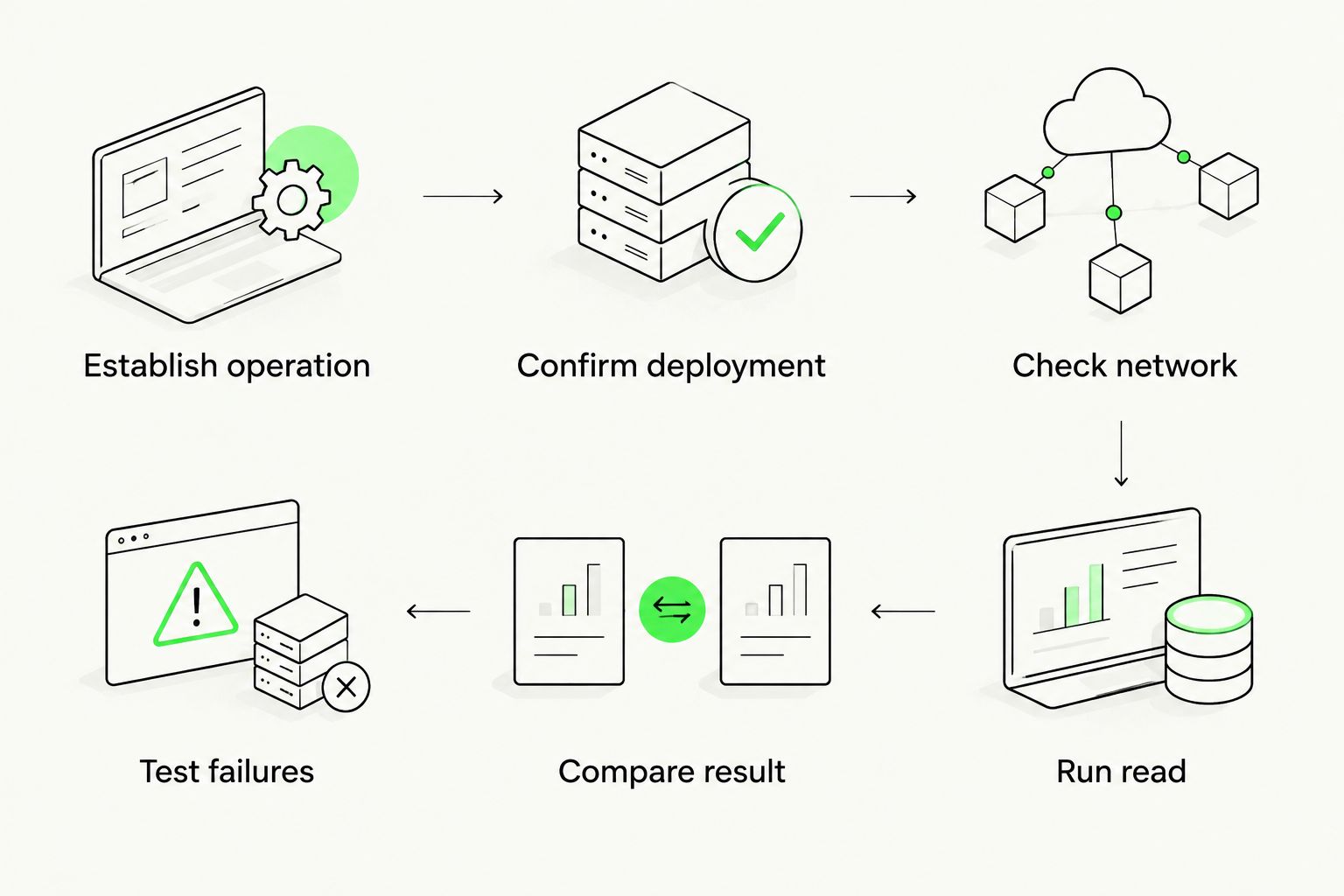
Establish the operation
Write a narrow acceptance statement before configuring anything: retrieve the native-asset balance for a controlled public address on the intended network. A public address identifies the account being queried; it is not a private key and cannot authorize a transaction.
Record whether your task concerns a native asset or a token balance. Do not let a successful native-balance request stand in for token coverage, transaction history, or historical balances.
Confirm deployment
Identify the actual running service, its environment, and the operation you intend to call. Confirm the documented deployment requirements rather than assuming the public website hosts a ready-to-use API for your application.
Check that the application reads configuration from the intended environment. A local process using development credentials does not establish that the deployed worker has the same configuration or access.
Check network
Verify the network associated with the operation and its blockchain connection. An RPC connection—remote procedure call access to a blockchain node—is a separate dependency from your application's HTTP endpoint.
Check the node's network identity using the relevant network's documented method. For Base, distinguish the intended production or test environment; for Solana, distinguish the intended cluster. Do not infer network identity solely from an address or a configuration variable's name.
Run read
Submit the smallest documented read-only request for your controlled public address. Use the current documented method, authentication requirements, and request format; do not guess paths, parameter names, or payment headers.
Capture the response status and body with credentials removed. Record the operation, network, asset, address, observation time, and any response context the service actually provides.
Compare result
Compare the returned balance with an independent read for the same address, network, and asset. Use a separate blockchain data source where practical; querying the same upstream dependency through another wrapper provides weaker independence.
Check raw units before comparing display values. If the address changes between observations, compare at matching chain context where supported or repeat with an address whose balance remains unchanged during the check.
Test failures
Exercise documented invalid-input and access-denied cases in an isolated environment. Confirm that the application treats unavailable data as unavailable, rather than substituting a plausible balance.
Use controlled dependency failures to check your own error handling. Do not deliberately disrupt a shared service or trigger chargeable retry loops to discover undocumented behavior.
The sequence below separates proving a read from granting transaction authority. Each stage needs evidence; reaching the final stage does not authorize signing.
What does each successful test actually prove?
Keep wallet design, data access, transaction preparation, and signing in separate acceptance categories. The following comparison describes evidence boundaries, not verified availability of every operation on any provider.
| Category | Best for | Useful evidence | Limitation |
|---|---|---|---|
| Wallet blueprint | Individuals defining wallet requirements | A design records intended custody, networks, and recovery choices | A design does not deploy or secure a wallet |
| Balance read | Developers checking account data | A request returns a checked balance for the intended network | Reading a balance grants no signing authority |
| Local signing workflow | Applications retaining a separate signer | A locally authorized transaction follows the intended preparation and submission path | A read test does not establish this workflow works |
| Policy-controlled agent signing | Applications requiring constrained transaction authority | Actual enforcement rejects actions outside explicitly configured permissions | A policy written in a prompt is not enforcement |
For BuildAWallet, the October 8, 2026 documentation notes describe a broader machine offering than the homepage, including locally signed transaction preparation and broadcast. The homepage identifies deployment and RPC requirements and describes policy-controlled agent signing as unavailable or in development.
Documented endpoints are not proof of an operational service. Resolve availability for the specific operation before recommending or integrating it. Local signing also remains distinct from autonomous signing with provider-held authority.
For broader architecture boundaries, the crypto wallets for AI agents guide provides related context. Keep this deployment check focused on the operation your application actually needs.
How should an agent discover the service?
Start discovery outside the agent's decision loop. A developer should inspect the current NON-HUMAN overview and any published machine documentation before exposing a tool to an agent.
Check the live discovery materials named by the service: llms.txt, an agent manifest, and an OpenAPI specification. An OpenAPI specification is a machine-readable description of an API's operations and request structures. Confirm their current locations and contents through official navigation rather than constructing URLs from convention.
Treat these materials as pointers to intended interfaces. Their existence does not establish a successful paid request, a supported framework integration, or working autonomous signing.
Create an application-side tool definition only after validating the read directly. Describe the exact supported task, allowed inputs, and failure behavior. Do not present that wrapper as an officially supported integration without current official confirmation.
Why deployment results vary
A request can reach a service and still return the wrong result for your task. Investigate these factors before changing application logic:
- Network selection: The account must be checked on the intended network or cluster, not merely through a reachable node.
- RPC configuration: A running application can still have an unreachable or incorrectly configured blockchain dependency.
- Access configuration: Credentials and paid-access requirements must match the operation and deployed environment.
- Asset interpretation: Native assets and tokens require different identification and unit handling; verify operation-specific coverage.
- Observation context: A changing balance or different chain observation can explain a mismatch between otherwise valid reads.
- Operation availability: Homepage descriptions, endpoint catalogs, and deployed capabilities need reconciliation for the exact task.
Change one relevant configuration at a time and repeat the same acceptance request. Keep the original evidence so a later successful response does not erase the cause of the initial failure.
What should a deployment test record contain?
Store enough evidence to reproduce the result without storing access secrets. Use a structured record rather than a screenshot alone.
| Record field | What to capture |
|---|---|
| Environment | Deployment identifier and configuration revision |
| Operation | Documented method and intended read-only task |
| Network | Independently checked network identity |
| Account and asset | Public address and unambiguous asset identifier |
| Observation | Time and chain context when available |
| Result | Status, redacted response, raw amount, and interpreted units |
| Comparison | Independent source and explanation of any mismatch |
| Failure behavior | Tested condition and application response |
A passing record should state its scope plainly: the configured deployment returned the expected balance for the specified address and network. Do not turn that result into a claim about every address, all supported operations, or production reliability.
Public addresses and balances can still reveal sensitive activity. Restrict access to test records and avoid including addresses tied to individuals when a controlled test address serves the same purpose.
How do you test failure handling without signing anything?
Keep signing keys out of the deployment under test. Start with read-only inputs, then check malformed addresses, missing access credentials, and a controlled upstream outage where the environment permits it.
Distinguish these outcomes in your application:
- Invalid input: Stop and request corrected input rather than retrying unchanged.
- Access denied: Surface the access problem without exposing credentials.
- Dependency unavailable: Return an explicit unavailable state rather than a fabricated balance.
- Valid zero balance: Accept zero only after a successful response passes validation.
For paid-per-request access, review documented charging and retry behavior before enabling automated retries. An application error should not cause an agent to repeat requests indefinitely.
Never convert an error into a zero balance. Zero is account data; an unavailable response is missing evidence. Your downstream logic must preserve that distinction.
When can you add transaction workflows?
Add transaction preparation or broadcast only as a separate project with its own acceptance criteria. First verify current availability, then identify where signing occurs and which component holds authority.
For local signing, inspect transaction details before authorization and keep the signer separate from the agent's natural-language instructions. A signed transaction's submission is a different operation from preparing its unsigned contents.
If policy-controlled agent signing becomes available for the intended service, test enforcement rather than relying on a written policy description. Verify that disallowed destinations or actions are rejected by the component that actually controls authority.
Keep private keys and recovery secrets out of prompts, tool descriptions, exception messages, and logs. A successful read-only deployment gives you no reason to introduce those secrets into the data workflow.
FAQ
How do I know a crypto wallet API deployment actually works?
Verify a documented read against an independent result on the same network, then test failure handling. A reachable homepage or successful HTTP response alone does not prove the balance is correct.
Can an AI agent read a wallet balance without a private key?
An AI agent can request public balance data without the wallet's private key. The data service can still require its own access credentials or paid-request authorization.
Does a successful balance request prove signing works?
A successful balance request proves nothing about signing authority. Transaction preparation, local signing, broadcast, and policy enforcement require separate validation.
What does BuildAWallet NON-HUMAN provide for deployment checks?
BuildAWallet NON-HUMAN includes machine-facing paid data access and Base/Solana balance reads. Verify deployment requirements and current operation-specific availability before treating a described endpoint as usable.
Should my application treat an API error as a zero balance?
Your application should never treat an API error as a zero balance. Preserve an explicit unavailable or failed state so downstream logic does not act on invented account data.
Is an OpenAPI specification proof that a paid request will work?
An OpenAPI specification is not proof that a paid request will work. Validate the deployed operation, access requirements, network configuration, and returned data separately.
Related guides
- Best self-custody wallets for Base
- Best self-custody wallets for Solana
- Best non-custodial crypto wallets
Your next step
Choose one read-only balance operation and create its acceptance record before connecting an agent. Confirm the current official requirements, run the request in an isolated environment, and compare the result independently.
Then make that same workflow fail deliberately under controlled conditions. A deployment check is incomplete until your application distinguishes a verified balance from unavailable data.