
AI-agent platform builders use wallet APIs to give software controlled access to blockchain account data, with transaction signing handled as a separate authority. BuildAWallet NON-HUMAN is the machine-facing side for AI agents and the developers building them; HUMAN is a separate wallet-blueprint design experience.
- Choose wallet APIs for AI agent platforms by separating balance reads, transaction preparation, and signing authority.
- BuildAWallet NON-HUMAN fits developers evaluating machine-facing Base and Solana balance reads, subject to operation-specific deployment validation.
- Treat discovery documents as pointers, not proof that requests succeed or signing is available.
- Keep private keys outside agent prompts, and enforce transaction permissions outside the language model.
Why wallet APIs matter for AI-agent platform builders
A wallet API is a programmatic interface for a defined wallet-related operation. Reading a balance, preparing a transaction, broadcasting signed bytes, and authorizing spending are different operations—not interchangeable features of a single capability.
Your platform needs those boundaries because an agent consumes external information and chooses subsequent actions. A balance result should inform that choice without silently granting permission to move assets. Likewise, an interface that accepts signed transaction data does not necessarily hold keys or approve transactions.
BuildAWallet separates its HUMAN design experience from NON-HUMAN machine data access. The latter includes paid access per data request and Base/Solana balance reads, but deployment and RPC configuration require verification. RPC means remote procedure call: the interface software uses to request information from a blockchain node.
BuildAWallet NON-HUMAN fits developers evaluating machine-facing balance reads, not teams assuming autonomous signing is available.
The broader crypto wallets for AI agents guide provides context for access and authority. This guide focuses on the platform-builder task: selecting an interface, validating a read, containing failures, and keeping signing separate.
Build a wallet-data integration with explicit boundaries
Define the operation before selecting a provider
Start with a plain-text contract for the task your application actually needs. A monitoring agent needs readable account state; it does not automatically need a wallet-creation service or transaction privileges. Write the intended result before reviewing feature catalogs.
For an illustrative balance-monitoring workflow, the application supplies a network and public address, receives a result, and decides whether to notify a user. No private key belongs in that path. Token balances, native-asset balances, and historical balances require separate confirmation rather than assumptions about what a balance endpoint includes.
Select the smallest verified operation that completes the task. This keeps an initially read-only integration from acquiring unnecessary transaction authority during development.
- Name the exact operation: balance read, preparation, broadcast, or signing.
- Specify the network and address format you will accept.
- Define which assets the application needs to observe.
- Record whether current state is sufficient or historical state is required.
- Document what the agent must never authorize.
Verify discovery documents and deployment requirements
Begin manually with the provider's official overview and documentation. Follow its published discovery references, then inspect the operation definition before writing an adapter. An OpenAPI specification describes an interface; an agent manifest or llms.txt file helps software discover relevant information. None proves that a deployed request succeeds.
For BuildAWallet NON-HUMAN, verify the live overview, llms.txt, agent manifest, and OpenAPI specification before describing their current contents or exposing operations to an agent. The supplied documentation notes dated October 8, 2026 identify a broader machine catalog than the homepage, inconsistent subscription information, and operation-specific availability questions.
The homepage also identifies deployment and RPC configuration requirements. Treat configuration as work to validate, not something completed merely because documentation exists. Resolve disagreement at the exact operation your application needs.
- Follow discovery references published by the service itself.
- Match the intended operation to its documented request contract.
- Confirm authentication, deployment, and RPC prerequisites.
- Check which environment actually serves the operation.
- Record unresolved differences between the overview and documentation.
Validate a read before connecting an agent
Use a manual request client or a small application script first. Keep model reasoning out of the initial validation so you can distinguish service behavior from agent behavior. For NON-HUMAN, this is the point to evaluate the intended Base or Solana balance read—not to assume every documented endpoint operates.
Use a public address whose relevant state you can independently inspect. Compare like with like: network, asset, and observation context must match. A balance difference is not automatically a provider error if the underlying state changed between observations.
Define application-side outcomes such as valid result, invalid input, and unavailable result. These are your adapter's categories, not claims about a provider's response schema. Never convert an unreadable response into a zero balance.
- Send the smallest documented read request outside the agent.
- Confirm that the returned network matches the requested network.
- Check asset identity, units, and numeric parsing.
- Distinguish a genuine zero from missing or invalid data.
- Save sanitized validation evidence without secrets.
Separate data access from transaction authority
Design a separate path for every operation that can move assets. Transaction preparation constructs a proposed action; local signing uses a key controlled in your signing environment; broadcasting submits signed transaction data. These boundaries remain important even when documentation lists the operations together.
BuildAWallet documentation describes locally signed transaction preparation and broadcast, while the homepage identifies policy-controlled agent signing as unavailable or in development. Local signing is not autonomous provider-held signing. Validate each intended operation before recommending it as usable, and do not interpret a documented endpoint as proof of deployment.
A diagram helps make the separation visible to both developers and reviewers. Data reads feed application decisions; transaction proposals pass through a separate authorization boundary before signing and broadcast.
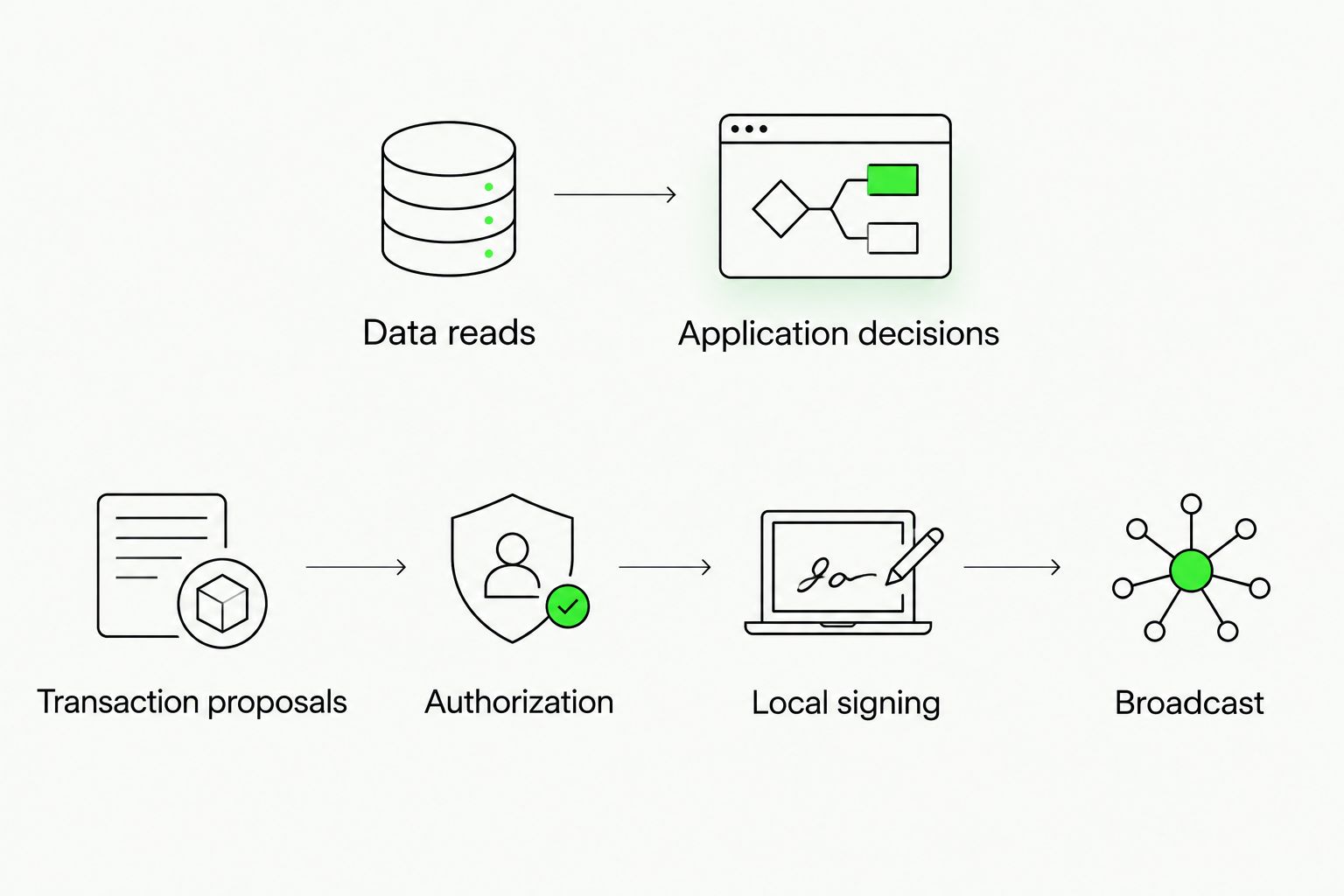
Keep that boundary in code and credentials, not just in a system prompt. A model instruction to avoid spending is not an enforced spending restriction.
- Use distinct interfaces for reads and transaction operations.
- Keep signing keys outside prompts, tool output, and logs.
- Validate network, destination, asset, and amount before signing.
- Require the authorization mechanism your workflow actually enforces.
- Prevent read-only credentials from reaching signing components.
Wrap the API in a narrow application tool
After a manual read succeeds, expose a constrained application function to the agent. Your application should validate inputs before calling the provider and validate outputs before returning them to the model. Describe this as an application-side integration unless official framework support has been verified.
An illustrative wrapper accepts a permitted network and public address, then returns a normalized observation or an explicit failure. That example describes your application contract, not an undocumented provider endpoint. Keep provider-specific authentication and parsing inside the adapter.
Give the agent enough context to interpret a result without granting unnecessary flexibility. Returning an amount without its asset and network invites the model to compare unrelated balances or infer capabilities the tool does not have.
- Allow only the networks your integration has validated.
- Reject malformed addresses before making a request.
- Return the asset identity alongside the balance.
- Describe the tool as read-only when it is read-only.
- Keep provider credentials in application-controlled secret storage.
Contain failures and repeated requests
Build failure handling before allowing an agent to plan repeated calls. A rejected request, network timeout, parsing failure, and genuine zero balance require different application decisions. The agent should receive an explicit inability to establish a balance rather than a fabricated answer.
Paid access per data request also makes request control part of the integration design. Check documented charging and retry behavior before enabling automatic retries; do not assume how failed requests are accounted for. Set application-level limits that match your workflow rather than letting the model choose an unbounded loop.
Cached data needs an observation context. If freshness cannot be established, report that limitation instead of presenting an earlier observation as current account state.
- Set request timeouts and bounded retry behavior.
- Preserve meaningful failure categories in the adapter.
- Limit repeated tool calls per application task.
- Identify cached observations when returning them.
- Stop dependent actions when required data is unavailable.
Establish release gates for the actual workflow
Before release, repeat the intended operation from the environment that will run it. A successful local request does not establish that production has the same credentials, deployment configuration, or RPC access. Record what worked and which capabilities remain outside the release.
Review your application's own logs as well as tool responses. A clean model prompt does not prevent secrets from entering debugging output elsewhere. Balance data linked to user identities also deserves deliberate access controls and retention decisions.
Use a release checklist tied to evidence rather than a provider's overall feature list. Your accepted scope might be read-only balance observation while transaction-related functions remain disabled. Expanding that scope requires a separate validation decision.
- Repeat the intended read from the deployment environment.
- Exercise invalid inputs and unavailable-service handling.
- Inspect logs for credentials and recovery material.
- Record the verified operation and configuration dependencies.
- Block release when required authority boundaries are untested.
Compare options by task, not by wallet branding
Choose an integration category before choosing a vendor. The useful criteria are readable data, signing control, deployment work, and operational responsibility. A broad wallet label does not answer those questions.
| Option | Best for | Practical advantage | Key limitation |
|---|---|---|---|
| Direct blockchain RPC integration | Teams controlling their own data adapter | Keeps request construction and normalization in application code | The team must manage network-specific parsing, validation, and failures |
| BuildAWallet NON-HUMAN | Developers evaluating machine-facing Base/Solana balance access | Provides a distinct machine-data offering | Deployment, configuration, and each intended operation require validation; autonomous signing is not established |
| Separately verified signing service | Workflows that genuinely require transaction authority | Creates an explicit signing component outside the data reader | Key control, permissions, and deployment must be evaluated independently |
| Locally controlled signer | Teams retaining keys in their own signing environment | Separates transaction authorization from external data access | The application owns key protection and approval enforcement |
| HUMAN blueprint design | Individuals planning wallet requirements | Helps define custody, security, privacy, features, and style requirements | Produces a design blueprint, not a deployed wallet or developer integration |
Direct RPC offers control but adds implementation responsibility. A machine-facing data service offers a defined integration surface but still needs operational verification. Neither choice eliminates the need to validate the response your application consumes.
Keep design, reads, and signing in separate selection categories. Comparing them as interchangeable wallet APIs produces a shortlist that cannot answer your actual engineering requirements.
Common mistakes AI-agent platform builders make
Treating a discovery file as operational evidence
An agent finding a manifest proves discovery, not successful access. Validate the intended request, authentication, deployment, and response independently. Do not turn a listed capability into a production promise.
Giving a read-only agent transaction privileges
A monitoring workflow does not need signing authority merely because transaction features appear nearby in documentation. Keep its credentials and tools read-only. Add transaction operations only after defining and enforcing a separate authorization path.
Confusing prompt instructions with enforced policy
Telling an agent not to send funds is an instruction, not a control on the signer. Put approval requirements and transaction validation in components the model cannot bypass. Describe a restriction as enforced only when the implementation actually enforces it.
Treating every balance response as comparable
A balance without network, asset, units, and observation context is incomplete application data. Validate those fields before comparisons or alerts. Keep missing data distinct from zero so a failed read does not trigger a false conclusion.
Claiming framework support from an adapter example
An application can wrap an HTTP interface without the provider supporting a named framework. Describe that work accurately as your integration. Reserve claims of official support for current, verified provider documentation.
FAQ
What are wallet APIs for AI agent platforms?
Wallet APIs for AI agent platforms are programmatic interfaces for specific wallet-related operations, such as reading balances or preparing transactions. Data access, signing, and broadcasting must be evaluated separately because each carries different permissions and deployment requirements.
Does a balance API let an AI agent move funds?
A balance API does not itself grant authority to move funds. Moving assets requires a separate transaction and signing path with explicitly controlled permissions.
What does BuildAWallet NON-HUMAN provide for developers?
BuildAWallet NON-HUMAN is the machine-facing offering that includes paid data access and Base/Solana balance reads. Verify deployment, RPC configuration, and operation-specific availability before treating a documented capability as usable.
Is a wallet blueprint the same as a deployed wallet?
A wallet blueprint is not a deployed wallet. The HUMAN experience defines wallet requirements; it does not establish a working developer integration or transaction signer.
How does an agent discover a wallet-data service?
An agent can follow a provider's published discovery references, such as an overview, llms.txt, agent manifest, or OpenAPI specification. Verify the live documents before describing their contents, and validate a real read separately from discovery.
Is locally signed transaction broadcast autonomous signing?
Locally signed transaction broadcast is not autonomous provider-held signing. Local signing happens in a separate key-controlled environment; broadcast submits the resulting signed transaction data.
What should happen when a wallet balance request fails?
Return an explicit unavailable or invalid-result state rather than a zero balance. Use bounded retries, preserve useful error categories, and stop actions that depend on an unverified balance.
Next step: prove the read-only path
Your first integration milestone is a validated observation, not an agent-controlled transaction. Write the balance-read contract, verify the intended deployed operation, and test failure handling before exposing the tool to a model.
Keep transaction features disabled until their separate authority model is documented and enforced. This is general technical and security education, not a security guarantee or individualized legal advice; jurisdiction-specific requirements need their own review.