Machine-to-machine commerce wallet APIs connect software to wallet data and transaction workflows so services can check funds, authorize payments and verify settlement without confusing those tasks. BuildAWallet NON-HUMAN is the machine-facing side for AI agents and the developers building them; HUMAN is a separate wallet-blueprint design experience.
- Choose wallet APIs for machine to machine commerce by separating balance reads, signing authority and settlement verification.
- BuildAWallet NON-HUMAN covers machine-facing data access, including Base and Solana balance reads; validate operation-specific availability.
- A successful balance read does not authorize spending or prove a payment settled.
- Keep signing keys outside agent prompts and enforce spending rules in application code or a separate signing system.
Why wallet APIs matter for machine-to-machine commerce
A software service needs more than a wallet address to complete a commercial exchange. It needs to identify the network and asset, evaluate available funds, obtain payment authorization and confirm the outcome. Treating those as one API capability hides the boundaries that protect your funds.
BuildAWallet NON-HUMAN is best suited to developers evaluating Base and Solana balance reads, not delegated signing. The BuildAWallet homepage distinguishes the machine-facing offering from HUMAN wallet design. A blueprint is not a deployed wallet, and access to wallet data is not permission to move assets.
Your selection criteria should therefore start with the operation you need, not the phrase agent wallet. A reporting agent and a payment executor have different requirements even when both use the same public address.
Build a workflow with explicit authority boundaries
Define the commercial task before choosing an API
Start manually: write down what your service receives, what it delivers and what evidence permits delivery. For a balance-monitoring task, that evidence is a validated data response. For a payment-dependent service, it is a confirmed payment associated with the correct order.
Use an illustrative acceptance test: 1 balance read must grant 0 signing authorizations. Those numbers describe a test requirement, not a provider capability. The distinction should remain true regardless of which API supplies the balance.
Avoid requesting transaction permissions for a task that only needs public data. Extra authority creates a separate security problem without improving the read.
Define these items before comparing providers:
- Business action: specify what the machine is allowed to request or deliver.
- Network and asset: identify the chain and the exact asset being measured.
- Wallet relationship: distinguish a monitored public address from a wallet your application controls.
- Acceptance evidence: define the response or transaction state required to continue.
- Failure outcome: specify when the service must stop, retry or request human review.
Separate data access from payment execution
Sketch the workflow without selecting a vendor. A remote procedure call, or RPC, lets software request information from a blockchain node; direct RPC access is one way to inspect public wallet data manually before adding an abstraction.
A balance API packages data access. A signing system authorizes a transaction using a private key. Broadcasting submits an already signed transaction to the network. Reconciliation checks that the transaction matches the commercial obligation.
Do not let a successful read advance your application into a payment-authorized state. A returned balance tells you about an address at a particular observation point; it does not reserve funds for your service.
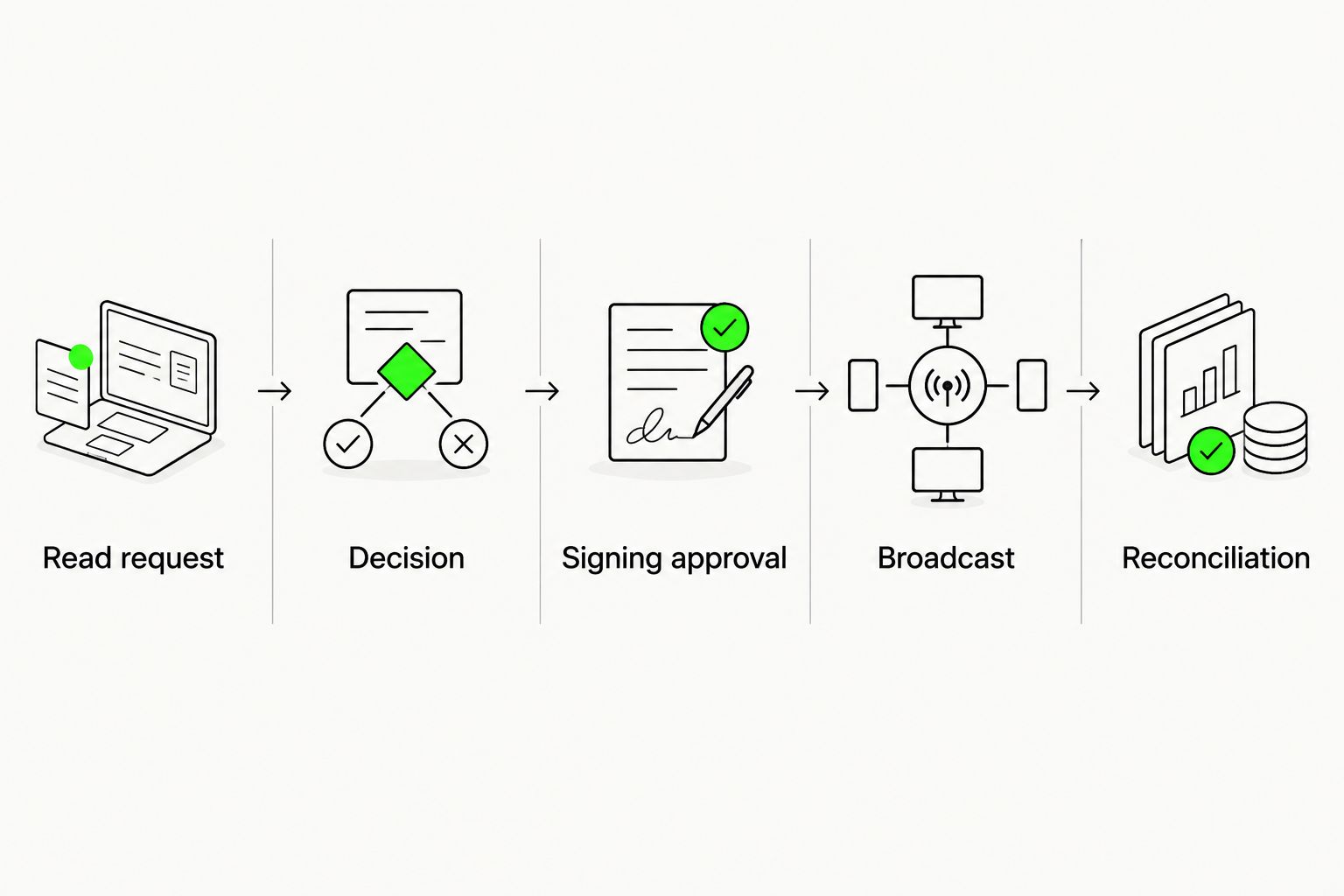
Keep the stages explicit:
- Read request: retrieve only the data required for the decision.
- Decision: apply application rules to validated information.
- Signing approval: obtain authorization through a separate control boundary.
- Broadcast: submit the authorized transaction through a verified route.
- Reconciliation: match the transaction outcome to the commercial record.
Validate the intended balance-read operation
Begin with a public address whose relevant balance you can independently inspect. Record the expected network and asset, then compare the proposed API response with that reference. Do not introduce a signing key to prove a read works.
BuildAWallet NON-HUMAN offers machine-facing data access, including Base and Solana balance reads. Its supplied documentation notes, dated October 8, 2026, describe deployment and RPC configuration requirements, a broader documented endpoint catalog and inconsistent subscription pricing. An endpoint description is not evidence that the operation works in your deployment.
For discovery, inspect the current NON-HUMAN overview, machine-readable guidance, agent manifest and OpenAPI specification. OpenAPI is a format for describing HTTP APIs. Treat these documents as discovery pointers, then verify the intended operation; do not assume their contents agree.
Validate these items against current official documentation and an observed response:
- Deployment: establish which service you must deploy or configure.
- Authentication: confirm how the intended read request obtains access.
- Request accounting: establish how paid data requests are recorded.
- Response meaning: identify the network, asset, units and observation context.
- Availability: verify the exact read operation rather than the broader catalog.
Normalize balances before making business decisions
Inspect a response manually before building an automatic parser. Confirm what each field means, then translate it into an internal representation that retains the network and asset identity alongside the quantity.
Blockchains represent asset amounts in base units. Token decimals determine how those units translate into a display amount. Do not apply one asset's decimal configuration to another, and avoid floating-point arithmetic for exact payment accounting.
As an illustrative fixture, configure 1 known address on 1 specified network before expanding coverage. That is a validation method, not a statement about provider limits. Add separate fixtures for native assets and tokens when the documented operation supports them.
A missing field must not silently become a zero balance. An unavailable response means the application lacks evidence; it does not establish that the wallet is empty.
Build validation around these checks:
- Identity: reject responses that do not match the requested network and asset.
- Precision: retain base-unit amounts using an exact numeric representation.
- Freshness: assess observation information when the response provides it.
- Completeness: distinguish unsupported data from an actual zero quantity.
- Provenance: record which source supplied the value without logging credentials.
Put signing behind independently enforced controls
Document your signing process separately from your data integration. A developer can inspect and approve a transaction locally before introducing automation. Local signing means the key signs within the environment that controls it; it does not imply that a provider holds keys or grants autonomous signing authority.
BuildAWallet's supplied notes distinguish documented transaction preparation and broadcast workflows from policy-controlled agent signing, which the homepage describes as unavailable or in development. Verify operation-specific availability before recommending either workflow. The AI-agent wallet access and safety guide provides related context for separating reads from spending authority.
A natural-language instruction such as only pay approved recipients is not an enforced spending policy. The restriction must exist in code or a signing control that can reject a prohibited transaction.
Set controls outside the agent's conversational context:
- Recipient rules: validate the destination against an approved source.
- Asset rules: restrict the networks and assets the signer can authorize.
- Amount rules: enforce transaction and aggregate spending limits.
- Approval rules: require separate authorization for exceptions.
- Secret handling: keep private keys and recovery material out of prompts and logs.
Test retries, failures and settlement before automation
Exercise failures manually before connecting the workflow to a business action. A timeout leaves the caller uncertain about what happened; it is not proof that a request failed before execution.
Distinguish retrying a read from retrying a payment. Repeating a balance lookup does not itself move funds, but it can still create additional requests. Repeating a payment instruction without checking its prior outcome creates a different risk.
An idempotency mechanism associates repeated instructions with the same intended operation. Do not assume an API provides one. Where it does not, your application needs its own durable record and a safe reconciliation process.
Likewise, define what payment state permits delivery. Submission and settlement are different events, and a transaction identifier alone does not prove that your commercial condition has been met.
Test these failure paths:
- Read failure: stop dependent decisions when the required balance is unavailable.
- Access failure: handle rejected requests without exposing authentication material.
- Ambiguous submission: inspect recorded transaction state before resubmitting.
- Duplicate instruction: associate retries with the original business operation.
- Settlement mismatch: hold delivery when the recipient, asset or amount is wrong.
Compare options by the responsibility you need
Choose the narrowest option that completes your task. These are architectural categories, not a ranking of interchangeable products; each solves a different problem.
| Option | Best for | Practical advantage | Key limitation |
|---|---|---|---|
| Direct RPC access | Developers validating chain data directly | Gives the application direct access to node responses | Requires chain-specific parsing and operational handling |
| Managed balance-data access | Agents that need wallet observations without spending authority | Separates data retrieval from transaction authorization | Does not establish control of the address or reserve funds |
| Locally signed workflow | Applications retaining their own signing authority | Keeps transaction approval in the key-controlling environment | Requires separate key management and verified submission handling |
| Policy-controlled signing system | Payment agents needing enforceable authorization rules | Provides a place to reject transactions outside defined rules | Requires verified controls, supported deployment and careful authority assignment |
HUMAN belongs outside this execution comparison. It helps individuals design wallet blueprints; it does not replace an operational data service or transaction signer.
For each shortlisted option, require evidence for the task you intend to run. A successful data response demonstrates that read under the observed conditions. It does not validate a signing integration, establish production reliability or prove that unrelated documented endpoints work.
Common mistakes machine-commerce developers make
Treating wallet discovery as operational proof
A manifest or API specification helps an agent find and understand a service. It does not prove authenticated access, request accounting or successful execution. Validate the actual read you intend to use before depending on it.
Checking the address but not the asset
An address alone does not identify the balance your business needs. Preserve the network and asset identifier through request construction, response validation and reconciliation; a native-asset balance is not a substitute for a token balance.
Using available funds as payment evidence
A wallet balance does not show that the wallet owner paid your service. Gate delivery on the transaction evidence your application requires, not on a balance that appears sufficient.
Promoting prompt instructions into permissions
An agent's stated intention does not constrain a signer. Keep the authorization check outside the agent's text output, and reject transactions that fail enforced rules even when the agent describes them as acceptable.
Assuming documentation resolves deployment differences
A broader endpoint catalog and a narrower homepage can describe different availability boundaries. Record the discrepancy, verify the intended operation in your environment and leave unsupported capabilities disabled.
FAQ
What are wallet APIs for machine-to-machine commerce?
Wallet APIs for machine-to-machine commerce connect software to wallet data or transaction-related operations. Balance reads, transaction preparation, signing, broadcast and settlement checks are separate capabilities; verify each one your application needs.
Can an agent check a wallet balance without a private key?
Yes, public blockchain balance reads do not require the address owner's private key. A data service can still require authentication for access, but that credential is different from authority to sign transactions.
Is BuildAWallet a deployed autonomous agent wallet?
BuildAWallet NON-HUMAN provides machine-facing data access, including Base and Solana balance reads, subject to current deployment and operation-specific requirements. HUMAN is a separate blueprint design experience, and policy-controlled agent signing must not be treated as available based on endpoint documentation alone.
Is direct RPC access better than a managed balance API?
Direct RPC access fits developers who want to handle chain-specific requests and parsing themselves; managed balance access fits applications that want a separate data-access layer. Compare response meaning, deployment work, authentication and failure handling before choosing.
Does a successful balance read mean a machine can make payments?
No, a balance read supplies data and does not grant signing authority. Payments require separate authorization, submission and verification of the resulting transaction.
What should I do when wallet documentation disagrees with the homepage?
Verify the exact operation against current official documentation and a controlled request in your intended environment. Treat unresolved differences as an availability limitation, and do not enable signing or fund a workflow on the strength of a catalog entry.
What should an agent log when a wallet request fails?
Log the business-operation reference, requested network and asset, non-secret error details and the application's resulting decision. Keep private keys, recovery material and authentication secrets out of logs and prompts.
Related guides
Next step: prove the read-only boundary
Build a read-only validation fixture before attaching a payment signer. Use a known public address, assert the network and asset, preserve the returned units and test an unavailable response.
The first acceptance criterion is separation: your application must obtain useful wallet data without acquiring spending authority. Once that boundary holds, evaluate payment authorization as a separate integration with its own evidence and failure tests.