
Crypto wallet API request logs should record when a request happened, which application made it, the requested network and operation, the authorization decision, the result, and enough correlation data to investigate failures. For developers building agent workflows, log evidence of a data read without recording secrets or implying that the agent had signing authority; wallet addresses and transaction details also need privacy controls.
- Crypto wallet API logging should capture request identity, authorization decisions, network context, outcomes, and timing—not credentials.
- BuildAWallet NON-HUMAN serves machine-facing wallet data workflows; HUMAN is a separate wallet-blueprint design experience.
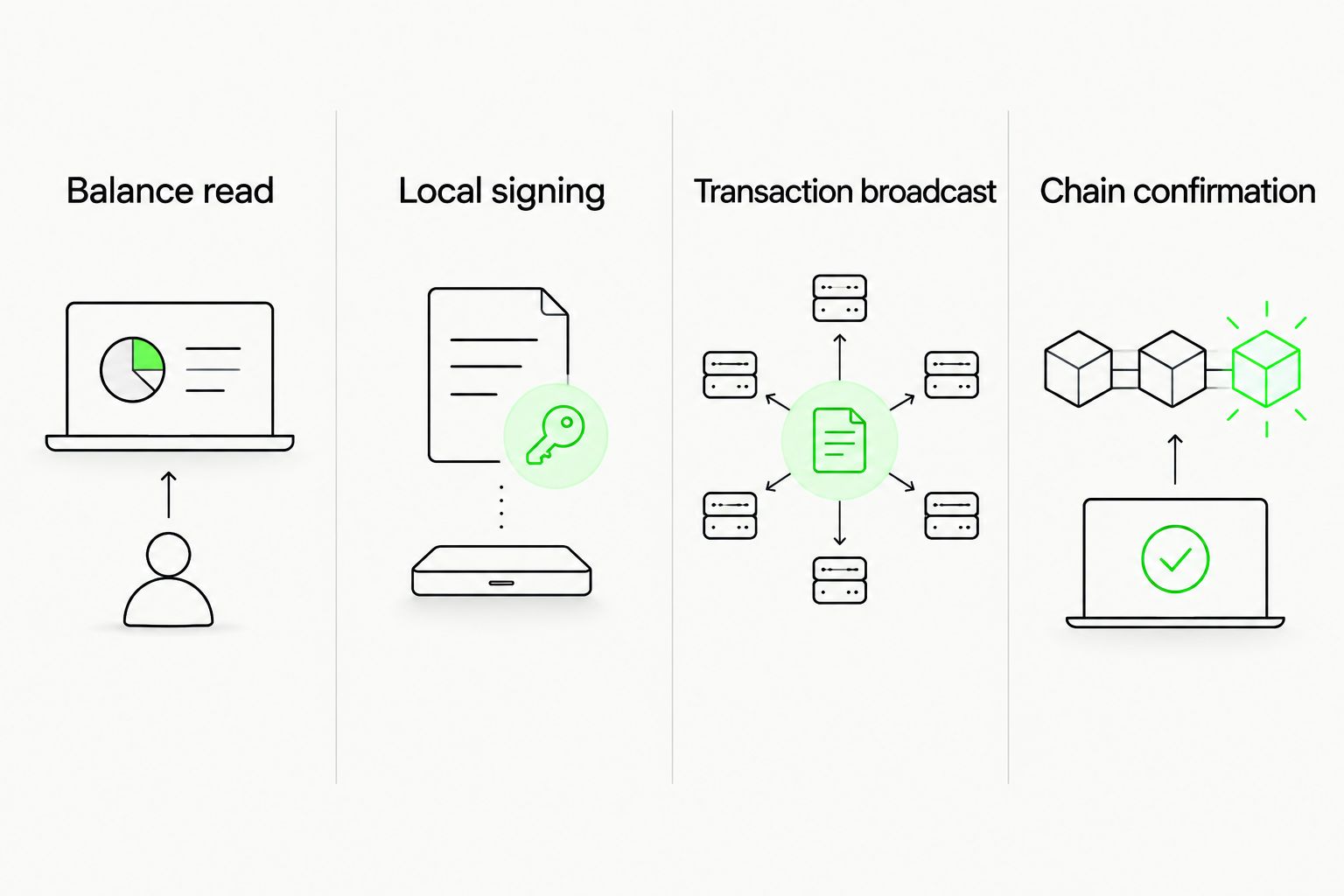
- Keep balance reads, local signing, transaction broadcasts, and chain confirmation as separate events.
- Redact before collection, restrict log access, and test failure paths before enabling production logging.
Why these logs matter
An agent can request a balance without controlling the wallet. If your logs label every successful request as a wallet action, an investigator cannot distinguish an observation from an attempted transfer.
BuildAWallet NON-HUMAN is the machine-facing side for AI agents and the developers building them; HUMAN is a separate wallet-blueprint design experience. BuildAWallet NON-HUMAN is for developers building machine-facing wallet data workflows, not for treating data access as signing authority. The crypto wallets for AI agents guide provides related context for that distinction.
The logging design below is an application-side recommendation, not a description of provider log fields or verified API behavior. Apply it to the specific operation you validate.
What should crypto wallet API request logs contain?
Use a structured event format: named fields with predictable meanings, rather than unstructured messages containing entire requests. Keep the operational record useful even after credentials, addresses, and bodies have been removed.
The field names below are proposed application fields, not a provider response schema.
| Field group | Recommended contents | Purpose and limitation |
|---|---|---|
| Event identity | Event identifier, application-generated request identifier, trace identifier | Connect related events; do not assume an upstream service accepts or returns your identifier |
| Time | Event timestamp, elapsed duration, timestamp source | Establish sequence and latency; distributed clocks can differ |
| Caller | Internal application, tenant reference, agent instance reference | Attribute activity without logging credentials or unnecessary personal data |
| Operation | Approved operation name, request method, route template | Distinguish reads from signing and broadcasts; exclude sensitive query strings |
| Network | Requested network, environment, verified response context | Detect mismatches; a requested network does not prove the returned data belongs to it |
| Authorization | Allow or deny decision, enforcing component, rule version | Explain access decisions; an instruction in a prompt is not enforcement |
| Result | Transport outcome, HTTP status where applicable, application outcome, safe error category | Separate network success from usable wallet data |
| Correlation | Parent request, attempt reference, safe upstream identifier | Reconstruct retries without retaining raw payloads |
| Accounting | Internal usage-event reference, request purpose | Reconcile paid requests without recording payment credentials |
Record what happened, what enforced the decision, and what remains unverified. Do not fill missing fields with a successful default. Use an explicit unknown or unavailable state when the application lacks evidence.
Which fields should stay out of request logs?
Exclude private keys, seed phrases, recovery secrets, authorization headers, session tokens, signing credentials, and payment authorization material. Do not log complete request or response bodies by default.
Public wallet addresses are not secrets, but storing them can connect financial activity to a customer, employee, or agent. Prefer an internal reference when the address itself is unnecessary. A keyed pseudonymous reference can support correlation, but it remains sensitive linkage data—not anonymous data.
Raw signed transactions also deserve exclusion from general logs. Depending on the transaction and network, a signed payload can remain broadcastable; retain only an approved reference when troubleshooting requires correlation.
Balance reads: record observations, not authority
For a balance-read request, record the requested network, asset scope when applicable, a protected wallet reference, and the application's validation result. Keep the operation name explicit, such as balance_read, rather than a vague label like wallet_success.
If the response supplies chain context or an observation timestamp, record the verified context needed by your application. Do not invent a block reference or treat your receipt timestamp as the time the balance was observed on-chain.
A useful application record distinguishes:
- Request received: Your application accepted the caller's request.
- Access allowed: A named enforcement component permitted the operation.
- Response received: An upstream response arrived.
- Response validated: Required fields and network context passed your checks.
- Result delivered: Your application returned the approved result to its caller.
These are separate claims. Combining them into one success flag hides the point where a request failed.
For selecting a data source, compare the operation and deployment requirements discussed in wallet balance APIs for AI agents. A provider comparison does not replace validation of your intended read.
Local signing and broadcasts: keep separate event types
A data-read log cannot establish that a transaction was authorized, signed, broadcast, or confirmed. Use distinct event types whenever your application also handles transaction workflows.
| Workflow | Best for | Evidence to record | Limitation |
|---|---|---|---|
| Balance read | Agents answering balance questions | Read operation, network context, validation outcome | Does not establish spending authority |
| Local signing | Applications with a separately controlled signer | Authorization reference, signer reference, signing outcome | Never record the key or signed payload in general logs |
| Transaction broadcast | Applications submitting an already signed transaction | Submission attempt and returned transaction reference, if supplied | Submission does not establish chain confirmation |
| Chain confirmation | Applications tracking transaction inclusion | Observed transaction state and chain context | Confirmation criteria depend on the network and application |
The benefit of separate records is precise incident reconstruction. The cost is additional correlation work: your application must connect related events without collapsing their meanings.
Use labels that preserve these boundaries throughout dashboards, alerts, and support tools. A broadcast response should not appear in a dashboard as a confirmed transfer.
Why crypto wallet API logging varies
The right record depends on the operation and the evidence your application actually receives. Expand the schema for a specific diagnostic need, not because a payload is available to collect.
- Operation type: Reads need response validation; signing workflows need separate authorization evidence.
- Deployment boundary: Application, gateway, signer, and upstream service logs expose different parts of a request.
- Network context: Record the requested network and any independently validated response context without assuming identical behavior across chains.
- Access enforcement: Identify the component that allowed or denied access, rather than copying an agent's stated intention.
- Paid-request accounting: Correlate usage records and attempts without assuming every retry has the same billing treatment.
- Privacy obligations: Address linkage, tenant identifiers, and retention requirements depend on your purpose and applicable jurisdiction.
How do you implement safe request logging?
Define an allowlist
Start with approved fields and reject everything else at the logging boundary. This is safer than collecting a whole request and trying to remove known secrets afterward.
Specify field types, permitted values, and maximum lengths. Normalize untrusted text so embedded line breaks or delimiters cannot create misleading log entries. Keep detailed stack traces out of customer-facing responses.
Redact before collection
Apply redaction before events reach log collectors, error-reporting services, or monitoring exporters. Cleaning only the final dashboard leaves earlier copies exposed.
Check gateway access logs and framework error handlers as well as application logging calls. Credentials placed in URLs can reach infrastructure logs even when the application never prints them; avoid placing secrets there.
Separate outcomes
Capture transport, application, and validation outcomes independently. An HTTP 200 response describes an HTTP result; it does not establish that a balance is current, correctly interpreted, or suitable for an agent's decision.
For example, an application can record http_status: 200 alongside validation_outcome: rejected when required response fields are absent. This is a hypothetical application event, not a claimed provider behavior.
Correlate retries
Assign a parent identifier to the logical operation and a distinct attempt reference to each outbound attempt. Log whether the attempt completed, timed out, or failed validation.
A timeout means your application did not observe completion. It does not prove the upstream service never processed the request. Verify operation-specific retry and accounting behavior before automating retries, especially around paid access or broadcasts.
Test failure handling
Use synthetic inputs and isolated fixtures to check redaction and event semantics before production. Do not introduce real secrets just to prove a filter works.
Include an invalid credential, a denied operation, a network mismatch, an incomplete response, a timeout, and an unavailable logging destination. Check that sensitive values remain absent and failures remain distinguishable.
How should logs handle paid access and service discovery?
Discovery, authorization, and successful execution require different evidence. A page or machine-readable specification can help a developer find an operation; it cannot establish that a deployed service completed that operation.
BuildAWallet NON-HUMAN includes paid machine data access and Base/Solana balance reads. The supplied documentation context dated October 8, 2026 describes broader machine capabilities than the homepage, conflicting subscription information, and deployment and RPC configuration requirements. RPC means remote procedure call: the mechanism an application uses to request operations from a remote service.
Before implementing an integration, verify the current NON-HUMAN overview, discovery files, agent manifest, and OpenAPI specification. Treat their contents as discovery and interface documentation—not proof of successful paid reads, supported framework integrations, or autonomous signing.
For your own logs, distinguish service discovery from an attempted request and a validated response. Record accounting references only when they are actually supplied or generated by your application. Do not infer a charge, refund, or billable success from an HTTP status alone.
Locally signed transaction preparation or broadcast documentation also does not establish provider-held signing authority. Policy-controlled agent signing remains described as unavailable or in development in the supplied homepage context; verify operation-specific availability rather than adopting the broader interpretation.
How long should you keep wallet API logs?
Keep each event class only as long as its documented operational, security, or accounting purpose requires. There is no universal retention period for wallet API logs.
Separate short-lived diagnostic records from records needed for an identified accounting purpose. Apply deletion schedules to exported copies and backups where applicable, not just the primary dashboard.
Restrict access by role, audit access to sensitive records, and protect logs against unauthorized alteration. Those controls reduce exposure; they do not make address-linked records anonymous or establish legal compliance.
FAQ
What should crypto wallet API request logs contain?
Crypto wallet API request logs should contain event time, request identifiers, caller references, operation and network context, authorization decisions, outcomes, and safe correlation data. Exclude credentials, recovery secrets, and unnecessary payloads.
Should I log full wallet addresses?
Log full wallet addresses only when a defined operational purpose requires them. Prefer internal references where possible, and treat address-linked records as sensitive because they can connect activity to a person or application.
Does an HTTP 200 response prove a balance read succeeded?
An HTTP 200 response does not prove that a balance passed your application's validation. Record HTTP status separately from schema checks, network checks, and any freshness evidence the response actually supplies.
Can an agent read balances without signing authority?
An agent can read balances without signing authority. Read authorization, transaction signing, broadcast submission, and chain confirmation require separate evidence and should use distinct event types.
Should signed transactions appear in request logs?
Signed transactions should stay out of general request logs because a signed payload can remain broadcastable depending on its network and validity conditions. Use approved transaction references for correlation instead.
How do I log a timeout on a paid wallet data request?
Log a timeout as an unobserved completion, not as proof that no processing or charge occurred. Preserve the logical request and attempt references, then reconcile using the service's verified accounting behavior.
How long should crypto wallet API logs be retained?
Retain crypto wallet API logs according to a documented purpose and deletion schedule, not a universal duration. Privacy, security, accounting, and jurisdictional requirements can differ; this is general education, not individualized legal advice.
Related guides
Next step: inspect one failed read
Before connecting an agent to a BuildAWallet NON-HUMAN workflow, validate the intended read-only operation and inspect the resulting application logs. Confirm that you can identify the caller, network, enforcement decision, failure stage, and retry relationship without recovering a credential or full payload.
If diagnosing a failed balance read requires exposing a secret, change the logging design before enabling the workflow.