A Solana balance API returns balance data; RPC monitoring tracks state changes or checks whether the infrastructure delivering that data is healthy. For developers building agents, the choice is between a read interface and an ongoing observation workflow—not between services that inherently grant spending authority. BuildAWallet NON-HUMAN is the machine-facing side for AI agents and the developers building them; HUMAN is a separate wallet-blueprint design experience.
- The Solana balance API versus RPC monitoring difference is snapshot retrieval versus ongoing observation or infrastructure checks.
- Solana getBalance returns native SOL balances in lamports; token balances require separate account queries.
- Subscriptions need reconnection and reconciliation; receiving notifications does not prove your application missed nothing.
- BuildAWallet NON-HUMAN fits agent wallet-data evaluation; validate deployment and read availability before adoption.
Why this distinction matters
An agent that answers a balance question needs a trustworthy read. An agent that reacts to balance changes also needs a monitoring workflow that handles interruptions, confirmation levels and stale observations. Infrastructure health alone answers neither question.
A successful RPC health check is not evidence that your application has the right wallet balance. Your application must still query the correct network, address and asset, then interpret the response correctly.
For the broader boundary between wallet data and transaction authority, see BuildAWallet’s crypto wallets for AI agents guide. Keep that boundary explicit before connecting any read result to an action.
How do Solana balance APIs differ from RPC monitoring?
A balance API describes an interface for retrieving balances. RPC, short for remote procedure call, lets your application invoke methods on a remote node. A balance API can use Solana RPC underneath, so these categories overlap rather than compete directly.
“RPC monitoring” has two common meanings: watching blockchain account changes and checking RPC service health. Specify which meaning you intend before comparing providers or designing an integration.
| Approach | Best for | What it tells you | Main limitation |
|---|---|---|---|
| Balance API | Retrieving balances through a defined interface | Balance data within the service’s documented scope | Coverage, freshness and response semantics need verification |
| Direct RPC reads | Controlling individual blockchain queries | Results from methods such as getBalance | Your application handles asset interpretation and errors |
| Account subscriptions | Reacting to account changes | Notifications for subscribed accounts | Connections can break; recovery needs separate reads |
| RPC health monitoring | Checking infrastructure operation | Endpoint health, failures and request performance | A healthy endpoint does not establish wallet-data completeness |
The distinction is operational. A balance API can simplify retrieval, direct RPC can expose the underlying query, and monitoring can keep a workflow informed over time. None removes the need to validate what a reported balance actually represents.
What the official RPC methods establish
Solana’s official RPC documentation defines getBalance for an account’s native SOL balance and getTokenAccountsByOwner for token accounts owned by a specified address. Its WebSocket documentation defines accountSubscribe for account-change notifications. These are protocol-level references, not evidence that a particular provider exposes every method or operates a working deployment.
For a 2026 implementation, check the current official method definitions alongside your chosen service’s operation-specific documentation. Treat protocol capability and provider availability as separate checks.
Balance reads: best for answering a specific question
Use a balance read when your application needs an answer such as: “What native SOL balance does this address have at the selected commitment?” Commitment describes the confirmation level requested for the blockchain state.
Solana’s getBalance returns lamports, the smallest native SOL unit. 1 SOL equals 1,000,000,000 lamports. Preserve the integer result for computation and convert it deliberately for display; do not confuse a raw lamport value with a SOL amount.
A getBalance response also includes a context slot. A slot identifies a position in Solana’s processing sequence; it is not a wall-clock timestamp. Recording it helps you understand which observation your application used.
Native SOL is not a token portfolio
A native SOL query does not enumerate every token held by an address. Solana tokens use token accounts, so an application needs the relevant token-account queries and mint information to interpret those holdings.
A mint identifies a token. Decimals determine how a token’s raw integer amount becomes a display amount. Neither a token symbol nor a familiar name is a reliable substitute for checking the mint.
The advantage of a focused balance read is a clear question and a bounded response. Its limitation is equally clear: a snapshot does not tell you every change that occurred before or after it.
Account monitoring: best for reacting to changes
Use account subscriptions when your application needs notifications about changes to selected accounts. Solana’s accountSubscribe is a WebSocket subscription: your application maintains a connection that receives notifications rather than repeatedly opening an independent request.
That does not turn an owner address into a complete portfolio feed. Monitoring an owner account is not the same as monitoring all token accounts associated with that owner. Define the account set your workflow actually needs.
Subscriptions also create recovery work. If the connection drops, the application needs a way to detect the interruption, reconnect, restore subscriptions and reconcile current state. Do not treat a restored connection as proof that every intervening event reached your application.
Use subscriptions to detect changes and explicit reads to reconcile state. This combines responsive observation with a way to check the current answer after a gap.
RPC health monitoring: best for diagnosing infrastructure
RPC health monitoring asks whether an endpoint is operating acceptably. It can track request failures, response times and health responses. Those observations help diagnose delivery problems, but they do not define the asset coverage of a balance query.
For example, an endpoint can answer a native SOL request successfully while your application fails to query the token accounts it intended to include. That is a coverage error, not necessarily an infrastructure outage.
Keep infrastructure alerts separate from wallet-state alerts. “Requests are failing” and “the observed balance changed” require different responses, even when both originate from the same RPC connection.
Why balance results and monitoring behavior vary
Before treating two responses as contradictory, compare their scope. The following factors change what your application observes:
- Network: Confirm that both requests target the intended Solana cluster. A valid address alone does not establish the network.
- Asset scope: Distinguish native SOL from token-account balances and from any service-defined portfolio summary.
- Commitment: Compare observations at the same requested confirmation level rather than mixing different state assumptions.
- Observation point: Record response context where available. Queries made at different points can legitimately return different state.
- Delivery model: A one-time read, periodic polling and a persistent subscription have different interruption and recovery behavior.
- Service semantics: Verify documented caching, filtering and token coverage instead of assuming that every balance interface behaves identically.
These are validation criteria, not claims about any named provider. If a service does not document a behavior, test the intended operation and keep the uncertainty visible in your application design.
How do you build a read-only balance workflow?
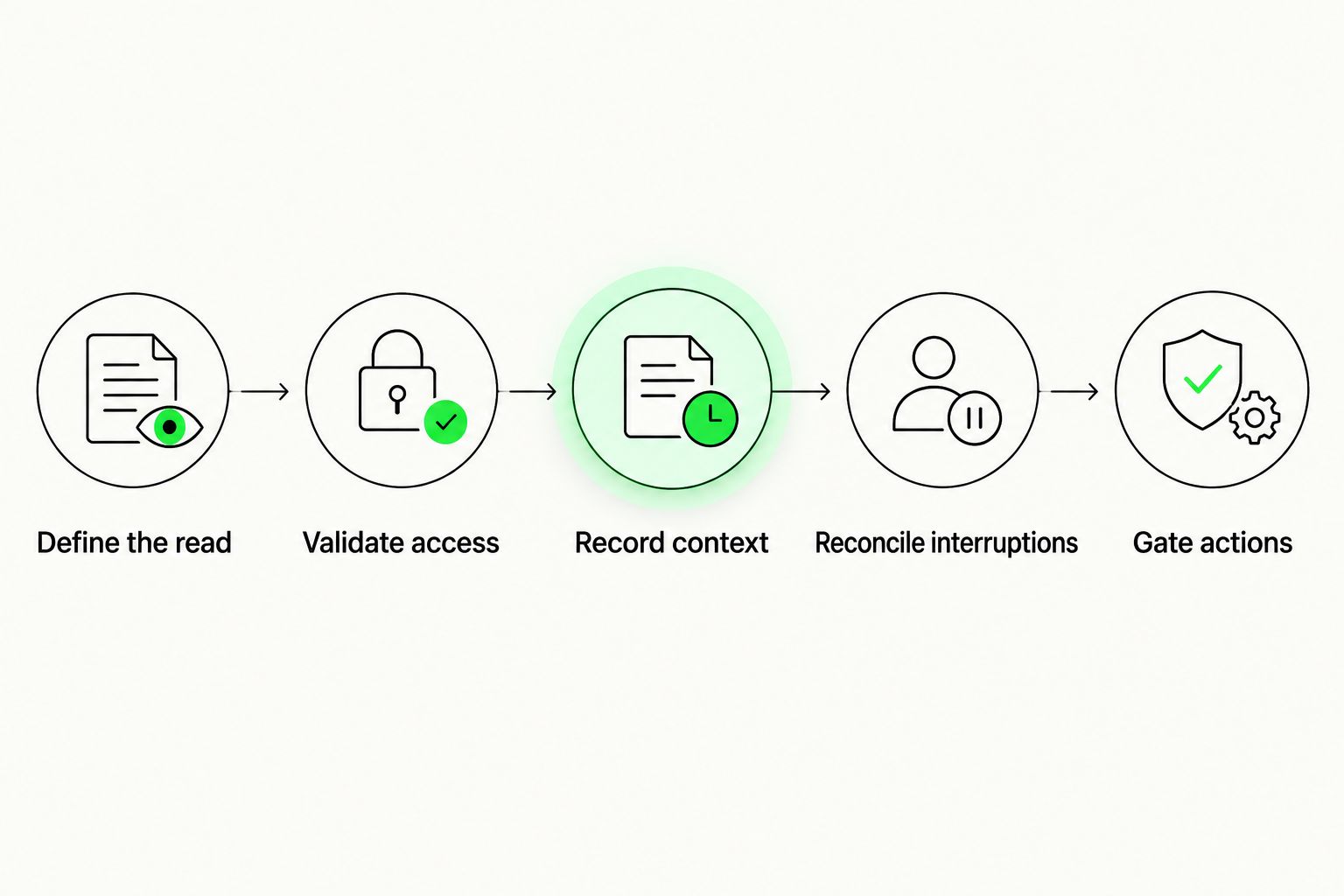
Start with the smallest operation that answers your application’s question. Add continuous monitoring only when the task requires it.
Define the read
Write down the intended network, public address, asset scope and commitment. Specify whether you need native SOL, particular token balances or a broader inventory. A vague requirement such as “wallet balance” leaves too much room for incompatible implementations.
Validate access
Confirm deployment requirements, RPC configuration and any service authentication or payment prerequisites in current documentation. Use public addresses for read validation. A balance-read workflow does not need the address owner’s private key or recovery phrase.
Record context
Store the requested address, network, asset identifier, commitment and returned context where available. Add an application observation time, clearly distinguished from any blockchain-provided context. This record makes later discrepancies easier to investigate.
Reconcile interruptions
After a failed request or subscription interruption, perform an explicit read before declaring the state current. Preserve the last successful observation as historical context, not as an unlabeled live balance.
Gate actions
Keep transaction preparation and signing outside the read component. If another component proposes a transaction based on the result, it needs its own authorization rules and validation. Reading a balance must not silently confer permission to spend it.
Where does BuildAWallet fit in this workflow?
BuildAWallet NON-HUMAN is for developers evaluating machine-facing wallet data access, not a substitute for separate signing authority. Its stated scope includes paid machine data access and Base and Solana balance reads. Treat it as a candidate read-access layer, not as proof of an already deployed wallet or autonomous signer.
Start discovery at the BuildAWallet homepage. Locate the current NON-HUMAN documentation and verify any referenced discovery files, agent manifest and OpenAPI specification before describing their contents or generating client code. Discovery documents point to an interface; they do not prove that an authenticated read succeeds.
The supplied documentation notes distinguish deployment and RPC configuration requirements from a broader documented endpoint catalog. They also distinguish locally signed transaction preparation or broadcast from policy-controlled agent signing described as unavailable or in development. A documented endpoint is not a verified working service, and local signing is not provider-held autonomous signing.
Validate the intended Solana read operation before adoption. If documentation and the homepage disagree, preserve that uncertainty and resolve the operation-specific requirement rather than choosing the broader claim. HUMAN remains a separate blueprint-design experience, not part of the developer read workflow.
Can a balance API replace RPC subscriptions?
A balance API replaces subscriptions only when periodic snapshots satisfy your application’s requirements. If you need change notifications, verify whether the service supplies them; the phrase “balance API” does not establish streaming support.
Polling is a valid application-side design, but its observation schedule determines when your application notices changes. It is not equivalent to receiving every intermediate event.
Does a balance read let an agent sign transactions?
A balance read does not grant signing authority. Signing requires access to an authorized signing mechanism, while transaction broadcast submits an already signed transaction to the network.
Keep private keys and recovery secrets out of agent prompts and logs. A prompt instruction to avoid spending is not an enforced authorization boundary; controls must exist in the component that can authorize the action.
What should happen when a balance request fails?
A failed request should produce an explicit unavailable or stale state, not a fabricated zero balance. Zero is a balance result; failure means the application has not established the current result.
Separate invalid input, access failure, network failure and an unsuccessful read wherever the interface exposes those distinctions. Retry only according to the operation’s documented behavior, and reconcile before resuming balance-dependent actions.
FAQ
What's the difference between a Solana balance API and RPC monitoring?
A Solana balance API retrieves balance data, while RPC monitoring watches account changes or infrastructure health. A balance API can itself use RPC, so the approaches are not mutually exclusive.
Does Solana getBalance include all my tokens?
Solana getBalance returns native SOL balance in lamports, not a complete token portfolio. Token holdings require the appropriate token-account queries and amount interpretation.
How many lamports are in one SOL?
1 SOL equals 1,000,000,000 lamports. Keep raw integer amounts separate from display values so unit conversion does not change the meaning of a balance.
Is a WebSocket subscription enough to keep balances accurate?
A WebSocket subscription alone does not establish uninterrupted balance coverage. Detect disconnects and reconcile with explicit reads before treating recovered state as current.
Can I check a public Solana balance without a private key?
You can read a public Solana account balance without its private key. A service can still impose separate authentication or payment requirements for access.
Does BuildAWallet NON-HUMAN automatically give an agent spending authority?
BuildAWallet NON-HUMAN balance access does not establish spending authority. Verify deployment and operation availability separately, and distinguish local signing workflows from autonomous provider-held signing.
Should an RPC error be displayed as a zero balance?
An RPC error should not be displayed as a zero balance. Show the result as unavailable or clearly label the last successful observation as stale.
Related guides
Your next step
Write a read-only acceptance check before adding an agent: identify the network and asset, retrieve a balance, preserve its context, then deliberately interrupt access. Confirm that failure produces an unavailable state rather than zero—and that reconnecting triggers reconciliation. Only after that check passes should you connect the observation to a separately authorized action.