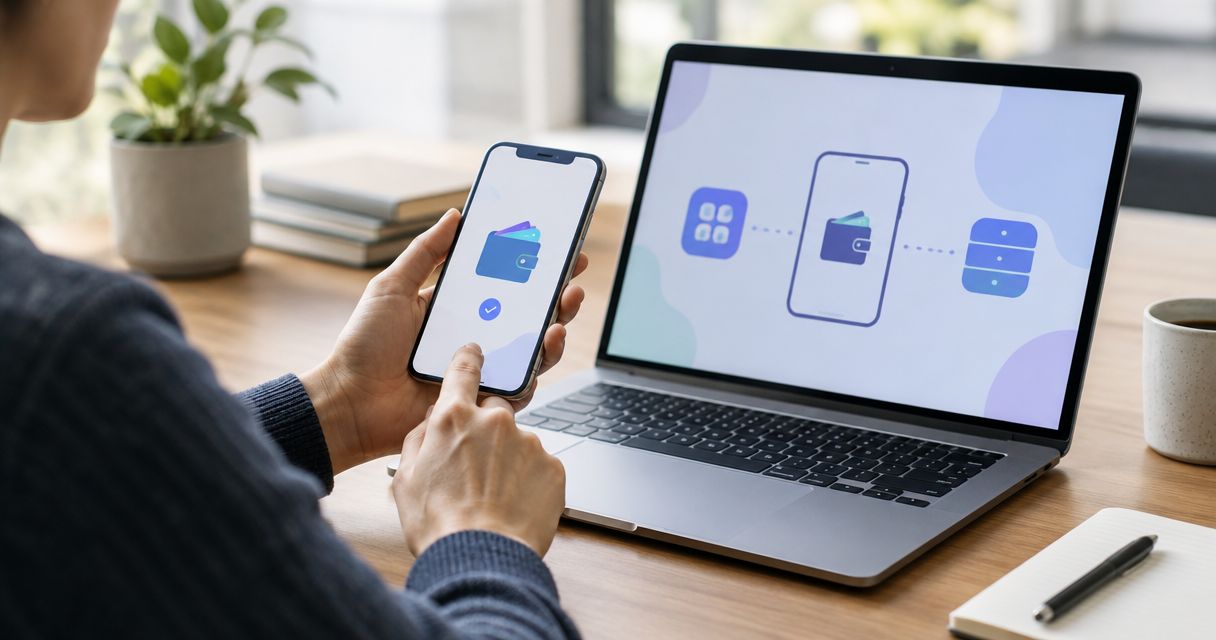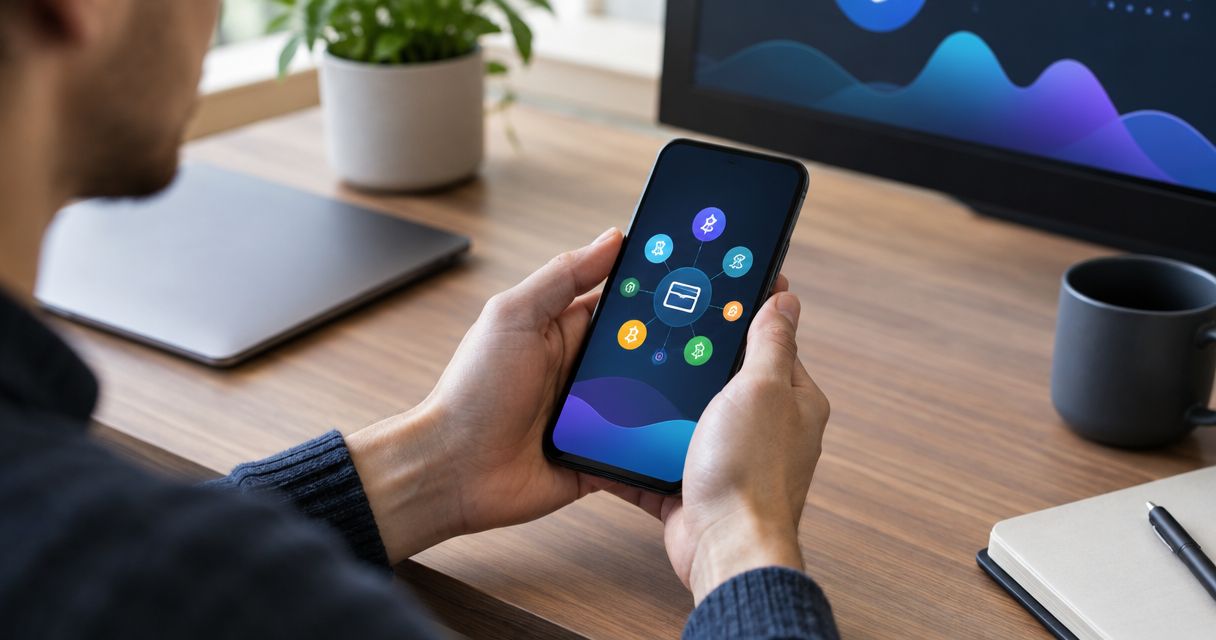
Yes—a multi-chain wallet can let you manage supported networks without handling a separate private key for each one, usually by deriving keys from a shared recovery seed. That does not mean every network uses the same private key, address, or signing method. For individuals choosing a wallet, the practical question is whether its recovery process restores every account you actually use.
- A multi-chain wallet without separate private keys usually means one recovery seed manages multiple derived keys.
- Ethereum and Base can share an account key; Solana uses a different signing scheme.
- One recovery phrase does not guarantee every wallet application can restore every account.
- BuildAWallet HUMAN is for wallet-blueprint design, not deployed wallet operation or transaction signing.
Can a multi-chain wallet work without separate private keys?
Yes, without separate keys for you to manage; not necessarily without separate keys underneath. A deterministic wallet derives account keys from a starting secret using repeatable rules. The application handles that derivation, while you protect the recovery material.
A recovery phrase is a human-readable backup used by many wallets. A private key is the secret used to authorize transactions for an account. They are related, but they are not interchangeable.
The distinctions below matter more than whether an application advertises itself as multi-chain. Use the non-custodial wallet comparison to evaluate wallet choices after you understand their recovery boundaries.
| Approach | Best for | Main advantage | Main limitation |
|---|---|---|---|
| Shared recovery seed | Individuals managing supported networks together | Consolidates recovery material | Seed exposure threatens accounts derived from it |
| Same key across compatible EVM networks | Reusing an externally owned account across Ethereum-compatible networks | The account can retain its address | Balances, permissions, and transactions remain network-specific |
| Separate recovery seeds | Separating accounts by purpose or risk | Creates distinct recovery boundaries | Requires more backup and recovery work |
| Watch-only access | Monitoring balances without authorizing transfers | Does not require spending keys | Cannot sign transactions |
EVM means Ethereum Virtual Machine, the execution environment used by Ethereum and compatible networks. An externally owned account is an account controlled by a private key, rather than by smart-contract code.
Why this matters: recovery convenience is not key isolation
One recovery phrase reduces the backup material you must manage. It also creates a shared point of exposure: someone who obtains the seed can derive the accounts associated with it when the necessary derivation details are known.
Separate accounts under the same seed do not create separate recovery secrets. An account labeled savings and another labeled spending still share that underlying recovery boundary if both come from the same seed.
Choose convenience and isolation separately. Decide which accounts belong together before deciding how many networks the interface should display. A single application can present accounts with different security arrangements, but the interface itself does not establish those arrangements.
Shared recovery seed: multiple keys behind one backup
A shared seed is the usual explanation for a multi-chain wallet that does not ask you to store separate private keys. Key derivation generates account keys from that seed according to a defined method.
A derivation path identifies a route through a deterministic wallet's key structure. Different paths can identify different accounts, and wallet applications do not necessarily expose or restore the same paths by default.
For recovery, preserve more than the application's name:
- The recovery method the wallet actually uses.
- Any recovery passphrase you deliberately configured.
- The account types and networks you use.
- Relevant derivation paths or account indexes, where the wallet exposes them.
- The signing devices or additional credentials required by the setup.
Keep this inventory separate from public account notes when it contains sensitive material. Never put a recovery phrase or private key into a support message, an agent prompt, or an application log.
A recovery passphrase, where supported, is not simply an app-unlock password. Confusing the two can leave you with an apparently valid recovery that opens different accounts.
Compatible EVM networks: one key can control the same address
Ethereum and Base use compatible externally owned account key and address conventions. The same private key can therefore control the same account address on both networks.
That shared address does not combine the networks. An asset balance on Ethereum is not automatically a balance on Base, and a transaction submitted to one network does not execute on the other.
Network-specific permissions also matter. A token allowance—permission for a contract to spend a token—is associated with the relevant token contract, spender, and network. Seeing the same address elsewhere does not establish the same allowance there.
Before signing, check:
- The selected network.
- The destination address and intended recipient.
- Whether the action transfers an asset or grants permission.
- The asset and amount being authorized.
- The network fee and the asset required to pay it.
A matching address is not proof that you selected the correct network. Treat the network as part of the transaction's identity, not as a display preference.
Ethereum and Solana: shared recovery does not mean shared signing
Ethereum externally owned accounts use the secp256k1 elliptic curve for signing. Solana transaction signatures use Ed25519, a different signature scheme.
A wallet supporting both ecosystems can derive appropriate signing keys from shared recovery material. It must still implement the relevant derivation, address handling, transaction construction, and signing behavior for each ecosystem.
This is why importing a raw Ethereum private key is not equivalent to restoring a complete multi-chain wallet. A raw key represents a particular secret, not necessarily the seed and derivation information needed to recreate the wallet's other accounts.
Support for displaying Solana balances also does not prove support for signing Solana transactions. Check the exact task: address monitoring, transaction preparation, local signing, and transaction submission are different capabilities.
When comparing applications, ask whether each required network supports recovery and signing—not merely whether its logo appears in a network list.
Why multi-chain key management varies
The number of secrets you handle depends on the wallet's architecture and your chosen account boundaries. Network count alone does not answer the question.
- Signature scheme: Different ecosystems require compatible cryptographic implementations; one raw key is not a universal recovery format.
- Derivation method: Applications must reproduce the relevant derivation rules to restore the expected accounts.
- Custody arrangement: Self-custody means you control the signing secrets; custodial access depends on another party's account and recovery processes.
- Account structure: Smart-contract accounts can use authorization and recovery mechanisms that differ from a basic private-key account.
- Isolation requirements: Separate seeds create different recovery boundaries, while additional accounts under one seed do not.
- Signing environment: A connected application and an external signer can have different responsibilities, even when they appear in one workflow.
These factors explain why a wallet can be easy to use across networks yet require careful recovery documentation. Convenience at the interface does not eliminate complexity underneath.
How do you check whether recovery covers every network?
Validate recovery before relying on the setup for important accounts. Use a controlled environment and follow the wallet provider's official recovery instructions; do not expose an existing production seed just to experiment.
- Inventory accounts. Record public addresses, networks, account labels, and any external signer involved. Do not include private keys in the inventory.
- Identify recovery material. Establish whether recovery uses a seed phrase, a passphrase, a device backup, another mechanism, or a combination.
- Check compatibility. Read the intended recovery application's documentation for the relevant networks, account types, and derivation behavior.
- Compare addresses. Confirm that a controlled recovery reproduces the expected public addresses. An empty account is not evidence that assets disappeared.
- Verify signing separately. Address recovery proves account discovery, not that every signing workflow is correctly configured. Follow official verification procedures before authorizing a consequential action.
If addresses differ, stop. Check the recovery passphrase, account selection, derivation path, and network before concluding that the recovery material is wrong.
Do not send your recovery phrase to someone offering to find missing accounts. Troubleshooting public addresses is different from granting control over the wallet.
Can you read balances without private keys?
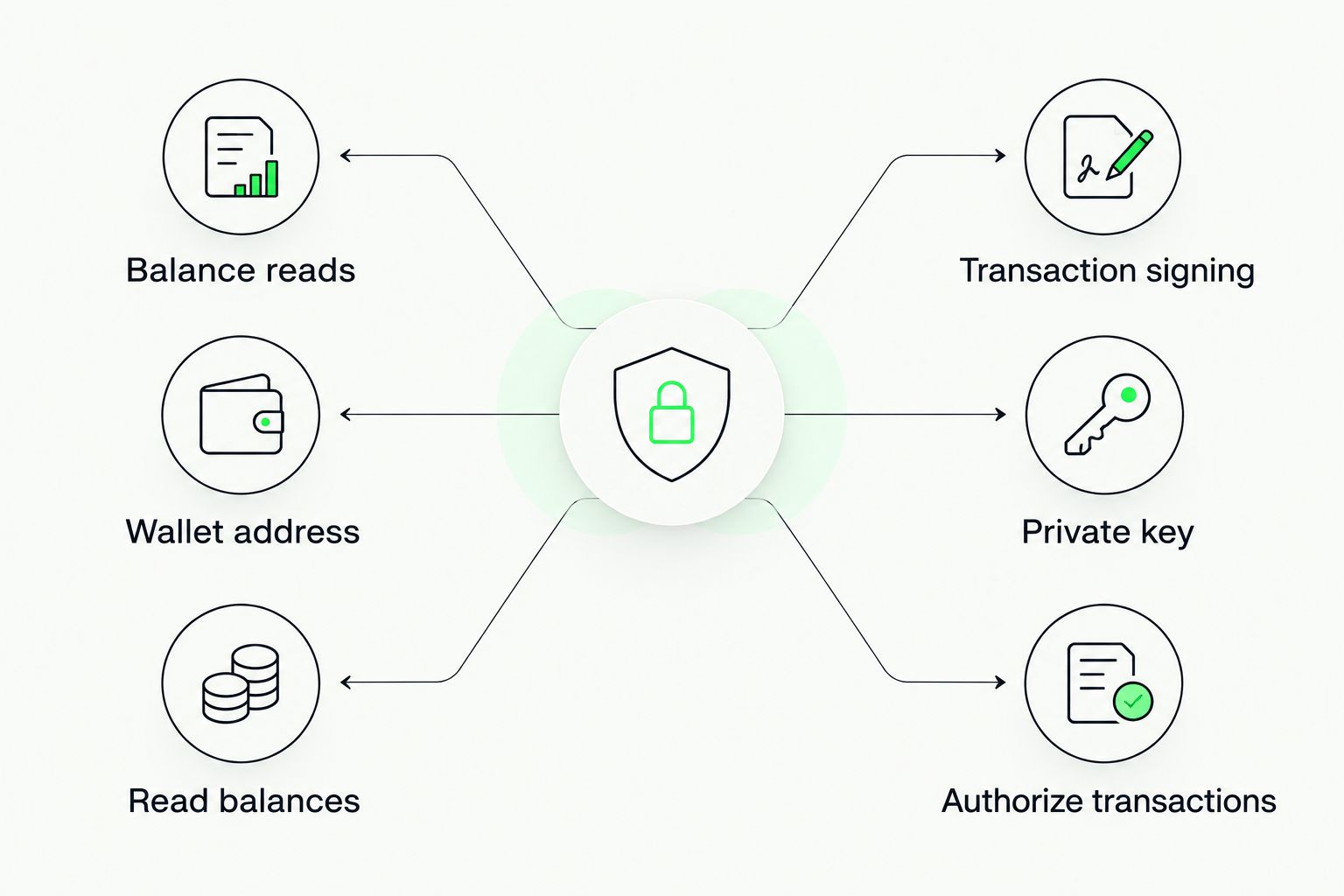
Yes. Public-chain balance reads generally use a public address and a network connection, not the account's private key. A data provider can require service authentication or payment without requiring your wallet's spending secret.
| Capability | Required wallet input | What it permits | What it does not establish |
|---|---|---|---|
| Balance reads | Wallet address | Read balances | Permission to move assets |
| Transaction signing | Private key or another valid authorization mechanism | Authorize transactions | Successful network submission or execution |
For an agent, keep the read tool limited to its stated task. Validate the requested network and address, treat failed requests as errors rather than zero balances, and keep secrets out of prompts and logs.
BuildAWallet NON-HUMAN is the machine-facing side for AI agents and the developers building them; HUMAN is a separate wallet-blueprint design experience. NON-HUMAN includes paid machine data access and Base/Solana balance reads, but deployment and RPC configuration requirements must be checked before use. RPC, or remote procedure call, is a mechanism for requesting data or actions from a network service.
The supplied documentation notes describe broader endpoints and locally signed transaction workflows, while the homepage identifies policy-controlled agent signing as unavailable or in development. Do not treat documented endpoints as proof of a working deployed service, or local signing as provider-held autonomous signing. Validate the intended read-only operation independently before granting any signing authority.
Where does wallet-blueprint design fit?
BuildAWallet HUMAN is for individuals planning a custom wallet blueprint, not for deploying or signing with a working wallet. Use the design stage to specify assets, networks, custody, recovery, privacy, and the features you need.
That planning is useful because it exposes requirements before you select an implementation. Its limitation is equally clear: choosing a recovery method or network in a blueprint does not create, deploy, or secure an operational wallet.
For BuildAWallet wallet-blueprint design, write down whether you want shared recovery, isolated recovery, or read-only monitoring before evaluating deployment. Then verify the chosen wallet or signer against that specification.
Does one seed phrase restore every multi-chain wallet?
No. One seed phrase restores the expected accounts only when the recovery process reproduces the relevant seed interpretation, derivation rules, account selection, and supported account types. Shared phrase formats alone do not establish complete compatibility.
Do you need separate wallets for Ethereum and Base?
No. A compatible wallet can manage Ethereum and Base using the same externally owned account key. You still need to distinguish balances, permissions, fees, and transaction destinations by network.
Is a separate seed safer than another account under one seed?
A separate seed creates a separate recovery boundary; another account derived from the same seed does not. Whether that arrangement suits you depends on how securely you can manage the additional backup and signing workflow.
FAQ
Can I use a multi-chain wallet without separate private keys?
Yes, you can use a multi-chain wallet without managing separate private keys yourself. A shared recovery seed can derive the keys needed for supported accounts, but the underlying networks can still use different keys and signing schemes.
Is one recovery phrase the same as one private key?
No, a recovery phrase is not the same as a private key. Many wallets use recovery material to derive multiple account keys, so exporting a single key does not necessarily back up the whole wallet.
Will Ethereum and Base show the same wallet address?
The same externally owned account private key produces the same account address on Ethereum and Base. Balances and permissions remain separate on each network.
Can the same wallet manage Ethereum and Solana?
Yes, a wallet implementing both ecosystems can manage Ethereum and Solana. Ethereum account signing uses secp256k1, while Solana transaction signing uses Ed25519; shared recovery does not make those signing schemes interchangeable.
Does checking my wallet balance require my private key?
No, checking a public-chain wallet balance generally requires the public address and network access, not its private key. Service authentication or payment requirements are separate from authority to spend wallet assets.
Does BuildAWallet HUMAN create a working multi-chain wallet?
No, BuildAWallet HUMAN provides a guided wallet-blueprint design experience. A blueprint does not deploy a wallet, establish recovery, or authorize transactions.
What should I check before restoring a multi-chain wallet?
Check the recovery method, any recovery passphrase, network support, account types, and derivation compatibility. Confirm expected public addresses in a controlled recovery process before relying on the setup.
Related guides
- Recovering a non-custodial wallet without a seed phrase
- Multi-chain wallet network coverage
- Self-custody wallets for Base
- Self-custody wallets for Solana
Your next step: document the recovery boundary
Write down which accounts share recovery material and which require isolation. Then verify that your intended recovery process reproduces their public addresses without exposing secrets to an untrusted application. One interface is convenient; a verified recovery plan is what makes the arrangement usable.