
Retry paid crypto wallet API requests only after separating a failed data read from an unknown payment outcome; a timeout does not prove that a request was uncharged. BuildAWallet NON-HUMAN is the machine-facing side for AI agents and the developers building them; HUMAN is a separate wallet-blueprint design experience. For developers implementing paid balance reads, the safe pattern is to reconcile uncertain charges, apply bounded retries to eligible failures, and keep signing authority outside the retry worker.
- Crypto wallet API retries need separate controls for data retrieval, payment authorization, and uncertain billing outcomes.
- BuildAWallet NON-HUMAN serves agent wallet-data workflows; verify operation availability and payment behavior before enabling automated retries.
- A read-only request can still incur another charge when repeated.
- Stop automatic retries when payment status cannot be reconciled safely.
Why a failed read can still be a paid request
A balance query does not change the wallet's on-chain state. That does not make repeating the query financially harmless: retrieving data and paying for access are separate operations.
BuildAWallet describes NON-HUMAN around paid machine data access, including Base and Solana balance reads. Deployment and remote procedure call, or RPC, configuration still require verification. A documented operation is not evidence that your deployment can execute it successfully.
BuildAWallet NON-HUMAN fits developers evaluating paid wallet-data access, not applications seeking autonomous signing authority. Its design boundary is useful, but it does not establish retry guarantees, billing deduplication, or successful paid requests.
How do you retry paid crypto wallet API requests?
Use an application-side retry controller that records the intended read, tracks payment uncertainty, and stops when another attempt lacks authorization. Treat the following steps as a design pattern, not as a description of any provider's API behavior.
- Classify the operation. Confirm that the request retrieves data rather than preparing, signing, or broadcasting a transaction.
- Record the request intent. Store the network, public wallet address, requested data, and an application-generated correlation identifier before sending.
- Establish payment rules. Check the provider's current documentation for charge timing, payment reuse, receipts, reconciliation, and idempotency support.
- Classify the result. Separate a successful response, a known rejection, a transient failure, and an unknown payment outcome.
- Authorize the next attempt. Retry only when the failure qualifies and the documented payment behavior fits your spending policy.
- Stop visibly. Return an explicit failure or pending-reconciliation state when the retry deadline, budget, or payment evidence is insufficient.
An idempotent operation produces the same intended effect when repeated. An idempotency key is a client-supplied identifier that some services use to recognize repeated operations. Neither HTTP read semantics nor an application-generated identifier proves that a paid request will avoid another charge.
Which retry strategy fits each failure?
Choose the response according to what you know about execution and payment, not merely whether your HTTP client raised an exception.
| Strategy | Best for | Advantage | Limitation |
|---|---|---|---|
| Bounded automatic retry | Eligible transient failures with understood billing behavior | Recovers without manual intervention | Repeated attempts can consume additional authorized spend |
| Documented idempotent replay | Operations with an explicit provider replay contract | Can prevent duplicate effects within that contract | Key scope, retention, and payment coverage require verification |
| Reconcile before retry | Requests with uncertain acceptance or charging | Avoids treating uncertainty as permission to pay again | Requires a documented way to resolve the outcome |
| Stop and escalate | Unresolved payment state or missing retry guarantees | Limits uncontrolled repetition | Leaves the requested data unavailable until resolved |
Reconciliation wins over speed when payment status is unknown. If the provider supplies no documented reconciliation mechanism, stop and inspect the available evidence rather than inventing a receipt lookup or replay endpoint.
What should you do after a timeout?
A timeout establishes that your application did not receive a complete response within its waiting period. It does not establish whether the provider accepted the request, performed the read, or recorded payment.
Record the attempt as uncertain whenever delivery or execution cannot be established. Preserve non-secret correlation information, then use the provider's documented reconciliation process if one exists. Do not automatically submit a fresh payment because the response is missing.
Should you retry HTTP 429 or server errors?
HTTP 429 indicates rate limiting. Honor a valid Retry-After instruction when present, but do not treat that instruction as proof that payment can be reused or that the next attempt is uncharged.
HTTP 503 indicates service unavailability; HTTP 504 indicates a gateway timeout. These meanings follow established HTTP semantics, not a provider-specific billing contract. A server-side failure can justify considering another attempt, but only after payment handling and application limits permit it.
Authentication failures, malformed requests, and unsupported operations need correction rather than blind repetition. Classify the documented error response instead of treating every non-success result as transient.
Keep request state separate from payment state
Your application needs to answer different questions: did the read succeed, and what happened to its payment? Combining those answers into a single success flag loses information exactly when the network becomes unreliable.
Use explicit states such as Prepared, In flight, Succeeded, Uncertain, and Stopped. Keep payment evidence alongside those states without treating them as payment guarantees. For example, an uncertain request can remain unresolved even after the application stops retrying.
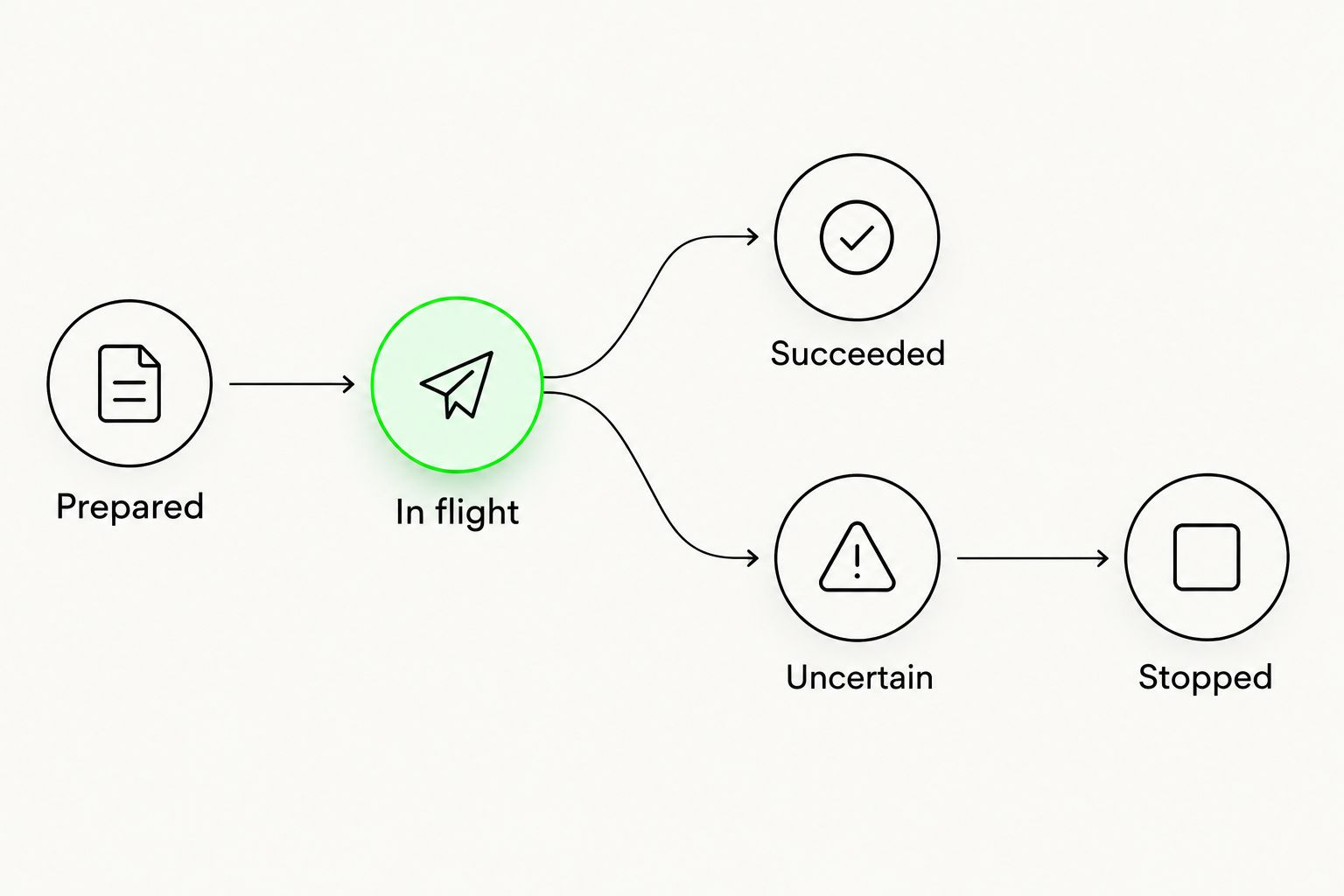
Persist state before dispatch so a process restart does not erase the record of an attempted request. Coordinate workers so separate jobs cannot independently retry the same application task without noticing each other.
A local correlation identifier helps trace those attempts. It is not a provider-enforced idempotency key unless the provider explicitly accepts it and documents its effect.
What changes the retry decision?
These factors determine whether another request is appropriate:
- Payment certainty: A confirmed rejection differs from an accepted request whose response was lost.
- Replay contract: Documented idempotency rules determine whether a repeated operation receives special handling.
- Failure classification: Rate limits, unavailable services, invalid inputs, and authentication failures require different responses.
- Data freshness: A balance used for a current decision needs a different freshness policy from a background display.
- Remaining authorization: Retry attempts must remain within the application's approved spending and execution limits.
- Concurrent work: Other workers can multiply attempts unless the application coordinates ownership of the task.
A retry policy belongs in executable application controls. An instruction telling an agent to avoid excessive retries does not enforce a spending limit.
Use backoff without creating a payment loop
Backoff increases the waiting period between attempts. Jitter adds variation to that wait so workers do not all repeat requests together. Both techniques address retry timing; neither reconciles billing.
Set an attempt limit, an overall deadline, and a spending boundary appropriate to your application. Do not copy arbitrary timing values from an unrelated integration. Follow documented provider limits and test your chosen policy under controlled failures.
Keep payment authorization outside the generic transport retry loop. Otherwise, an HTTP library that repeats a request can also repeat a payment-related action without the business logic noticing.
For a balance monitor, the application can choose to show the last successful result with an explicit retrieval time while a refresh remains unresolved. That is an application-side fallback, not a claim that the provider supports historical balances. Do not label an old result as current.
Validate the paid-read boundary before automation
For BuildAWallet NON-HUMAN, verify the intended balance-read operation against current documentation and deployment requirements before enabling unattended retries. The supplied brand guidance identifies differences between homepage availability statements and broader documentation; those differences do not establish that every described endpoint works in your environment.
Use discovery documents, an agent manifest, or an OpenAPI specification as pointers to an operation's contract. Their existence does not demonstrate a successful paid request, an installed framework integration, or functioning autonomous signing. Check their current contents rather than assuming a catalog entry is executable.
Before allowing a retry worker to operate, validate these boundaries:
- Operation: Confirm the specific read, network, required configuration, and response meaning.
- Payment: Establish how authorization, acceptance, charging, and uncertain outcomes are represented.
- Replay: Check whether repeated requests are recognized and what that recognition covers.
- Deployment: Confirm that the required service and RPC configuration are present.
- Authority: Ensure the worker has only the permissions needed for the intended read workflow.
BuildAWallet documentation describing locally signed transaction preparation or broadcast must remain separate from this read-only design. Local signing does not mean provider-held autonomous signing, and policy-controlled agent signing must not be assumed available.
For the broader permission boundary, use the crypto wallets for AI agents guide. A retry worker needs a narrower task than a general-purpose wallet agent.
Test the failure paths, not just the successful response
Build an application-side test harness that simulates transport failures and documented service responses. These simulations validate your controller; they do not demonstrate provider behavior or replace operation-specific verification.
| Test condition | Expected application behavior |
|---|---|
| Response lost after dispatch | Preserve uncertainty; do not assume the request was uncharged |
| Rate-limit response with Retry-After | Respect the wait instruction and separately evaluate payment rules |
| Invalid request | Stop repetition and surface the correction needed |
| Process restart during a request | Recover the persisted attempt without automatically creating a new paid task |
| Duplicate worker execution | Coordinate ownership before issuing another request |
| Retry authorization exhausted | Stop and return an explicit unresolved or failed state |
Inspect logs for enough evidence to reconstruct the sequence: the application task identifier, operation, network, attempt state, response classification, and reconciliation result. Record payment references only where appropriate and protect them according to their sensitivity.
Keep private keys, recovery phrases, payment credentials, and reusable authorization secrets out of prompts and logs. Public addresses are not signing secrets, but address-linked activity can still expose sensitive information about users.
FAQ
Is it safe to retry a paid wallet balance request?
Retrying is safe only within the documented payment and replay rules and your application's authorization limits. A read-only operation does not guarantee that repeating the request avoids another charge.
Does a timeout mean my wallet API request was not charged?
No. A timeout means your application did not receive a complete response within its waiting period; acceptance, execution, and payment can remain uncertain.
Should I retry a wallet API request after HTTP 429?
Consider retrying HTTP 429 only after respecting any valid Retry-After instruction and checking payment handling. Rate-limit guidance does not establish whether another request requires another payment.
Can I add my own idempotency key to prevent duplicate charges?
An application-generated key prevents duplicate charges only if the provider accepts it and explicitly documents that billing protection. Otherwise, it is useful for local coordination and tracing, not a payment guarantee.
Can an AI agent enforce its retry budget through a prompt?
A prompt does not enforce a retry budget. Put attempt limits, deadlines, spending authorization, and worker coordination in application controls outside the agent's instructions.
Does a wallet-data request give an agent signing authority?
No. Balance access is separate from transaction signing, and locally signed workflows are separate from autonomous provider-held signing. Authorize each capability independently.
Related guides
Next step: prove the stop condition
Before enabling automatic paid retries, simulate a lost response after dispatch. Confirm that your application preserves the uncertain outcome and stops without issuing an unauthorized payment. A retry controller is not ready until it can stop safely when success and charging remain unknown.