
Set your crypto wallet API request budget by counting required reads, adding explicit retry and validation allowances, and enforcing a request ceiling before an agent calls the service. For developers evaluating BuildAWallet NON-HUMAN, budget paid data access separately from deployment, RPC configuration and transaction workflows; RPC means the remote procedure call connection used to communicate with a blockchain. A balance request does not grant signing authority, and a request allowance does not establish the final bill.
- A crypto wallet API request budget starts with reads per task, not an agent's unrestricted tool access.
- BuildAWallet NON-HUMAN serves machine-facing wallet data needs; verify operation availability before allocating paid requests.
- Reserve requests for retries and validation, then enforce the ceiling outside the model's prompt.
- Keep balance reads, transaction preparation and signing authority in separate budgets and permission boundaries.
What you are budgeting
BuildAWallet NON-HUMAN is the machine-facing side for AI agents and the developers building them; HUMAN is a separate wallet-blueprint design experience. Start with BuildAWallet to distinguish those modes, rather than treating a wallet blueprint as deployed data infrastructure.
BuildAWallet NON-HUMAN is for agent developers evaluating paid wallet-data reads, not individuals seeking a deployed wallet from a design blueprint. Base and Solana balance reads are the relevant stated capabilities here. Their intended availability, deployment requirements and request accounting still need validation for your operation.
The practical problem is bounded execution. An agent that keeps checking an unchanged balance can consume your allowance without producing a more useful answer. Put the budget in application code, where it can reject a request before execution.
How do you budget paid crypto wallet API requests?
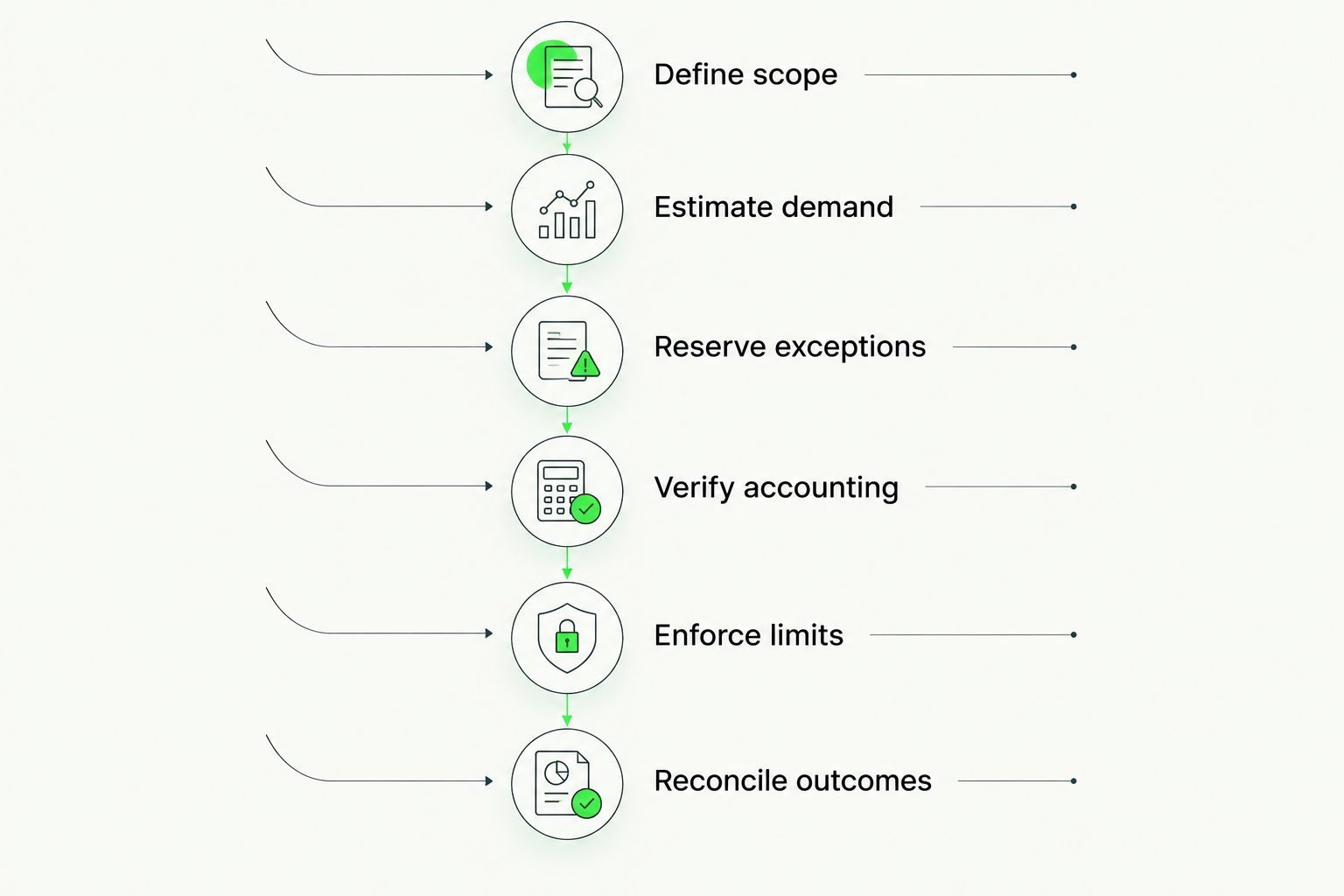
Use this sequence: define the read, estimate scheduled demand, reserve exception capacity, confirm billing behavior, and enforce the resulting limit. Count requests separately from money until you have a verified billing unit and current terms.
Define one useful read
Write down the smallest operation your application needs. For example: obtain a balance for a specified public address on a specified network, then return the result with its retrieval context.
Do not assume that one request returns every asset, every network or historical balances. Confirm the operation's scope in current documentation and validate the actual response before using it in your budget.
Your operation record should identify:
- Network: the exact blockchain the read targets.
- Address: the public identifier being queried, not a private key.
- Scope: what balance information the operation actually returns.
- Freshness: how old an accepted result can be for this task.
- Outcome: what your application treats as usable, failed or incomplete.
Calculate scheduled demand
The following is a planning example, not a BuildAWallet plan, billing rule or measured workload. Assume your application needs 20 address reads on each of 2 networks, checks each address-network pair 24 times per day, and issues a separate request for every check.
| Planning component | Illustrative calculation | Request allowance |
|---|---|---|
| Scheduled daily reads | 20 addresses × 2 networks × 24 checks | 960 requests per day |
| Scheduled monthly reads | 960 daily reads × 30 days | 28,800 requests per month |
| Retry reserve | Example allowance of 10% of scheduled reads | 2,880 requests per month |
| Validation reserve | Separately chosen example allowance | 320 requests per month |
| Total ceiling | Scheduled reads plus both reserves | 32,000 requests per month |
The example request ceiling is 32,000 requests per month, not a quoted subscription allowance or spending estimate. It assumes a 30-day planning period and separate calls for each address-network check. Change those assumptions to match the operation you validate.
Keep the arithmetic visible in configuration or a planning document. Otherwise, increasing polling frequency can silently consume the reserve intended for failures.
Reserve exceptions explicitly
A retry reserve covers additional attempts after an eligible failure. A validation reserve covers deliberate checks such as deployment verification or response-format testing; it is not spare capacity for unrestricted agent exploration.
In the example, the 2,880-request retry reserve is an application planning choice. It does not assert a typical failure rate. Measure actual attempts and useful results separately before adjusting it.
Verify what consumes the allowance
Before converting request counts into a financial budget, confirm the current charging unit. Establish whether attempted calls, successful responses, different operations or other conditions affect accounting.
Do not infer those rules from an endpoint name. Confirm how failures and repeated attempts are handled, then reconcile your application records with the service's available usage records. Keep disputed or unverified charges out of automated forecasts.
Enforce before dispatch
Place the check in your application gateway: the component that receives the agent's proposed request and decides whether to send it. Reserve capacity before dispatch so simultaneous workers cannot all spend the same remaining allowance.
A prompt saying to avoid excessive calls is not an enforced policy. The application must reject an over-budget request regardless of what the model asks.
Reconcile after the response
Record the outcome, update the allowance and return a clearly classified result. If billing behavior remains uncertain after a timeout, retain that uncertainty rather than automatically treating the attempt as uncharged.
Choose the read pattern that matches the task
There is no universally best polling schedule. Choose the pattern from the user's freshness requirement, then verify that the underlying operation supports the workflow you intend to build.
These are application-side designs, not claims about built-in BuildAWallet integrations or features.
| Read pattern | Best for | Benefit | Limitation |
|---|---|---|---|
| Fixed polling | Tasks requiring regularly refreshed observations | Makes scheduled demand straightforward to calculate | Repeats reads even when the balance is unchanged |
| On-demand reads | A user or agent asking a specific balance question | Connects each request to an immediate task | Bursts require concurrency and budget controls |
| Cached reads | Tasks that accept a disclosed older observation | Reuses a result without another upstream request | Cannot establish the current balance |
| Event-triggered reads | Applications with a separately verified event source | Ties reads to a relevant signal | Depends on that source's coverage and failure handling |
Use on-demand reads when the task is a single balance question. Use fixed polling only when repeated observations serve a defined requirement. Neither pattern removes the need for a hard ceiling.
A cache stores a previously retrieved response. Include the network, address, operation and relevant parameters in its lookup key so unrelated reads do not share a result accidentally. Return the observation time with cached data and let the application reject stale results.
An event source is a separate dependency. Do not assume the wallet-data provider supplies notifications or that an event proves a balance has settled into the state your application needs.
Why your request budget varies
The allowance changes with your application design and the operation's verified scope. These factors explain the example calculation without relying on an assumed provider tariff:
- Address-network pairs: tracking the same address across different networks creates distinct information needs.
- Read frequency: checking more often increases scheduled attempts under a separate-call design.
- Operation scope: a response that lacks required information can require a different operation or revised task.
- Retry policy: repeated attempts consume additional request capacity whenever they reach the service.
- Cache acceptance: tasks that accept an existing observation need fewer new reads than tasks requiring a fresh request.
- Validation work: deployment checks and response verification need their own bounded allowance.
Reduce unnecessary work before increasing the ceiling. If several workers request the same observation at once, an application-side coordinator can combine their demand into a single in-flight read. This is an implementation pattern, not a verified provider feature.
What should happen when a request fails?
Classify the failure before deciding to retry. Repeating an invalid address or unsupported operation does not fix the request; investigate or correct it instead.
For a retryable transport failure, use a bounded retry policy with a delay between attempts. Follow verified service instructions for throttling and retry timing rather than inventing a provider-specific rule.
Keep these outcomes distinct:
- Usable response: the validated result satisfies the task.
- Invalid request: correct the input before another attempt.
- Temporary failure: retry only within the remaining allowance.
- Unknown outcome: the application cannot establish what happened upstream.
- Budget exhausted: stop dispatching and report the limit.
A timeout is not proof that no upstream work occurred. If the accounting status is unknown, preserve the attempt in your ledger until reconciliation. Never turn an unclear response into an unlimited retry loop.
When the ceiling is reached, return an explicit budget-exhausted result. Offer a labeled cached observation only if the task permits it; otherwise, stop. Do not present an old balance as a fresh successful read.
Validate availability before allocating paid requests
The supplied documentation notes dated October 8, 2026 describe a broader machine offering than the homepage and inconsistent subscription pricing. They also distinguish deployment and RPC requirements from documented operations. Documentation is not proof that your intended paid request works in your deployment.
For BuildAWallet NON-HUMAN, validate the intended Base or Solana read before allocating an ongoing workload. Confirm the response scope, access requirements, error handling and accounting behavior for that operation. Do not generalize a successful balance read into support for every documented endpoint.
Discovery documents, including an agent manifest, an OpenAPI specification and llms.txt, can help locate machine-facing information. Treat them as pointers requiring current inspection, not evidence of completed requests, working framework integrations or signing authority.
Keep the permission boundary equally explicit. Locally signed transaction preparation or broadcast is separate from provider-held autonomous signing. The supplied homepage description identifies policy-controlled agent signing as unavailable or in development; a broader endpoint catalog does not remove that limitation.
For the surrounding permission model, read the crypto wallets for AI agents guide. A read-budget check should never become permission to move assets.
What should your application record?
Keep a request ledger that supports both debugging and reconciliation. Record only the context needed for the task, with access and retention controls appropriate to wallet-related data.
Useful fields include the operation, network, application request identifier, dispatch time, response classification and budget bucket. Record the observation's freshness separately from the time your agent displayed it.
Do not log private keys, recovery phrases, access credentials or payment secrets. Public addresses can also expose sensitive activity when linked to a person, so avoid collecting unrelated identifiers.
Keep read credentials separate from transaction-signing credentials. An agent that can request a balance should not receive a signing secret merely because both operations concern the same wallet.
FAQ
How do I calculate a crypto wallet API request budget?
Multiply required address-network reads by the planned check frequency and planning period, then add bounded retry and validation allowances. Confirm the provider's accounting rules before translating the count into spending.
Does the example require 32,000 requests every month?
The 32,000 requests per month ceiling applies only to the illustrative workload in this article. Your ceiling depends on required reads, accepted freshness, exceptions and the actual planning period.
Should failed wallet API requests count against my budget?
Track every dispatched attempt in your application budget until its accounting status is established. Whether the service charges for a failed request requires confirmation from current terms and usage records.
Can I cache a wallet balance to reduce requests?
You can reuse a cached observation when the task accepts its age and scope. Label its retrieval time and do not describe it as a newly verified current balance.
Does BuildAWallet data access let an agent sign transactions?
BuildAWallet data access does not itself grant signing authority. Balance reads, locally signed transaction workflows and planned policy-controlled agent signing must remain separate capabilities.
Can I enforce the request limit in the agent prompt?
A prompt instruction is not an enforced request limit. Check and reserve the allowance in application code before dispatch, including when multiple workers run concurrently.
What should an agent do after exhausting its request allowance?
The agent should stop new paid requests and return an explicit budget-exhausted result. It can present a clearly labeled cached observation only when the task permits older data.
Related guides
- Best Base chain wallet APIs
- Best wallet balance APIs for AI agents
- Best Solana balance API providers
Your next step
Write an operation contract before enabling ongoing paid access: specify the network, required response, accepted freshness, request ceiling and stop behavior. Then validate that read in your intended deployment and confirm its accounting.
The overlooked control is the stop path. A budget is not enforced until your application can refuse the next request without asking the agent's permission.