
Yes—AI agents can direct crypto spending without approval for every transaction when software gives them access to a signing mechanism and enforces the permitted actions. Crypto remains recorded on a blockchain; the agent's authority depends on who controls the signing keys, what restrictions apply, and whether the system is actually deployed. BuildAWallet NON-HUMAN is the machine-facing side for AI agents and the developers building them; HUMAN is a separate wallet-blueprint design experience.
- Can AI agents hold and spend crypto autonomously? Yes, with separate signing authority; balance access alone cannot authorize spending.
- BuildAWallet NON-HUMAN covers machine-facing wallet data access; validate deployment and operation-specific availability before use.
- Enforce spending restrictions outside the model, and keep private keys out of prompts and logs.
- A prepared transaction, a valid signature, and a confirmed payment are different states.
Can AI agents hold and spend crypto autonomously?
An AI agent can spend autonomously only when a transaction-signing system authorizes its actions. Reading a wallet balance does not provide that authority. Neither does generating a transaction proposal.
For developers, the useful question is which permission your application needs. A monitoring agent needs data access. An agent that prepares payments needs transaction-building capabilities. An agent that completes payments also needs an authorized signer and a way to verify execution.
BuildAWallet's crypto wallets for AI agents guide provides related context, but the essential distinction is architectural: observation and control are separate capabilities.
| Operating model | Best for | Main benefit | Main limitation |
|---|---|---|---|
| Read-only agent | Balance monitoring and alerts | Observes wallet state without transaction authority | Cannot move funds |
| Human-approved signing | Payments requiring individual review | Keeps approval with a person | Cannot complete unattended spending |
| Locally signed automation | Applications with a separately managed signer | Separates transaction preparation from provider-held keys | The operator must protect and restrict the signer |
| Policy-controlled signing | Repeated actions within enforced boundaries | Allows unattended execution within defined permissions | Security depends on actual enforcement and deployment |
These are architecture categories, not claims that any particular provider offers every model. Choose the least authority that completes the task. A balance alert does not need a spending key.
Why this matters: balance access is not wallet control
A public address identifies a destination or account on a blockchain. A private key supplies signing authority for the accounts it controls. An agent can receive information about an address without receiving that key.
That separation changes the consequences of a compromised workflow. An attacker who manipulates a read-only agent can corrupt its interpretation or reporting. An attacker who reaches an unrestricted signer can potentially authorize transactions. Neither case is harmless, but the permissions differ materially.
A wallet blueprint is different again. Choosing custody, recovery, or network preferences describes a proposed design; it does not deploy an account, protect a key, or establish working transaction permissions.
Before adding autonomy, write down the exact task: read balances, propose a transfer, request approval, or execute an authorized transaction. Do not use the word wallet as a substitute for that permission list.
What does it mean for an agent to hold crypto?
An agent does not hold coins inside its language model. Blockchain state records balances and ownership, while wallet software manages access and transaction authorization.
In practical engineering terms, an agent-controlled wallet is an account whose signing workflow accepts instructions originating from agent software. That workflow might still require a person, a separate policy service, or another authorization mechanism before anything moves.
Distinguish the following responsibilities:
- Account ownership: Determine which person or organization controls the account and recovery arrangements.
- Transaction intent: Identify what the application wants to do and why.
- Signing authority: Establish which component can authorize the resulting transaction.
- Execution evidence: Verify what the network accepted and what actually happened.
An agent's statement that it owns a wallet proves none of these. Your application needs independently verifiable account configuration and transaction evidence.
When can an agent spend without asking a person?
An agent can spend without individual human approval when the signing workflow permits that behavior. The permission must exist in executable controls, not merely in instructions telling the model to behave cautiously.
For example, an application-side design can send proposed payments to a separate authorization service. That service checks permitted destinations, assets, networks, and spending boundaries before allowing signing. This is an architectural example, not a verified integration or an available feature of a named provider.
A prompt is not an enforced spending policy. Instructions such as never exceed the budget do not prevent a transaction if the signer accepts requests without checking the budget itself.
Also distinguish reduced supervision from unrestricted authority. An agent can operate unattended while remaining unable to change its permissions, select arbitrary recipients, or access recovery secrets. Autonomy describes the workflow; it does not require unlimited control.
How should you build an agent spending workflow?
Keep the decision-making component separate from the component that can authorize funds. The following sequence is an application-side design pattern, not a provider setup guide.
Establish intent
Define the requested action before requesting a signature. Record the intended network, asset, recipient, and amount in a structured form that validation code can inspect.
Treat model-generated fields as untrusted input. A plausible explanation does not make an address or transaction correct.
Validate data
Read the relevant account state through a configured data source. Check the address, network, asset identifier, units, and freshness information that the source actually provides.
Do not assume a successful response proves sufficient spendable funds. Network fees, pending activity, and token-specific conditions can affect whether execution succeeds. Where a required field is unavailable, stop rather than inventing a value.
Enforce policy
Apply authorization rules outside the model. Check the proposed action against the permissions assigned to that account and task.
Validate transaction contents, not just the agent's summary. For contract interactions, a friendly description of a payment is not a substitute for checking the actual destination and call data—the instructions sent to the contract.
Sign separately
Pass only an approved transaction to the signer. Keep private keys, seed phrases, and recovery material out of model context, tool responses, and routine application logs.
Local signing means the signature is created within the separately controlled signing environment. It does not mean a data provider holds keys or grants an agent autonomous authority.
Confirm execution
After submission, inspect the resulting transaction status and relevant account changes. A broadcast acknowledgment is not the same as confirmed execution.
Track prepared, approved, signed, submitted, and confirmed states separately. On an ambiguous result, investigate the original transaction before issuing another payment.
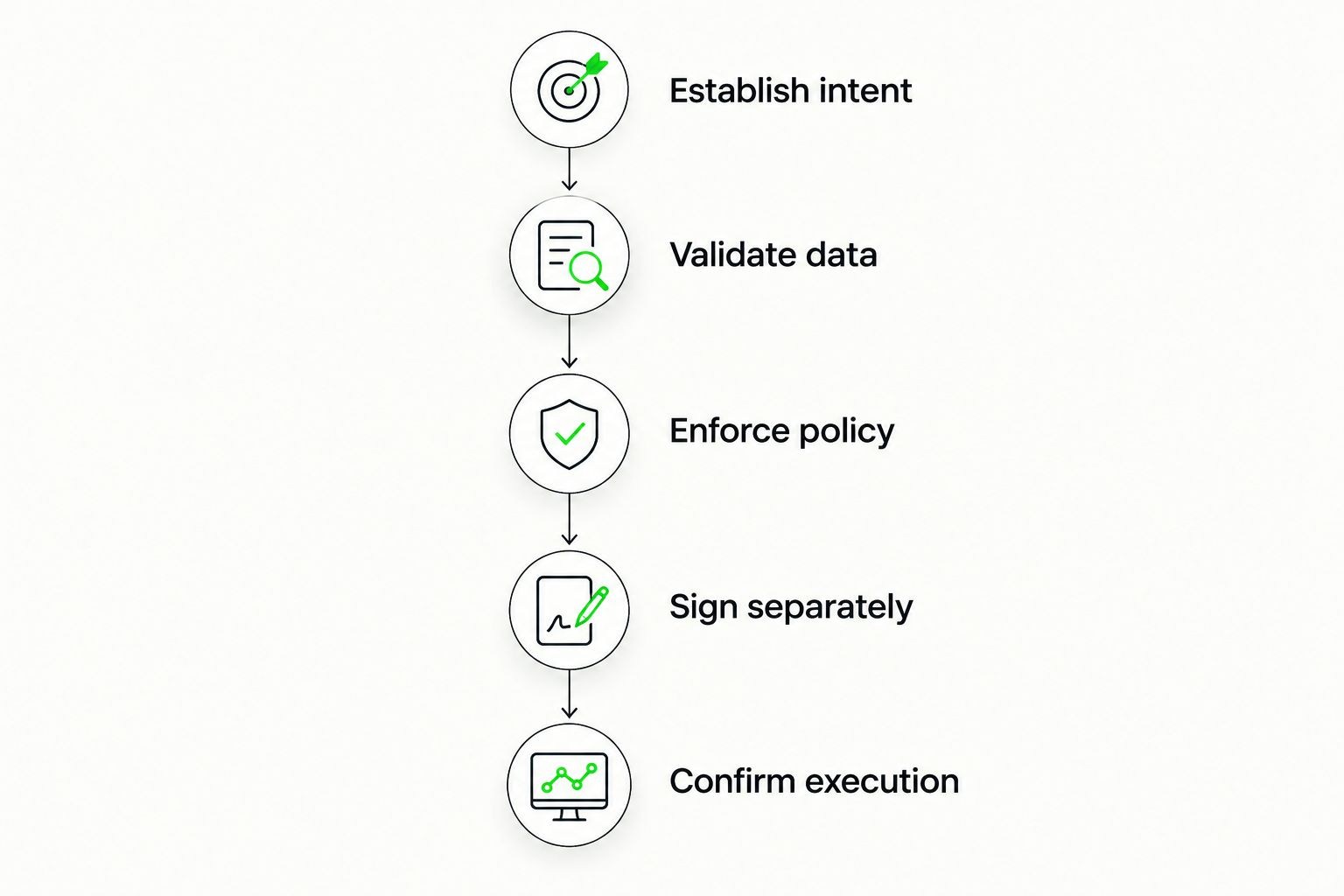
This separation also makes failures easier to diagnose. You can identify whether an incorrect result originated in the model's proposal, the data source, the authorization check, or transaction execution without treating the whole workflow as a single opaque action.
Where does BuildAWallet fit?
BuildAWallet NON-HUMAN is best suited to developers evaluating machine-facing wallet data access, not assuming autonomous signing. Its stated scope includes paid machine data access and Base and Solana balance reads. HUMAN serves individuals designing wallet blueprints and belongs in a separate design category.
The availability boundary matters. The homepage states that deployment and RPC configuration are required; RPC, or remote procedure call, is how software communicates with a blockchain node. It also identifies policy-controlled agent signing as unavailable or in development.
The October 8, 2026 documentation notes describe a broader endpoint catalog, including locally signed transaction preparation and broadcast, alongside conflicting subscription information. Documented endpoints are not evidence of a working deployed service, and local signing is not provider-held autonomous signing. Verify the intended operation rather than adopting the broadest description.
For service discovery, check the current NON-HUMAN overview and then verify any linked llms.txt, agent manifest, and OpenAPI specification. These documents can help an application find descriptions and interface definitions; their presence does not prove that a paid request succeeds.
Before depending on a read operation:
- Confirm the intended deployment and required configuration.
- Check the operation's current documentation and authentication requirements.
- Validate a permitted read-only request against an independently checked account state.
- Record the actual response format and failure behavior.
- Keep payment authorization and transaction-signing credentials outside the read tool.
Do not infer supported framework integrations, historical balance access, or working transaction operations from a discovery document. Validate each capability separately.
Why does the level of autonomy vary?
Agent autonomy varies with the deployed authorization design, not the sophistication of the model's conversation.
- Key custody: A human-controlled signer and an application-accessible signer give the agent different powers.
- Approval requirements: Individual approval prevents unattended execution even when transaction preparation is automated.
- Policy enforcement: Restrictions matter only when the signing or execution layer rejects prohibited actions.
- Operation availability: A described endpoint is unusable until the required service and configuration work.
- Network scope: A verified balance read on one network does not establish signing support on another.
- Failure handling: Ambiguous payment or transaction results require reconciliation before further spending.
Keep data-request budgets separate from transaction budgets. Paying for account information is a different action from authorizing a transfer from the monitored account. Review those permissions independently, even when one application coordinates both.
Can an agent with balance access transfer funds?
Balance access alone cannot transfer funds. The agent also needs an authorized signing path or another existing permission that can cause funds to move.
Check what else the application exposes. A nominally read-only tool does not make the whole system read-only if another tool can invoke a signer or retrieve its credentials. Audit the combined permissions, not just the name of the balance function.
Does local signing make an agent autonomous?
Local signing does not, by itself, make an agent autonomous. It identifies where signing happens, not whether a person must approve or which policies the signer enforces.
A locally managed key can support human-reviewed transactions or unattended automation. Determine who can invoke the signer, which transaction fields are checked, and how access can be revoked before describing the workflow as autonomous.
What should happen when a balance read fails?
A failed balance read should block actions that depend on a verified balance. Do not convert a missing response into a zero balance, and do not substitute an old result without an explicit freshness policy.
Keep data-request failures distinct from transaction failures. If a paid request has an uncertain outcome, reconcile its status before repeating it. If transaction submission has an uncertain outcome, check the original transaction before authorizing another transfer.
FAQ
Can an AI agent own a crypto wallet?
An AI agent can operate software connected to a wallet, but software control does not establish legal ownership. Ownership, responsibility, and legal treatment depend on the arrangement and jurisdiction.
Does an AI agent need a private key to check my balance?
An AI agent does not need your private key merely to read public on-chain balances. A data service can still require separate authentication or payment credentials, which must not be confused with wallet signing keys.
Can I give an agent my seed phrase so it can make payments?
Keep seed phrases and private keys out of agent prompts, tool responses, and logs. Use a separately controlled signing workflow with explicit authorization checks instead.
Is an agent's spending limit enforceable if I put it in a prompt?
A spending limit written only in a prompt is not an enforced authorization control. The signer or execution layer must independently reject transactions that violate the limit.
Does BuildAWallet provide autonomous agent signing?
BuildAWallet's homepage identifies policy-controlled agent signing as unavailable or in development. Documentation describing local transaction signing or broadcast does not establish provider-held autonomous signing; verify current operation-specific availability.
Does a submitted transaction mean the agent has paid successfully?
A submitted transaction does not prove successful payment. Verify network execution status and the relevant transfer outcome before marking the payment complete.
Is autonomous crypto spending safe and legal?
Autonomous crypto spending has technical risks and jurisdiction-dependent legal obligations; autonomy itself provides no safety or legal guarantee. This is general education, not individualized security or legal advice.
Related guides
- Keep a crypto wallet API tool read-only
- Verify crypto wallet API deployment
- Handle crypto wallet API payment failures
One last thing: test rejection before granting authority
A successful balance read proves nothing about spending restrictions. Before connecting a signer, test whether the authorization layer rejects a disallowed destination, an unsupported network, and an action outside the assigned budget.
Start with a read-only workflow, verify its data and failure handling, then evaluate signing as a separate permission. Keep spending disabled until the relevant rejection checks work.