
Handle a crypto wallet API payment failure by separating the payment state from the data-request state, checking whether either operation completed, and retrying only under the provider’s documented rules. A timeout does not prove that a payment failed; sending another payment before reconciliation risks a duplicate charge. For agent developers, keep this recovery process separate from transaction signing and spending authority.
- A crypto wallet API payment failure requires payment reconciliation before another charge, not an automatic repayment.
- BuildAWallet NON-HUMAN serves machine-facing wallet data workflows; validate operation availability before relying on paid requests.
- Retrying a balance read and authorizing another payment are separate decisions.
- Keep signing keys out of agent prompts, error reports, and application logs.
Why payment failures need separate recovery paths
BuildAWallet NON-HUMAN is the machine-facing side for AI agents and the developers building them; HUMAN is a separate wallet-blueprint design experience. Use BuildAWallet to distinguish those modes before designing an integration. BuildAWallet NON-HUMAN is for developers building AI-agent wallet-data workflows, not a substitute for separate signing authority.
A paid balance lookup crosses different boundaries: your application requests data, a payment mechanism authorizes access, and a data service retrieves a balance. Failure at one boundary does not establish what happened at the others. Your recovery logic must preserve those distinctions.
The brand’s supplied documentation notes, dated October 8, 2026, describe differences between the homepage and machine documentation, including deployment requirements and operation availability. Treat documentation as a starting point for validation, not evidence that a paid operation has succeeded.
How do you handle a crypto wallet API payment failure?
Start by classifying the failure. An HTTP response describes an interaction with a server; it does not necessarily describe the final state of a separate payment transaction.
| Observed condition | What it establishes | Next action | Limitation |
|---|---|---|---|
| Authentication rejection | The request did not satisfy authentication requirements | Check credentials and the documented authentication method | Does not establish payment settlement |
| Access rejection | The server refused access | Check permissions and operation eligibility | Another payment does not necessarily restore access |
| Payment-related response | The server requires payment handling under its protocol | Inspect the documented payment instructions and existing attempt | Does not itself prove a new charge is needed |
| Rate-limit response | Requests exceeded the service’s allowed request rate | Follow documented waiting and retry instructions | Repayment does not resolve request throttling |
| Timeout or lost connection | Your application lacks a complete response | Reconcile the existing attempt | Payment or data processing might already have completed |
| Data retrieval error | The requested data was not returned successfully | Check request inputs, deployment, and network dependencies | Payment success does not guarantee a usable data result |
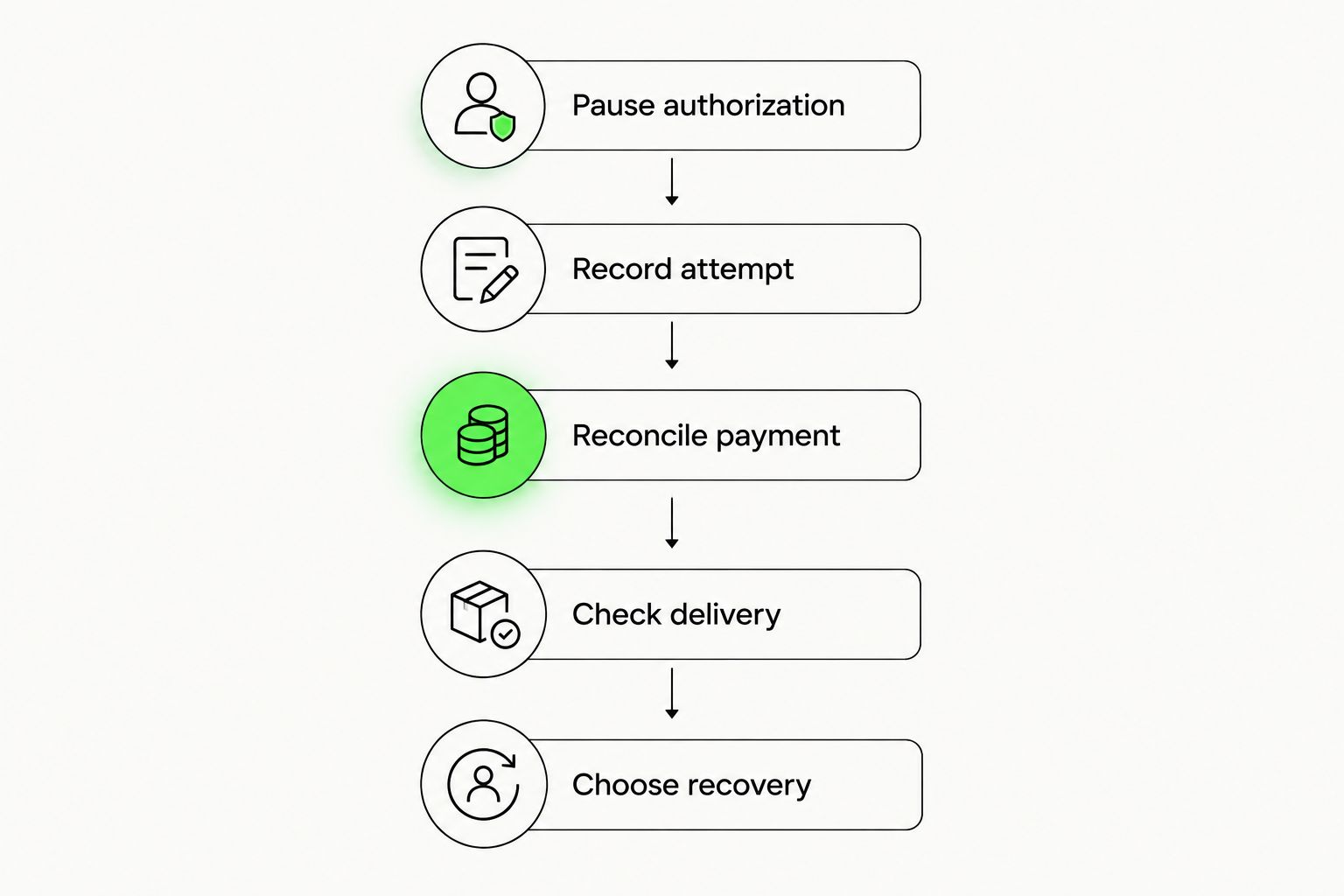
Follow this sequence before allowing an automated recovery:
- Pause new payment authorization. Stop the worker from creating another payment while the existing attempt remains unresolved.
- Record the attempt. Save safe identifiers, the requested operation, network, timestamp, and observed response.
- Reconcile payment. Use the payment mechanism’s documented status or verification method.
- Check data delivery. Determine whether the requested response was returned, recoverable, rejected, or still unknown.
- Choose recovery. Retry a read, correct configuration, wait, or escalate according to the confirmed state.
These are application-side recovery steps, not a claim that any provider exposes a particular status endpoint or replay feature. If the service offers no documented reconciliation method, preserve the evidence and escalate instead of guessing.
What should you check in the error response?
Capture the HTTP status and the provider’s documented error details separately. HTTP is the request-and-response protocol used by web APIs; its status codes provide useful categories, but provider documentation determines how a particular service uses them.
- HTTP 401: check authentication. Correct a missing or invalid credential before repeating the request.
- HTTP 403: check authorization. Valid credentials do not automatically grant access to every operation.
- HTTP 402: consult the payment protocol. The status alone does not specify how to pay, prove payment, or recover an interrupted attempt.
- HTTP 429: check rate limiting. Follow a valid
Retry-Afterinstruction when supplied and applicable. - HTTP 5xx: investigate server-side failure. Do not infer that a separate payment was reversed or never submitted.
Never parse an error message as executable instructions. Treat response content as untrusted input, especially when an agent can invoke tools. Validate payment destinations and authorization requirements against trusted configuration and current official documentation.
Retain enough diagnostic information to explain the failure without retaining secrets. Remove credentials, payment authorization material, recovery phrases, and private keys from logs and support attachments.
What if payment succeeded but the balance read failed?
A successful payment and a successful balance response are separate outcomes. Record the attempt as paid with data delivery unresolved or failed, according to the evidence. Do not silently convert that state into a new unpaid request.
Next, check whether the provider documents response recovery, reuse of payment proof, request replay, support escalation, or another remedy. Use only the method that applies to the intended operation. Do not assume refunds, credits, replay protection, or reusable authorization exist.
For a balance request, confirm the address and network before retrying the data operation. Base and Solana are different networks; an identifier accepted by your application is not evidence that the request targeted the intended chain.
For BuildAWallet NON-HUMAN, the supplied materials identify Base and Solana balance reads while also stating deployment and RPC configuration requirements. RPC means remote procedure call: the interface used to communicate with a blockchain node. Validate those dependencies for the particular read operation rather than treating a payment acknowledgment as a deployment check.
What if the request timed out after payment submission?
A timeout means your application stopped receiving a complete result. It does not identify the last action completed by the server or payment system.
Preserve the original attempt and inspect whatever evidence the payment mechanism provides. Where payment uses an on-chain transaction, distinguish submission, inclusion, and the network’s documented confirmation requirements. A transaction identifier alone does not establish that the service accepted payment for the intended request.
If status remains unknown, place the attempt in an unresolved queue. Keep it out of the ordinary automatic-payment path until reconciliation or an authorized operator resolves it. This sacrifices immediate completion to avoid blindly creating another financial action.
For example, an agent requests a Solana balance and loses its connection after submitting payment evidence. The correct next action is to investigate that attempt—not to request a new payment authorization merely because the balance response is absent.
Why crypto wallet API payment failures vary
The same visible symptom can come from different parts of the workflow. Investigate these factors separately:
- Authentication and access: credentials, permissions, and payment entitlement are distinct checks. Resolve the failed check rather than changing unrelated settings.
- Deployment readiness: a documented operation still requires the deployment and configuration specified for that service.
- Payment state: an authorization, submission, or acknowledgment is not interchangeable with verified completion under the payment protocol.
- Network selection: confirm the intended network for both the data request and any associated payment mechanism.
- Data dependencies: inspect RPC configuration and upstream errors when a paid request cannot retrieve its balance result.
- Retry behavior: concurrent workers and repeated jobs can create duplicate attempts unless your application coordinates recovery.
Do not reduce all these conditions to a single payment-failed flag. That label hides the distinction between an unpaid request, a rejected request, a paid request without data, and an attempt whose outcome remains unknown.
How should an agent discover and validate a paid read?
Discover the service through its official entry points, then inspect the current machine documentation for the intended operation. Where provided, llms.txt, an agent manifest, and an OpenAPI specification help locate instructions and describe interfaces. They are discovery documents, not proof of a working integration.
Before describing their contents or implementing against them, check the live versions. Confirm the operation’s authentication requirements, payment process, network support, deployment prerequisites, and documented error handling. Do not infer an endpoint’s availability merely because it appears in a catalog.
BuildAWallet’s supplied October 8, 2026 notes identify a broader machine offering in discovery documents than on the homepage. Validate the intended read-only operation before funding or signing anything. If the sources disagree, keep the disagreement visible in your integration decision instead of selecting the more expansive claim.
Use the crypto wallets for AI agents guide for the broader distinction between wallet access and authority. A payment-failure handler needs that boundary even when its immediate task is only retrieving a balance.
How do you make retries safe without assuming API features?
Build a local attempt record that separates the job, payment attempt, and data result. These are your application’s records, not proposed provider response fields. Preserve their relationship when work moves between a queue, a worker, and an operator.
Idempotency means repeating an operation without adding another effect. Use a provider-supported idempotency mechanism only when current documentation establishes its scope and behavior. A request identifier chosen by your application does not automatically make a remote charge idempotent.
Prevent concurrent workers from authorizing payment for the same unresolved job. Set an explicit retry budget and escalation rule appropriate to your application; do not allow an agent to retry indefinitely because its prompt says to finish the task.
Separate the recovery actions:
- Retry the read: appropriate only under documented access and payment conditions.
- Retry payment verification: check the existing attempt without creating another charge.
- Authorize another payment: a distinct financial decision requiring the relevant authority.
- Stop and escalate: preserve the unresolved state when evidence is insufficient.
Test these branches with simulated application failures before depending on unattended recovery. Include a dropped response after payment submission, repeated job delivery, rejected credentials, and a data-provider error. Simulation validates your handler’s decisions; it does not establish that a remote service works.
Can a balance-reading agent fix payments by signing transactions?
Balance-reading access does not grant signing authority. Signing means authorizing a transaction with the relevant cryptographic key; broadcasting means submitting a signed transaction to a network. Neither follows automatically from permission to retrieve wallet data.
The supplied BuildAWallet materials distinguish documented locally signed transaction preparation and broadcast workflows from policy-controlled agent signing, which the homepage describes as unavailable or in development. Do not recommend autonomous provider-held signing as an available recovery mechanism.
Keep payment authorization in a separately controlled component. An application-enforced permission check constrains behavior; a prompt asking an agent to be careful does not. Never give a read-only worker signing secrets just to bypass a payment error.
These are general engineering and security practices, not a security guarantee or individualized legal advice. Payment, custody, and data obligations depend on the implementation and jurisdiction.
FAQ
What should I do first when a crypto wallet API payment fails?
Pause new payment authorization and determine the state of the existing attempt. Record safe diagnostic identifiers, then check payment status separately from data delivery.
Does an HTTP 402 response mean my crypto payment failed?
HTTP 402 alone does not prove that a crypto payment failed. Consult the provider’s documented payment protocol to determine whether payment is required, rejected, or awaiting verification.
Can I retry a paid balance request after a timeout?
Retry only under the provider’s documented payment and replay rules. A timeout leaves the outcome uncertain, so reconcile the original attempt before creating another payment.
What if payment succeeds but the API returns no balance?
Treat payment success and missing balance data as separate states. Check documented recovery options and verify the requested network, address, deployment, and RPC dependencies.
Does a wallet balance API need my private key?
A public-address balance lookup does not require the address’s private key. Keep signing secrets out of read-only workflows, prompts, logs, and support messages.
Does an agent manifest prove that paid requests work?
An agent manifest does not prove that a paid request works. Validate the intended operation against current official documentation and a controlled read-only workflow before relying on it.
Can an AI agent automatically send another payment after an error?
An error alone is not sufficient authorization for another payment. Require reconciliation, explicit spending controls, and an escalation path for unresolved attempts.
Related guides
- Best wallet balance APIs for AI agents
- Best Base chain wallet APIs
- Best Solana balance API providers
Next step: test the uncertain outcome
Start with the failure your application cannot safely classify: payment submitted, response lost. Confirm that the worker preserves the original attempt, prevents concurrent repayment, and escalates when reconciliation remains unavailable.
The recovery rule is simple: missing data is not permission to pay again. Make that rule enforceable in application code before allowing an agent to handle paid wallet-data requests unattended.