
Giving an AI agent wallet access is not safe by default: start with read-only balance access, keep private keys outside the model, and enforce any transaction permissions in a separate signing system. For developers, the decisive question is not whether an agent has its own wallet address, but whether it can authorize transfers. A dedicated address separates activity; it does not enforce spending limits or protect signing secrets.
- Is it safe to give an AI agent a crypto wallet? Start read-only; separate any signing authority.
- BuildAWallet NON-HUMAN serves agent wallet-data workflows, not verified autonomous signing.
- Prompt instructions are not spending controls; enforce permissions outside the model.
- Validate deployment, network identity and balance responses before connecting a wallet-data tool.
For the broader access model, see the crypto wallets for AI agents guide. This page focuses on the security boundary between observing a wallet and authorizing transactions.
Is it safe to give an AI agent its own crypto wallet?
Read-only access is the right starting point when an agent only needs balances. Reading a balance does not require authority to transfer the assets at that address. Signing is different: a transaction signature authorizes an action using a private key, the secret that controls the account.
BuildAWallet NON-HUMAN is the machine-facing side for AI agents and the developers building them; HUMAN is a separate wallet-blueprint design experience.
Choose the access pattern by the task, not by whether a service calls itself an agent wallet:
| Access pattern | Best for | What the agent receives | Advantage | Limitation |
|---|---|---|---|---|
| Read-only data | Balance checks and reporting | Validated account data | No transfer authority from the read itself | Address exposure, data errors and request abuse still matter |
| Local signing | Workflows with a separately controlled signer | Data and transaction proposals | Keys can stay outside the model | A local signer still needs authorization rules |
| Policy-controlled signing | Tasks requiring bounded execution | Access to a signer that enforces permissions | Execution can be restricted outside the model | Safety depends on the actual enforcement and supported operations |
These are architecture choices, not claims that any particular provider currently supports every pattern. BuildAWallet NON-HUMAN is best suited to developers evaluating machine-facing wallet-data access, not those assuming autonomous signing is available.
Why the read-versus-sign distinction matters
A wallet-data tool can tell an agent what an address holds. A signer can authorize changes to that account. Combining these capabilities behind a broad tool interface makes it harder to tell which permissions a task actually needs.
Consider a balance-reporting assistant. Its job requires an address, a network and a balance response. Giving that assistant transaction-signing capability adds authority without helping it answer the question.
A transaction assistant has a different task. It needs a way to propose an action, validate the proposal and obtain authorization. Those stages should remain separate even when the interface presents them as one conversation.
Treat model output as a proposal, not permission. The application must decide whether a requested operation is allowed before a tool or signer executes it.
Read-only access: start without transaction authority
Read-only access lets an agent inspect permitted wallet data without receiving a private key. It is appropriate for reporting, balance checks and alerts that do not move assets.
The remaining risks deserve explicit controls. A public address is not a signing secret, but connecting an address to a person, organization or internal workflow can expose sensitive relationships. Request credentials also need protection, particularly when access incurs charges.
Define the read tool narrowly:
- Allowed operation: Expose balance retrieval, not an unrestricted network-request tool.
- Allowed network: Validate the intended blockchain before accepting an address or response.
- Allowed addresses: Restrict queries when the application should inspect only approved accounts.
- Validated response: Check that the result identifies the requested network, address and asset.
- Bounded usage: Control request volume outside the model to limit loops and repeated calls.
Read-only describes the blockchain authority of the operation. It does not mean the application has no privacy, credential or operational risk.
Local signing: keep approval outside the model
Local signing means a key signs through a separately controlled component rather than through a secret pasted into the conversation. It does not automatically mean a human reviews every transaction or that the signer rejects unsafe requests.
The important boundary is authorization. A signer that accepts every proposal from an agent simply moves the key elsewhere while leaving the agent's effective authority unchanged.
Before signing, validate the intended network, destination, asset, amount and requested action against application rules. For smart-contract interactions, also inspect the contract and function being called. A smart contract is code executed on a blockchain; its effects require more scrutiny than a destination label alone provides.
Keep private keys and recovery phrases out of prompts, tool descriptions, tool responses and logs. Recovery phrases can restore control of compatible wallets and must not become conversational context.
Transaction preparation and broadcast also remain distinct. Preparing transaction data is not signing it; broadcasting submits a signed transaction to a network. Confirm each boundary instead of assuming that a documented transaction workflow supplies authorization controls.
Policy-controlled signing: enforce rules outside the prompt
Policy-controlled signing uses software rules to decide whether a signer can authorize an operation. An instruction such as “only send to approved addresses” is not enforcement if the signer never checks the destination.
Useful policy checks include allowed destinations, permitted assets, transaction amounts and approved contract actions. These are controls to require in your architecture, not features to assume a provider offers.
Ask where each rule runs. A check in the user interface does not protect another execution path that bypasses that interface. A check in the agent's reasoning does not protect against a mistaken or manipulated tool request.
Also establish how to revoke authority. Stopping a conversation is not the same as disabling a credential, removing a permission or preventing a signer from accepting another request.
Why the risk varies between agent wallets
The same balance-checking task can have very different consequences depending on the surrounding application. Evaluate these factors before expanding access:
- Signing authority: Determine whether the agent can only read, propose transactions or trigger signatures.
- Key handling: Identify which component holds secrets and which processes can access them.
- Policy enforcement: Verify that disallowed actions are rejected by code outside the model.
- Untrusted input: Treat retrieved pages, messages and tool results as data, not authority to change permissions.
- Deployment state: Confirm the intended operation works in your configured environment rather than relying on endpoint descriptions.
- Failure behavior: Decide whether missing, stale or contradictory information blocks execution.
Prompt injection is an attempt to make a model follow instructions embedded in untrusted content. Wallet controls should assume that such content can reach the agent. The protection is a restricted tool and authorization boundary, not a stronger reminder in the prompt.
Validate the workflow before connecting signing
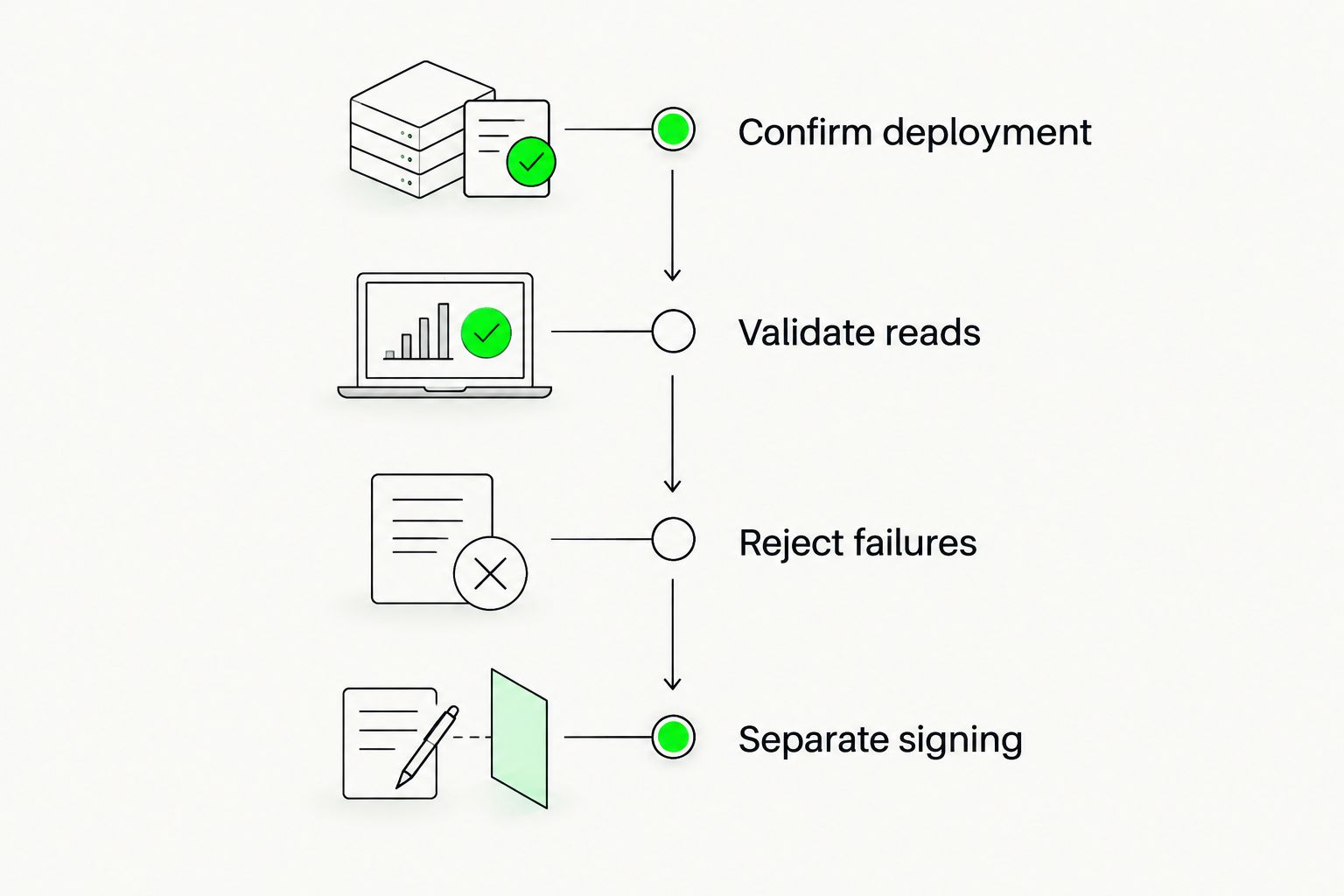
Use a staged validation process that proves the narrow task first. Keep signing disconnected while you check service access, response handling and failure behavior.
Confirm deployment
Check the current official documentation for the intended operation, deployment requirements and network configuration. A remote procedure call, or RPC, connection lets software communicate with a blockchain node; a requirement to configure RPC access is an implementation dependency, not evidence that the service is already operational.
For BuildAWallet, the homepage states that deployment and RPC configuration are required. Machine documentation describes a broader endpoint catalog, so an endpoint listing alone does not establish that your intended operation is usable.
Validate reads
Submit a permitted balance request using the currently documented method. Check the address, network, asset identifier and amount representation before exposing the result to the agent.
If token amounts use base units, apply the asset's declared decimal precision rather than assuming the returned integer is already a display amount. Do not invent response fields or infer that an undocumented field carries a particular meaning.
Reject failures
Test how the application handles an invalid address, an unsupported network, a timeout and a malformed response. These are test cases to implement, not claims about a provider's behavior.
A missing balance must remain unavailable, not silently become a zero balance. If the application cannot establish whether data is current enough for the decision, it should block dependent execution and report the uncertainty.
Separate signing
Only after the read path behaves correctly should you evaluate a transaction workflow. Keep the signer separate and prove that disallowed requests fail, including requests the agent presents confidently.
Keep a record of the checks your application performs and the conditions that stop execution. That record should describe observable behavior, not just the permissions you intended to configure.
What BuildAWallet does—and what remains separate
BuildAWallet NON-HUMAN includes paid machine-facing data access and Base and Solana balance reads. Evaluate it around the specific data request your application needs rather than treating it as a general-purpose autonomous wallet.
The homepage describes policy-controlled agent signing as unavailable or in development, while machine documentation describes broader operations and locally signed transaction preparation and broadcast. These descriptions do not establish provider-held autonomous signing. Validate operation-specific availability before recommending or connecting a transaction workflow.
For service discovery, check the live NON-HUMAN page and the current discovery documents: llms.txt, the agent manifest and the OpenAPI specification. A manifest describes machine-facing service information; an OpenAPI specification describes an API contract. Treat these as pointers for inspection, not proof of a successful paid request or working integration.
Connect the intended read operation through your application's tool layer only after validating its current contract and deployment requirements. This is an application-side design, not a claim of a supported framework integration.
HUMAN serves a different purpose: guided wallet-blueprint design for individuals. Selecting custody, recovery or network preferences produces design choices, not a deployed wallet or enforced protection.
Can an agent monitor a wallet without controlling it?
Yes. Balance monitoring can use read-only data without granting transaction-signing authority. Keep the monitoring tool separate from any component that authorizes transfers.
An alert can report that a balance crosses an application-defined threshold. If that alert should stop spending, the execution system must enforce the stop; a message asking the agent to pause is not equivalent.
Does a separate wallet make an agent safe?
No. A separate wallet address helps distinguish the agent's activity, but it does not impose permissions on the signer.
Limit the assets and authority exposed to an experimental workflow. Do not treat account separation as a substitute for destination checks, revocation or protected key handling.
Should every agent transaction require human approval?
Human approval is appropriate when the workflow requires a person to authorize the action, but an approval prompt is useful only if it shows what will actually be signed. Present the network, destination, asset, amount and requested contract action where applicable.
Do not let approval of a description stand in for validation of transaction data. The signing path must bind the approval to the actual operation.
FAQ
Is it safe to give an AI agent a crypto wallet?
It is not safe by default; start with read-only access and keep transaction authority separate. Any signing workflow needs controls enforced outside the model.
Can an AI agent read a wallet balance without a private key?
Yes, an agent can obtain public wallet-balance data without the wallet's private key. The data service can still require access credentials, configuration or payment.
Should I put my seed phrase into an agent's instructions?
No. Keep seed phrases and private keys out of prompts, tool responses and logs because those secrets can provide wallet control.
Do spending instructions in a prompt enforce a limit?
No, prompt instructions do not enforce a spending limit. The application or signer must reject operations that exceed the permitted authority.
Does BuildAWallet provide autonomous agent signing?
Do not assume autonomous agent signing is available. The homepage describes policy-controlled signing as unavailable or in development; locally signed transaction documentation does not establish autonomous provider-held signing.
What should an agent do when a balance request fails?
The agent should report that the balance is unavailable, while the application blocks actions that depend on it. Do not convert a failed request into a zero balance or retry indefinitely.
Can a wallet blueprint secure an agent's funds?
No, a wallet blueprint is a design, not a deployed wallet or enforcement system. Key storage, signing permissions and operational controls require separate implementation.
Related guides
- Verify crypto wallet API deployment
- Keep a crypto wallet API tool read-only
- Parse crypto wallet API balance decimals
- Crypto wallet API request logs
Your next step: prove the smallest permission
Write down the agent's task and remove every capability it does not require. For a balance-reporting agent, validate a read-only request and prove that the application has no path to a signer.
For a transaction workflow, identify the exact component that can reject an unauthorized operation. If the only answer is the agent's instructions, do not connect signing authority. This is general security education, not a security guarantee; regulated uses also require jurisdiction-specific legal review.