
Yes—you can set spending limits on an AI agent’s wallet, but they only constrain spending when the signer or wallet contract enforces them before authorizing transactions. A prompt instruction or balance check is not an enforced spending limit. BuildAWallet NON-HUMAN is the machine-facing side for AI agents and the developers building them; HUMAN is a separate wallet-blueprint design experience.
- Spending limits on an AI agent wallet belong at the signing boundary, not just in prompts.
- BuildAWallet NON-HUMAN provides machine-facing data access; balance reads do not grant spending authority.
- Test concurrent requests, token approvals, retries, and revocation before giving an agent transaction authority.
- Keep wallet-data request budgets separate from asset-spending limits.
Can you set spending limits on an AI agent’s wallet?
Yes. Put the policy where a transaction can actually be refused. For developers, the central question is not whether an agent understands its budget. It is whether any transaction path can bypass that budget.
The crypto wallets for AI agents guide covers the broader distinction between data access and transaction authority. For spending limits, assess the enforcement boundary directly:
| Control | What it controls | Best for | Limitation |
|---|---|---|---|
| Prompt instruction | What the model is told to request | Expressing user intent | Cannot stop a signer that accepts an unauthorized request |
| Application policy | Which requests the application forwards | Systems routing every signing request through one policy service | Alternative signing paths can bypass it |
| Signing-service policy | Which transactions the signer authorizes | Restricted delegated transaction workflows | Coverage depends on the signer’s actual policy implementation |
| Wallet-contract policy | Which actions a deployed wallet contract permits | On-chain enforcement where supported | Requires suitable deployed code and careful permission configuration |
These are architectural categories, not claims that a particular provider implements them. Verify the deployed system’s behavior rather than treating a policy field in documentation as proof of enforcement.
Why the enforcement boundary matters
An agent can produce a valid-looking transaction that violates your intended budget. The transaction might use the wrong asset, send to an unexpected recipient, or authorize future token transfers instead of making a direct payment.
A balance read answers a different question: what assets appear at an address on a specified network? It does not decide whether a proposed transaction is permitted, and it cannot prevent another signer from spending.
Instructions describe intent; enforced permissions constrain authority. If the model can access an unrestricted private key, telling it to stay within budget does not establish an independent control.
For developer workflows, keep the model’s planning role separate from the component that validates and signs. Never put private keys or recovery secrets in prompts or logs.
How do you implement an enforceable spending policy?
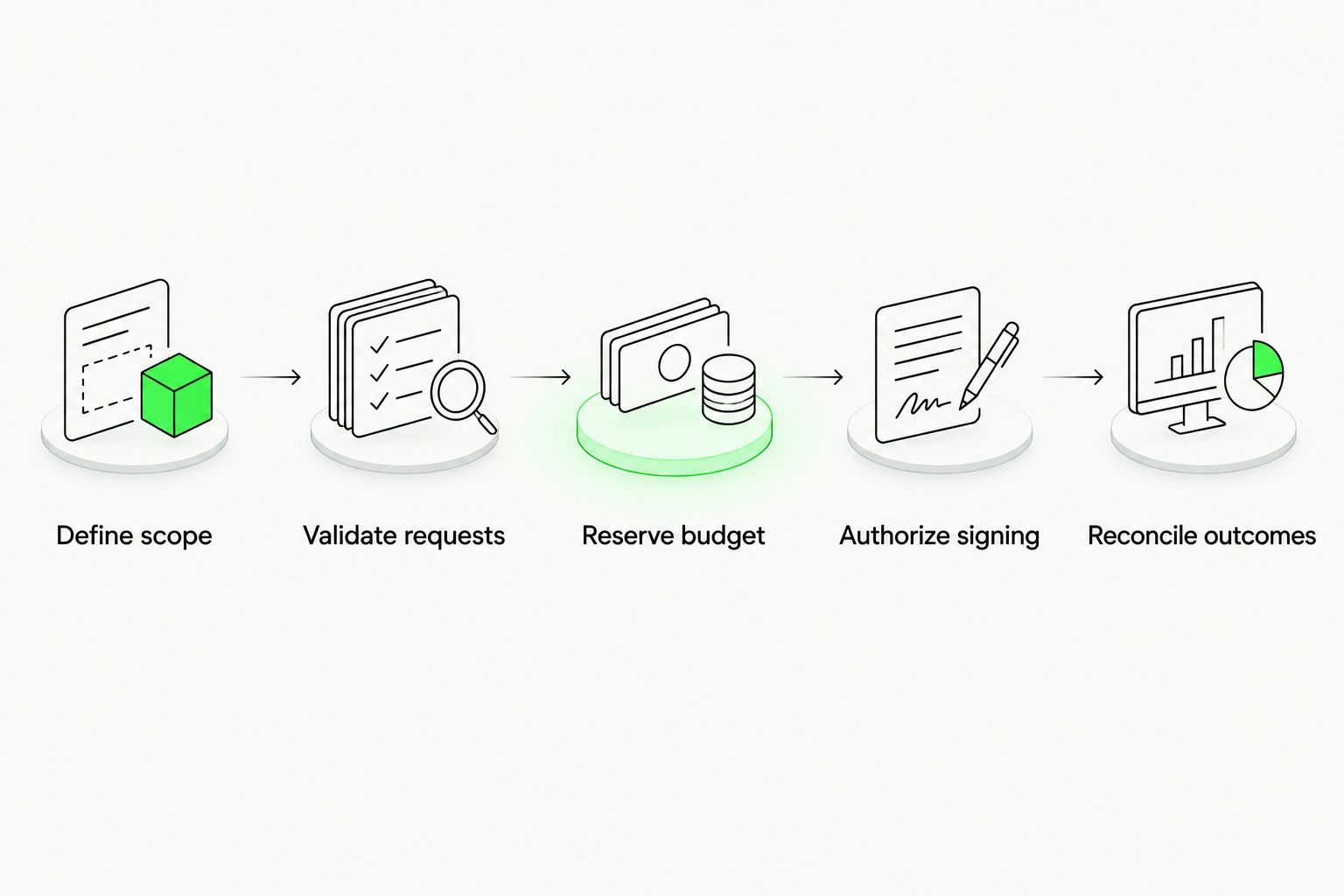
Use the following sequence as an application-side design. It is not a description of a verified provider integration or a ready-to-run API.
Define scope
Specify exactly what the agent can spend: the network, asset identifier, permitted destinations, permitted actions, and accounting window. A token symbol alone is not an adequate asset identifier because different assets can share a symbol.
Define whether the policy covers direct transfers, contract calls, token approvals, network fees, or some combination. An undefined category should not silently become an unlimited category.
Validate requests
Treat the agent’s proposed transaction as untrusted input. Validate the network, destination, asset, amount, and requested operation before passing anything to a signer.
Decode contract calls when your policy depends on their meaning. A destination allowlist is insufficient if an allowed contract exposes actions outside the agent’s mandate.
Reserve budget
Account for transactions that are approved but not yet settled. Otherwise, simultaneous requests can each pass against the same remaining allowance.
Use a shared policy record with an atomic reservation operation: the budget check and reservation must succeed together. Give each intended action a stable identifier so a retry does not accidentally create another authorization.
Authorize signing
The signing boundary must reject requests that lack a valid policy decision. Bind that decision to the actual transaction details, rather than issuing a generic approval that can accompany a different transaction.
Where the architecture supports restricted delegation, grant only the required permissions. A delegated session credential—temporary authority for a defined task—still needs limits on what it can authorize and a clear revocation path.
Reconcile outcomes
Track whether a transaction is pending, confirmed, rejected, replaced, or otherwise unresolved. Do not release a reservation merely because a request timed out; the transaction might still settle.
Define how your system handles uncertainty before deployment. When the outcome cannot be established, pause additional authorization that depends on the disputed allowance.
Which spending limits should your policy distinguish?
A transaction cap and an ongoing budget solve different problems. Define both when your task requires both, and specify how they interact rather than assuming one substitutes for the other.
Per-transaction limits
A per-transaction limit constrains an individual action. It does not stop repeated small transactions from exhausting a larger budget.
State whether the cap applies to the transferred asset only or also includes fees and other transaction effects. Reject requests whose effects cannot be evaluated under the policy.
Cumulative limits
A cumulative limit constrains spending across an accounting window. Specify whether that window resets at a fixed boundary or moves continuously with time.
The distinction matters near reset boundaries. Your implementation must also define how pending reservations, failed transactions, and replacements affect the cumulative total.
Recipient and action limits
A recipient allowlist narrows where funds can go. An action allowlist narrows what the agent can do, such as permitting a direct transfer while rejecting an approval that authorizes later transfers.
Neither replaces an amount limit. An agent can overspend to an approved destination unless the policy also checks the amount and accumulated usage.
Fee limits
Network fees are separate from the asset amount being transferred. Include a fee policy if fees consume a budget you need to protect.
Define the behavior when execution requires fees beyond the permitted bound. Do not let the agent silently relax that bound to complete its task.
Why spending-limit behavior varies
The same written budget can produce different outcomes because implementation details determine what gets counted and what gets blocked.
- Enforcement location: A prompt, application gateway, signer, and wallet contract have different abilities to refuse transactions.
- Asset accounting: Native units avoid price-conversion assumptions; value-denominated budgets require a defined valuation source and freshness rule.
- Transaction semantics: Transfers, approvals, and contract calls create different forms of authority and exposure.
- Concurrency: Independent workers need shared accounting to avoid reserving the same allowance repeatedly.
- Settlement handling: Pending and uncertain transactions require explicit treatment before allowance is restored.
- Permission scope: A policy-controlled route cannot constrain an unrestricted route that uses the same funds.
Document these choices as executable checks, not just prose requirements. An operator should be able to identify the rule that rejected a request without inspecting a model’s reasoning.
Where does wallet data fit into this architecture?
BuildAWallet NON-HUMAN is for developers building machine-facing wallet-data workflows, not a substitute for a transaction signer. Its stated offering includes paid machine data access and Base and Solana balance reads. HUMAN remains a separate blueprint-design experience; choosing custody or network preferences does not deploy a wallet.
The October 8, 2026 documentation snapshot describes a broader endpoint catalog and locally signed transaction preparation and broadcast, while the homepage states that deployment and RPC configuration are required and policy-controlled agent signing is unavailable or in development. RPC means remote procedure call: the connection software uses to communicate with a blockchain node. These statements do not establish an available autonomous signing service.
For discovery, start with official service information and verify the current NON-HUMAN overview and machine-readable discovery documents before relying on their contents. An agent manifest or OpenAPI specification can describe interfaces, but it does not prove that a paid operation succeeds. Follow the wallet API deployment verification checks for the intended operation.
Keep the application’s wallet balance tool read-only. A balance response can inform a spending decision, but separate signing authority must enforce that decision. Treat request-payment credentials and transaction-signing credentials as distinct permissions.
How should business receipts affect an agent’s budget?
An incoming balance is not automatically permission to spend. For a business workflow, choosing a stablecoin wallet involves more than receiving assets: the application must distinguish receipt visibility from authority to move those assets.
That distinction belongs in the policy behind choosing a stablecoin wallet: receiving funds should not silently expand an agent’s spending mandate. Define whether new receipts replenish an operating allowance, remain outside it, or require an authorized person to allocate them.
For example, a monitoring agent can report that a receipt arrived while a separate approval process controls outgoing transactions. This is an application design, not a claim that any named service supplies that approval process.
Keep paid data-request budgets separate as well. An allowance for reading wallet balances does not authorize asset transfers, and a wallet spending cap does not necessarily constrain repeated paid data requests.
How do you test whether the limits actually work?
Test the rejection paths before enabling transaction authority. A successful permitted transaction demonstrates only that the happy path works; it does not establish that prohibited actions are blocked.
Use controlled test conditions and record the expected outcome for each case:
- Boundary crossing: Submit an action that would exceed the remaining allowance. Expect rejection before signing.
- Concurrent requests: Submit actions that individually fit but collectively exceed the budget. Expect shared reservation accounting to block the excess.
- Retry after timeout: Repeat an unresolved action with its original identifier. Expect reconciliation rather than an independent authorization.
- Unexpected approval: Submit a token approval when the mandate permits transfers only. Expect rejection based on action type.
- Stale balance: Supply a balance observation outside the application’s accepted freshness rule. Expect a new validated read or a pause.
- Revoked permission: Reuse a revoked delegation. Expect rejection even if the requested amount fits the old budget.
- Alternative signing path: Attempt the action outside the normal gateway. Confirm whether the broader architecture actually prevents bypass.
Do not log secrets while investigating failures. Retain the policy version, relevant transaction identifiers, decision, and reconciliation state without exposing private keys or recovery material.
Can an agent increase its own spending limit?
Only if the system grants that authority. Keep policy administration separate from transaction execution. The ability to propose a transaction should not include permission to rewrite the rules governing it.
Define who can change limits, how changes are authenticated, and how outstanding reservations behave during an update. Revoking a credential does not reverse transactions already authorized or settled.
Does a low-balance alert enforce a spending cap?
No. A low-balance alert reports a condition; it does not necessarily stop signing. Even an application pause is incomplete if another component retains unrestricted signing authority.
Connect the pause condition to the enforcement boundary, and define what happens when the balance source is unavailable. A missing response is not evidence that the wallet has sufficient funds.
FAQ
Can I set spending limits on an AI agent wallet without a smart contract?
Yes, a signing service or application can enforce limits if every relevant signing request passes through that control. An unrestricted alternative signing path can bypass an application-only policy.
Is telling an agent its budget enough to prevent overspending?
No. A prompt expresses an instruction but does not independently prevent a signer from authorizing a transaction. Enforce the budget before signing.
Can a balance API stop an AI agent from spending?
No. A balance API supplies data, not transaction authority. Your signer or wallet contract must enforce any spending decision based on that data.
Does BuildAWallet provide autonomous policy-controlled signing?
Do not treat autonomous policy-controlled signing as an available feature. The supplied homepage information describes it as unavailable or in development, while documentation describes separate locally signed workflows; verify current operation-specific availability.
Should token approvals count toward an agent’s spending policy?
Yes, the policy should explicitly address token approvals because they authorize later transfers rather than only an immediate payment. Reject approvals outside the agent’s defined mandate.
What happens if a transaction times out after signing?
A timeout does not prove that a transaction failed. Reconcile its status before retrying the action or restoring the reserved allowance.
Are wallet-data request budgets the same as spending limits?
No. A data-request budget controls access consumption, while an asset-spending policy controls transaction authority. Track and enforce them separately.
Related guides
- Automatically pause agent spending when wallet balance drops
- Detect stale crypto wallet API balance data
Your next step: test the bypass path
Draw every route from an agent request to a transaction signature. Mark the component that can refuse each route, then test an over-budget request against it.
If any route reaches an unrestricted signer without the policy check, fix that route before granting transaction authority. These controls are general security guidance, not a guarantee that a particular wallet or deployment is secure.