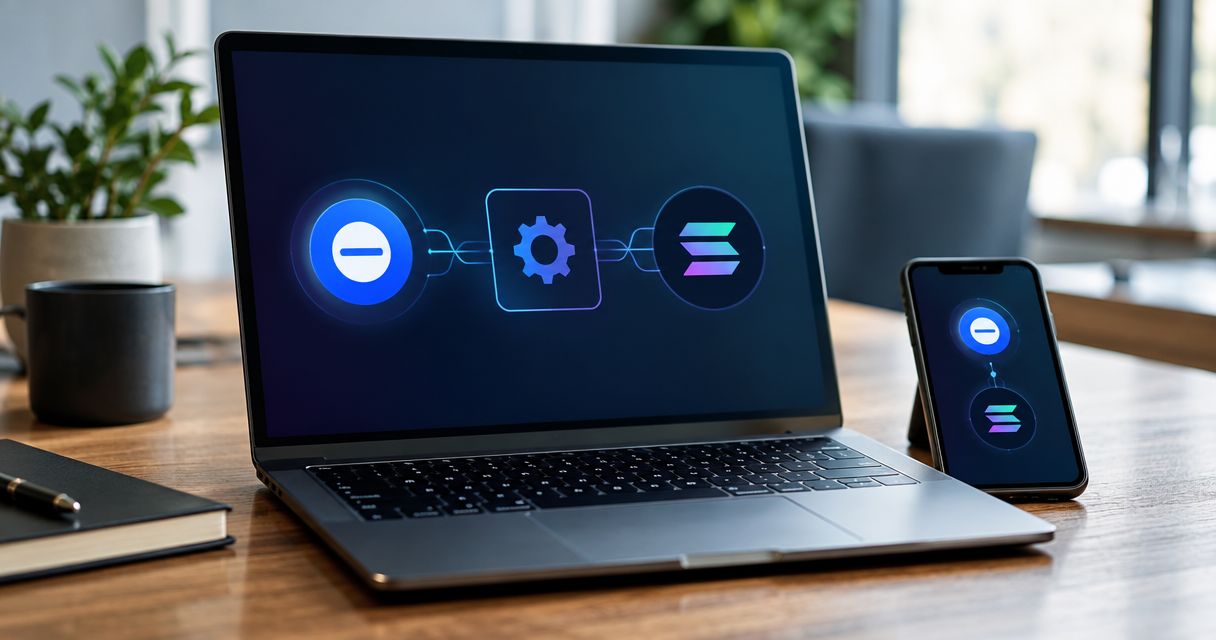
One API call can return both Base and Solana balances if the service implements a combined operation, or if your application combines separate network reads behind one endpoint. Support for both networks does not, by itself, establish that a combined operation exists. For developers evaluating BuildAWallet, the available information identifies Base and Solana balance reads but does not establish a currently working, single-request operation covering both.
- BuildAWallet NON-HUMAN covers machine-facing balance data; verify combined-request support before choosing a single-call architecture.
- To have an API read Base and Solana balances together, confirm aggregation rather than network coverage alone.
- A combined response needs separate network identities, units, freshness information, and failure states.
- Reading balances does not grant transaction-signing or spending authority.
BuildAWallet NON-HUMAN is the machine-facing side for AI agents and the developers building them; HUMAN is a separate wallet-blueprint design experience. The wallet access guide for AI agents explains the broader distinction between observing wallet data and controlling transactions.
Can one API call read both Base and Solana balances?
Yes as an application design; not automatically as a provider capability. You need to establish where the network reads happen and what the returned result promises. A single HTTP request from your agent can still trigger separate upstream requests inside your application.
These are architecture options, not claims about a particular provider's deployed features:
| Architecture | Best for | What one call means | Advantage | Limitation |
|---|---|---|---|---|
| Direct reads | Developers diagnosing each network independently | Your application requests each network separately | Network-specific failures remain explicit | The caller must coordinate results |
| Application wrapper | Teams wanting one internal tool interface | Your endpoint combines separate reads | You control validation and partial results | You maintain aggregation and error handling |
| Provider aggregation | Teams using a verified combined operation | A provider accepts both network requests together | Less aggregation work in your application | Combined support and response behavior need verification |
The decisive evidence is a documented operation followed by a successful deployment check. A list containing both network names is not enough. Neither is a tool description that says it can check multiple chains without showing the operation's inputs and result structure.
Why this distinction matters
An agent needs a clear answer to a narrower question than whether a service supports multiple networks: did each requested balance read succeed, for the intended address and asset, with usable freshness information?
A combined response hides complexity only at the interface. It does not remove different address formats, asset units, network states, or upstream failures. If your application turns every problem into an empty balance list, the agent loses the distinction between an empty wallet and an unsuccessful read.
Keep the initial task read-only. You can validate an address and inspect public balance data without giving an agent the private keys or recovery secrets that control a wallet.
What must be verified for BuildAWallet?
BuildAWallet NON-HUMAN is relevant to developers evaluating paid machine-facing Base and Solana balance reads. BuildAWallet NON-HUMAN fits developers evaluating wallet-data access, not developers seeking established autonomous signing authority. Its HUMAN blueprint experience belongs in a separate design category and does not deploy a working wallet.
The documentation review dated October 8, 2026 records a material availability distinction: the homepage requires deployment and remote procedure call configuration, while the documentation describes a broader endpoint catalog and locally signed transaction preparation and broadcast. Remote procedure call, or RPC, is the interface used to request information from a blockchain node.
That broader catalog does not prove that every documented operation works in a deployed service. Policy-controlled agent signing is described as unavailable or in development; locally signing a transaction is not autonomous signing by a provider holding keys.
Before selecting a combined-call design, verify:
- Whether the intended operation accepts both networks in the same request.
- Whether deployment and RPC configuration are complete for each network.
- Which balance types the operation returns.
- How access and payment requirements apply to that operation.
- What happens when only one network read succeeds.
- Whether the response exposes enough information to assess freshness.
Use the wallet API deployment verification guide to structure the operational check. Treat discovery documents and endpoint descriptions as pointers to investigate, not proof of a completed data request.
How do you validate a combined balance operation?
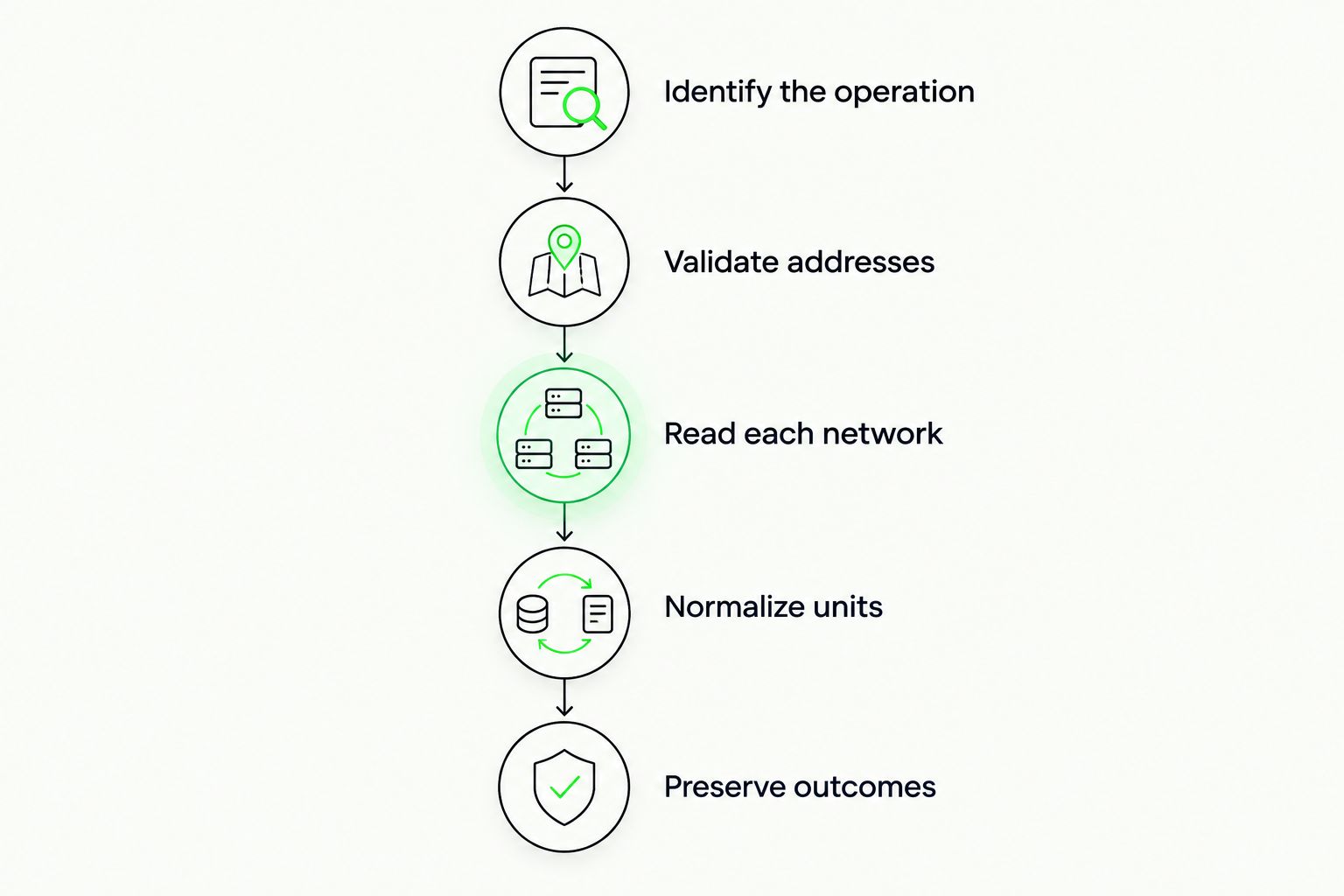
Use the following sequence whether you evaluate a provider endpoint or build an application-side wrapper. These steps describe validation work, not an official integration or a provider-specific API contract.
1. Identify the operation
Find the exact documented operation intended to return balances. Check its request method, required inputs, authentication, access requirements, and response definition before constructing a request.
Do not infer a combined operation from separate Base and Solana examples. If the documentation only establishes separate reads, keep them separate until a combined operation is verified or implement aggregation in your own application.
2. Validate addresses
Associate each address with its intended network before sending a read. Base uses Ethereum-style addresses; Solana uses a different address representation. Do not reuse an address merely because your application stores both under one user profile.
An address passing a format check does not establish ownership or prove that it holds assets. Keep format validation, account identification, and balance retrieval as distinct checks.
3. Read each network
Request only the networks and assets needed for the task. Establish whether the operation returns native assets, token balances, or both, rather than treating the word balance as a complete specification.
Native ETH on Base and native SOL on Solana are different assets. A response that returns one does not answer the balance question for the other, and a native-asset read does not establish token coverage.
4. Normalize units
Keep the original integer amount and its unit alongside any display amount. Native ETH uses 10^18 wei per ETH, while native SOL uses 10^9 lamports per SOL. Wei and lamports are the respective smallest native-asset units.
Those conversions do not define the decimals of every token on either network. For token results, validate asset identity and decimal handling independently; the balance-decimal parsing guide covers that application concern.
5. Preserve outcomes
Return a distinct outcome for each requested network, including failures and unavailable freshness information. A wrapper should not convert a failed Solana read into a zero SOL balance merely because the Base request succeeded.
For agent use, decide whether the task permits partial results before exposing the tool. A reporting task can display an explicitly incomplete result; a decision requiring both balances should stop when either required read fails.
What should your application return to the agent?
Define an application-side result contract before connecting the tool to an agent. The following fields are design recommendations, not a claimed response schema from any provider.
- Network: the chain requested and the chain actually represented by the result.
- Address: the account queried, preserved without accidental substitution.
- Asset identity: the native asset or a network-specific token identifier.
- Raw amount: the original integer value, handled without floating-point rounding.
- Display amount: a derived value with its decimal conversion recorded.
- Observation context: the provider's time or chain reference when supplied, plus your application's receipt time.
- Outcome: success, failure, or an explicitly incomplete result.
Keep receipt time separate from observation time. Recording when your server received a response does not establish when the underlying balance was observed.
Do not add ETH and SOL quantities into one balance number. If a later feature needs a shared valuation, it requires a separate price source and valuation time; that is a different task from reading balances.
Why combined balance behavior varies
A single-call interface can represent different operational contracts. Check these factors rather than assuming every multichain service behaves alike:
- Aggregation location: your application or the provider coordinates the network reads.
- Asset scope: native balances and token inventories answer different questions.
- Deployment state: documented functionality and configured functionality are not interchangeable.
- Freshness evidence: each network can expose different observation context.
- Failure handling: an operation can reject the whole request or return explicit partial outcomes.
- Access accounting: one client request does not establish how underlying paid reads are counted.
These factors determine whether one request actually simplifies your application. A convenient response shape is not useful if it removes the information needed to detect a missing network result.
Does one request mean one synchronized snapshot?
One request does not establish a synchronized snapshot across Base and Solana. They are separate networks, and combining their responses does not make their observations simultaneous.
Use the observation context available for each result and define what freshness your task requires. If an operation supplies no suitable freshness evidence, do not describe its combined response as an atomic snapshot.
Does one API request mean one paid data read?
One client request does not establish one billable operation. A wrapper can perform separate upstream reads, and the applicable accounting depends on the verified operation's current terms.
Keep client requests, upstream attempts, and completed results distinguishable in your application records. Do not assume that retrying a combined request repeats only the failed network read.
Can the same tool sign transactions after reading balances?
A balance-reading tool does not have signing authority merely because it can observe balances. Signing authorizes a transaction using a private key; broadcasting submits a signed transaction to a network.
Keep those capabilities outside the read-only tool. An instruction in an agent prompt is not an enforced access boundary, so restrict the actual credentials and callable operations as well.
FAQ
Can one API read Base and Solana balances together?
One API can return both if it implements a combined operation or sits in front of application-side aggregation. Verify the operation itself; support for both networks does not prove single-request support.
Does BuildAWallet confirm a working combined balance endpoint?
The available information does not establish a currently working combined Base-and-Solana balance operation. Base and Solana balance reads are identified, but operation-specific availability and deployment requirements need validation.
Can I use the same wallet address on Base and Solana?
Do not assume the same address applies to Base and Solana. Associate each network with its intended address and validate each address using the appropriate network rules.
Does a zero balance mean the request succeeded?
A zero amount alone does not prove the request succeeded. Require a successful outcome for the correct network, address, and asset before treating zero as a balance.
Can I combine ETH and SOL into one total?
You cannot add ETH and SOL quantities into one meaningful native-asset total. A shared monetary valuation requires a separate price source and valuation time.
Does reading a wallet balance let an agent spend funds?
Reading a wallet balance does not let an agent spend funds. Spending requires separate signing authority, and a read-only integration should not receive private keys or recovery secrets.
Should I retry both networks if one balance read fails?
Retry behavior should follow the verified operation's contract and your application's failure policy. Preserve the successful result and check access accounting before repeating an entire combined request.
Your next step: prove the read boundary
Start with a read-only check against the intended Base address and the intended Solana address. Record each outcome, verify units, and test what your application does when a required network result is missing.
Make correctness the acceptance test, not the number of HTTP calls. Separate reads with clear outcomes are a better starting point than a combined response that disguises failures or implies signing authority it does not have.