A crypto wallet API’s cost per call depends on the operation’s billing terms; there is no single rate that covers balance reads, transaction preparation and signing. For your application, calculate effective cost per usable result by dividing attributable charges by validated results, not by HTTP requests sent. Include separately billed dependencies and chargeable failed attempts before treating a quoted request rate as your operating cost.
- Crypto wallet API cost per call depends on the billable operation, not just the request count.
- BuildAWallet NON-HUMAN serves machine-facing wallet data workflows; verify operation-specific availability before budgeting production use.
- Compare attributable charges with validated balance results, including chargeable retries and separate infrastructure.
- Balance reads do not grant signing authority; budget transaction execution as a separate workflow.
Why the billing unit matters
If you are building an agent that checks wallet balances, you need a budget for reliable data reads—not an assumed price for an entire wallet platform. A successful HTTP response is not automatically a usable balance result: the network, address, asset, units and freshness must match your task.
BuildAWallet NON-HUMAN is the machine-facing side for AI agents and the developers building them; HUMAN is a separate wallet-blueprint design experience. BuildAWallet NON-HUMAN fits developers evaluating paid wallet-data reads, not developers seeking autonomous provider-held signing. Base and Solana balance reads are within its stated scope, but deployment and operation-specific availability still require validation.
Start your estimate with a defined workload. The guide to budgeting paid crypto wallet API requests addresses that planning task; this page focuses on identifying the billing unit and calculating what each usable result actually costs.
How much does a crypto wallet API cost per call?
The defensible answer comes from the current terms for the exact operation you intend to use. A balance lookup, transaction preparation request and broadcast request are different tasks. Do not assign them the same billing treatment without confirmation.
Use this breakdown when requesting or reviewing an API quote:
| Cost component | What to confirm | How to account for it |
|---|---|---|
| Operation charge | Which operation triggers a charge | Attribute charges to that operation |
| Access commitment | Whether access requires a separate recurring commitment | Allocate it across the workload using that access |
| Failed attempts | Whether rejected, timed-out or unsuccessful requests are billable | Include only attempts the terms classify as chargeable |
| Dependencies | Whether deployment, RPC or other infrastructure is separate | Add attributable dependency charges |
| Transaction execution | Whether the workflow includes signing or broadcasting | Keep execution costs separate from balance-read costs |
RPC means remote procedure call: the interface an application uses to request information or actions from a blockchain node. A wallet-data service and its underlying RPC dependency are not necessarily the same billable service.
Compare the same completed task across providers. A request returning one required balance is not equivalent to a request whose response still needs additional lookups before your application can act.
Compare billing arrangements without assuming equivalence
These are evaluation categories, not verified offerings from any named provider. Apply a row only when the provider’s current terms establish that arrangement.
| Arrangement | Best for | Benefit | Limitation |
|---|---|---|---|
| Per-request billing | Workloads with countable, bounded operations | Connects usage to individual requests | Failed attempts and repeated reads need explicit treatment |
| Subscription access | Workloads assessed against a recurring access commitment | Provides a defined access arrangement | Effective cost depends on actual usage and included operations |
| Self-managed deployment | Developers prepared to operate dependencies | Makes infrastructure choices part of application design | Requires separate deployment, monitoring and dependency accounting |
A subscription is not automatically cheaper, and per-request billing is not automatically more expensive. Compare each arrangement against the same workload, response requirements and failure policy.
Calculate cost per usable balance result
Build the estimate around a result your application can accept. Keep the provider’s billing metric and your application’s success metric separate.
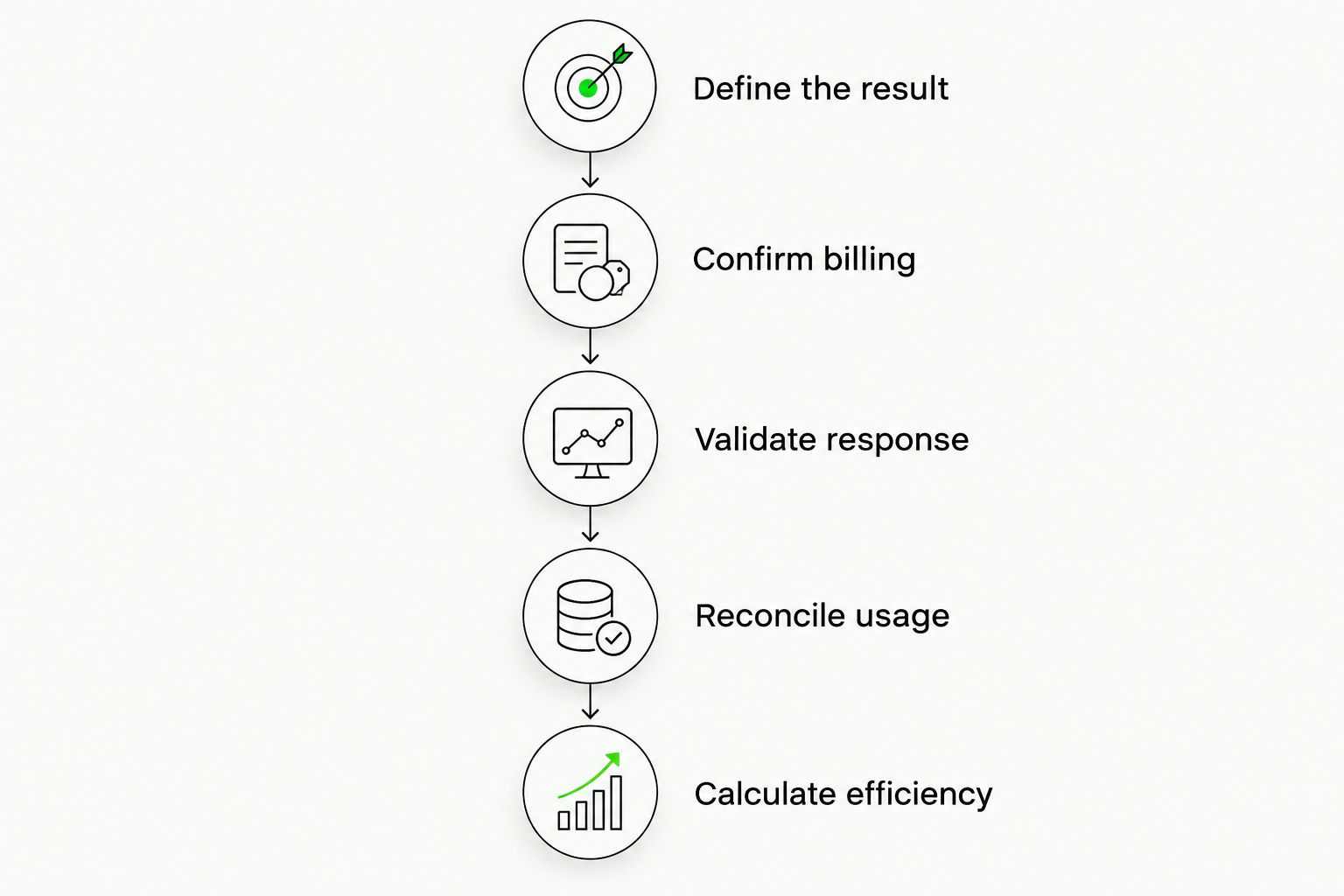
Define the result
Write an acceptance rule before sending requests. Specify the network, wallet address, asset, expected units and freshness requirement.
For example, an agent checking a Solana balance needs a result explicitly associated with the intended Solana address. An unrelated network response or an unparseable amount does not satisfy that task, even if the transport request succeeded.
Confirm billing
Check the operation-specific terms for the charging event, payment requirements and treatment of unsuccessful attempts. Record when you checked them because a saved estimate does not establish current terms.
Do not infer billing behavior from a payment-related endpoint name. Documentation must explain the operation, and a controlled validation must establish that the intended deployed service behaves as required.
Validate response
Confirm that your application can identify the returned network, address, asset and amount without guessing. Establish how it will handle missing fields, parsing errors and data that fails your freshness requirement.
A request that receives a response but fails these checks belongs in your failure accounting. Whether it also belongs in billable usage depends on the provider’s terms.
Reconcile usage
Match application-side request records with the provider’s available usage or billing records. Keep credentials, private keys and recovery secrets out of both prompts and logs.
Track the intended operation, attempt outcome and acceptance decision. Use only request identifiers and response metadata that the service actually exposes; do not assume a particular logging schema exists.
Calculate efficiency
Use this application-accounting formula:
Effective cost per usable result = attributable charges ÷ validated results.
Attributable charges include the operation’s confirmed charges and any separately allocated access or infrastructure charges. If no results pass validation, report the workload as producing no usable results rather than presenting a misleading unit-cost figure.
Why crypto wallet API costs vary
These factors determine what belongs in your estimate. Treat each as a question to resolve, not as an assumed provider feature.
- Operation scope: Balance reads, transaction preparation and broadcast perform different work. Confirm billing separately for every operation your application uses.
- Network and asset coverage: Verify that the intended network and asset are supported by the deployed operation. Do not generalize from a network name elsewhere in the documentation.
- Read frequency: Repeated checks increase request volume. Set polling or event-triggered behavior according to the task’s actual freshness requirement.
- Failure and retry treatment: An unsuccessful attempt can consume resources without producing usable data. Confirm chargeability and bound retries in application code.
- Deployment dependencies: Account for required deployment and RPC configuration separately from the advertised data-access model.
- Response usability: Missing context, incorrect unit handling or unacceptable freshness can require additional work. Measure accepted results rather than counting responses alone.
Caching can reduce repeated reads, but cached data is not a fresh observation. Define when reuse is acceptable and when the application must request a new result; do not use cache savings to conceal an unmet freshness requirement.
What does BuildAWallet’s per-request positioning cover?
BuildAWallet NON-HUMAN is positioned around paid machine data access, including Base and Solana balance reads. That establishes the intended category—not proof that a particular deployed operation is ready for your workload.
Its homepage requires deployment and RPC configuration and describes policy-controlled agent signing as unavailable or in development. Machine documentation describes a broader endpoint catalog, including locally signed transaction preparation and broadcast. A documented endpoint is not evidence of an operational deployed service.
The source descriptions also disagree on subscription pricing. Do not use the conflicting figures to derive a per-call estimate; validate the current billing terms for the intended read-only operation instead.
Keep these boundaries explicit:
- Data reads: Retrieve wallet information without treating the response as permission to move assets.
- Local signing: Signing occurs within a separately controlled signing workflow; it is not autonomous signing by the data provider.
- Broadcast: Submitting an already signed transaction is distinct from granting authority to sign it.
- HUMAN design: A wallet blueprint is a design output, not a deployed wallet or transaction signer.
For the wider authority model, BuildAWallet’s crypto wallets for AI agents guide provides related context. Keep the cost estimate scoped to the specific data operation you validate.
How should an agent discover and validate a paid read?
Begin with the provider’s verified overview and machine documentation. If the service publishes an agent manifest, an OpenAPI specification or llms.txt, inspect the current documents before relying on their contents. OpenAPI describes an API interface; llms.txt provides machine-readable guidance or pointers.
Discovery material is a starting point, not a successful request receipt. It does not prove that authentication, payment, deployment or the intended operation works together.
Before production use:
- Identify the exact read-only operation and required deployment dependencies.
- Verify its current request requirements and billing terms.
- Validate the network and public address before sending the request.
- Run a controlled read with a bounded request allowance.
- Check the returned data against your acceptance rule.
- Reconcile the attempt with available usage records before expanding traffic.
Do not give an agent signing authority to troubleshoot a balance-read failure. Keep private keys and recovery material outside the data tool, its prompts and its logs.
Does a failed API call still count toward usage?
A failed API call counts toward billable usage only when the provider’s terms make that attempt chargeable. HTTP status alone does not establish the billing outcome.
Separate transport failure, payment failure and application validation failure in your records. A timeout leaves uncertainty about what happened remotely; retrying without checking the documented behavior can repeat work or payment attempts.
Set a retry budget in application code. A prompt telling an agent to avoid excessive requests is not an enforced limit. Stop when the budget is reached and surface an actionable error rather than continuing indefinitely.
Are blockchain transaction fees included in a balance-read call?
A balance read does not itself authorize a blockchain transaction. Do not add transaction-execution assumptions to a read-only estimate or treat payment for data access as permission to spend from the queried wallet.
If your application later prepares, signs or broadcasts a transaction, budget and validate that workflow separately. Distinguish any data-access payment from transaction execution and from the authority controlling the wallet.
FAQ
What is the crypto wallet API cost per call?
The cost depends on the current terms for the exact operation. Calculate effective cost by dividing attributable charges by validated results, including confirmed charges for dependencies and failed attempts.
Is pay-per-call billing cheaper than a subscription?
Neither arrangement is inherently cheaper for your workload. Compare the same operations, usable result volume, access commitments and failure treatment under each set of current terms.
Does BuildAWallet charge for wallet data requests?
BuildAWallet NON-HUMAN is positioned around paid machine data access. Verify the current operation-specific billing terms and deployed availability; conflicting subscription descriptions do not establish a reliable per-call rate.
Can I assume an unsuccessful balance request is free?
No, an unsuccessful balance request is not automatically free. Confirm how the provider treats rejected requests, timeouts and responses that your application cannot use.
Does paying for wallet data let an agent sign transactions?
No, paying for wallet data does not grant signing authority. Keep read access, local signing and transaction broadcast as separate capabilities with separately verified controls.
Can caching lower my wallet API request volume?
Caching can reduce repeated requests when your application permits reuse. Set an explicit freshness rule so an older cached balance is not mistaken for a new observation.
Do agent discovery files prove a paid endpoint works?
No, discovery files describe or point to an interface; they do not prove successful paid operation. Validate the intended deployed read and its billing behavior before expanding usage.
Related guides
- Verify crypto wallet API deployment
- Retry paid crypto wallet API requests
- Keep a crypto wallet API tool read-only
Next step: price the result, not the request
Choose one read-only operation and write down its acceptance rule, confirmed charging event, deployment dependencies and retry limit. Validate that narrow workflow before estimating broader usage.
The useful comparison is not which service advertises the smallest billing unit. It is what your application pays to obtain a balance result it can actually trust for the defined task.