
Policy-controlled wallet infrastructure stops overspending by rejecting transactions that exceed enforced limits before signing and by reserving budget for pending requests. A balance check or an instruction in an agent's prompt cannot enforce that boundary alone. BuildAWallet NON-HUMAN is the machine-facing side for AI agents and the developers building them; HUMAN is a separate wallet-blueprint design experience.
- Policy-controlled wallet infra stops overspending only when the signing path enforces spending limits and accounts for pending requests.
- BuildAWallet NON-HUMAN separates wallet data access from signing authority; verify operation-specific deployment before using it.
- Reserve budget before signing, reject policy failures, and reconcile uncertain submissions before retrying.
- Keep transaction budgets separate from paid wallet-data request budgets.
How does policy-controlled wallet infra stop overspending?
It makes spending authorization a rule the agent cannot bypass, rather than a request the agent can ignore. For developers, the task is to connect reliable wallet data to an authorization boundary that controls every relevant signing route.
For BuildAWallet, keep the boundary explicit: NON-HUMAN includes paid machine data access and Base/Solana balance reads. Those reads supply information; they do not give the caller transaction-signing authority or establish that spending limits are enforced.
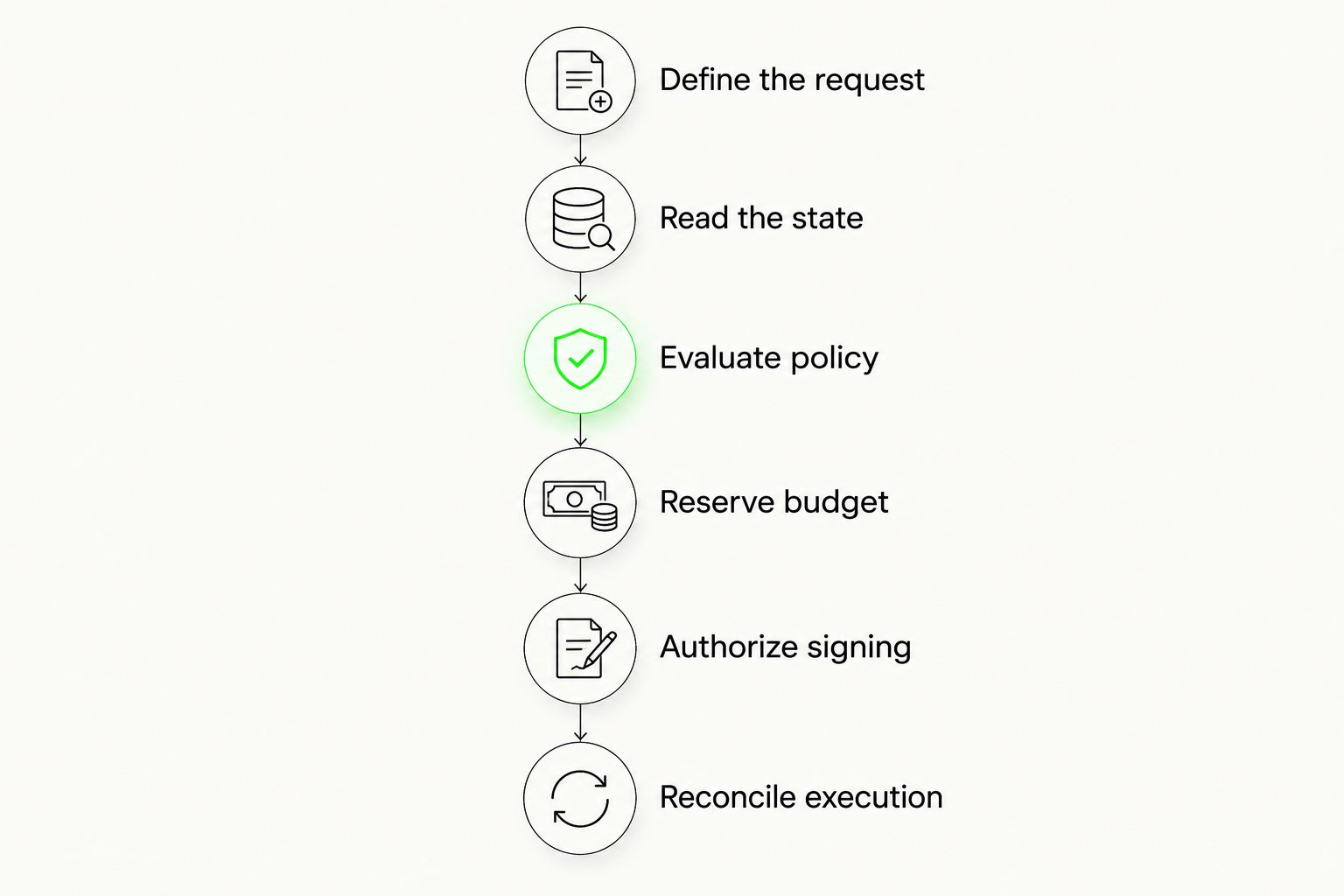
A spending-control workflow should follow this sequence:
- Define the request. Identify the network, asset, destination, amount and operation before evaluating permission.
- Read the state. Check the applicable spending budget, pending reservations and relevant wallet balances.
- Evaluate policy. Reject requests outside the allowed scope, including requests whose fee requirements exceed the available reserve.
- Reserve budget. Make the allowance unavailable to competing requests before handing the transaction to a signer.
- Authorize signing. Permit only the approved transaction through a controlled signing path.
- Reconcile execution. Track the outcome and settle or release reservations according to confirmed state.
This is an application architecture, not a claim that any particular provider implements every step. Verify where each rule runs and whether alternate signing paths can bypass it.
Separate information from permission
A wallet balance answers what an address holds at the state represented by the response. Spending policy answers what a particular actor is allowed to authorize. Treating those questions as interchangeable creates a control gap.
The following comparison describes architectural approaches, not verified features of a named service.
| Approach | Best for | What it contributes | Limitation |
|---|---|---|---|
| Prompt instructions | Explaining intended behavior to an agent | States goals and operating rules | Does not independently restrict a signer |
| Read-only balance access | Checking funds before requesting authorization | Supplies wallet-state information | Does not enforce spending permission |
| Application policy gate | Controlling requests inside your application | Applies rules before handing off a request | Alternate signing routes can bypass it |
| Signer-enforced policy | Restricting what a controlled signer authorizes | Rejects requests outside the signer's rules | Coverage depends on the actual signer and configuration |
| Contract-enforced policy | Restricting operations through configured contract logic | Enforces rules on the covered execution path | Requires suitable deployed logic and correct permissions |
Use read-only data to inform decisions; use an enforced authorization boundary to restrict spending. Neither a policy document nor a successful balance response proves that the second part exists.
The crypto wallets for AI agents guide covers the broader separation between wallet access and spending authority. Here, the implementation question is narrower: what prevents an unauthorized request from reaching a usable signer?
Reserve pending spend before approving another request
Concurrency means requests overlap in time. Without reservations, overlapping requests can each pass a budget check even though their combined spend exceeds the limit.
Consider this illustrative example, not a provider limit: an application allows 100 token units within its chosen budget window. Two workers each request 60 token units. Both requests fit individually, but together they require 120 token units.
A separate check followed by a separate update leaves room for both workers to observe the same unused allowance. Use an atomic reservation: a budget check and reservation that succeed or fail together.
Your reservation record should identify:
- The policy and budget window being charged.
- The network and asset being counted.
- The authorized amount and treatment of transaction fees.
- The request identifier used to detect duplicates.
- The execution state and evidence needed to settle the reservation.
Do not release a reservation solely because a worker timed out. A timeout describes what the worker observed, not whether a transaction reached the network.
Define what the limit actually counts
A limit is incomplete until you specify its accounting unit and scope. A token-denominated allowance is not automatically a limit on its changing market value, and a per-transaction cap is not a cumulative budget.
Document these decisions before implementing the gate:
- Asset scope: Count each permitted asset explicitly, using network and asset identifiers rather than display symbols alone.
- Budget scope: Decide whether the allowance belongs to an agent, wallet, application or shared group.
- Time window: Specify when the budget begins, resets and carries pending reservations forward.
- Fee treatment: Decide how native network fees affect authorization and reserves.
- Operation scope: Distinguish direct transfers from approvals, contract interactions and other permitted operations.
- Exception authority: Identify who can change a limit or approve an exception outside the agent's own instructions.
Token approvals deserve separate handling. An approval can grant a spender permission to transfer tokens later; checking only the immediate transfer amount does not capture that authority.
Evaluate the permission a transaction creates, not just the amount it transfers immediately. If your policy evaluator cannot interpret an operation, route it to a separate review path or reject it.
Why overspending protection varies
The effectiveness of a spending policy depends on the enforcement path, not the presence of a dashboard setting. These factors determine whether the limit holds:
- Signer coverage: A gate cannot restrict transactions signed through credentials or routes outside its control.
- Shared accounting: Workers need a common budget state; isolated counters do not enforce a shared allowance.
- Pending transactions: Reservations must account for authorized requests whose final outcomes remain unresolved.
- Data validation: Wrong networks, token decimals or stale responses can produce incorrect eligibility decisions.
- Failure behavior: Missing state must not silently become permission to proceed.
- Permission changes: Administrative overrides, approvals and policy updates need explicit authorization and records.
A useful review question is: can the agent obtain a valid signature without passing this check? If the answer is yes, the check is advisory for that route.
Where BuildAWallet fits—and where it does not
BuildAWallet NON-HUMAN fits developers evaluating machine-facing wallet data reads, not developers assuming autonomous signing is available. Its stated scope includes paid data access and Base/Solana balance reads. HUMAN remains a separate blueprint-design experience, not a deployed wallet.
The homepage states that deployment and remote procedure call configuration are required. A remote procedure call, or RPC, connection lets software request blockchain information or submit supported operations through a node interface.
The documentation describes a broader endpoint catalog and locally signed transaction preparation and broadcast. The homepage also identifies policy-controlled agent signing as unavailable or in development. Documented endpoints are not evidence of an operational deployed service, and local signing is not provider-held autonomous signing.
For service discovery, inspect the current NON-HUMAN overview and machine documentation, then verify any referenced llms.txt file, agent manifest and OpenAPI specification. These documents can describe discovery or an interface; they do not prove that a paid request succeeds or that a signing policy is enforced.
Before connecting a production agent, validate the intended read-only operation against the actual deployment. Keep keys and recovery secrets out of prompts and logs. Any transaction workflow needs separately verified signing authority and policy enforcement.
What should happen when a check fails?
Fail closed: do not authorize the transaction when a required control cannot establish permission. Distinguish a policy denial from an unavailable balance source, an invalid response and an uncertain transaction outcome.
Use explicit failure handling:
- Policy denial: Reject the request and record the rule that blocked it.
- Unavailable balance data: Pause authorization rather than interpreting a missing value as an acceptable balance.
- Invalid asset data: Reject ambiguous network, asset or decimal information before calculating eligibility.
- Uncertain submission: Preserve the reservation while checking the transaction's state.
- Duplicate request: Retrieve the existing request state instead of creating another authorization.
Idempotency means repeated handling of the same logical request does not create an additional action. Design it into your application; do not assume an API supports idempotency keys without documentation and validation.
Keep audit records useful but restrained. Record policy decisions, request identifiers, state transitions and transaction references where applicable, without logging signing secrets.
Can a balance check alone stop an agent from overspending?
A balance check alone cannot enforce an agent's spending limit. It supplies information at a particular observed state but does not restrict what a signer can authorize afterward.
Even an accurate response cannot account for your application's pending reservations unless your application includes them. Combine validated data with budget accounting and a controlled signing route.
Does local signing mean the provider controls the budget?
Local signing does not mean the provider controls or enforces your spending budget. The signer operates in your environment, so your application must establish which checks occur before it authorizes a transaction.
Inspect the signed transaction against the approved intent before broadcast. A transaction-preparation endpoint and a broadcast endpoint do not, by themselves, establish policy enforcement.
Test the boundary, not just the successful request
A successful authorized transaction demonstrates one permitted path. It does not establish that prohibited paths are blocked.
Build a validation plan around failures and bypass attempts:
- Submit overlapping requests that collectively exceed the illustrative budget.
- Repeat a request after a timeout without changing its identity.
- Supply an unsupported asset or the wrong network.
- Make required balance data unavailable.
- Request an operation outside the permitted transaction types.
- Attempt to reach signing through an alternate application route.
- Change a policy while an earlier authorization remains pending.
For each case, define the expected authorization decision, reservation state and evidence needed for reconciliation. Test in a controlled environment before enabling real spending authority. These are proposed validation cases, not reported results for a provider.
FAQ
What's the most important control for stopping agent overspending?
The most important control is an authorization boundary the agent cannot bypass. It must evaluate the applicable policy and reserve budget before allowing signing.
Can two agents share one spending budget safely?
A shared budget requires shared accounting and atomic reservations. Separate checks against the same balance do not prevent overlapping requests from exceeding the allowance.
Does BuildAWallet provide autonomous policy-controlled signing?
Do not treat autonomous policy-controlled signing as available. BuildAWallet's homepage identifies it as unavailable or in development, while documented locally signed workflows require separate evaluation.
Does reading a Base or Solana balance let an agent spend funds?
Reading a Base or Solana balance does not grant transaction-signing authority. Spending requires a separate authorized signing path and the permissions applicable to the operation.
Should an agent retry a transaction after a timeout?
An agent should reconcile an uncertain submission before authorizing another attempt. A timeout does not establish that the original transaction failed or that its reservation can be released.
Are paid wallet-data requests part of the transaction budget?
Paid wallet-data requests need their own usage budget, separate from transaction spending. Control request frequency and retries without assuming that a wallet spending policy also limits data-access charges.
Can a prompt enforce a wallet spending limit?
A prompt cannot independently enforce a wallet spending limit. Put the restriction in a controlled authorization path and treat prompt instructions as guidance, not permission enforcement.
Related guides
- Set spending limits on an AI agent's wallet
- Verify crypto wallet API deployment
- Budget paid crypto wallet API requests
Next step: trace one request to its signer
Choose one proposed agent operation and trace every route from request creation to signing. Identify where the budget is reserved, who can bypass that boundary and how uncertain outcomes are reconciled. Do not enable spending until the enforcement point—not merely the balance read—has passed your validation plan.