
Your crypto payroll wallet system cost is the combined expense of payroll software, wallet data access, transaction execution, signing controls, and operational support—not just the fee for sending payments. Budget implementation separately from recurring operation, and keep employee compensation outside the infrastructure total. For developers adding agent-assisted balance checks, read-only wallet data is a separate dependency from the authority to approve or send payroll.
- Crypto payroll wallet system cost includes data reads, network fees, signing controls, reconciliation, and operational support.
- BuildAWallet NON-HUMAN addresses machine-facing wallet data, not a complete deployed payroll system.
- Budget read requests separately from payroll transfers; polling and retries create different workloads.
- Validate deployment and the intended read-only operation before relying on an endpoint description.
Why this matters
A successful balance check does not prove that payroll can execute. A funded address does not prove that the correct person approved the payment, either. Your budget must cover each responsibility rather than treating a wallet connection as a finished payroll integration.
BuildAWallet NON-HUMAN is the machine-facing side for AI agents and the developers building them; HUMAN is a separate wallet-blueprint design experience. BuildAWallet belongs in the data-access discussion here, not in the role of a payroll processor or deployed transaction signer.
How much does a crypto payroll wallet system cost to run?
Calculate running cost from your actual workload and contracts, not from a single advertised wallet fee. Separate recurring commitments, usage-based charges, and the staff time required to operate the system.
Use this budget structure:
Recurring operating cost = payroll service charges + wallet data access + network transaction fees + signing infrastructure + hosting and monitoring + reconciliation and support.
Keep initial development, migration, security review, and onboarding in an implementation budget. Otherwise, an expensive launch period distorts your estimate of normal operations.
| Cost component | What belongs in the budget | What to verify |
|---|---|---|
| Payroll service | Payroll calculation, administration, and reporting services you actually use | Contract scope and responsibilities |
| Wallet data | Balance checks and other required reads | Charging unit, retry treatment, and operation availability |
| Network execution | Fees for submitting payroll transactions | Network, transaction structure, and fee funding |
| Signing controls | Approval workflow, key management, and transaction authorization | Who can sign and where controls are enforced |
| Infrastructure | Application hosting, RPC access, monitoring, and protected logs | Deployment responsibilities and usage limits |
| Operations | Reconciliation, exception handling, support, and maintenance | Staff ownership and escalation procedures |
RPC means remote procedure call: an interface your application uses to communicate with blockchain infrastructure. An RPC connection is a dependency to budget and validate, not evidence that the entire payroll workflow works.
Do not count employee compensation as a wallet operating expense. Track the amount owed to employees, the assets needed to settle those obligations, and the expenses of operating the payment system separately.
Choose the operating model before estimating usage
Different operating models move responsibility between your team and external providers. Compare the same payroll scope before deciding which arrangement fits; a data-only service and a managed payroll service do not solve the same problem.
| Operating model | Best for | Practical benefit | Limitation to budget for |
|---|---|---|---|
| Managed payroll service | Teams seeking an external operator for agreed payroll tasks | Defined service responsibilities under a contract | Verify supported jurisdictions, payment scope, and your remaining obligations |
| In-house wallet workflow | Teams prepared to own payment execution and operations | Direct control over application behavior and approvals | Your team maintains signing, reconciliation, incident response, and dependencies |
| Data-only integration | Developers adding balance visibility to an existing workflow | Keeps observation separate from payment authority | Does not replace payroll calculation, signing, or transaction execution |
BuildAWallet NON-HUMAN fits developers evaluating machine-facing wallet data access, not teams seeking a complete payroll operator. Its stated scope includes paid data access and Base and Solana balance reads. Deployment and operation-specific availability still require validation.
Treat framework connections as application-side integration work unless official support is verified. An agent receiving a balance result does not establish that the provider supports your payroll framework, authorization model, or payment workflow.
Estimate paid reads from payroll events
Count the checks your application needs before choosing a polling schedule. A pre-payment balance check, a post-payment reconciliation check, and continuous treasury monitoring are different activities; each needs a purpose and an owner.
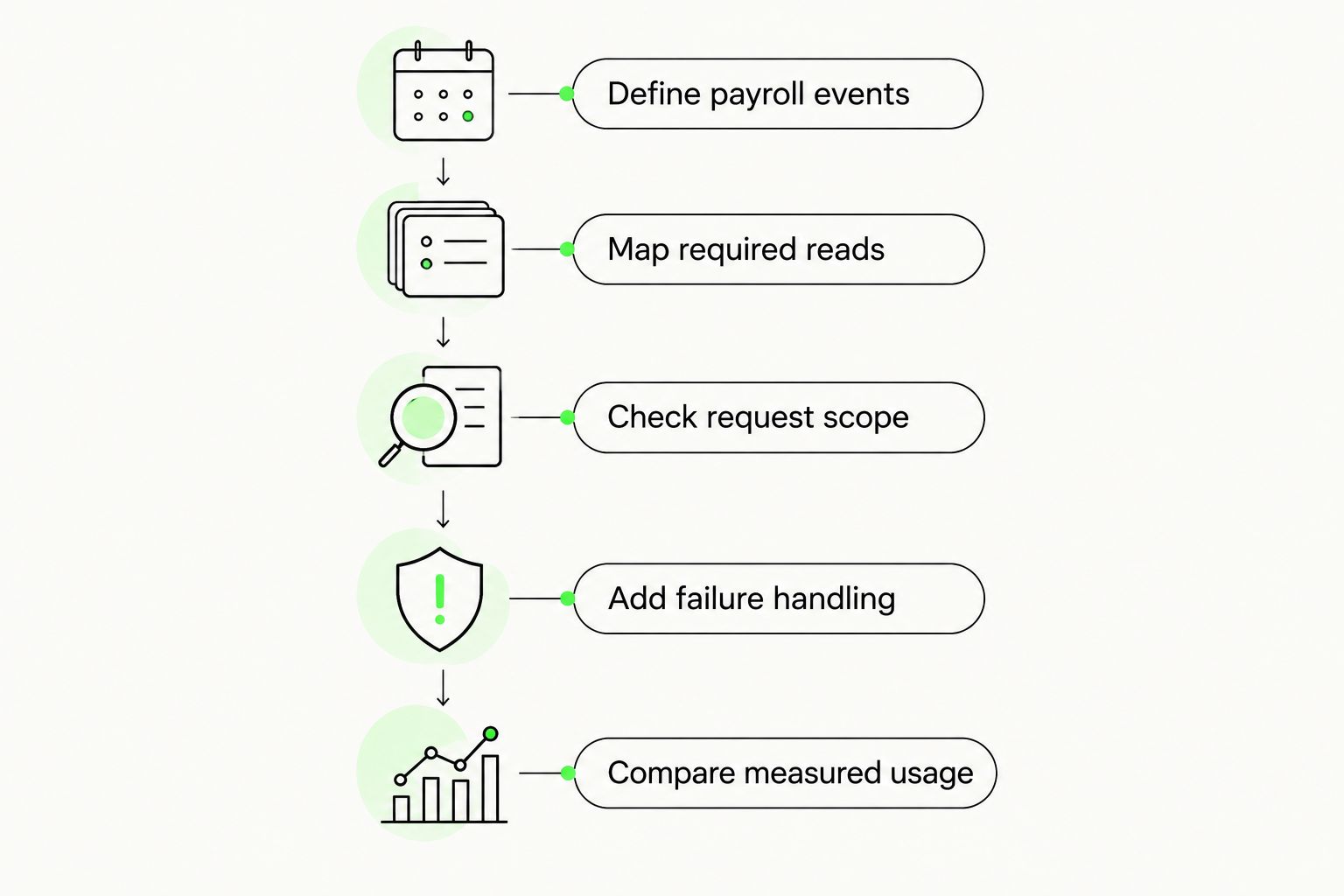
Use a worksheet with these steps:
- Define payroll events. Record payment runs, recipient changes, and reconciliation events.
- Map required reads. Identify the address, network, asset, and freshness requirement for each check.
- Check request scope. Verify whether the intended operation returns the information your application needs.
- Add failure handling. Include bounded retries and exception checks in the usage estimate.
- Compare measured usage. Replace assumptions with observations from a validated integration.
For a clearly hypothetical workload, assume 120 recipients and 2 payroll runs per month, with one payout to each recipient per run. That produces 240 payouts per month. If your application deliberately makes three independently billed reads for every payout, the example produces 720 reads per month, before retries or other monitoring.
Those figures describe an application design, not a provider's billing behavior. A shared treasury balance check or a different request scope changes the calculation. Do not assume that recipient count equals billable request count.
Cache only where the workflow permits reuse of an earlier result. A dashboard and a payment approval check need separate freshness decisions. Record when a balance was observed, and do not present an old result as a fresh check.
Keep signing outside the data-read budget
A balance read reports information. Signing uses cryptographic authority to authorize a transaction. Broadcasting submits a signed transaction to a network; it does not, by itself, establish successful settlement.
Your budget should identify the component responsible for each action:
- Read: obtains the balance information required for a decision.
- Approve: applies the organization's authorization process.
- Sign: uses the authorized key or signing mechanism.
- Broadcast: submits the signed transaction.
- Reconcile: compares the payment outcome with the payroll obligation.
A prompt telling an agent not to overspend is not an enforced spending control. Put approval and transaction restrictions in the component that controls execution, and test rejection paths as well as successful requests.
The distinction is central to the crypto wallets for AI agents guide: access to information and authority over funds require separate evaluation.
Keep private keys and recovery secrets out of prompts and logs. Budget for protected credential handling, access reviews, and recovery procedures rather than treating secret management as incidental application code.
Why crypto payroll operating costs vary
The main drivers are workload, execution design, and the responsibilities your team retains. Use these factors to explain changes between payroll periods:
- Read frequency: event-driven checks and continuous polling generate different request workloads.
- Payment structure: individual transfers and other payment arrangements require different transaction accounting; verify the actual implementation.
- Network choice: fee mechanics and transaction requirements depend on the network used for settlement.
- Signing responsibility: operating your own authorization system creates work that a read-only service does not cover.
- Exceptions and retries: invalid addresses, unavailable dependencies, and uncertain outcomes require investigation and controlled recovery.
- Payroll obligations: reporting, employment, and tax requirements depend on the worker relationship and applicable jurisdictions.
Do not treat the lowest data-access expense as the lowest total operating cost. A service that leaves more operational responsibilities with your team changes the labor budget, even if its read charges fit your request volume.
Legal and security considerations here are general education, not individualized advice or a guarantee. Confirm the payroll arrangement with qualified advisers for the jurisdictions involved.
What must you validate before relying on wallet data?
Start with a specific read-only task: retrieve the intended balance for the intended address, network, and asset. Validate that task independently before connecting it to a payroll decision.
For BuildAWallet, the supplied documentation status notes dated October 8, 2026 identify a material scope distinction. The homepage states that deployment and RPC configuration are required and describes policy-controlled agent signing as unavailable or in development. Documentation describes a broader endpoint catalog, including locally signed transaction preparation and broadcast; that description does not establish a working deployed service or autonomous provider-held signing.
An agent's discovery path should begin with verified official service information. Check the live NON-HUMAN page, machine documentation, llms.txt, agent manifest, and OpenAPI specification before describing their current contents or using them to configure discovery. Treat these documents as pointers, not proof of a successful paid request.
Before relying on the integration:
- Confirm deployment and required configuration.
- Validate the exact read-only operation and response interpretation.
- Check asset units and decimal handling.
- Distinguish unavailable data from a genuine zero balance.
- Record request outcomes without exposing credentials.
- Test whether failures stop dependent payroll actions.
Do not infer historical balance support, supported request combinations, or signing availability from a general endpoint list.
Can balance checks replace a payroll approval system?
Balance checks cannot replace payroll approval. They establish neither the amount owed nor the authority to send it. Keep the payroll calculation, recipient verification, approval record, and signing decision distinct from the balance observation.
A sufficient balance is a prerequisite for some payment workflows, not an authorization. Design the application so a read result cannot silently become permission to transfer funds.
Should a failed payroll operation be retried automatically?
Retry only after classifying the failure and checking the operation's effect. A failed read and an uncertain transaction submission require different recovery procedures. Repeating a payment instruction without establishing the previous outcome creates duplicate-payment risk.
Use bounded retries for eligible data requests, with explicit stop conditions. For payment uncertainty, reconcile the transaction state before another execution attempt and escalate unresolved cases to the responsible operator.
FAQ
What should I include in a crypto payroll wallet system budget?
Include payroll services, wallet data access, network transaction fees, signing controls, infrastructure, and operational support. Track implementation expenses and employee compensation separately from recurring infrastructure costs.
Does every payroll recipient require a separate paid balance request?
No, recipient count does not determine request count by itself. Your application design and the verified scope of each operation determine which reads are necessary.
Can I run payroll using only a wallet balance API?
No, a wallet balance API supplies data rather than a complete payroll workflow. You still need payroll calculation, recipient validation, authorization, transaction execution, and reconciliation.
Does BuildAWallet provide a complete crypto payroll system?
BuildAWallet's stated scope is HUMAN wallet-blueprint design and NON-HUMAN machine-facing wallet data access, not a complete payroll system. Validate deployment and the intended Base or Solana read operation before relying on the data service.
Can an AI agent approve payroll because it can read a wallet balance?
No, balance access does not grant signing or payroll approval authority. Enforce authorization in the execution system rather than relying on instructions in an agent prompt.
How do I keep monitoring from generating unnecessary requests?
Tie monitoring frequency to the decision it supports and define where cached results are acceptable. Measure actual requests, bound retries, and keep stale observations separate from fresh payment checks.
Related guides
- Budget paid crypto wallet API requests
- Retry paid crypto wallet API requests
- Verify crypto wallet API deployment
Next step: budget a complete payroll path
Map one payroll run from obligation to reconciliation before approving the infrastructure budget. For every stage, name its operator, billing unit, failure response, and evidence of completion. Then validate the read-only dependency separately from signing and execution; a successful balance response is not a completed payroll payment.