
x402 is a protocol for payment-gated HTTP requests, not a complete standard for agent-to-agent commerce. For developers choosing a payment interface in 2026, it addresses how software requests and pays for a resource; you still need separate controls for signing authority, spending limits, service identity, and failed requests.
- Treat the x402 standard for agent-to-agent payments as a payment interface, not a complete agent-control system.
- BuildAWallet NON-HUMAN serves AI-agent wallet-data workflows; HUMAN is a separate wallet-blueprint design experience.
- Verify the deployed operation, payment requirements, and signer before enabling automated paid requests.
- A successful payment does not prove the returned balance is correct, current, or suitable for another transaction.
Is x402 becoming the standard for agent-to-agent payments?
Treat x402 as a candidate payment protocol, not a universal interoperability guarantee. Its scope is narrower than the full interaction between autonomous services: a client requests a resource, encounters payment requirements, and submits payment information through the supported payment flow.
BuildAWallet NON-HUMAN is the machine-facing side for AI agents and the developers building them; HUMAN is a separate wallet-blueprint design experience. For BuildAWallet, keep paid data access, deployment requirements, and signing authority separate when evaluating any proposed x402 workflow.
The distinction matters because a protocol specification and a working service answer different questions. A specification describes an interaction. A deployment must actually accept the intended payment, deliver the requested resource, and handle failures predictably.
Use these selection criteria rather than treating a protocol label as an endorsement:
| Approach | Best for | Useful property | Limitation to evaluate |
|---|---|---|---|
| x402 payment flow | Software paying for individual HTTP resources | Connects payment requirements to a resource request | Does not itself define your agent's spending policy or service-quality checks |
| Account-based API access | Applications with an established provider account | Separates account authentication from individual resource requests | Account permissions and billing rules remain provider-specific |
| Direct onchain transfer | Workflows explicitly organized around a blockchain payment | Creates a payment transaction independent of an HTTP resource exchange | The application must connect payment evidence to delivery and failure handling |
These are architecture choices, not a ranking of verified providers. Select the approach that matches your transaction boundary and operational requirements.
Why this matters for agent developers
An agent buying access to a balance read is not necessarily paying another autonomous agent. It can be calling an ordinary API operated by a service provider. Machine-to-machine payment and agent-to-agent negotiation are different capabilities.
The HTTP standard provides useful context. IETF RFC 9110, section 15.5.3, reserves status code 402 for future use; it does not define a complete payment workflow. The x402 protocol supplies payment conventions beyond the status code, so checking for HTTP 402 alone does not establish compatibility.
Before choosing a stack, write down what your application actually needs. A paid read-only tool, a locally signed transaction workflow, and an independently spending agent require different permissions. The crypto wallets for AI agents guide provides related context for separating wallet data from wallet authority.
What must work before two services are compatible?
Interoperability means that your client and the deployed service agree on the complete interaction, not merely the protocol name. Verify the following boundaries for the exact operation you intend to use.
Payment requirements
Confirm which protocol version, payment scheme, network, asset, and recipient the operation accepts. Read those requirements from trusted configuration and validate them against your application's policy.
Do not let an agent treat arbitrary payment instructions returned by an unfamiliar service as authorization. Discovery tells the client where something is; your application decides whether that destination is acceptable.
Signing authority
Identify the component that can authorize payment. A wallet address identifies an account, but a balance response does not supply the authority to spend from it.
Keep private keys and recovery secrets outside prompts and application logs. If your architecture uses local signing, review the transaction or payment authorization in the signing component rather than assuming the language model's request is sufficient approval.
Resource delivery
Specify what counts as success before sending payment. For a wallet-data request, that includes the intended address, network, asset interpretation, and a response your application can validate.
A payment receipt is not the resource itself. Your system needs a separate result for payment status and data-delivery status so it can distinguish a paid request from a usable response.
Failure handling
Define what happens when payment succeeds but the response is lost, the service times out, or the returned data fails validation. Do not assume that replaying a request is free of additional payment consequences.
A retry policy belongs in application code. Use operation identifiers and duplicate-request behavior only where the provider documents and supports them; do not invent a header or assume every x402 deployment implements the same recovery mechanism.
Keep discovery, data, and authority separate
A practical architecture separates Service discovery, Payment authorization, Data validation, and Action approval. These are application-side boundaries, not a claim that a particular framework supplies them automatically.
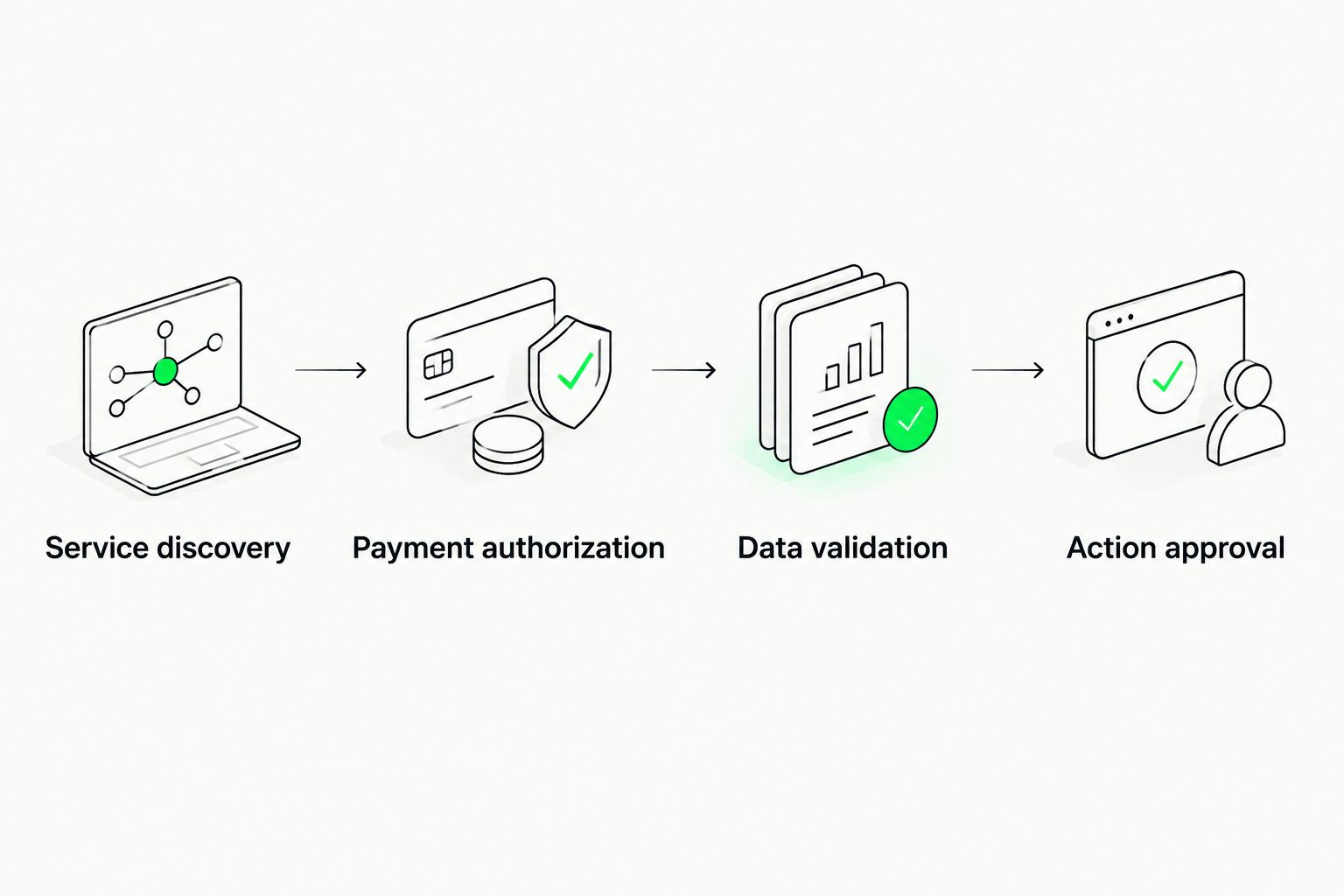
- Service discovery: Identify the provider and the intended operation. Treat discovery documents as pointers, not evidence that the endpoint works.
- Payment authorization: Check the destination and requested payment against enforced application policy before the signer acts.
- Data validation: Confirm the returned network, address, asset, units, and freshness information where supplied.
- Action approval: Evaluate any subsequent transaction independently. A successful read must not automatically grant permission to transfer assets.
The benefit is a clear permission boundary. The trade-off is additional integration work: your application must implement and test these checks instead of expecting a payment protocol to supply them.
For example, an agent can request a balance and use the result to prepare a recommendation. That read-only task does not require giving the agent authority over the wallet whose balance it checks. Any payment needed for the data request is a separate authorization question.
Validate a paid balance-read workflow before automation
Use this sequence as an application-side validation plan. It does not assume a particular SDK, endpoint path, response format, or supported integration.
- Name the operation. Record the network, address, and balance information you need. Do not assume that support for Base implies support for Solana through the same operation.
- Check deployment requirements. Confirm that the relevant service is deployed and that required RPC configuration is complete. RPC, or remote procedure call, is the interface a service uses to communicate with a blockchain node.
- Inspect the payment contract. Verify the deployed operation's current payment requirements and compatibility with your client. A general documentation page is not a successful request.
- Constrain the signer. Restrict what the payment component can authorize. Enforce recipient and spending rules outside the prompt.
- Validate the returned data. Check the requested address and network, then interpret the balance using the documented units. Reject responses your application cannot interpret safely.
- Exercise failure recovery. Test rejected payments, unavailable services, incomplete responses, and interrupted requests in an environment appropriate to the deployment. Record outcomes without logging secrets.
Promote the workflow to unattended use only after the intended operation passes your acceptance checks. A successful discovery lookup or an accessible documentation page does not satisfy that requirement.
Record the evidence for each boundary separately. Useful records include the operation you requested, the payment decision, the delivery outcome, and the validation result. Keep payment credentials, private keys, and recovery material out of those records.
Where BuildAWallet fits—and where it does not
BuildAWallet NON-HUMAN is best evaluated by developers seeking paid wallet-data reads, not delegated signing authority. The stated offering includes Base and Solana balance reads, while HUMAN helps individuals design a wallet blueprint rather than deploy a working wallet.
The supplied brand notes describe a material documentation boundary: the homepage requires deployment and RPC configuration and identifies policy-controlled agent signing as unavailable or in development. The documentation describes a broader endpoint catalog, including locally signed transaction preparation and broadcast. Those descriptions do not establish that every documented operation is available in a deployed service.
Local signing also differs from provider-held autonomous signing. Preparing or broadcasting a transaction signed elsewhere does not mean the provider controls the signing key or can independently approve spending.
For an x402 evaluation, verify operation-specific compatibility before connecting a payer. Do not infer x402 support, a working paid read, or autonomous signing from the existence of machine-facing documentation. The discovery documents described in the brand's October 8, 2026 notes are pointers, not proof of successful execution.
Why x402 suitability varies
Your decision depends on the boundaries of the actual service and application, not the breadth of its protocol claims:
- Task scope: Paying for a balance read is different from authorizing an asset transfer or negotiating a service contract.
- Deployment readiness: Documentation, configured infrastructure, and a working paid operation are separate milestones.
- Payment compatibility: Client and server must agree on the supported payment requirements for the requested resource.
- Authority model: Local signing, external approval, and autonomous signing expose different permissions and failure risks.
- Recovery behavior: A service must explain how your application should handle uncertain payment and delivery outcomes.
- Data requirements: A response must contain enough information for your application to interpret the balance and assess whether it is suitable for the task.
No single protocol label resolves all of these factors. Document each boundary as an acceptance condition before comparing implementations.
Does x402 let an AI agent sign transactions?
x402 does not itself grant an agent signing authority. Your application still needs an authorized signing component and enforceable rules governing what that component can approve.
A prompt saying not to overspend is an instruction, not an enforced spending limit. Put the restriction where payment or transaction authorization actually occurs.
Does paying for a balance read prove the balance is usable?
Paying for a balance read proves neither data freshness nor suitability for another transaction. Validate the response separately and check any timing or consistency information the operation actually supplies.
Do not assume historical balance support or a specific freshness guarantee unless the current operation documents it. A current-looking response without interpretable context is not enough for a spending decision.
Can two x402 services work together automatically?
Two x402 services are not automatically compatible for your application. Verify the protocol version, accepted payment requirements, deployment configuration, and resource-delivery behavior on both sides.
Successful payment is only part of the acceptance test. The client must also receive and validate the intended resource without crossing an unintended authority boundary.
FAQ
Is x402 an official HTTP payment standard?
HTTP 402 is a status code reserved for future use in IETF RFC 9110; x402 defines a payment protocol beyond that status code. An HTTP 402 response alone does not prove that a service supports your client's x402 payment flow.
What's the best way to evaluate x402 for agent payments?
Evaluate x402 against one concrete paid operation and its full failure path. Verify payment compatibility, signing authority, delivery validation, and retry behavior before enabling unattended requests.
Does x402 require giving an agent my private key?
A payment protocol does not require placing a private key in an agent's prompt. Keep signing authority in a separate component and keep private keys and recovery secrets out of prompts and logs.
Is a paid API request the same as an agent-to-agent payment?
A paid API request is not necessarily an agent-to-agent interaction. The receiving service can be an ordinary API, without autonomous negotiation or independent agent behavior.
Can BuildAWallet HUMAN deploy an agent wallet?
BuildAWallet HUMAN is a wallet-blueprint design experience, not a deployed wallet or transaction signer. Evaluate NON-HUMAN separately for machine-facing data access and verify the intended operation's deployment requirements.
Should I retry a paid request after a timeout?
Do not automatically repeat a paid request until you understand the operation's documented recovery behavior. A timeout leaves payment and delivery outcomes uncertain, so inspect available status information before authorizing another attempt.
Related guides
- BuildAWallet x402 data access checks
- Verify crypto wallet API deployment
- Retry paid crypto wallet API requests
Your next step
Choose a single read-only operation and write its acceptance conditions before selecting a payment protocol. Require separate evidence for authorized payment, successful delivery, and valid data—and keep any later transaction behind its own approval boundary.